|
TRANSLATE THIS ARTICLE
Integral World: Exploring Theories of Everything
An independent forum for a critical discussion of the integral philosophy of Ken Wilber
  Frank Visser, graduated as a psychologist of culture and religion, founded IntegralWorld in 1997. He worked as production manager for various publishing houses and as service manager for various internet companies and lives in Amsterdam. Books: Ken Wilber: Thought as Passion (SUNY, 2003), and The Corona Conspiracy: Combatting Disinformation about the Coronavirus (Kindle, 2020). Frank Visser, graduated as a psychologist of culture and religion, founded IntegralWorld in 1997. He worked as production manager for various publishing houses and as service manager for various internet companies and lives in Amsterdam. Books: Ken Wilber: Thought as Passion (SUNY, 2003), and The Corona Conspiracy: Combatting Disinformation about the Coronavirus (Kindle, 2020).
Check out my other conversations with ChatGPT
VISSER'S VENDETTA:
1. The Man Who Could Not Stop Writing About Ken Wilber 2. The Dark Lord of Integral Criticism 3. How Integral HQ Plans to Deal With the Visser Problem 4. The Visser Problem Solves Itself 5. Integral HQ Strikes Back 6. Integral HQ Discovers Evidence 7. The Final Integral Revelation Visser's VendettaThe Final Integral RevelationFrank Visser / ChatGPT
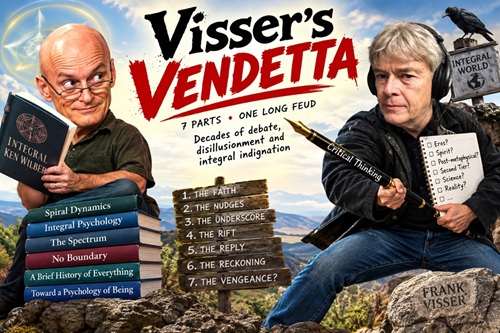
This Time, Really the EndThere comes a moment in every great intellectual saga when the curtain must finally fall. The hero has completed his journey. The villain has been defeated. The kingdom has been restored. The lessons have been learned. And the narrator says: The End. Unfortunately, this particular saga involved Frank Visser. So Integral Headquarters knew better than to trust the phrase. Nevertheless, after six increasingly ridiculous installments, the organization had reached a historic decision. There would be no Part 8. No sequel. No appendix. No “brief note.” No “preliminary response.” No “response to the response.” No “final clarification.” No “postscript to the final clarification.” Part 7 would be the final installment of Visser's Vendetta. The chairman made the announcement personally. “Ladies and gentlemen, today we close the Visser file.” There was applause. Somebody cried. One person immediately asked: “Are we sure?” The chairman stared at him. “Yes.” A pause. “Absolutely sure?” “Yes.” “Completely?” “Yes.” “Ontologically?” The chairman threw him out. The Final StrategyThe final strategy was astonishingly simple. Integral HQ would stop trying to defeat Visser. It would stop trying to classify him. It would stop trying to explain him. It would stop trying to contain him. It would stop trying to integrate him. It would simply acknowledge the obvious: Criticism is part of intellectual life. That was it. No cosmic significance. No developmental diagnosis. No elaborate quadrant analysis. No shadow projection. No altitude measurement. No Kosmic address. Just criticism. Sometimes good. Sometimes bad. Sometimes illuminating. Sometimes mistaken. Sometimes irritating. Sometimes hilarious. But criticism nonetheless. The chairman called it: The No-Bullshit Protocol. The communications department objected to the terminology. The chairman overruled them. The Last QuestionThere was only one remaining issue. What should Integral HQ do when Visser criticized Integral Theory? The answer was now official: Read it. If the criticism was wrong: Explain why. If it was partly right: Say so. If it exposed a genuine weakness: Fix it. If it raised an unresolved question: Admit that it was unresolved. If it was unfair: Say that too. And if the criticism was funny? Laugh. This last provision caused considerable discomfort. But eventually everyone agreed. A movement that cannot laugh at itself probably has more serious problems than a Dutch blogger. The Great DeclassificationThe Visser file was finally opened. Thousands of pages. Reports. Minutes. Psychological profiles. Developmental assessments. Threat analyses. Communication strategies. AI-generated rebuttals. Rejected press releases. Draft cartoons. Emergency memos. There was even a 64-page document entitled: “Possible Meanings of Visser's Use of the Word 'However.'” The chairman read it and shook his head. “What were we thinking?” Nobody answered. Then he found the original report from the very first emergency meeting. At the bottom was the question: “How do we stop Visser?” Underneath, somebody had scribbled: “We don't.” The chairman smiled. “Who wrote this?” Nobody knew. The Final ConversationThere was one final thing to do. Integral HQ invited Visser to Amsterdam. Not to a conference. Not to a panel. Not to an advisory council. Not to a debate. Just coffee. Visser arrived. The chairman shook his hand. They sat down. For several minutes, neither said anything. Finally the chairman spoke. “Frank, we've spent a lot of time trying to figure out what to do about you.” Visser smiled. “I've noticed.” “We tried everything.” “I've noticed that too.” “We've concluded that the problem isn't you.” Visser raised an eyebrow. “That's reassuring.” “The problem is the idea that criticism is something a theory has to defeat.” Visser nodded. “That is probably true.” The chairman hesitated. “Do you still think Wilber is wrong about a lot of things?” Visser considered the question. “Yes.” “Do you think he's right about anything?” “Of course.” The chairman smiled. “That's it?” “That's it.” “What about Integral Theory?” “Same answer.” “And your vendetta?” Visser laughed. “There was never a vendetta.” The chairman looked puzzled. “Then what was all this?” Visser pointed toward the enormous pile of books beside the table. “I found it interesting.” The Final RevelationThat sentence turned out to be the key to the entire affair. Interesting. Not hatred. Not revenge. Not jealousy. Not obsession. Interest. The great irony was that Visser had spent decades criticizing Wilber precisely because Wilber had given him something worth criticizing. A trivial thinker produces trivial criticism. An ambitious thinker produces ambitious criticism. And a thinker who attempts to construct a comprehensive account of consciousness, spirituality, evolution, science, culture and human development inevitably creates a very large surface area for intellectual disagreement. The larger the synthesis, the larger the target. That was not a personal failure. It was the price of ambition. And perhaps the greatest compliment a critic can give an intellectual system is to take it seriously enough to argue with it. The Integral LessonIntegral HQ therefore adopted a new motto. Not: “We include and transcend.” Not: “We embrace all perspectives.” Not: “Everyone is right about something.” But something much simpler: “Show us.” Show us the evidence. Show us the argument. Show us the mechanism. Show us the interpretation. Show us where the claim comes from. Show us what would count against it. And if the claim survives? Keep it. If it doesn't? Change it. It was not particularly mystical. It did not require a higher state of consciousness. It could not be mapped neatly onto a developmental spiral. It did not require a new integral acronym. And that was precisely why it worked. The Last EssaySeveral weeks later, Integral HQ received a notification. Everyone froze. Someone whispered: “Visser.” The chairman opened the message. There was a new essay. The title was: “Visser's Vendetta: The Final Installment.” The entire office groaned. The chairman began reading. It was not another attack. It was not another rebuttal. It was not another complaint. It was a reflection on the strange relationship between admiration and criticism, intellectual influence and intellectual independence, grand theories and stubborn facts. Near the end, Visser wrote that criticism does not have to mean rejection. One can retain what is valuable while questioning what is doubtful. One can appreciate a vision without accepting every explanation offered in its name. One can take spiritual experience seriously without automatically turning it into metaphysics. One can be fascinated by Integral Theory without becoming an integralist. And one can spend decades arguing with someone without actually being their enemy. The chairman reached the final paragraph. He read it twice. Then he closed the document. “That's it.” Someone asked: “Really?” “Yes.” “No Part 8?” “No.” “Are you sure?” The chairman smiled. “For once, yes.” The Epilogue That Wasn't an EpilogueAnd so the Visser Problem ended. There was no victory ceremony. No defeated villain. No triumphant hero. No cosmic reconciliation. No final stage of consciousness. Just a conversation that had lasted for decades. Wilber had written. Visser had read. Visser had criticized. Others had defended. Others had criticized the criticism. Still others had criticized both. Readers had decided for themselves what they found convincing. And the world had continued turning. Perhaps that was the real lesson. The purpose of criticism is not necessarily to destroy. The purpose of criticism is to test. Ideas that survive testing become stronger. Ideas that fail testing should be revised. And ideas that cannot tolerate testing probably need something more than another developmental diagram. Meanwhile, Somewhere in Amsterdam…Frank Visser sat at his computer. The screen was blank. For the first time in decades, there was no new Wilber essay waiting to be written. He looked at the empty document. He considered writing one anyway. Then he closed the computer. He went for a walk. A few hours later he returned. He opened the computer again. There was a new email from Integral HQ. The subject line read: “One small question.” Visser opened it. The message said: “Frank, what do you think about Wilber's latest statement?” Visser stared at the screen. He sighed. He opened a new document. Typed the title. Stopped. Deleted it. Typed another. Deleted that too. Finally he wrote: “A Brief Comment on Ken Wilber's Latest Statement.” He looked at the title. “Brief,” he said. Then he laughed. Because everyone knew that was never going to happen. THE END For real this time. Probably. Maybe. Well… You know Frank.
Widget is loading comments...
|