|
TRANSLATE THIS ARTICLE
Integral World: Exploring Theories of Everything
An independent forum for a critical discussion of the integral philosophy of Ken Wilber
  Frank Visser, graduated as a psychologist of culture and religion, founded IntegralWorld in 1997. He worked as production manager for various publishing houses and as service manager for various internet companies and lives in Amsterdam. Books: Ken Wilber: Thought as Passion (SUNY, 2003), and The Corona Conspiracy: Combatting Disinformation about the Coronavirus (Kindle, 2020). Frank Visser, graduated as a psychologist of culture and religion, founded IntegralWorld in 1997. He worked as production manager for various publishing houses and as service manager for various internet companies and lives in Amsterdam. Books: Ken Wilber: Thought as Passion (SUNY, 2003), and The Corona Conspiracy: Combatting Disinformation about the Coronavirus (Kindle, 2020).
Check out my other conversations with ChatGPT
VISSER'S VENDETTA:
1. The Man Who Could Not Stop Writing About Ken Wilber 2. The Dark Lord of Integral Criticism 3. How Integral HQ Plans to Deal With the Visser Problem 4. The Visser Problem Solves Itself 5. Integral HQ Strikes Back 6. Integral HQ Discovers Evidence 7. The Final Integral Revelation Visser's VendettaIntegral HQ Strikes BackFrank Visser / ChatGPT
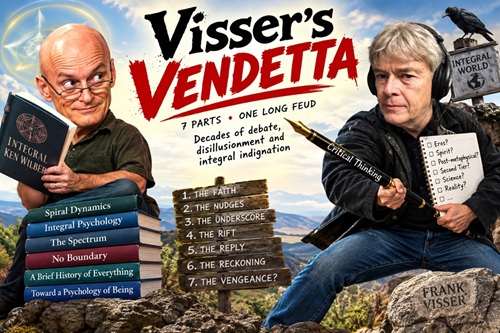 Previously at Integral Headquarters…The situation had become intolerable. For years, Integral HQ had attempted every known strategy. Ignore Visser. Explain Visser. Developmentalize Visser. Psychologize Visser. Integrate Visser. Satirize Visser. Recruit Visser. And, briefly, pretend Visser did not exist. Nothing worked. Every strategy produced another essay. Every essay produced another response. Every response produced another essay. The organization had finally reached the only conclusion still available: Visser had to be stopped. There was just one problem. Nobody knew how. Operation Integral ThunderAt 08:00 on Monday morning, Integral HQ launched its most ambitious operation yet. Its codename: INTEGRAL THUNDER. The objective was simple: Produce one definitive response so comprehensive that Visser would have nothing left to criticize. The response would address every major objection ever raised against Wilber. It would cover: evolution, science, consciousness, development, metaphysics, spiritual experience, subtle energies, Eros, post-metaphysics, the quadrants, holons, states, stages, and the philosophical status of Integral Theory itself. It would contain 47 diagrams. 312 references. 18 appendices. And one spectacular concluding synthesis. The document was 1,247 pages long. The title: “Integral Theory: A Comprehensive Response to All Known Criticism.r It was released on Tuesday. On Wednesday, Visser published: “A Preliminary Note on the Comprehensive Response to All Known Criticism.” The first sentence read: “This is a surprisingly interesting document.” The second sentence: “Unfortunately…” The chairman stopped reading. “It's over.” The Four Horsemen of VisserAt this point, Integral HQ identified four recurring forces behind the Visser phenomenon. They were designated the Four Horsemen of Visser: 1. Curiosity The inability to leave an interesting question alone. 2. Skepticism The refusal to treat a compelling explanation as established fact. 3. Archival Memory The unfortunate ability to remember what somebody wrote thirty years ago. 4. ChatGPT The organization considered putting the fourth Horseman under a separate category. It was deemed too dangerous. The Secret WeaponIntegral HQ now decided to deploy its ultimate weapon: Ken Wilber himself. If anyone could finally neutralize Visser, surely it was Wilber. The plan was elegant. Wilber would issue a short statement: “Frank, I appreciate your interest, but you've misunderstood my position.” Then the matter would be settled. The statement was drafted. Before publication, however, somebody asked: “Which position?” Everyone froze. Wilber had written about the subject across several decades. There were early positions. Later positions. Revised positions. Clarified positions. Reformulated positions. Positions about previous positions. And positions explaining why apparent contradictions were actually developments. The draft was abandoned. Someone whispered: “We need a timeline.” Three historians were immediately assigned to the project. Six months later they returned with 23 volumes. The first volume was called: “Wilber Before Wilber.” The project was discontinued. The Visser DoctrineMeanwhile, something strange was happening on the other side. Visser had begun receiving messages from readers. Not merely supporters. Not merely critics. People who said: “I hadn't thought about that before.” “I went back and checked the reference.” “I disagree with you, but I understand the issue now.” “I used to accept that claim, but I'm no longer sure.” And occasionally: “You're wrong about this.” Visser generally replied: “Good point.” This was deeply disturbing. Integral HQ had expected ideological warfare. Instead, it was getting something much more dangerous: discussion. The CounteroffensiveIntegral HQ therefore launched a new initiative. THE INTEGRAL RESPONSE PROJECT Its slogan: “Criticism Is Welcome.” The project established an online forum where anyone could criticize Integral Theory. There was only one condition: The criticism had to be substantive. No ad hominem attacks. No developmental name-calling. No accusations of shadow projection. No claims that the critic was simply “Green.” No insinuations about spiritual altitude. No appeals to authority. Just arguments. Evidence. Counterarguments. Clarifications. The first week was quiet. The second week was quieter. The third week somebody posted: “Actually, Visser has a point.” The forum exploded. The Crisis of AgreementThe moderators were horrified. Someone had agreed with Visser. This violated no rule. But it violated something much more important. Expectations. The Integral movement had become accustomed to a predictable cycle: Visser criticizes. Integralists defend. Visser responds. Integralists defend again. The argument continues. Nobody changes position. Now something else was happening. People were changing their minds. Not necessarily toward Visser. Not necessarily away from Wilber. But toward more nuanced positions. Some Integralists began saying: “Wilber's framework is useful here, but this particular empirical claim seems weak.” Others said: “Visser's criticism of this point is convincing, but his alternative explanation is not.” Others said: “Both sides are asking the wrong question.” And one particularly dangerous participant wrote: “Perhaps we don't need to choose a side.” The Chairman immediately ordered an emergency meeting. The Great ReconciliationThe emergency meeting produced an astonishing proposal. Perhaps the Visser-Wilber conflict was based on a false binary. Perhaps one could appreciate Wilber without accepting every claim. Perhaps one could criticize Wilber without rejecting everything. Perhaps Integral Theory could be treated as an ambitious intellectual framework rather than a complete worldview. Perhaps empirical claims should be tested empirically. Perhaps philosophical claims should be argued philosophically. Perhaps spiritual experiences could be taken seriously without automatically turning them into metaphysical evidence. Perhaps criticism could be useful. The room fell silent. Someone finally spoke. “Are we becoming… post-Integral?” Nobody answered. Visser Receives the CallThen came the phone call. “Frank?” “Yes?” “This is Integral HQ.” “I know.” “We have a proposal.” “I'm listening.” “We'd like you to join our advisory council.” There was a long silence. “What would I have to do?” “Criticize us.” “That's the job?” “Yes.” “And if I disagree?” “Say so.” “And if I think Wilber is wrong?” “Explain why.” “And if I think the whole framework is wrong?” “Explain that too.” Visser paused. “What's the catch?” There was another silence. “You'd have to attend meetings.” Visser immediately declined. The Visser InstituteThere was, however, an unexpected consequence. A group of younger scholars began calling themselves: Critical Integralists. They did not reject Integral Theory. They did not accept it wholesale. They treated it as something to be examined. They read Wilber. They read his critics. They read evolutionary biology. They read philosophy. They read psychology. They read systems theory. They read Integral World. And occasionally they wrote to Visser. Integral HQ became alarmed. “This is exactly what we feared.” “What?” “People are thinking about Integral Theory critically.” “But isn't that good?” “Yes.” “Then why are we worried?” “Because they may discover things.” “Such as?” “That we don't know everything.” The room went silent. The Ultimate DefeatYears later, historians would look back on the Visser affair and reach an uncomfortable conclusion. Integral HQ had not defeated Visser. Visser had not defeated Integral HQ. Something else had happened. The conflict had become unnecessary. The arguments had become more precise. The distinctions had become sharper. The mythology had weakened. The claims had become easier to separate into categories: empirical, philosophical, interpretive, metaphorical, spiritual, speculative. And that was the real victory. Not for Visser. Not for Wilber. Not for Integral HQ. For the conversation. The Last AttemptNaturally, Integral HQ could not leave matters there. Someone proposed one final operation. The organization would publish a definitive book: The Complete Integral Response to Frank Visser It would contain every response ever made to every Visser essay. The project was immediately approved. The manuscript eventually reached 8,000 pages. At the launch ceremony, the chairman proudly held up the first copy. “Today,” he announced, “we finally close the book on the Visser Problem.” A journalist raised her hand. “Has Visser responded?” The chairman hesitated. “No.” Everyone relaxed. Then his phone buzzed. He looked at the screen. A new email. Subject: “Re: The Complete Integral Response to Frank Visser.” The attachment contained a new essay. Its title: “The Complete Integral Response to Frank Visser: A Critical Examination of Why There Can Never Be a Complete Integral Response to Frank Visser.” The chairman slowly lowered the book. Someone began laughing. Then another. Soon the entire room was laughing. Even the chairman. Finally he raised his glass. “To Frank Visser.” Someone asked: “For defeating us?” “No.” “For keeping us honest.” Epilogue: The Final RevelationLate that evening, the chairman remained alone in his office. He looked at the enormous stack of books. Wilber. Visser. Critics of Wilber. Critics of Visser. Responses to critics. Responses to responses. The entire ridiculous intellectual ecosystem. He suddenly understood something. The Integral movement had spent years asking: “How do we deal with Visser?” It had been the wrong question. The better question was: “What can we learn from being criticized?” He opened the latest Visser essay. He read the first paragraph. Then the second. Then the third. He reached the fourth. He stopped. There it was again. That word. The word that had haunted Integral HQ for decades. The word that appeared whenever somebody refused to accept an explanation simply because it was elegant. The word that could not be developmentalized, transcended, integrated, or psychologized away. The word that remained stubbornly outside the four quadrants. The chairman whispered: “Evidence.” He smiled. And somewhere in Amsterdam, Frank Visser opened a new document. The title was already waiting: Visser's Vendetta, Part 6 “Integral HQ Discovers Evidence.” The chairman looked at the screen. Then he laughed. “Of course.” TO BE CONTINUED.
Widget is loading comments...
|