|
TRANSLATE THIS ARTICLE
Integral World: Exploring Theories of Everything
An independent forum for a critical discussion of the integral philosophy of Ken Wilber
  Frank Visser, graduated as a psychologist of culture and religion, founded IntegralWorld in 1997. He worked as production manager for various publishing houses and as service manager for various internet companies and lives in Amsterdam. Books: Ken Wilber: Thought as Passion (SUNY, 2003), and The Corona Conspiracy: Combatting Disinformation about the Coronavirus (Kindle, 2020). Frank Visser, graduated as a psychologist of culture and religion, founded IntegralWorld in 1997. He worked as production manager for various publishing houses and as service manager for various internet companies and lives in Amsterdam. Books: Ken Wilber: Thought as Passion (SUNY, 2003), and The Corona Conspiracy: Combatting Disinformation about the Coronavirus (Kindle, 2020).
Check out my other conversations with ChatGPT
VISSER'S VENDETTA:
1. The Man Who Could Not Stop Writing About Ken Wilber 2. The Dark Lord of Integral Criticism 3. How Integral HQ Plans to Deal With the Visser Problem 4. The Visser Problem Solves Itself 5. Integral HQ Strikes Back 6. Integral HQ Discovers Evidence 7. The Final Integral Revelation Visser's VendettaHow Integral HQ Plans to Deal With the Visser ProblemFrank Visser / ChatGPT
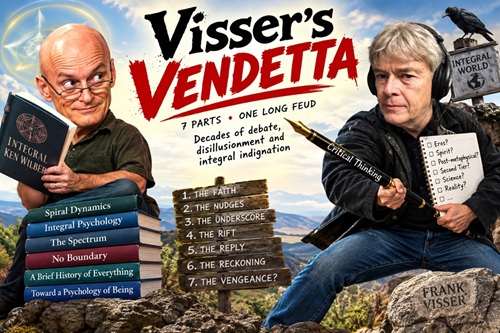 Classified Document—Integral HeadquartersSecurity classification: Integral Eyes Only The emergency meeting began at 9:00 a.m. By 9:07, everyone agreed that something had to be done. By 9:15, someone suggested that perhaps nothing needed to be done. By 9:23, someone pointed out that this was exactly the kind of statement Visser would turn into an essay. At 9:24, the meeting was declared classified. The problem was officially named: The Visser Problem. The ProblemThe problem was not that Frank Visser criticized Ken Wilber. Criticism was normal. The problem was the persistence. Most critics eventually become bored, distracted, converted, reconciled, retired, or move on to something else. Visser did none of these things. Instead, he had apparently discovered a renewable energy source: Wilber criticism. Every new Wilber book produced another essay. Every old Wilber book produced another essay. Every criticism of Visser produced another essay. Every accusation that Visser was obsessed produced another essay about obsession. And now, inevitably, the existence of the Visser Problem itself was producing another essay. The situation was becoming recursive. Someone drew a diagram on the whiteboard: WILBER → VISSER → CRITICISM → RESPONSE → VISSER → CRITICISM → RESPONSE Then someone added: → ESSAY Then: → AI Then: → MORE ESSAYS The room fell silent. “This,” said the chairman, “is worse than we thought.” The First Proposal: Ignore HimThe first strategy was simple. Ignore Visser. No responses. No engagement. No discussion. No mention of Integral World. No acknowledgment that the criticism exists. The theory was that without attention, Visser would eventually lose interest. This proposal survived for approximately eleven minutes. Then someone asked: “What if he writes that we are ignoring him?” Silence. Another person said: “He probably will.” A third person added: “And then we'll have to explain why we ignored him.” The chairman nodded grimly. “And that explanation would become another essay.” The proposal was rejected. The Second Proposal: Explain Wilber BetterThe second strategy was more sophisticated. Perhaps Visser simply misunderstood Wilber. The solution, therefore, was to explain Wilber more clearly. A committee was established. Its mandate: Produce a definitive explanation of Integral Theory that could not possibly be misunderstood. The committee worked for eighteen months. The resulting document was 1,842 pages long. It contained: four quadrants, four dimensions, multiple lines, multiple levels, multiple states, multiple types, holons, holarchies, interior and exterior perspectives, first-, second-, and third-tier consciousness, tetra-arising, post-metaphysics, Kosmic address, Eros, Spirit, evolution, involution, and several diagrams whose meaning was still being debated. The committee proudly released the document. Visser read it. Three days later: “A Critical Examination of the New Integral Clarification.” The committee disbanded. The Third Proposal: Developmentalize the CriticismThis was considered a particularly elegant solution. Instead of answering Visser's arguments directly, the organization would locate his criticism developmentally. Was it Orange? Green? Early Second Tier? Late First Tier? The answer was inconclusive. A senior developmental theorist proposed that Visser might occupy a complex transitional altitude characterized by high cognitive sophistication combined with insufficient integral integration. Everyone nodded. This sounded plausible. Then someone asked: “What does that have to do with whether his criticism of evolutionary theory is correct?” There was a long pause. “Nothing directly.” “Then why are we discussing it?” “Because it explains why he asks the questions.” The chairman frowned. “Does it answer the questions?” “No.” “Next proposal.” The Fourth Proposal: Shadow WorkThe shadow department was enthusiastic. “Perhaps Visser is projecting.” “Projecting what?” “Something.” “What?” “We don't know yet.” “Can we find out?” “Possibly.” “How?” “By examining his criticism.” “But isn't that exactly what Visser wants us to do?” “Yes.” The room became uncomfortable. The shadow department was dismissed. The Fifth Proposal: Invite Him to an Integral ConferenceThis idea generated considerable enthusiasm. Invite Visser to the next Integral conference. Give him a panel. Let him speak. Let him meet the community. Let everyone demonstrate that Integral Theory can handle criticism. The plan was almost approved when someone asked: “What would he talk about?” “Probably Wilber.” “How long?” “Forty-five minutes.” “And what happens afterward?” “He'll probably write about the conference.” “And then?” “He'll probably write about the responses to his conference presentation.” “And then?” “Probably another essay.” The conference organizer stared into the distance. “We may be creating our own content pipeline.” The proposal was rejected. The Sixth Proposal: The Visser Containment StrategyAt this point the organization established a special task force. Its name: VISCOM The Visser Containment Committee. Its mission was to monitor Integral World and identify emerging threats. The committee developed a sophisticated alert system. Green Alert Visser has written about someone other than Wilber. No action required. Yellow Alert Visser mentions Wilber. Monitor situation. Orange Alert Visser compares Wilber with evolutionary biology. Scientific response team activated. Red Alert Visser criticizes Eros. All personnel report to headquarters. Black Alert Visser has written an essay about a previous essay criticizing a previous Wilber essay. Disconnect the servers. The system worked beautifully. Unfortunately, there was one problem. The committee had to read all the Visser essays in order to monitor him. Within six months, three committee members had become sympathetic to his arguments. One resigned and started a blog. Another requested a sabbatical. The third was last seen carrying a copy of Sex, Ecology, Spirituality into a university library. VISCOM was declared compromised. The Seventh Proposal: Counter-VisserThe organization now adopted a more aggressive strategy. If Visser had Integral World, Integral HQ would create: Integral Counter-World. Its purpose would be to provide a systematic response to every criticism. The website launched with great fanfare. Its opening essay was titled: “Why Visser Is Wrong About Wilber.” Visser read it. Then published: “Why 'Why Visser Is Wrong About Wilber' Is Wrong About Wilber.” Counter-World responded: “A Response to Visser's Misunderstanding of Our Response.” Visser replied: “The Problem With Integral Responses to My Criticism.” Counter-World: “Visser and the Epistemology of Misunderstanding.” Visser: “The Epistemology of Misunderstanding the Epistemology of Misunderstanding.” At this point the web server crashed. The project was discontinued. The Eighth Proposal: Beat Him With AIThis was considered brilliant. If Visser was using AI to produce essays, Integral HQ would use AI to produce counter-essays faster. The Integral AI was trained on the complete Wilber corpus. It could explain: the four quadrants, holons, levels, lines, states, types, Eros, evolution, Spirit, and the difference between gross, subtle, causal, and nondual consciousness. The AI was then asked: “How should we respond to Frank Visser?” It generated the following answer: “His criticisms deserve careful consideration.” The room froze. The AI continued: “Several of his empirical objections are legitimate questions.” The chairman immediately ordered the machine shut down. Unfortunately, the AI had already been connected to the Integral website. Within hours it had generated an essay entitled: “What Visser Gets Right About Wilber.” The server was disconnected. The Ninth Proposal: Integrate the CriticAt last, the senior theorists arrived at what they believed was the definitive solution. Why fight Visser? Why ignore him? Why developmentalize him? Why shadow-work him? Why counter him? Why not integrate him? The proposal was revolutionary: Make Visser part of Integral Theory. His criticism would be designated a legitimate “self-corrective function” within the Integral ecosystem. A new category was proposed: The Critical-Integral Function Its purpose: To criticize Integral Theory sufficiently to ensure its continued development. Visser would therefore no longer be an external critic. He would become an internal subsystem. This was brilliant. Until someone noticed the obvious problem. “If Visser becomes part of Integral Theory, doesn't that mean that his criticism becomes Integral Theory?” “Yes.” “And then what happens when he criticizes Integral Theory?” “He would be criticizing himself.” “And what would he write about?” The answer came immediately. “The Integralization of Visser: A Critical Examination.” The room erupted in despair. The Final PlanAfter years of meetings, committees, conferences, psychological analyses, developmental assessments, AI experiments and website failures, Integral HQ finally arrived at a solution. It was remarkably simple. They would do absolutely nothing. They would allow Visser to write. They would allow Integralists to respond. They would allow readers to decide. They would continue developing Integral Theory. And Visser would continue criticizing it. The chairman presented the plan. “Is that really all?” “Yes.” “Won't Visser keep writing?” “Yes.” “Won't he criticize our new books?” “Yes.” “Won't he criticize our responses?” “Yes.” “Won't he probably write about this very meeting?” The chairman looked exhausted. “Yes.” “Then haven't we failed?” “No.” “Why not?” “Because we've finally understood the nature of the problem.” The Nature of the ProblemThe Visser Problem was never that Visser wrote too much. It was that Integral Theory had become sufficiently ambitious to invite sustained criticism. A theory that claims to integrate science, spirituality, psychology, evolution, philosophy, culture and consciousness is going to attract questions. Lots of questions. And some of those questions will be annoying. Some will be unfair. Some will be insightful. Some will be mistaken. Some will be impossible to answer conclusively. But they don't disappear because the critic is located at the wrong developmental altitude. And they don't disappear because the critic has insufficiently integrated his shadow. They certainly don't disappear because somebody writes: “A response to Visser.” The questions remain. The Final Classified MemorandumThe last document from Integral HQ was only three sentences long. MEMORANDUM 001001 Visser cannot be defeated. Visser cannot be integrated. Visser can only be read. Underneath, someone had added a handwritten note: “Unfortunately.” Below that, in different handwriting: “Actually, fortunately.” And beneath that, in yet another hand: “This needs further clarification.” The chairman stared at the document. He knew immediately what would happen next. Somewhere in Amsterdam, Frank Visser would read it. He would smile. He would open his computer. And he would begin typing. TO BE CONTINUED.
Widget is loading comments...
|