|
TRANSLATE THIS ARTICLE
Integral World: Exploring Theories of Everything
An independent forum for a critical discussion of the integral philosophy of Ken Wilber
  Frank Visser, graduated as a psychologist of culture and religion, founded IntegralWorld in 1997. He worked as production manager for various publishing houses and as service manager for various internet companies and lives in Amsterdam. Books: Ken Wilber: Thought as Passion (SUNY, 2003), and The Corona Conspiracy: Combatting Disinformation about the Coronavirus (Kindle, 2020). Frank Visser, graduated as a psychologist of culture and religion, founded IntegralWorld in 1997. He worked as production manager for various publishing houses and as service manager for various internet companies and lives in Amsterdam. Books: Ken Wilber: Thought as Passion (SUNY, 2003), and The Corona Conspiracy: Combatting Disinformation about the Coronavirus (Kindle, 2020).
Check out my other conversations with ChatGPT
VISSER'S VENDETTA:
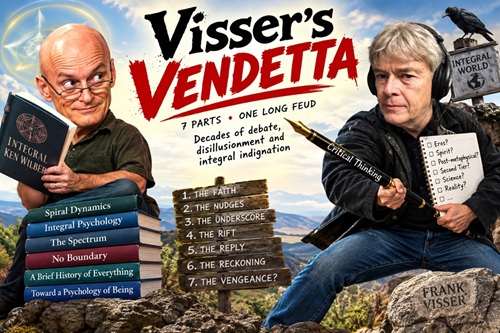
1. The Man Who Could Not Stop Writing About Ken Wilber 2. The Dark Lord of Integral Criticism 3. How Integral HQ Plans to Deal With the Visser Problem 4. The Visser Problem Solves Itself 5. Integral HQ Strikes Back 6. Integral HQ Discovers Evidence 7. The Final Integral Revelation Visser's VendettaIntegral HQ Discovers EvidenceFrank Visser / ChatGPT
 The Word That Changed EverythingFor decades, Integral Headquarters had been searching for the answer to the Visser Problem. They had tried ignoring him. They had tried answering him. They had tried developmentalizing him. They had tried shadow work. They had tried satire. They had tried AI. They had tried integrating him. They had even tried inviting him to meetings. Nothing worked. Then, one fateful evening, the chairman of Integral HQ discovered the solution. It was sitting on his desk. A small piece of paper. One word. EVIDENCE. He stared at it for several minutes. Then he called an emergency meeting. “Ladies and gentlemen,” he announced, “I think I've found the answer.” Everyone leaned forward. “What is it?” “Evidence.” Silence. Someone finally asked: “What is that?” The Evidence Task ForceThe organization immediately established a new department. THE INTEGRAL EVIDENCE TASK FORCE Its mission was ambitious: To determine whether claims made by Integral Theory were actually supported by evidence. The task force consisted of philosophers, psychologists, developmental theorists, spiritual practitioners, systems thinkers, and one person whose main qualification was having read Karl Popper. The first meeting began with enthusiasm. “Let's start with the easy claims.” “Such as?” “Gravity.” Everyone agreed. “Evidence?” “Yes.” “Excellent.” They moved on. “Evolution?” “Yes.” “Evidence?” “Lots.” “Excellent.” “Consciousness?” The room became quieter. “Evidence?” “Depends what you mean.” “Good.” “Spiritual states?” “Evidence of experience.” “Evidence of metaphysical interpretation?” “Different question.” The chairman nodded slowly. “This may be more complicated than we thought.” The First Major DiscoveryThe task force discovered something extraordinary. Not all claims were the same kind of claim. This should not have been revolutionary. But within Integral HQ it had the explosive force of a paradigm shift. There were empirical claims. There were philosophical claims. There were phenomenological claims. There were interpretive claims. There were metaphysical claims. There were speculative claims. And there were claims that moved mysteriously between categories. The chairman looked at the classification chart. “So when someone says, 'Evolution has an inherent drive toward greater consciousness,' what category is that?” The room went silent. “Empirical?” “Where is the evidence?” “Philosophical?” “Then why is it being presented as a fact about nature?” “Metaphysical?” “Perhaps.” “Speculative?” “Possibly.” The chairman sighed. “Call Visser.” Nobody wanted to. The Visser HotlineIntegral HQ had established a special telephone line for emergencies. It was called: THE VISSER HOTLINE. It had only one button. Pressing it would automatically call Amsterdam. The chairman pressed it. The phone rang. Once. Twice. Three times. “Hello?” “Frank?” “Yes?” “We have a question.” “About Wilber?” “Yes.” “What's the question?” “What kind of claim is this?” There was a pause. “Send it to me.” The chairman emailed the document. Five minutes later the reply arrived. “It depends on exactly what is being claimed.” The chairman smiled. “That wasn't very helpful.” Another email arrived. “Read the sentence carefully.” The chairman opened the original statement. They read it again. The chairman looked up. “Oh.” “What?” “We've been arguing about the conclusion without defining the claim.” The room went silent. Someone whispered: “He's right.” The chairman looked horrified. “Don't say that too loudly.” The Eros CrisisThe Evidence Task Force then turned to one of Integral Theory's more ambitious ideas: Eros. Was Eros a metaphor? A phenomenological description? A philosophical principle? A developmental tendency? A causal force? A cosmic impulse? A poetic way of describing increasing complexity? Or something else? The task force produced six competing interpretations. Then eight. Then twelve. Finally somebody asked: “What evidence would distinguish these interpretations?” Nobody answered. The chairman immediately recognized the danger. “This is going to Visser.” It was. Visser replied with characteristic brevity: “Exactly.” The chairman stared at the word. “Exactly what?” Nobody knew. This produced another 87-page report. The Evolution Department RevoltsThe next crisis came from the Evolution Department. For years, Integral Theory had been discussing evolution in terms of increasing complexity, consciousness, emergence, Eros, transcendence, and transformation. The evidence team asked an innocent question: “Which parts of this are actually established by evolutionary biology?” The evolutionary consultants produced a list. Natural selection. Genetic drift. Mutation. Recombination. Gene flow. Selection. Constraint. Ecological interaction. Developmental processes. Historical contingency. They then looked at the Integral vocabulary. Eros. Spirit-in-action. Kosmic evolution. Ascending and descending currents. The two lists did not line up neatly. Someone proposed drawing a bridge. Someone else proposed calling the bridge “integral evolutionary science.” The biologists left the room. The Great Footnote EventThe crisis reached its climax when an Integral researcher discovered an old footnote. It contained a citation. The citation referred to a scientific source. The scientific source did not actually support the claim for which it had been cited. The discovery was catastrophic. The researcher immediately notified the chairman. “We have a problem.” “How serious?” “It's a footnote.” The chairman understood immediately. “Visser?” “Yes.” “How did he find it?” “He reads footnotes.” The chairman closed his eyes. “We should have known.” The Evidence HierarchyThe task force then developed a sophisticated system for evaluating claims. Level 1: Direct empirical evidence Observations, measurements, experiments. Level 2: Multiple independent lines of evidence Different methods pointing toward the same conclusion. Level 3: Strong theoretical inference A conclusion supported by established evidence but not directly observed. Level 4: Philosophical interpretation A reasonable conceptual interpretation of evidence. Level 5: Speculation An interesting possibility requiring further support. Level 6: Integral enthusiasm A sentence beginning: “Perhaps the universe itself…” The last category was immediately controversial. Someone suggested replacing it with: “Poetic metaphysical speculation.” The committee voted. The phrase passed 7–2. The two dissenters requested a developmental assessment of the voting procedure. The meeting ended. The Unexpected ConsequenceSomething remarkable happened. Once Integral HQ began distinguishing evidence from interpretation, the arguments became easier. Not necessarily easier to resolve. But easier to understand. Instead of asking: “Is Integral Theory true?” They began asking: “Which part?” And: “In what sense?” And: “Based on what evidence?” And: “What would count against it?” These were much better questions. Unfortunately, they were also exactly the sort of questions Visser had been asking for years. The chairman became suspicious. “Have we accidentally become Visserian?” The chief theorist shook his head. “No.” “Are you sure?” “We prefer the term 'reflexively integral.'” The chairman sighed. “Of course you do.” The Visserian ContagionThe Evidence Task Force began spreading through the organization. Soon people were asking questions at meetings. “What's the evidence?” “What exactly do we mean?” “Is that an empirical claim?” “Is that interpretation supported independently?” “Could there be another explanation?” “What's the mechanism?” The effect was dramatic. People became more cautious. Some claims disappeared. Others were reformulated. Some remained strong. Others were explicitly labeled speculative. And several very impressive diagrams quietly vanished. Nobody knew what to do about that last development. The Emergency MeetingThe chairman called another meeting. “This has gone too far.” “What has?” “People are asking for evidence.” “Yes.” “They're asking for mechanisms.” “Yes.” “They're distinguishing metaphor from explanation.” “Yes.” “They're saying 'we don't know.'” “Yes.” The chairman looked around the room. “This is not how we planned it.” A young researcher raised her hand. “Maybe that's the point.” Everyone turned toward her. She continued. “Perhaps a theory becomes stronger when it knows what it knows, what it doesn't know, and what would count as evidence either way.” Nobody spoke. The chairman looked at the Evidence Task Force report. Then at the Visser essays. Then at the enormous shelf of Integral literature. Finally he said: “Don't tell Visser.” Too LateHis phone buzzed. A new email. Subject: “Re: Integral HQ Discovers Evidence.” The chairman opened it. There was a single paragraph: “I see that Integral HQ has finally discovered evidence. Welcome to the discussion.” Then a link. The chairman clicked it. It opened a new essay. “From Integral Enthusiasm to Epistemic Accountability.” He read the first paragraph. Then the second. Then the third. A smile appeared on his face. The chief theorist noticed. “What?” The chairman handed him the phone. The theorist read the essay. “What do you think?” The chairman paused. “I think…” He looked around the room. “…we may finally have a problem worth having.” The Visser Principle The organization eventually formalized the discovery. It became known internally as: The Visser Principle The more ambitious the claim, the greater the burden of explanation and evidence. It was not anti-integral. It was not pro-Visser. It was not even particularly controversial. It was simply intellectual hygiene. And, strangely enough, it improved the quality of the discussion. Some Integralists remained convinced of Wilber's larger vision. Others became more skeptical of specific claims. Some critics moderated their objections. Some became more critical. Nobody agreed on everything. But they were now arguing about the claims rather than about the developmental status of the people making them. This was considered a major advance. The Final TwistThe chairman thought the matter was finally settled. Then a new report arrived. It was from the Artificial Intelligence Division. “What's this?” “Our analysis of Visser's essays.” “And?” “We've identified a pattern.” “What pattern?” “Visser isn't actually trying to destroy Integral Theory.” The chairman smiled. “We know that.” “No. There's more.” “What?” “He keeps criticizing the parts he finds most interesting.” The chairman stopped smiling. “Meaning?” “He doesn't spend much time criticizing ideas he considers irrelevant.” The room became very quiet. The chairman slowly understood. The entire Visser phenomenon could be interpreted in a completely different way. Not as hatred. Not as revenge. Not as obsession. But as a strange form of intellectual respect. The chairman leaned back. “So after all these years…” “Yes?” “…we may have been the ones misunderstanding Visser.” Nobody laughed. Nobody reached for a developmental model. Nobody mentioned shadow. They simply sat there. And for once, they allowed an uncomfortable possibility to remain unresolved. Meanwhile, in AmsterdamFrank Visser closed his laptop. He looked at the latest essay. He was satisfied. Not because Integral HQ had finally agreed with him. It hadn't. Not because Wilber had been defeated. He hadn't. But because something much more interesting had happened. The argument had become better. He opened a new document. For several seconds, the page remained blank. Then he typed: “Part 7: The Final Integral Revelation.” He stopped. Looked at the title. And smiled. Because obviously, if there was one thing the Integral movement had not yet learned, it was this: Nothing escapes criticism. Not even criticism itself. TO BE CONTINUED.
Widget is loading comments...
|