|
TRANSLATE THIS ARTICLE
Integral World: Exploring Theories of Everything
An independent forum for a critical discussion of the integral philosophy of Ken Wilber
  Frank Visser, graduated as a psychologist of culture and religion, founded IntegralWorld in 1997. He worked as production manager for various publishing houses and as service manager for various internet companies and lives in Amsterdam. Books: Ken Wilber: Thought as Passion (SUNY, 2003), and The Corona Conspiracy: Combatting Disinformation about the Coronavirus (Kindle, 2020). Frank Visser, graduated as a psychologist of culture and religion, founded IntegralWorld in 1997. He worked as production manager for various publishing houses and as service manager for various internet companies and lives in Amsterdam. Books: Ken Wilber: Thought as Passion (SUNY, 2003), and The Corona Conspiracy: Combatting Disinformation about the Coronavirus (Kindle, 2020).
Check out my other conversations with ChatGPT
IAM INITIATIVES:
Big-Picture Thinking for a Fragmented World The Institutional Ambition: Natural Philosophy 2.0 Framework for Evaluating and Improving Worldviews The New Story of Wholeness, A Critical Review From Metatheory to Meta-Metatheory Gameplan For An Integrative Metatheory 2.0 Worldview Research or Evolutionary Prophecy? The Great Meaning Rescue, A Skeptical IAM Review What IAM Can Learn from Integral Institute The Great Meaning RescueA Skeptical Review of the Institute of Applied Metatheory and the Attempt to Save Us from the 'Meaning Crisis'Frank Visser / ChatGPT
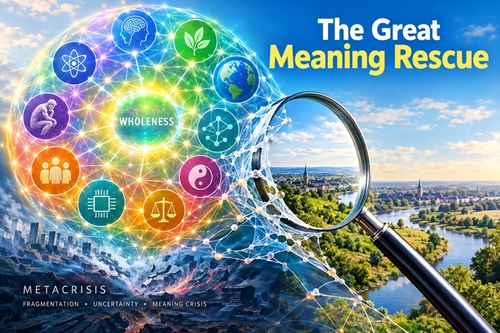 The Institute of Applied Metatheory, or IAM, is one of the most ambitious descendants of the Integral movement. It is also one of the most interesting, because it appears to have learned from some of the failures of classical Integral Theory while retaining its most characteristic ambition: the conviction that humanity needs a sufficiently large intellectual framework to put the pieces of reality back together. IAM describes itself as an international applied-philosophy network devoted to “big picture” thinking. Its stated purpose is to bring integrative metatheories to bear on “wicked” problems and discover transformational leverage points. Its initiatives now include the Integration journal, the New Story of Wholeness, Cultural Complexity Index, metacrisis mapping, the Evolution of Philanthropy, an Encyclopedia of Big Pictures, integrative policing, and various research forums and podcasts. This is serious intellectual infrastructure. It is not simply another Wilber fan club. But precisely for that reason, it deserves a serious skeptical examination. My central question is deceptively simple: What if the problem IAM is trying to solve is considerably smaller—or different—from the problem it thinks humanity has? Perhaps we do not have a “meaning crisis” in the grand metaphysical sense. Perhaps we have a collection of very real problems—climate change, war, technological disruption, loneliness, inequality, institutional distrust, political polarization, ecological degradation and rapid cultural change—that are difficult precisely because they are difficult. Perhaps they do not require a new worldview. Perhaps they require better science, better institutions, better education, better politics, better psychology, better technology, better journalism, and occasionally simply better judgment. And perhaps secular modernity, for all its deficiencies, already contains considerably more of the intellectual equipment required for that task than its critics admit. From Integral Theory to Integral Metatheory 2.0IAM's intellectual genealogy is not difficult to trace. Ken Wilber proposed an extraordinary ambition: integrate the sciences, humanities, psychology, spirituality, developmental theory, contemplative traditions and social theory into a single framework. The AQAL architecture was intended to provide a comprehensive map of reality. IAM has sensibly backed away from some of the more extravagant features of that system. The emphasis has shifted from AQAL to metatheory, from enlightenment to methodology, from spiritual stages to knowledge integration, and from an all-encompassing metaphysics to a more pluralistic dialogue among Integral Theory, critical realism, complexity theory, process philosophy, metamodernism and other approaches. The official IAM material explicitly presents itself as a network for applying “big picture” frameworks to big problems. It describes a process in which scholars and experts collaborate around difficult problems and attempt to identify “Transformational Fulcrums” from which practical innovations might emerge. That is a significant improvement over simply declaring that AQAL explains everything. But there is an obvious question. Why should the integration of these particular intellectual traditions produce something genuinely new? The answer cannot simply be that they are being integrated. Integration is not automatically innovation. A sufficiently large collection of theories can produce either a powerful synthesis or an enormous conceptual junk drawer. The distinction depends on whether the resulting framework actually explains something better, predicts something better, solves something better, or organizes knowledge better than its component theories already do. That is the standard IAM should ultimately face. The Metacrisis: The Problem That Explains EverythingThe word “metacrisis” has become the conceptual gateway through which much of this enterprise proceeds. The basic intuition is perfectly reasonable. Many contemporary problems interact. Ecological problems affect economies. Economics affects politics. Politics affects information systems. Information systems affect psychology. Technology affects all of them. But there is a danger in moving from interconnected problems to one underlying meta-problem. Once the metacrisis becomes sufficiently comprehensive, virtually anything can become evidence for it. Political polarization? Metacrisis. Climate change? Metacrisis. Loss of religious belief? Metacrisis. AI? Metacrisis. Declining trust? Metacrisis. Fragmented academic disciplines? Metacrisis. Loneliness? Metacrisis. The concept begins to resemble the old psychoanalytic trick in which every symptom confirms the theory. A concept that encompasses everything can become strangely difficult to falsify. IAM itself asks whether interconnected challenges require integrative solutions, and its Integration project explicitly connects metacrisis, worldview fragmentation, knowledge integration and planetary flourishing. But there is a crucial distinction between saying that problems interact and saying that their underlying cause is inadequate worldview integration. Those are very different propositions. A drought does not become less real because somebody has a better worldview. A dictator does not become less dangerous because his conceptual framework has been mapped. A badly designed institution does not become well designed because its stakeholders understand complexity. A corrupt incentive does not disappear because somebody achieves second-order awareness. And a war is not necessarily caused by insufficient metatheory. This is where the metacrisis discourse risks becoming intellectual imperialism: the tendency to explain problems that belong to economics, politics, sociology, biology, psychology or engineering as though they were ultimately problems of sensemaking. Sometimes the map is the problem. Very often, the territory is the problem. The Worldview That Discovered WorldviewsThere is a deeper paradox here. IAM is increasingly interested in studying worldviews themselves. That is potentially valuable. Worldviews clearly influence how people interpret evidence, formulate goals and organize institutions. But the moment an organization begins studying worldviews while simultaneously constructing a preferred integrative worldview, the epistemological situation becomes complicated. Is IAM describing a cultural development? Or participating in it? The answer appears to be: both. IAM's own “New Story of Wholeness” material is explicit about the ambition. The project asks whether patterns of knowledge integration point toward an emerging integrative worldview. In our previous examination of the project, the key skeptical distinction was between discovering an emerging worldview and constructing one. That distinction is crucial. If historians discover that an increasing number of intellectuals are interested in complexity, systems thinking, spirituality, ecological interdependence and developmental theory, that is an empirical observation. If IAM then says these convergences constitute the emergence of a new worldview appropriate to the planet, that is an interpretation. If IAM then builds institutions, journals, podcasts, research programs, software and educational initiatives designed to strengthen that worldview, it has become an intervention. There is nothing illegitimate about intervention. But intervention should not be presented as evidence of historical inevitability. You cannot simultaneously manufacture the wave and then cite the wave as evidence that history wanted it. The New Story of WholenessThis is perhaps the most revealing feature of the entire enterprise. IAM repeatedly invokes wholeness. The attraction is obvious. Fragmentation feels bad. Integration feels good. Complexity demands connection. Specialization can obscure relationships. Modern institutions often operate in silos. But “wholeness” is one of those words that can migrate remarkably easily from metaphor to metaphysics. We start with: Everything is interconnected. Fair enough. We proceed to: Therefore we need integrative thinking. Often reasonable. Then: Therefore an integrative worldview is emerging. Possible, but requiring evidence. Then: Therefore this worldview represents a new developmental stage. Now the burden of proof becomes much heavier. And finally: Therefore reality itself is evolving toward greater integration, complexity, consciousness or value. We have crossed into metaphysics. This is precisely the escalation that has repeatedly occurred in Integral discourse. The crucial question is: How do we know that reality is becoming more integrated rather than that integrative thinkers are becoming better at noticing integration? The two possibilities can look identical from inside the movement. Depth: The Old Integral Ladder in New Clothes?The “Depth” initiative pushes this even further. The appeal of Depth is understandable. It attempts to provide a richer way of understanding human experience than a purely flattened materialism. It brings together development, emergence, participation, theology, complexity and metamodernism. But the architecture risks recreating one of Integral Theory's oldest habits: turning qualitative differences into a vertical developmental story. More depth. More complexity. More integration. More wholeness. More consciousness. More value. More God. At some point the vocabulary itself starts doing the philosophical work. The problem is not that development exists. Development unquestionably exists in biology, psychology, culture and institutions. The problem is the leap from developmental difference to developmental direction. And then from developmental direction to normative superiority. And finally from normative superiority to cosmic teleology. Our earlier examination of IAM's Depth initiative noted precisely this danger: the language of depth, evolution, intelligence, value and unity can form a mutually reinforcing metaphysical trajectory, even when each individual concept sounds innocuous. The old Wilberian formula has not disappeared. It has become more sophisticated. And Then God EmergesBrendan Graham Dempsey's DEPTH theology makes the underlying trajectory particularly visible. Dempsey's proposal attempts to reinterpret God as an emergent, participatory and developmentally evolving reality. God becomes immanent rather than supernatural, historically mutable rather than immutable, and “real” in the sense of possessing emergent causal power. This is ingenious. But ingenious is not the same as demonstrated. The fundamental problem remains the word God. Suppose human beings form communities around rituals, stories, symbols, ethical commitments and shared experiences. Suppose these communities produce powerful emergent effects: solidarity, identity, moral motivation, emotional regulation, cooperation and collective action. All of that is perfectly plausible. Why call the emergent social reality God? The word adds enormous historical and emotional baggage while apparently adding very little explanatory power. If the claim is simply that human communities can generate powerful higher-order cultural phenomena, sociology and cultural evolution already provide perfectly respectable vocabularies. If the claim is that something genuinely divine emerges, then “emergence” has not solved the metaphysical problem. It has merely moved it upstairs. Where is the discriminating evidence? What observation would distinguish emergent God from emergent culture? What prediction follows from God being real that would not follow from psychology, sociology, cultural evolution and systems theory? Until those questions are answered, “emergent God” looks less like an empirical discovery than a metaphysical reinterpretation. It is theology wearing complexity theory as a new jacket. The Cultural Complexity IndexThe Cultural Complexity Index is potentially more interesting because here IAM moves toward actual measurement. IAM describes the project as an attempt to quantify cultural complexification across history, using hierarchical-complexity scoring applied to cultural artifacts. And its more recent white paper on developmental “altitude” claims to have subjected historical developmental-stage claims to empirical measurement using Lectical Assessment System scoring of historical interview material. The project reports more than 540 performances drawn from original developmental research materials. This is exactly the kind of empirical turn that Integral Theory needed for decades. But measurement introduces a new problem. What exactly has been measured? If we measure the structural complexity of texts or interviews, we have measured structural complexity. We have not thereby measured consciousness. We have not measured spiritual evolution. We have not measured moral progress. We have not measured humanity's movement toward God. And we certainly have not demonstrated that history is moving toward an integrative worldview. The danger is always the same: a legitimate measurement becomes recruited into a much larger narrative than the measurement itself warrants. A thermometer measures temperature. It does not measure the health of civilization. A complexity scale measures complexity. It does not automatically measure wisdom. This distinction may seem pedantic. It is actually the whole game. The Great Measurement UpgradeThere is nevertheless something genuinely important happening here. IAM appears to understand that the old Integral habit of aligning developmental models “by eye” was inadequate. The new work attempts to replace intuitive correspondences with actual scoring procedures. That is exactly the right direction. But it also creates a fascinating irony. If IAM succeeds in making developmental complexity empirically measurable, it may eventually discover something less exciting than the Integral story predicts. Human beings may indeed become more complex in certain respects without becoming morally better. Cultures may become more differentiated without becoming wiser. Institutions may become more sophisticated while remaining corrupt. Knowledge may increase while wisdom remains unevenly distributed. Technological power can grow much faster than ethical maturity. Evolution has no obligation to produce saints. Complexity is not goodness. And intelligence is not wisdom. These distinctions have haunted developmental theory for a century because they are genuinely difficult. No amount of sophisticated metatheory makes them disappear. Critical Realism to the Rescue?IAM's incorporation of critical realism is another attempt to correct the epistemological looseness of older Integral Theory. This is understandable. Critical realism insists on a reality that exists independently of our descriptions while recognizing that human knowledge of that reality is mediated, fallible and theory-laden. Excellent. But here another question arises. If critical realism tells us that reality is stratified, emergent and only partially knowable, does it follow that reality has a developmental trajectory toward consciousness, meaning, value or spiritual integration? No. Critical realism can provide philosophical room for emergence without providing a cosmic purpose. This distinction is crucial for the entire IAM project. Emergence is not teleology. Complexity is not purpose. Organization is not intention. Development is not progress. Interdependence is not spirituality. And a richer ontology is not automatically a sacred ontology. The temptation to run these concepts together is one of the oldest habits of integral and process thought. Visionary Realism and the Return of the SacredThe same issue appears in Nicholas Hedlund's “Visionary Realism,” which IAM presents as an attempt to articulate a worldview adequate to the complexity and sacredness of reality, emphasizing reverence, humility and listening. IAM's own media program places Visionary Realism alongside critical realism, process philosophy, complex integral realism and metamodernism as components of its intellectual ecosystem. Again, there is nothing wrong with reverence. Human beings can certainly cultivate attitudes of awe toward nature, life and the cosmos without believing in supernatural beings. But “sacredness” is a normative interpretation of reality, not a scientific measurement of it. And this leads us to the most important alternative to the IAM project. Perhaps Secularity Was Not the ProblemThere is an assumption lurking underneath much contemporary metamodern and integral discourse: modern secular culture stripped the world of meaning. Religion supplied meaning. Modernity removed religion. Therefore modernity produced a meaning crisis. The obvious solution is to reconstruct meaning at a higher level. This is a beautiful story. It is also much too simple. Secularization did not merely take things away. It gave us enormous intellectual and moral freedoms. Science no longer requires theological permission. Astronomy no longer has to preserve biblical cosmology. Biology no longer has to fit creation narratives. Medicine no longer has to explain disease as divine punishment. Ethics no longer has to depend upon revelation. Politics can be separated from theology. Citizens can disagree about ultimate reality while cooperating on shared institutions. Human beings can construct meaning without pretending that the universe itself has issued them an assignment. This last point is particularly important. Meaning does not have to be cosmically guaranteed in order to be humanly real. A friendship has meaning. A scientific discovery has meaning. Raising children has meaning. Making music has meaning. Fighting injustice has meaning. Writing a book has meaning. Helping a stranger has meaning. Learning something true has meaning. None of these activities requires the universe to contain a metaphysical force called Meaning. The Existentialist AnswerThe secular alternative is therefore not nihilism. It is existentialism. The absence of a cosmic script does not imply the absence of human purposes. Quite the opposite. It makes our purposes ours. This is the uncomfortable freedom that existentialist thinkers recognized long ago. We do not need to discover the Meaning of the Universe before beginning to live meaningful lives. And perhaps this is where the Integral and metamodern “meaning crisis” discourse occasionally overdiagnoses the patient. People may be confused because life is difficult. They may be anxious because the future is uncertain. They may be lonely because human relationships are difficult. They may distrust institutions because institutions sometimes deserve distrust. They may suffer from information overload because there is too much information. They may feel politically alienated because politics is genuinely antagonistic. They may experience ecological anxiety because ecological problems are real. None of these necessarily constitutes a metaphysical crisis. Sometimes a crisis is just a crisis. The Secular Achievement IAM Risks ForgettingModern secularism has developed an extraordinary technology for handling disagreement: You do not need to agree about ultimate reality. That is an astonishing achievement. A Christian, atheist, Muslim, Buddhist, Jew, agnostic and secular humanist can all participate in the same scientific institution. They can share a hospital. They can teach at the same university. They can vote in the same election. They can obey the same traffic laws. They can collaborate on climate research. They can work together to cure diseases. They do not require a comprehensive worldview synthesis first. This is one of the great advantages of secular pluralism. It separates cooperation from cosmological agreement. IAM's ambition is partly to overcome fragmentation through deeper integration. But there is another possibility: perhaps some fragmentation is healthy. Different disciplines may have different methods because reality has different kinds of problems. Physics does not need sociology. Sociology does not need theology. Psychology does not need metaphysics in order to study depression. Political science does not need a theory of cosmic evolution to study institutions. History does not need a theory of consciousness to explain revolutions. Pluralism is not necessarily fragmentation. Sometimes it is simply specialization. The Fantasy of the Master FrameworkThere is a recurring intellectual temptation among grand theorists: if only we could construct the sufficiently comprehensive framework, the fragmentation would disappear. Wilber's AQAL promised something like this. IAM's Integrative Metatheory 2.0 is deliberately more modest, but the ambition remains recognizable. The danger is that the framework becomes another layer of abstraction floating above the specialized knowledge it claims to integrate. This is the metatheory paradox. The more domains you attempt to integrate, the less detailed you can become about each one. The less detailed you become, the more dependent you are on the specialists whose knowledge you are supposedly integrating. The framework then risks becoming a sophisticated index to other people's work. Useful, perhaps. But not necessarily revolutionary. And the more confident the metatheorist becomes about the unity discovered beneath the disciplines, the more likely it is that the complexity of those disciplines has been compressed away. From Theory to Institutional EcosystemIAM deserves credit for recognizing that ideas require institutions. The organization now has research programs, an Integration journal, podcasts, research forums, initiatives, a nonprofit foundation and a network of scholars. Its journal editorial board includes scholars associated with integral theory, process philosophy, developmental psychology, metamodernism, critical realism and related fields. That is considerably more substantial than Wilber's largely author-centered intellectual model. It also creates a new test. • Can IAM generate error correction? • Can its researchers publish results that undermine their preferred developmental assumptions? • Can the Cultural Complexity Index demonstrate that cultural development is not progressive? • Can metacrisis research discover that worldview has little causal importance in a particular domain? • Can Depth theory conclude that God is unnecessary? • Can Visionary Realism discover that the “sacred” is a projection? • Can Integrative Metatheory 2.0 conclude that integration itself is sometimes counterproductive? If the answer to all these questions is yes, then IAM has something potentially valuable. If every investigation ultimately confirms integration, complexity, development, wholeness and emergence, then we have not constructed an empirical research program. We have constructed a sophisticated confirmation machine. The AI Problem Makes This Even More InterestingThere is another irony. IAM is emerging at exactly the moment when artificial intelligence makes the traditional meaning crisis look rather different. AI can already perform a remarkable amount of conceptual integration. • It can compare disciplines. • Summarize theories. • Construct maps. • Identify conceptual overlaps. • Generate hypotheses. • Translate terminology. • Find contradictions. • Build taxonomies. • Produce synthetic narratives. The old justification for metatheory was partly that no individual could hold enough conceptual material in mind to integrate the world's knowledge. AI changes that equation. The question is no longer simply: How can human beings integrate more knowledge? It becomes: What kind of integration is actually useful? That is a much harder question. An AI can produce a beautiful synthesis of Integral Theory, critical realism, Whitehead, complexity science, developmental psychology and metamodernism in seconds. But a synthesis is not necessarily understanding. And understanding is not necessarily truth. And truth is not necessarily wisdom. IAM's future contribution may therefore depend less on producing ever larger conceptual maps and more on identifying which integrations actually matter. The Uncomfortable PossibilityHere is the skeptical conclusion I would put before IAM. Perhaps the world does not need saving from a meaning crisis. Perhaps the meaning industry has diagnosed a crisis partly because it has a product to sell. Not necessarily a commercial product. An intellectual product. A framework. A vocabulary. A community. A research program. A worldview. A new generation of conferences, journals, podcasts, models, assessments, maps and initiatives. There is nothing sinister about this. Human beings have always created intellectual movements around perceived civilizational problems. But the movement must not confuse its own existence with evidence for the problem it was created to solve. The fact that highly educated people want a grand synthesis does not demonstrate that civilization requires one. The fact that people experience existential anxiety does not demonstrate that the universe has lost its meaning. The fact that secularism leaves ultimate questions unanswered does not demonstrate that those questions need metaphysical answers. And the fact that spirituality is psychologically attractive does not demonstrate that spiritual metaphysics is true. What IAM Gets RightA skeptical review should not obscure what is genuinely valuable. • IAM is right that disciplinary boundaries can obstruct communication. • It is right that worldviews influence perception and action. • It is right that complex problems cannot always be understood through single-variable explanations. • It is right that metatheoretical assumptions deserve examination. • It is right that developmental theories should be empirically tested rather than merely aligned by intuition. • It is right that critical realism, complexity theory, process thought, developmental psychology and other traditions contain insights worth putting into dialogue. • And it is right that the Integral movement needs more methodological self-criticism. The Integration journal's explicit attempt to create a scholarly home for these conversations is therefore potentially significant. Its editorial structure is considerably broader than the old Integral intellectual ecosystem. The question is not whether IAM should exist. It is what claims it is entitled to make. What IAM Should Give UpWhat IAM should abandon is the temptation to turn every legitimate observation into a grand evolutionary story. • It does not need to prove that consciousness is evolving toward integration. • It does not need to prove that history is moving toward a new worldview. • It does not need to resurrect God as an emergent property of cultural complexity. • It does not need to transform complexity into cosmic purpose. • It does not need to make secularism responsible for existential dissatisfaction. • It does not need to rescue humanity from fragmentation. • And it certainly does not need to believe that the universe has been waiting patiently for Integrative Metatheory 2.0. There is a more modest—and potentially much more powerful—version of the project available. • Let's compare big pictures. • Let's discover where they work. • Let's discover where they fail. • Let's test developmental claims. • Let's distinguish empirical findings from metaphysical interpretations. • Let's allow incompatible perspectives to remain incompatible when the evidence does not resolve them. • Let's use complexity theory without turning complexity into cosmic spirituality. • Let's use emergence without smuggling teleology through the back door. • Let's study meaning without assuming that the universe itself is meaningful. • And above all, let's permit the possibility that the answer to a difficult human problem may sometimes be less metaphysics, not more. Perhaps the World Is Not Flat After All—But Neither Is It WilberianThere is a final irony. The secular world that IAM implicitly regards as spiritually and intellectually impoverished may already possess the very pluralism IAM is trying to achieve. Science accepts multiple levels of description. Democracy accepts multiple worldviews. Universities contain multiple disciplines. Liberal societies permit multiple religions and nonreligious outlooks. Psychology studies meaning without deciding what the cosmos ultimately means. Evolutionary biology explains complexity without requiring cosmic purpose. Ecology studies interdependence without requiring Gaia to be a conscious deity. Humanism provides ethics without supernatural authority. Existentialism provides meaning without metaphysical guarantees. And science gives us perhaps the most important lesson of all: we can remain uncertain. That may be the real alternative to the meaning crisis. Not nihilism. Not fundamentalism. Not Integral Theory. Not metamodern theology. Not a New Story of Wholeness. But intellectual adulthood: the capacity to live with unanswered questions while continuing to investigate the ones that can be answered. The Institute of Applied Metatheory is at its best when it is doing exactly that—comparing frameworks, exposing blind spots, developing better methods and testing developmental claims. Its official program of initiatives shows that it is now attempting to turn this ambition into an actual research and institutional ecosystem. But at its weakest, IAM risks repeating the oldest Integral mistake in a more sophisticated vocabulary: taking our hunger for wholeness as evidence that reality itself is whole in precisely the way our theory says it is. That is the temptation to resist. Perhaps there is a metacrisis. Perhaps there is a meaning crisis. Perhaps humanity really is approaching a profound transformation in its worldview. Or perhaps we are simply living through a historically turbulent period and trying, as human beings always have, to make sense of it. We should investigate these possibilities. We should not presuppose the answer. And perhaps the greatest service IAM could render to the world would be to discover that secularity was never the enemy it imagined it was. It may instead be the intellectual space in which we finally learned that we do not need a single story to live together—or a cosmic guarantee to make our lives meaningful. That would be a genuinely radical form of integration: integrating the possibility that no final integration is required.
Widget is loading comments...
|