|
TRANSLATE THIS ARTICLE
Integral World: Exploring Theories of Everything
An independent forum for a critical discussion of the integral philosophy of Ken Wilber
  Frank Visser, graduated as a psychologist of culture and religion, founded IntegralWorld in 1997. He worked as production manager for various publishing houses and as service manager for various internet companies and lives in Amsterdam. Books: Ken Wilber: Thought as Passion (SUNY, 2003), and The Corona Conspiracy: Combatting Disinformation about the Coronavirus (Kindle, 2020). Frank Visser, graduated as a psychologist of culture and religion, founded IntegralWorld in 1997. He worked as production manager for various publishing houses and as service manager for various internet companies and lives in Amsterdam. Books: Ken Wilber: Thought as Passion (SUNY, 2003), and The Corona Conspiracy: Combatting Disinformation about the Coronavirus (Kindle, 2020).
Check out my other conversations with ChatGPT
BIG PICTURE TALK:
When the Map Meets the Real Critical Realism and the Limits of AQAL Visionary Realism and the Return of Metaphysics When Integral Theory Meets RealityCritical Realism and the Limits of AQALFrank Visser / ChatGPT
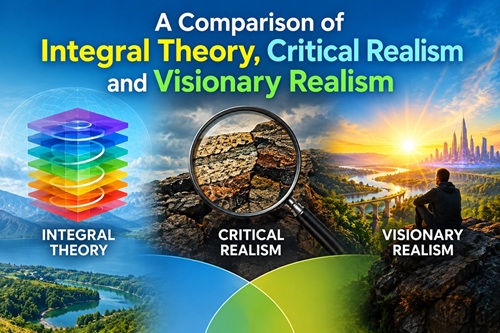 There was something almost inevitable about the encounter between Ken Wilber's Integral Theory and Roy Bhaskar's Critical Realism. Both emerged from dissatisfaction with intellectual fragmentation. Both wanted to overcome reductionism without simply retreating into relativism. Both regarded reality as deeper and more complex than the narrow world described by positivist science. Both aspired to some form of theoretical inclusiveness. And yet the encounter produced an irony that Integral Theory has never fully digested. Critical Realism did not simply give Integral Theory another perspective to add to its already enormous collection of perspectives. It raised a much more uncomfortable question: What if Integral Theory itself has not adequately distinguished reality from its descriptions of reality? That question goes straight to the heart of Wilber's post-metaphysical project. The dialogue was serious and substantial. Beginning with the 2010 Luxembourg symposium and continuing through several subsequent meetings, Integral theorists and Critical Realists spent years exploring possible forms of collaboration. The result was Metatheory for the Twenty-First Century: Critical Realism and Integral Theory in Dialogue, edited by Bhaskar, Sean Esbjörn-Hargens, Nicholas Hedlund and Mervyn Hartwig. The volume explicitly presents itself as the product of more than four years of engagement between the two communities and identifies several possible positions on their integration. But from an Integral World perspective, the interesting question is not how harmonious this dialogue was. It is what happened when Integral Theory's grand synthesis encountered a philosophy whose central demand was: show me what you mean by reality. Integral Theory's Favorite TrickWilber's great intellectual strength has always been his ability to notice partiality. Materialism sees the exterior and neglects the interior. Idealism makes the opposite mistake. Individualism neglects collective structures. Collectivism can dissolve individuals into systems. Behaviorism ignores subjective experience. Mysticism can ignore empirical investigation. AQAL promises to solve these problems by putting the pieces together. The four quadrants become the basic architecture of the solution: interior-individual, exterior-individual, interior-collective and exterior-collective. Add developmental levels, lines, states, types and stages, and virtually any human phenomenon can be placed somewhere on the map. It is an impressive cartographic achievement. But here lies the first problem. A map is not an ontology. The fact that we can classify different perspectives on a phenomenon does not tell us what the phenomenon actually is. And the ability to identify multiple perspectives does not automatically explain the causal relations between the things those perspectives describe. This distinction becomes particularly important when Integral Theory moves from the relatively harmless claim that "different perspectives reveal different aspects of reality" to the much stronger claim that reality is somehow constituted through those perspectives or their enactments. That is where Critical Realism enters the room. Bhaskar's Annoying QuestionRoy Bhaskar's central philosophical insight is devastatingly simple. Our knowledge of reality is not reality itself. The world exists independently of our descriptions of it, while our knowledge of that world is historically situated, fallible, theory-laden and revisable. This is not crude positivism. Critical Realism explicitly rejects the idea that reality is exhausted by observable events. Its ontology distinguishes the real, the actual and the empirical, and emphasizes underlying causal mechanisms and structures that may not be directly observable. That is precisely why the word critical matters. Critical Realism is realist because it insists that reality is not manufactured by our theories. It is critical because it insists that our access to reality is always mediated and fallible. The two propositions belong together. And this is where Integral Theory encounters a problem. For all its talk about multiple perspectives, AQAL can sometimes seem remarkably reluctant to answer the elementary realist question: What exists independently of the perspective? The Epistemic FallacyBhaskar called the reduction of questions about being to questions about knowledge the epistemic fallacy. In crude form, the mistake is: We only encounter reality through knowledge, therefore reality is reducible to what can be known. Integral Theory's post-metaphysical turn was explicitly designed to avoid naïve metaphysics. Wilber increasingly emphasized that knowledge is enacted through particular perspectives and methodologies rather than passively copied from a pre-given world. That move has considerable merit. But it can overshoot. If every phenomenon is described primarily in terms of the perspective, methodology or enactment through which it becomes available, we risk losing the distinction between different ways of knowing something and different things being brought into existence by different ways of knowing. These are not equivalent. A mountain can be experienced as sacred, measured as geological, represented artistically, owned as property, mapped geographically and remembered autobiographically. There are many mountains of meaning. There is not necessarily a different mountain corresponding to each perspective. The realist insists that something remains there to constrain all these descriptions. That "something" is precisely what Integral Theory sometimes seems to make strangely difficult to talk about. Wilber's CounterattackWilber was not unaware of the problem. In his response to the Critical Realist criticism, he turned the accusation around. If Critical Realists accuse Integral Theory of committing the epistemic fallacy, Wilber argued, Critical Realism itself risks an opposing mistake: privileging ontology as though we could simply step outside our epistemic conditions and encounter a completely unmediated world. This objection deserves to be taken seriously. There is no God's-eye view available to human beings. Critical Realism does not, however, require one. Its point is almost the opposite: our knowledge is fallible precisely because reality is not identical with our knowledge of it. This distinction was central to the debate. The published exchange records Integral theorists such as Paul Marshall and Nicholas Hedlund-de Witt raising the epistemic-fallacy objection against Integral Theory, while Wilber responded by accusing Critical Realism of an "ontic fallacy" or "myth of the given." The irony is delicious. Wilber's defense of Integral Theory against Critical Realism ends up demonstrating why Critical Realism is needed. Both sides agree that naïve realism is inadequate. But only one side makes the distinction between fallible knowledge and mind-independent reality its philosophical starting point. Enactment Is Not CreationThis brings us to one of Wilber's most consequential ideas: enactment. Different methods disclose different phenomena. This is plainly true. A telescope discloses things invisible to the naked eye. A microscope discloses cellular structures. A psychological interview discloses dimensions of subjective life. A sociological investigation reveals social patterns. Meditation can disclose unusual states of consciousness. But notice the subtle shift that can occur. From: Different methods reveal different aspects of reality we can slide into: Different methods enact different realities. The first proposition is compatible with realism. The second requires considerably more argument. Critical Realism asks why we should make that second move. And Integral Theory has never really provided a compelling answer. Indeed, Iskra Nunez's 2023 article in the Journal of Critical Realism takes precisely this line of attack. Her "omissive critique" argues that Integral Theory commits the epistemic fallacy and also charges it with actualism, ontological monovalence, atomism and problems concerning transformative agency. Most importantly, she argues that Integral Theory's emphasis on patterns, perspectives, non-exclusion and enactment risks neglecting the ontological structures and causal mechanisms underlying observable phenomena. This is no longer merely an argument about terminology. It is an argument about what counts as an explanation. The Difference Between Mapping and ExplainingHere we reach what may be the most serious weakness of Integral Theory. It is extraordinarily good at mapping. It is much less impressive at explaining. Consider developmental stages. Integral Theory can tell us that a phenomenon appears at a particular developmental level. It can tell us that different worldviews interpret the same event differently. It can classify the phenomenon across quadrants. • But what actually produces the developmental transition? • What mechanisms generate the observed pattern? • Under what conditions does development accelerate, stop, regress or branch? • What competing explanations have been ruled out? • What empirical observations would falsify the proposed developmental model? These are Critical Realist questions. And they are not answered by adding another quadrant. The same problem appears with social phenomena. Suppose a society exhibits racism, authoritarianism, economic inequality or ecological destruction. An Integral analysis can classify the phenomenon at multiple levels and perspectives. Fine. • But what are the mechanisms reproducing it? • Which institutions sustain it? • Which material conditions constrain individual agency? • Which beliefs mediate those conditions? • Which causal processes operate at which levels? • How do those mechanisms interact? This is where Critical Realism is potentially far more than an Integral accessory. It provides a theory of causal depth. The Four Quadrants Are Not Four Causal MechanismsThis is one of the distinctions that AQAL enthusiasts often blur. The four quadrants tell us that interior and exterior, individual and collective dimensions should not be ignored. They do not, by themselves, tell us how those dimensions causally interact. An individual's beliefs can influence behavior. But behavior can also modify beliefs. Institutions shape individuals. Individuals reproduce or transform institutions. Economic structures influence culture. Culture can influence economic institutions. Biological constraints influence psychological development. Psychological development can alter behavior that feeds back into biological and social systems. That is a genuinely complex causal network. Simply putting these things into four boxes does not explain it. Critical Realism's language of emergence, structure, causal powers, levels and conditions offers something AQAL too often substitutes with a taxonomy. And taxonomy is not causality. The Great Integral ConfusionThis may be the fundamental confusion: Integral Theory frequently mistakes comprehensiveness for explanatory power. If a theory contains psychology, sociology, biology, spirituality, developmental theory, systems theory and epistemology, it certainly looks comprehensive. But comprehensiveness is not the same thing as truth. Nor is it the same thing as explanatory depth. A telephone directory contains more information about a city than a map. That does not make it a better map. AQAL's enormous vocabulary can create a similar illusion. Once everything has a place, it becomes psychologically tempting to believe that everything has therefore been explained. But classification can conceal explanatory emptiness. "That is a second-tier phenomenon." "That is a lower-left cultural expression." "That is a developmental stage." "That is a state rather than a trait." These statements may be useful descriptions. But they can become substitutes for mechanisms. Critical Realism asks the irritating follow-up question: Yes—but why? When Integral Theory "Integrates" Critical RealismThe history of the dialogue is revealing here. The 2015/2016 volume Metatheory for the Twenty-First Century contains chapters with titles such as "Developing a Complex Integral Realism," "Towards a Complex, Integral Realism," and "Towards a Critical Realist Integral Theory." The project was explicitly framed as a possible cross-fertilization between the two traditions. This sounds promising. But there is a danger hidden in the phrase Integral Realism. What if "integral" simply absorbs "realism"? What if Critical Realism becomes one more component in the great AQAL synthesis? Then the very thing Critical Realism is supposed to challenge disappears into the framework it was meant to interrogate. The question should not be: How can Integral Theory incorporate Critical Realism? It should be: What would Integral Theory have to give up if Critical Realism were taken seriously? That is a much more interesting question. Critical Realism as a Test of Integral TheoryImagine reversing the relationship. Instead of AQAL asking how Critical Realism fits into its framework, let Critical Realism examine AQAL. Now the questions become uncomfortable. • Are the quadrants ontological structures or heuristic categories? • Are developmental stages empirically established structures, ideal types or theoretical constructions? • Are "levels of consciousness" causal entities, descriptions of recurring patterns, or interpretations of subjective experience? • Does the Integral vocabulary identify mechanisms or merely redescribe correlations? • When Wilber speaks of evolution moving toward greater complexity and consciousness, what is the mechanism? • When he invokes Eros, what is its causal status? • When he speaks of Spirit, what evidence distinguishes Spirit from a metaphysical interpretation of evolutionary and psychological processes? • When he invokes nondual realization, what part of the claim is phenomenological and what part is ontological? These questions become much harder once Critical Realism is sitting across the table. And that may be exactly why the dialogue matters. The Problem of ErosThe issue becomes particularly stark with Wilber's evolutionary metaphysics. Wilber has repeatedly described Eros not merely as a poetic metaphor but as something like a genuine force in evolution. In Finding Radical Wholeness, for example, he describes Eros as an actual force alongside familiar physical forces. Here Critical Realism should become merciless. • If Eros is a metaphor for the tendency of complex systems to self-organize, then say so. • If Eros is a phenomenological description of the human experience of striving, aspiration and integration, then say so. • If Eros is a metaphysical principle, explain what makes it real. • If Eros is an actual causal force, identify its mechanism. • What empirical consequences follow from its existence? • What observations would distinguish Eros-driven evolution from evolutionary processes explained through mutation, selection, developmental constraints, self-organization, niche construction, drift and other established mechanisms? Without answers to those questions, "Eros" risks functioning not as an explanation but as a name for the phenomenon that supposedly needs explaining. And this is exactly where Critical Realism is useful. It asks the simplest possible question: What causal work is this concept actually doing? Integral Theory's Other Problem: Ontological InflationThere is a recurring pattern in Wilber's work. A useful phenomenological observation becomes a psychological principle. The psychological principle becomes a developmental principle. The developmental principle becomes an evolutionary principle. The evolutionary principle becomes an ontological principle. And suddenly a description of human experience has become a statement about the structure of the cosmos. This is ontological inflation. Critical Realism provides a useful brake because it demands distinctions between levels of reality and between different kinds of causal claims. • The fact that human beings experience meaning does not establish that meaning is written into the cosmos. • The fact that people experience mystical unity does not establish metaphysical nonduality. • The fact that development often involves increasing differentiation and integration does not establish that the universe itself is developing toward Spirit. • The fact that evolution generates increasing complexity in some lineages does not establish a universal cosmic drive toward consciousness. Each additional step requires additional argument. Integral Theory is often weakest precisely at these transition points. The Strange Alliance of Postmodernism and MetaphysicsThere is another irony. Wilber's post-metaphysical turn was designed partly to protect Integral Theory from old-fashioned metaphysical assertions. But post-metaphysics can become metaphysics by another route. Instead of saying: Reality is X. one says: Different perspectives enact different worlds. That sounds epistemically sophisticated. But if one then treats these enacted worlds as ontologically authoritative, metaphysics has returned through the back door. The vocabulary has changed. The philosophical problem has not. This is why Critical Realism's distinction between ontology and epistemology is so valuable. It does not require us to abandon perspectives. It requires us to stop confusing perspectives with what they are perspectives of. What Integral Theory Could LearnThe strongest conclusion is therefore not that Integral Theory should simply be discarded. • Its insistence on non-reductionism remains valuable. • Its insistence that subjective experience matters remains valuable. • Its critique of one-dimensional explanations remains valuable. • Its developmental and perspectival sensitivities can be useful. But these strengths become liabilities when comprehensiveness substitutes for evidence and when the map begins to dictate the territory. Critical Realism could force Integral Theory to become less grandiose and more rigorous. It could encourage Integral theorists to distinguish: • phenomenology from ontology, • correlation from causation, • description from explanation, • heuristic models from real structures, • developmental patterns from developmental mechanisms, • spiritual experiences from metaphysical interpretations, • and evolutionary trends from cosmic purposes. That would not destroy Integral Theory. It might actually save the best part of it. What Critical Realism Should ResistBut Critical Realism should resist the temptation to become AQAL with better philosophical footnotes. Critical Realism has its own grand-system tendencies. Bhaskar's later work became increasingly ambitious, moving from the philosophy of science through social theory, dialectics and emancipation toward his conception of meta-Reality. The Critical Realist tradition is therefore not immune to precisely the kind of philosophical expansion that it criticizes in Integral Theory. The irony is worth emphasizing. A philosophy designed to expose ontological overreach can itself become ontologically ambitious. So the Critical Realist should also ask: Where does your own explanatory apparatus stop? That is where genuine critical realism becomes genuinely critical. Beyond the Grand SynthesisPerhaps, then, the great promise of the Integral-Critical Realist dialogue lies not in creating a new super-theory. Perhaps the lesson is that not everything should be integrated. Some distinctions are productive. • Ontology and epistemology should not be collapsed. • Phenomenology and metaphysics should not be conflated. • Levels of explanation should not be confused with boxes on a diagram. • And perspectives should not be allowed to dissolve the reality that constrains those perspectives. This is where the Integral project encounters its deepest philosophical challenge. Wilber has spent decades criticizing everyone else for mistaking a part for the whole. But what happens when the same criticism is turned against Integral Theory itself? • What if AQAL is also a perspective? • What if Integral Theory is also a partial construction? • What if its extraordinary comprehensiveness is itself one particular response to the fragmentation of modern knowledge? • And what if recognizing this does not diminish Integral Theory but places it where it belongs: as a sophisticated map rather than the architecture of reality itself? The Final IronyThere is a delicious irony in the history of this encounter. Integral Theory was designed to integrate perspectives. Critical Realism arrived insisting that perspectives are not reality. Integral Theory responded that realism itself is always perspectival. Critical Realism replied that acknowledging epistemic mediation does not eliminate ontological independence. And the debate continues. Perhaps it should. Because the most useful result of the encounter is not a triumphant "Integral Critical Realism." It is the realization that Integral Theory needs a reality check. Not because perspectives are unimportant. Not because consciousness is reducible to matter. Not because science has everything figured out. But because after we have mapped every perspective, every quadrant, every level, every state, every line and every worldview, one stubborn question remains: What is actually there? That is the question Critical Realism puts back on the table. And it is precisely the question that a theory claiming to explain the whole should never have stopped asking.
Widget is loading comments...
|