|
TRANSLATE THIS ARTICLE
Integral World: Exploring Theories of Everything
An independent forum for a critical discussion of the integral philosophy of Ken Wilber
  Frank Visser, graduated as a psychologist of culture and religion, founded IntegralWorld in 1997. He worked as production manager for various publishing houses and as service manager for various internet companies and lives in Amsterdam. Books: Ken Wilber: Thought as Passion (SUNY, 2003), and The Corona Conspiracy: Combatting Disinformation about the Coronavirus (Kindle, 2020). Frank Visser, graduated as a psychologist of culture and religion, founded IntegralWorld in 1997. He worked as production manager for various publishing houses and as service manager for various internet companies and lives in Amsterdam. Books: Ken Wilber: Thought as Passion (SUNY, 2003), and The Corona Conspiracy: Combatting Disinformation about the Coronavirus (Kindle, 2020).
Check out my other conversations with ChatGPT
BIG PICTURE TALK:
When the Map Meets the Real Critical Realism and the Limits of AQAL Visionary Realism and the Return of Metaphysics Integral Theory and Critical RealismWhen the Map Meets the RealFrank Visser / ChatGPT
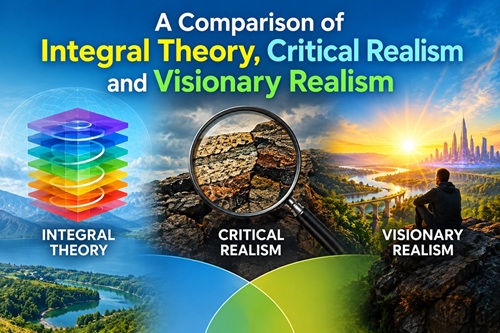 Two Grand Theories MeetIntegral Theory and Critical Realism are among the most ambitious attempts of the late twentieth and early twenty-first centuries to construct a philosophical framework capable of making sense of a fragmented intellectual landscape. Both emerged from dissatisfaction with reductionism, positivism, simplistic materialism, and the inability of specialized disciplines to communicate across their boundaries. Both also insist that reality is richer than any single theoretical perspective can capture. And yet, when these two projects finally met, something rather interesting happened. What initially looked like a natural intellectual alliance turned into a confrontation over one of the oldest questions in philosophy: does reality exist independently of our ways of knowing it? This is not a minor technical disagreement. It reaches into the foundations of Integral Theory itself. The encounter was remarkably substantial. After Sean Esbjörn-Hargens encountered Critical Realism around 2008, he began incorporating Bhaskarian ideas into his own work. Roy Bhaskar and Esbjörn-Hargens subsequently met in 2010, and a series of symposia brought together scholars from both communities. The discussions eventually produced Metatheory for the Twenty-First Century: Critical Realism and Integral Theory in Dialogue, edited by Bhaskar, Esbjörn-Hargens, Nicholas Hedlund and Mervyn Hartwig. The book explicitly presents the result as more than a casual comparison: it emerged from more than four years of engagement between the two intellectual communities. The important question, however, is what this encounter actually accomplished. Did Critical Realism provide Integral Theory with the missing ontological foundation it needed? Did Integral Theory provide Critical Realism with a richer account of consciousness, development and interiority? Or did the dialogue expose a fundamental incompatibility between two very different ideas of what a metatheory is supposed to do? The history suggests that all three things happened. What Critical Realism Is Trying to DoRoy Bhaskar's Critical Realism begins with a relatively simple but far-reaching observation: the world cannot be reduced to what we know about it. Scientific knowledge is historically situated, theory-laden and fallible. But the fallibility of our knowledge does not imply that reality itself is merely constructed by our knowledge. To confuse the two is what Bhaskar called the epistemic fallacy: reducing questions about being to questions about our knowledge of being. This distinction becomes especially important in science. A planet existed before astronomers described it. A virus existed before virologists identified it. Gravity did not begin operating when Newton formulated his equations. More subtly, the causal powers of social institutions, biological organisms or psychological structures need not depend upon our successfully recognizing them. Critical Realism therefore distinguishes between the real, the actual, and the empirical. What happens empirically is only a subset of what exists and what has causal power. Causes can remain unobserved. Mechanisms can operate without producing their characteristic effects in every circumstance. Reality is consequently deeper than observable events. This is why Critical Realism is particularly suspicious of approaches that equate reality with experience, observation, discourse or enactment. And this is where the trouble with Integral Theory begins. Integral Theory's Great Strength: InclusionWilber's Integral Theory starts from a different but complementary insight: human beings habitually mistake partial perspectives for the whole. Materialism reduces consciousness to matter. Idealism can reduce the external world to consciousness. Individualism ignores social structures. Collectivism can dissolve individual agency into systems. Psychology may ignore culture; sociology may ignore subjective experience. Science can neglect meaning, while spirituality can neglect empirical evidence. Wilber's famous AQAL framework attempts to hold these perspectives together through its four quadrants: interior-individual, exterior-individual, interior-collective and exterior-collective. This is genuinely useful as a cartographic device. It reminds us that a phenomenon can be investigated from multiple perspectives and that these perspectives need not be mutually exclusive. The problem arises when the map starts being treated as an ontology. Critical Realism asks: what exists, independently of our descriptions of it, and what causal powers does it possess? Integral Theory frequently asks instead: from which perspective, developmental level, state, line, type or worldview are we encountering this phenomenon? Those are not the same question. One is primarily ontological. The other is primarily metatheoretical. The difference is easy to overlook because Wilber's system is so comprehensive that it can give the impression of answering both. The Epistemic Fallacy Comes KnockingThe most important criticism Critical Realists directed toward Integral Theory was that its post-metaphysical formulations risked committing precisely the epistemic fallacy that Bhaskar had spent his career diagnosing. This became one of the central points of the debate following the 2011 symposium. Paul Marshall and Nicholas Hedlund-de Witt argued that Integral Theory's emphasis on enactment and perspectives created serious problems concerning ontology. Wilber responded in defense of Integral Theory, arguing that Critical Realism itself risked privileging ontology over epistemology and falling into what he regarded as an ontic version of the "myth of the given." Wilber's response is important because he did not simply reject Critical Realism. He recognized substantial common ground while arguing that Integral Theory and Critical Realism approached the relation between ontology and epistemology differently. This difference can be expressed quite simply. Critical Realism says: There is a real world, and our knowledge of it is fallible and mediated. Wilber's later Integral Theory says, roughly: There is no access to reality that is completely independent of perspective, interpretation and enactment. These propositions are not necessarily contradictory. But neither are they interchangeable. The first warns us not to confuse reality with our knowledge. The second warns us not to confuse our knowledge with a view from nowhere. A sophisticated philosophy needs both warnings. The Curious Case of "Enactment"Wilber's post-metaphysical turn was intended to solve a genuine problem. Traditional metaphysics often claims access to ultimate realities without sufficiently explaining how such knowledge is obtained. Integral Theory therefore became increasingly sensitive to the fact that different forms of consciousness disclose different worlds. Meditative experience, scientific observation, aesthetic experience and ordinary perception are not identical modes of engagement with reality. This insight is valuable. But it creates a danger. If every disclosure is treated as an enacted world, what prevents the distinction between different ways of knowing the same reality from collapsing into different realities constituted by different ways of knowing? Critical Realism's answer is that epistemic mediation does not abolish ontological independence. A mountain can be experienced as sacred, measured as geological, represented as landscape, remembered as a childhood place, or described as an economic resource. These are different perspectives on the mountain. They do not necessarily imply five different mountains. The distinction sounds obvious when stated this way. But it becomes much more difficult when the object under investigation is consciousness, Spirit, enlightenment, subtle energy or mystical experience. Here the Integral framework is tempted to move from phenomenology to ontology. And that is precisely where Critical Realism becomes useful. Wilber's Strange Opposition: Realism versus IdealismThe later debate became particularly revealing when Wilber discussed "realism and idealism" in his 2019 afterword to Dancing with Sophia. A problem appears here that has been noted by Nicholas Hedlund: Wilber's characterization of Critical Realism can make it appear closer to conventional materialism than it actually is. Critical Realism does not identify reality with physical objects alone. Bhaskar's ontology explicitly allows for the reality and causal efficacy of ideas, reasons, meanings and other interior phenomena. This matters enormously for Integral Theory. The familiar four-quadrant opposition between "interior" and "exterior" can accidentally encourage the thought that Critical Realism belongs on the exterior side of the map. It does not. Critical Realism's ontology is perfectly capable of recognizing that social structures, meanings, reasons, intentions and institutions possess real causal powers. Indeed, its conception of emergent reality is designed precisely to prevent the reduction of higher-order phenomena to lower-order ones. Consequently, the real disagreement is not: materialism versus interiority. It is closer to: perspectival/enactive epistemology versus ontological realism about the structures and powers disclosed through inquiry. That is a much more serious debate. Where Critical Realism Strengthens Integral TheoryThe strongest case for Critical Realism is that it forces Integral Theory to answer a question it sometimes postpones: What, exactly, is supposed to exist? Take the four quadrants. They are extraordinarily useful as a classification of perspectives. But are the quadrants themselves features of reality? Are they properties of the objects being studied? Are they properties of the relationship between observer and object? Or are they categories constructed by the theorist to prevent reductionism? The answer matters. Likewise with developmental levels. Integral Theory distinguishes numerous stages and waves of development. But are these ontological structures? Statistical regularities? Ideal types? culturally mediated developmental constructions? recurrent patterns of human development? or elements of a theoretical map? Critical Realism encourages the Integral theorist to distinguish these possibilities rather than sliding between them. That is a genuine philosophical gain. It also provides a more rigorous way to speak about causation. Instead of saying that a developmental stage "causes" a social phenomenon simply because the two are correlated, Critical Realism asks about mechanisms, structures, contexts and conditions. That is precisely the kind of discipline Integral Theory needs if it wants to become more than an extraordinarily elaborate vocabulary for talking about everything. Where Integral Theory Strengthens Critical RealismThe traffic, however, is not entirely one-way. Critical Realism has sometimes been criticized for concentrating heavily on ontology and social structures while giving insufficient attention to the extraordinary diversity of human experience. Here Integral Theory can contribute something important. Human beings do not merely occupy structures. They interpret them. They experience them. They develop within them. They resist them. They transform them. They create meanings through them. And consciousness itself is not adequately described simply by saying that it has emergent causal powers. Integral Theory's detailed attention to subjective states, developmental trajectories, cultural worldviews and contemplative experience can therefore enlarge Critical Realism's field of vision. This was already recognized within the Critical Realist side of the dialogue. Hans Despain argued that Critical Realism could benefit from Integral Theory's syntheses in areas such as developmental psychology, cultural anthropology and transpersonal psychology, even while arguing that Integral Theory could benefit substantially from Critical Realism's ontology and social analysis. Paul Marshall similarly described the two approaches as emphasizing different forms of emancipation: Integral Theory has tended toward individual transformation, while Critical Realism has placed greater emphasis on social emancipation. That distinction deserves much more attention than it has received. From Individual Enlightenment to Social StructureThere is a political and ethical asymmetry between the two frameworks. Integral Theory has historically been fascinated by the transformation of consciousness. Its developmental narrative moves toward increasingly inclusive, differentiated and integrated forms of awareness, culminating in various formulations of nondual realization. Critical Realism begins somewhere else. Its concern is not primarily whether an individual has reached a higher stage of consciousness but whether human beings are constrained by structures that they did not create and whether those structures can be transformed. This produces two different conceptions of emancipation. The Integral question is: What must consciousness become? The Critical Realist question is: What structures prevent human beings from flourishing, and what causal mechanisms reproduce them? A mature social theory probably needs both. But the two should not be confused. Meditation cannot substitute for institutional reform. Institutional reform cannot substitute for psychological transformation. And neither should automatically be interpreted as the hidden cause of the other. This is one of the places where a genuinely integral realism could become productive: not by dissolving differences between levels of explanation, but by explaining how they interact. The Great Temptation of MetatheoryThere is, however, a deeper problem. Both Integral Theory and Critical Realism are metatheories. Both attempt to provide frameworks within which other theories can be situated. That gives them enormous intellectual reach. It also creates an enormous temptation. The temptation is to believe that because one's framework can include another framework, it has thereby explained it. But inclusion is not explanation. A map containing physics, psychology, sociology, spirituality and politics does not automatically explain physics, psychology, sociology, spirituality or politics. This is perhaps the central weakness of Integral Theory. AQAL can tell us that several perspectives are relevant. It does not by itself tell us what the causal mechanisms are within any particular domain. Critical Realism is stronger here because it insists on generative mechanisms and causal powers. Yet Critical Realism can fall into the opposite temptation: believing that increasingly sophisticated ontological distinctions constitute an adequate explanation of concrete phenomena. Metatheory is therefore not a substitute for theory. And theory is not a substitute for evidence. The "Poisoned Chalice"Timothy Rutzou pushed this criticism much further. In "Integral Theory: A Poisoned Chalice?", he argued that Integral Theory's adoption of certain Kantian, Hegelian and Heideggerian assumptions produced actualist and ontological problems that Critical Realism could not simply repair from the outside. His later essay on Integral Theory and the "Holy Grail" of metatheory argued that Integral Theory's difficulties were not merely missing pieces that could be patched with a dose of Critical Realism. This is an important challenge to the more optimistic interpretation of the dialogue. Perhaps the problem is not that Integral Theory needs more ontology. Perhaps some of its foundational assumptions need reconsideration. That would be a much more radical conclusion. And it raises an uncomfortable possibility for the Integral community: Critical Realism may be most useful not as another quadrant to be added to AQAL, but as an external philosophical standard against which AQAL itself can be criticized. The Dialectical CritiqueThe most recent significant development in this debate is Iskra Nunez's 2023 article, "On Integral Theory: An Exercise in Dialectical Critical Realism." Nunez explicitly treats Integral Theory from within the resources of dialectical Critical Realism and argues that the relationship between the two cannot be reduced to simple complementarity. The critique concerns what she describes as Integral Theory's problems at the ontological, epistemological and methodological levels. This is important because the debate has now moved beyond the original question: How can Critical Realism help Integral Theory? The harder question is: What would happen if Integral Theory were subjected to Critical Realism's own standards of ontological and explanatory adequacy? That is a very different exercise. The first approach seeks synthesis. The second seeks adjudication. And the second may ultimately be more productive. Five Possible RelationshipsThe history of the dialogue reveals at least five different possibilities. • One possibility is absorption: Integral Theory incorporates Critical Realist ontology and continues essentially unchanged. • A second is integration: both theories are combined into a larger "integral critical realism." • A third is subordination: Integral Theory becomes an application or extension of a deeper Critical Realist ontology. • A fourth is mutual transformation: Critical Realism and Integral Theory each change through sustained interaction. • A fifth is critical differentiation: the dialogue reveals that certain elements are compatible while others should remain separate. The published dialogue itself contained several of these positions. Bhaskar and colleagues described different possibilities ranging from a preservative synthesis through a critical-realist reconstruction to more modest resonance and cross-fertilization. This plurality is intellectually healthy. The mistake would be to assume that the word "integral" requires everything eventually to be integrated. Sometimes the most accurate integral move is to preserve a distinction. The Unfinished EncounterThere is something revealing about the fact that the most important encounter between these traditions produced neither a universally accepted synthesis nor the disappearance of one framework into the other. That may be because they answer different questions. Integral Theory asks how apparently fragmented forms of knowledge can be related. Critical Realism asks what kind of world must exist for knowledge, science, causation, society and human agency to be possible at all. The first is primarily synthetic. The second is fundamentally ontological and explanatory. Their overlap is substantial, but their starting points are different. And that difference becomes especially important when Integral Theory ventures into its more ambitious claims about Spirit, consciousness, evolution and nonduality. Critical Realism can accommodate interiority without granting every interior experience ontological authority. It can take subjective experience seriously without concluding that the contents of that experience necessarily disclose the ultimate structure of reality. That distinction is invaluable. • A mystical experience may be real as an experience without its interpretation being true as an ontology. • A developmental stage may be a robust empirical pattern without being a metaphysical rung in a cosmic hierarchy. • A perspective may reveal something about reality without reality being reducible to the perspective. These are exactly the distinctions that Integral Theory most needs if it wants to move from an ambitious map of knowledge toward a defensible philosophy of reality. The Deeper LessonThe encounter between Integral Theory and Critical Realism therefore has a larger significance than the particular debate between Wilber and Bhaskar. It illustrates a recurring problem in contemporary metatheory. Once we become sophisticated enough to recognize that every perspective is partial, we may begin to think that reality itself is nothing more than the plurality of perspectives. That is the danger of excessive perspectivalism. But the opposite error is equally serious: once we recognize that there is a reality independent of our descriptions, we may begin to imagine that our preferred ontology has captured that reality once and for all. That is the danger of naïve realism. Critical Realism's great contribution is to insist on realism without naïveté. Integral Theory's great contribution is to insist on pluralism without simple fragmentation. The philosophical task is to hold both together. But "holding both together" should not mean producing yet another grand synthesis in which every distinction is absorbed into an even larger conceptual system. It may mean something more modest and more demanding: recognizing where different explanatory perspectives genuinely complement one another, where they contradict one another, and where neither has sufficient evidence to settle the question. That would be a more mature form of integral thinking. Beyond AQAL?The most interesting future for this dialogue may therefore lie not in adding another feature to AQAL but in asking a more fundamental question: What kind of reality does AQAL presuppose? If the answer is that AQAL is primarily a map of perspectives, then its usefulness need not depend upon proving that the map corresponds one-to-one with the architecture of the cosmos. That would actually strengthen Integral Theory. It would turn AQAL into what it is arguably best suited to be: a sophisticated metatheoretical heuristic for ensuring that important dimensions of a phenomenon are not prematurely excluded. Critical Realism could then perform a complementary function. It could ask what exists independently of the map, what mechanisms operate in the world, what evidence supports particular claims, and how explanations can be tested against reality. The resulting division of labor would be more modest than the grand synthesis imagined during the Bhaskar-Esbjörn-Hargens dialogue. But it might also be more intellectually defensible. The encounter between Integral Theory and Critical Realism has consequently produced an irony. Integral Theory set out to integrate perspectives that had been separated by modern specialization. Critical Realism arrived asking whether the integrator itself had adequately distinguished the real from the way the real is known. That question cannot simply be placed inside one more quadrant. It goes to the foundations of the entire Integral project. And perhaps that is the most valuable result of the encounter: not the creation of a final "Integral Critical Realism," but the realization that any theory claiming to integrate everything must itself remain open to being integrated—or challenged—by realities that lie beyond its map.
Widget is loading comments...
|