|
TRANSLATE THIS ARTICLE
Integral World: Exploring Theories of Everything
An independent forum for a critical discussion of the integral philosophy of Ken Wilber
  Frank Visser, graduated as a psychologist of culture and religion, founded IntegralWorld in 1997. He worked as production manager for various publishing houses and as service manager for various internet companies and lives in Amsterdam. Books: Ken Wilber: Thought as Passion (SUNY, 2003), and The Corona Conspiracy: Combatting Disinformation about the Coronavirus (Kindle, 2020). Frank Visser, graduated as a psychologist of culture and religion, founded IntegralWorld in 1997. He worked as production manager for various publishing houses and as service manager for various internet companies and lives in Amsterdam. Books: Ken Wilber: Thought as Passion (SUNY, 2003), and The Corona Conspiracy: Combatting Disinformation about the Coronavirus (Kindle, 2020).
Check out my other conversations with ChatGPT
BIG PICTURE TALK:
When the Map Meets the Real Critical Realism and the Limits of AQAL Visionary Realism and the Return of Metaphysics Visionary Realism and the Return of MetaphysicsA Critical Reading of Nicholas Hedlund's Attempt to Transcend Integral Theory and Critical RealismFrank Visser / ChatGPT
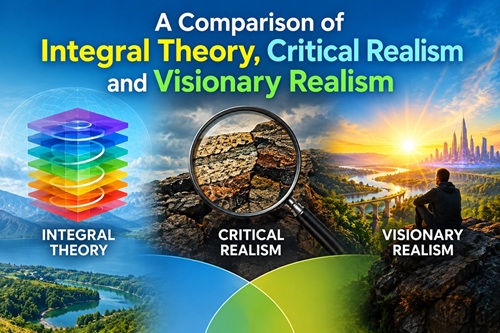 Nicholas Hedlund's Visionary Realism and the Emergence of a Eudaimonistic Society: Metatheory in a Time of Metacrisis [1] is an ambitious document. It is not merely another contribution to the enormous literature surrounding Ken Wilber's Integral Theory, nor simply another interpretation of Roy Bhaskar's Critical Realism. Hedlund is attempting something considerably more audacious: to construct a new metatheory out of the encounter between the two. The ambition is explicitly civilizational. Hedlund argues that humanity's overlapping ecological, political, psychological and cultural crises constitute a "metacrisis" requiring not merely better policies but better frameworks for understanding reality itself. Metatheory, in his account, can provide the intellectual scaffolding for the psycho-spiritual, cultural and social transformations needed to move toward a "eudaimonistic" or flourishing planetary society. His thesis therefore aims not simply to interpret the world but to contribute to its transformation. That makes Hedlund's project particularly interesting from an Integral World perspective. Because there is a fundamental question lurking underneath it: Does Visionary Realism actually solve the philosophical problems exposed by the encounter between Integral Theory and Critical Realism—or does it simply give those problems a more sophisticated vocabulary? My suspicion is the latter. Hedlund's work is serious, learned and considerably more philosophically self-conscious than much of the Integral literature. His critique of Wilber is often sharper than Wilber's own followers would be comfortable with. His insistence that Critical Realism and Integral Theory have genuine contradictions, absences and asymmetries is important. He explicitly rejects a simple "everything fits together" synthesis. Yet when the dust settles, Visionary Realism still seems to retain a remarkably strong appetite for the very thing that Critical Realism should make us suspicious of: a comprehensive account of reality that reaches from ontology through consciousness to spirituality and finally to the future of civilization. The visionary may simply have returned wearing a realist hat. From Critical Realist Integral Theory to Visionary RealismHedlund's intellectual journey is revealing. His earlier work sought something like a Critical Realist Integral Theory, or CRIT. The idea was straightforward enough: Integral Theory offered developmental and perspectival resources that Critical Realism lacked, while Critical Realism offered a more rigorous ontology and account of causation that Integral Theory needed. But Hedlund eventually became dissatisfied with the idea of simply combining the two. This is where his concept of non-preservative synthesis becomes important. He argues that a conventional synthesis can be too neat. A Hegelian or Wilberian synthesis may preserve the essential elements of both sides while claiming that their apparent contradictions have been transcended. Hedlund instead wants a more dialectical process in which contradictions and absences are allowed to transform the original frameworks themselves. He explicitly says that his research led him away from a "clean, symmetrical" synthesis toward an asymmetrical and dialectically negative one. It was this realization, he says, that made the label CRIT seem inadequate and led to the emergence of "visionary realism." This is an intellectually respectable move. It is also where the problem begins. Because one can ask whether the new synthesis is genuinely less metaphysical than the systems it supersedes—or merely metaphysical at a higher level. The Metatheory of MetatheoryHedlund's first great ambition is to rehabilitate metatheory itself. This is understandable. The fragmentation of academic knowledge is real. Climate change cannot be understood exclusively through climatology. Ecological collapse involves economics, politics, psychology, technology and culture. Artificial intelligence raises philosophical, social and economic questions simultaneously. The crises of liberal democracy, capitalism, meaning and ecological sustainability overlap in ways that make narrow disciplinary approaches inadequate. The problem is not recognizing this. The problem is what happens next. Once the inadequacy of fragmented knowledge has been established, there is a powerful temptation to conclude that what humanity needs is a sufficiently comprehensive metatheory. And now the metatheorist has acquired an almost impossible job: to see the relations between all the specialized domains that the specialists themselves cannot see. This is where Integral Theory has always been tempted to overreach. Hedlund is much more cautious. But he still describes metatheories as "deep causal codes" or "architectonic generator functions" of worldviews and socio-political orders. That is a remarkably strong claim. A metatheory is no longer merely a tool for comparing theories. It has become a causal force in civilization. And once that move is made, the metatheorist acquires enormous explanatory power. Perhaps too much. The Metatheory Can Explain EverythingThere is a recurring problem with grand explanatory systems. If every crisis can be interpreted as a manifestation of an underlying metacrisis, and every manifestation can be mapped across interior and exterior, individual and collective dimensions, developmental levels, cultural structures, psychological dynamics and deeper ontological conditions, then the framework becomes extraordinarily difficult to falsify. Everything fits. And a theory in which everything fits can become strangely empty. This is not an objection to complexity. Complex systems really are complex. It is an objection to the assumption that complexity automatically requires a single overarching interpretive framework. Sometimes the appropriate response to complexity is not synthesis but pluralism. Different sciences may offer genuinely different explanatory models because reality itself operates through multiple levels and mechanisms. The fact that climate science, economics and psychology all matter to climate politics does not imply that there must be one metatheory capable of generating all three. That additional step requires argument. Hedlund's Realism Is More Interesting Than Wilber'sTo be fair, Hedlund does something important that Wilber has often failed to do. He takes ontology seriously. Visionary Realism is not content merely to say that different perspectives disclose different worlds. Hedlund wants to defend a world that exists independently of our perspectives. His later formulation of visionary realism describes a cosmos of open systems containing deep structures, mechanisms, attractors and morphogenetic fields, with causal powers operating in both interior and exterior domains. He explicitly describes interiority as an ontologically real dimension rather than simply a subjective construction. This is a significant improvement over simplistic constructivism. But then another question immediately arises: Where did all these additional ontological entities come from? Critical Realism gives us mechanisms, structures, emergence and causal powers. • Why do we need morphogenetic fields? • Why attractors in the strong ontological sense? • Why "pandimensional realism"? • Why "transcendental evolutionary realism"? • Why "alethic resonance"? Some of these may ultimately prove useful. But each introduces another ontological commitment. And every additional ontological commitment carries a burden of justification. The Ontological Inflation ProblemThis is where Hedlund's project risks repeating the very movement we criticized in Wilber. First there is a valid observation. Interior experience is real. Then comes a legitimate philosophical conclusion. Interiority should not be reduced to subjective illusion. Then comes a stronger ontological conclusion. Interiority constitutes a genuinely emergent dimension of reality. Then another. Interior phenomena have causal powers. Then another. Those causal powers participate in evolutionary processes. And finally we arrive at a richly populated ontology containing morphogenetic fields, attractors, deep structures and evolutionary dynamics operating across interior and exterior domains. At every step, the language becomes more impressive. But the evidential burden also increases. The crucial question is therefore not whether the resulting ontology is coherent. It is: What evidence requires us to believe it? Interiority: Real Does Not Mean MysticalHedlund's discussion of interiority is perhaps the strongest and weakest aspect of the project simultaneously. He is entirely right to resist the crude equation: interior = merely subjective = unreal. Pain is interior, but it is real. A belief is interior, but beliefs can have enormous causal consequences. Intentions are interior, yet they can result in wars, marriages, scientific discoveries and political revolutions. Meanings are interior and intersubjective, but they organize institutions and civilizations. Critical Realism itself gives us ample resources for understanding such phenomena as real and causally efficacious. So why go further? Why does the recovery of the reality of interiority require a new science of spirituality? Why must consciousness and culture lead us toward a broader metaphysics of spiritual experience? Here Hedlund's later work becomes especially revealing. His 2025 Zygon article describes Visionary Realism as a framework for a "unified science of spiritual experience."[2] It combines Critical Realism and Integral Theory with William James's radical empiricism, Goethe's participatory epistemology and Rudolf Steiner's subtle empiricism. Hedlund argues for an expanded empiricism capable of investigating subjective, intersubjective and objective dimensions, and explicitly presents spirituality as a legitimate domain of scientific inquiry. This is where the project becomes much more controversial. From Interiority to SpiritualityThere is a perfectly respectable scientific project called the study of religious and spiritual experience. • Psychology can investigate meditation. • Neuroscience can investigate altered states. • Anthropology can investigate ritual. • History can investigate mystical traditions. • Sociology can investigate religious institutions. • Psychology can investigate the effects of contemplative practices. All of this is legitimate. But none of it requires the assumption that Spirit exists as an ontological dimension of reality. The distinction is crucial. A science of spiritual experience is possible without a metaphysics of Spirit. A science can study people's experiences of transcendence without confirming the metaphysical interpretation they attach to those experiences. This is precisely where Hedlund's realism may become less critical than advertised. The danger is that "interiority is real" quietly becomes: the contents and interpretations of interior experience disclose additional dimensions of reality. That conclusion does not follow. A dream is real as a dream. A mystical experience is real as an experience. An experience of cosmic unity is real as an experience. But the proposition "the cosmos is literally One" is an additional ontological claim. That claim requires independent evidence. The Steiner ProblemThe inclusion of Rudolf Steiner is therefore significant. Steiner developed an elaborate account of spiritual perception, supersensible realities and higher modes of cognition. Hedlund does not simply reproduce Steiner, of course. His project is explicitly more critical and seeks to bring subtle empiricism into dialogue with Critical Realism and other traditions. But the philosophical problem remains. Once subjective or participatory experience becomes an epistemic route to subtle reality, how do we distinguish genuine perception from culturally conditioned interpretation? The mystic says: "I experienced the divine." The Buddhist says: "I experienced emptiness." The Advaitin says: "I experienced Atman." The Christian says: "I encountered God." The shaman says: "I entered the spirit world." The psychedelic experiencer says: "I encountered entities." These experiences are all real as experiences. But they do not all support the same ontology. Indeed, their contradictory interpretations are precisely what should make a realist cautious. The question becomes: What independent procedures adjudicate between them? If the answer is "further subtle perception," we have a problem. The method has become its own validation. Alethic ResonanceHedlund's concept of alethic resonance is perhaps the most elegant—and most vulnerable—concept in Visionary Realism. The basic idea is attractive: our theories, institutions and worldviews should be more or less aligned with reality. Truth is not merely a correspondence between propositions and objects but an attunement to the real. Hedlund describes this as a way beyond both naïve realism and postmodern relativism. Knowledge can be situated and fallible while nevertheless achieving greater or lesser resonance with reality. Fine. But how do we measure resonance? This is the crucial question. If "resonance with reality" simply means that our theories successfully predict, explain and survive empirical testing, then we already have a perfectly respectable epistemology. We do not need the new term. If it means something more—an experiential, participatory or transformative attunement to deeper truth—then the concept becomes much more difficult to operationalize. And once again we face the possibility that a poetic metaphor is being promoted into an epistemological principle. The Return of the VisionaryThis may be the deepest irony in the entire project. Critical Realism emerged partly as a defense against the idea that reality can be reduced to experience or discourse. Integral Theory emerged partly as a defense against reductionism and fragmentation. Hedlund then combines them with traditions of radical empiricism, participatory epistemology and subtle empiricism. The result is called Visionary Realism. The name itself tells us something. Realism provides the epistemological discipline. Vision provides the enlarged horizon. But what prevents the vision from outrunning the realism? That is the question. The word "visionary" can mean imaginative and exploratory. It can also mean that one believes one has access to realities unavailable to ordinary perception. These are very different things. A critical philosophy should keep them rigorously apart. Transcendental Evolutionary RealismHedlund's treatment of evolution presents another difficulty. His visionary realist ontology describes evolution as an open, creative, emergent and participatory process. Importantly, he emphasizes contingency and explicitly rejects a simplistic deterministic trajectory. This is an improvement over Wilber's stronger cosmic-developmental rhetoric. Yet the phrase transcendental evolutionary realism remains suspiciously close to the kind of philosophical elevation of evolution that Integral Theory has historically favored. Evolution is indeed creative in the ordinary biological sense. • Natural selection generates novelty. • Developmental systems constrain evolutionary possibilities. • Organisms modify environments. • Ecological relationships feed back upon selection. • Evolutionary history is contingent. All of this gives us a fascinating, emergent and open-ended picture of life. But none of this establishes a transcendent direction to evolution. There is an enormous difference between: evolution is open-ended and evolution participates in a deeper evolutionary becoming. The latter may be philosophically suggestive. It is not thereby scientifically established. The Old Eros Problem ReturnsAnd here Hedlund's project encounters the same problem I have repeatedly raised with Wilber. What actually explains evolution? • If the answer is mutation, selection, drift, developmental constraint, ecological interaction, niche construction and related mechanisms, then these mechanisms do the explanatory work. • If "morphogenetic fields" or evolutionary attractors are additional causal realities, then we need evidence for them. • If they are metaphors for recurring patterns in complex systems, then they should be presented as such. • And if they are expressions of some deeper evolutionary tendency toward greater complexity, consciousness or integration, then we need to know what independent evidence distinguishes this claim from retrospective pattern recognition. Otherwise we have simply renamed the mystery. This is the recurring Integral temptation: Where science has not yet completely explained something, metaphysics supplies a deeper-sounding name for the unexplained remainder. Critical Realism should make us more—not less—suspicious of that procedure. The Metacrisis as a Metaphysical OpportunityThere is another feature of Hedlund's thesis that deserves criticism. The metacrisis is treated not merely as a political or ecological predicament but as a crisis in humanity's underlying worldview. This is plausible. But it can easily become circular. We are in crisis because our worldviews are inadequate. Our worldviews are inadequate because they fail to align with reality. Visionary Realism provides a more adequate worldview. Therefore Visionary Realism provides part of the solution to the crisis. But how do we know Visionary Realism is more adequate? • Because it is more comprehensive? • Because it integrates more perspectives? • Because it incorporates Critical Realism? • Because it recognizes interiority? • Because it offers a deeper ontology? • Because it provides a more meaningful vision of human flourishing? These are not the same thing. A worldview can be more comprehensive and still be false. It can be more inspiring and still be false. It can be psychologically transformative and still be false. It can integrate more perspectives and still be false. That is the point where realism must discipline vision. Eudaimonia and the Good SocietyHedlund's ultimate goal is not merely theoretical. He wants a flourishing planetary society. This gives the project moral seriousness. But it also creates another epistemological danger. Once a theory has a preferred vision of the good society, there is a temptation to interpret the theory as simultaneously describing reality and prescribing where humanity should go. The boundary between ontology and normativity begins to blur. Reality tells us what is. Ethics tells us what ought to be. Political philosophy tells us what institutions might move us from the former toward the latter. These relationships are enormously complicated. But no metatheory gets to derive the good society simply from its ontology. "Eudaimonia" is a normative ideal. It may be an excellent one. But realism does not establish it. We still need ethical argument, political deliberation and empirical experimentation. The Most Interesting Achievement of Visionary RealismDespite all these criticisms, Hedlund has achieved something genuinely valuable. He has made the Integral-Critical Realist dialogue considerably more intellectually interesting. Rather than simply adding Critical Realism to AQAL, he asks what happens when the two frameworks expose one another's weaknesses. He recognizes that Critical Realism can be insufficiently attentive to interiority, consciousness and developmental transformation. He also recognizes that Integral Theory requires a more serious ontology and a more rigorous account of causal depth. And unlike many Integral writers, he acknowledges that the two traditions are not simply harmonious. His thesis explicitly emphasizes contradictions, absences, aporias and incommensurabilities. That is real philosophical progress. But the next step is the difficult one. After criticizing both systems, why should we believe the resulting synthesis? The Infinite Regression of MetatheoryThere is a potentially comic problem lurking here. Integral Theory integrates many theories. Critical Realism critiques theories of knowledge and reality. Visionary Realism integrates Critical Realism and Integral Theory. What comes next? A meta-visionary realism that integrates Visionary Realism with another critique? And then a meta-meta-visionary realism? At some point the intellectual enterprise becomes self-referential. The answer cannot always be: We need a still more comprehensive framework. Sometimes we need less theory and more investigation. Less ontology and more evidence. Less synthesis and more discrimination. Less metatheory and more science. Less speculation about the architecture of reality and more humility about what we actually know. What Would Make Visionary Realism Stronger?The irony is that Hedlund's own Critical Realist commitments point toward the remedy. Visionary Realism should make fewer ontological claims, not more. • Where interiority can be studied empirically, study it. • Where spiritual practices produce measurable psychological or physiological effects, investigate them. • Where cultural patterns produce predictable social consequences, model them. • Where developmental theories make predictions, test them. • Where evolutionary processes are proposed, identify mechanisms. • Where morphogenetic fields are claimed, specify what observations would confirm or disconfirm them. • Where "alethic resonance" is invoked, define criteria by which greater resonance can be distinguished from greater subjective conviction. • And where spiritual experiences are interpreted metaphysically, separate the experience from the interpretation. This would transform Visionary Realism from a grand metaphysical synthesis into something potentially much more interesting: a research program. From Visionary Philosophy to Visionary ScienceThat distinction matters. A philosophy can legitimately ask what kinds of entities might exist. A science must provide methods for finding out. A philosophy can propose that interiority is ontologically real. A science must investigate its structures, mechanisms and relations. A philosopher can argue that spiritual experience deserves serious attention. A scientist must still ask what observations distinguish competing interpretations of those experiences. This is where Visionary Realism could become genuinely innovative. But it requires resisting the temptation to treat the philosophical possibility of a claim as evidence for its truth. The Final Reality CheckNicholas Hedlund's Visionary Realism is therefore an intriguing development in the long story of Integral Theory. • It represents a maturation of the Integral-Critical Realist dialogue. • It is more self-critical than standard Wilberian Integral Theory. • It is more attentive to interiority than conventional Critical Realism. • It takes ontology more seriously than much post-metaphysical Integral writing. • And it recognizes that the two traditions cannot simply be pasted together without transformation. But its greatest strength also points toward its greatest danger. Hedlund wants a framework capable of integrating ontology, epistemology, science, spirituality, evolution, consciousness, culture and civilizational transformation. That is precisely the kind of ambition that should make a Critical Realist nervous. Because the more territory a theory claims to cover, the more opportunities it has to turn speculation into ontology. The problem is not that Visionary Realism is too visionary. The problem is that vision has to earn its realism. • The fact that an idea is profound does not make it true. • The fact that it integrates many perspectives does not make it true. • The fact that it offers a compelling response to the metacrisis does not make it true. • The fact that it gives meaning to spiritual experience does not make its metaphysical interpretation true. • And the fact that it emerges from Critical Realism does not automatically confer the epistemic discipline of Critical Realism upon everything it subsequently proposes. That is the ultimate challenge for Hedlund. Critical Realism taught us to distinguish reality from our descriptions of it. Integral Theory taught us to notice how much our descriptions depend upon perspective. Visionary Realism now tries to bring the two together. The danger is that, in the process, it may once again construct a magnificent description of reality—and then quietly mistake the magnificence of the description for evidence that it has reached the real. That would be the oldest mistake in metaphysics. And the most interesting test of Visionary Realism will be whether it can resist it. NOTES[1] Nicholas Hancock Hedlund, "Visionary Realism and the Emergence of a Eudaimonistic Society: Metatheory in a Time of Metacrisis", Thesis Submitted in Fulfilment of the Requirements for the Degree of Doctor of Philosophy, UCL Institute of Education, University College London, 2021. [2] Nicholas Hedlund, "Toward a Unified Science of Spiritual Experience, Visionary Realism and the Ontology of Interiority: Philosophical Commentary on Chatlos's Framework of Spirituality", Zygon, Volume 59, Issue 4, December 2024.
Widget is loading comments...
|