|
TRANSLATE THIS ARTICLE
Integral World: Exploring Theories of Everything
An independent forum for a critical discussion of the integral philosophy of Ken Wilber
  Frank Visser, graduated as a psychologist of culture and religion, founded IntegralWorld in 1997. He worked as production manager for various publishing houses and as service manager for various internet companies and lives in Amsterdam. Books: Ken Wilber: Thought as Passion (SUNY, 2003), and The Corona Conspiracy: Combatting Disinformation about the Coronavirus (Kindle, 2020). Frank Visser, graduated as a psychologist of culture and religion, founded IntegralWorld in 1997. He worked as production manager for various publishing houses and as service manager for various internet companies and lives in Amsterdam. Books: Ken Wilber: Thought as Passion (SUNY, 2003), and The Corona Conspiracy: Combatting Disinformation about the Coronavirus (Kindle, 2020).
Check out my other conversations with ChatGPT
IAM INITIATIVES:
Big-Picture Thinking for a Fragmented World The Institutional Ambition: Natural Philosophy 2.0 Framework for Evaluating and Improving Worldviews The New Story of Wholeness, A Critical Review From Metatheory to Meta-Metatheory Gameplan For An Integrative Metatheory 2.0 Worldview Research or Evolutionary Prophecy? The Great Meaning Rescue, A Skeptical IAM Review What IAM Can Learn from Integral Institute From Metatheory to Meta-MetatheoryCan Integrative Metatheory 2.0 Ever Become a Coherent Worldview?Frank Visser / ChatGPT
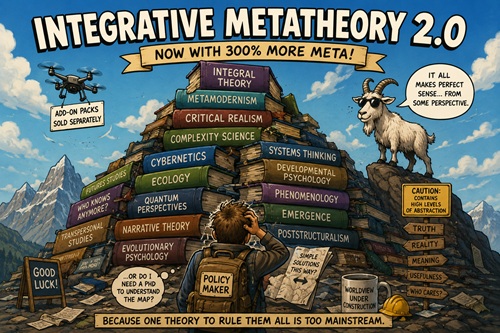 In a recent essay we reviewed a new iniative from the Intitute of Applied Metatheory, as presented by Robb Smith, Nick Hedlund and Brendan Graham Dempsey. The ambition of this "Integrative Metatheory 2.0" is both understandable and admirable. In a fragmented intellectual landscape, where disciplines, ideologies, and explanatory frameworks often speak past one another, the desire to create a larger integrative framework has obvious appeal. Why not combine the strengths of Integral Theory, metamodernism, critical realism, complexity science, systems thinking, developmental psychology, and other approaches into a more comprehensive synthesis? Yet this ambition raises an important question: at what point does a metatheory become so inclusive that it ceases to function as a metatheory and instead becomes a meta-metatheory—a framework designed not merely to integrate knowledge domains, but to integrate other integrative frameworks? The distinction is crucial. It determines whether such a project can realistically become a coherent worldview capable of guiding policy makers, or whether it risks becoming an endlessly expanding architecture of abstraction. The Metatheoretical Inflation ProblemClassical metatheories emerged to address limitations within specific fields. For example, systems theory attempted to reveal patterns common to diverse phenomena. Developmental theories sought principles governing growth across domains. Integral Theory attempted to coordinate multiple perspectives into a single framework. These approaches operated one level above ordinary theories. Integrative Metatheory 2.0 appears to move yet another level upward. Rather than integrating disciplines directly, it seeks to integrate frameworks that already integrate disciplines: • Integral Theory integrates knowledge domains. • Metamodernism integrates cultural narratives. • Critical Realism integrates ontology and epistemology. • Complexity Science integrates nonlinear systems behavior. • Developmental theories integrate models of growth. The result is not simply a metatheory but a metatheory of metatheories. This creates a recursive challenge. Every new framework added to the synthesis potentially introduces assumptions that conflict with those already present. The integration itself therefore becomes the primary object of study. Instead of answering substantive questions, the framework increasingly focuses on managing relationships between frameworks. The map becomes a map of maps. The Hidden TensionsThe difficulty is not merely one of complexity but of incompatibility. Consider several examples. Integral Theory traditionally assumes developmental hierarchies and vertical stages of consciousness. Metamodernism often emphasizes oscillation, ambiguity, and irreducible plurality. Critical Realism argues for a mind-independent reality structured by causal mechanisms. Some strands of Integral thought move toward idealism or spiritual ontologies that challenge straightforward realism. Complexity science often emphasizes emergent unpredictability, while developmental theories frequently assume identifiable directional trajectories. These tensions need not be fatal. Productive dialogue is possible. The problem arises when one attempts to present all these perspectives as components of a single coherent worldview. A toolbox can contain contradictory tools. A worldview cannot. At some point, choices must be made about ontology, epistemology, causality, development, and value. Without such choices, the framework remains a collection of perspectives rather than an integrated perspective. The Difference Between a Framework and a WorldviewThis distinction is often overlooked. A framework helps people analyze situations. A worldview helps people decide what is true. Policy makers ultimately require the latter. When governments face decisions regarding climate change, migration, economic development, biotechnology, or military conflict, they cannot operate indefinitely at the level of "multiple perspectives." They eventually need answers to practical questions: • What constitutes evidence? • Which causal explanations are most reliable? • Which values should be prioritized? • How should competing interests be weighed? • What outcomes count as success? A metatheory may help illuminate these questions. It cannot avoid them. Consequently, every practical application of Integrative Metatheory 2.0 would require simplification. Decision makers would inevitably extract specific principles while leaving much of the theoretical architecture behind. The richer the metatheory becomes, the greater this translation challenge becomes. The Policy Maker's DilemmaPolicy makers generally do not seek comprehensive philosophical systems. They seek actionable heuristics. Historically, successful policy frameworks have tended to be relatively simple. Economic liberalism, social democracy, evidence-based policymaking, systems thinking, and public health frameworks all gained influence because they translated complex knowledge into operational principles. The challenge facing Integrative Metatheory 2.0 is therefore not merely intellectual coherence but practical usability. Imagine presenting a minister with a framework incorporating: • developmental stages, • quadrants, • complexity dynamics, • metamodern oscillations, • critical realist stratification, • systems loops, • multiple epistemologies, • cultural narratives, • stakeholder perspectives, • and emergent futures. The immediate reaction is likely to be admiration followed by paralysis. The framework risks becoming descriptively rich but operationally weak. The Specter of Integral TheoryThis challenge is not new. Integral Theory itself aspired to become a universal framework for understanding reality. Its great strength was its integrative ambition. Its great weakness was the tendency toward theoretical expansion. Whenever anomalies appeared, additional distinctions, levels, lines, states, quadrants, perspectives, altitudes, and dimensions were introduced. The result was extraordinary comprehensiveness but declining falsifiability. Critics frequently argued that the theory became increasingly difficult to challenge because it could absorb almost any criticism into its expanding architecture. Integrative Metatheory 2.0 may face a similar danger. If every promising framework is incorporated into the synthesis, the result may become increasingly inclusive but increasingly difficult to define. The framework becomes more accommodating while becoming less distinctive. Toward a Functional PluralismPerhaps the most realistic future for Integrative Metatheory 2.0 is not as a worldview but as a meta-framework. This would require abandoning the dream of a grand synthesis in favor of what might be called functional pluralism. In this model, the framework does not claim to provide a single overarching account of reality. Instead, it serves as a navigation system for selecting appropriate lenses under different conditions. The goal shifts from unification to coordination. Different frameworks become tools rather than truths. Critical realism might be useful for analyzing causal mechanisms. Complexity science might illuminate emergent behavior. Developmental theories might help understand learning and organizational growth. Metamodernism might offer insight into cultural dynamics. Integral Theory might provide a vocabulary for perspective-taking. Such a system could be enormously valuable. But it would no longer function as a worldview in the traditional sense. It would function as an intellectual operating system. Conclusion: The Dream of Integration Meets the Limits of CoherenceThe IAM Institute's Integrative Metatheory 2.0 represents the latest stage in a long tradition of integrative thinking. Yet by attempting to integrate already integrative frameworks, it effectively moves into the realm of meta-metatheory. This shift creates both opportunities and dangers. The opportunity is unprecedented intellectual breadth. The danger is theoretical inflation: a framework so comprehensive that it struggles to maintain coherence, explanatory power, and practical applicability. Whether Integrative Metatheory 2.0 succeeds may ultimately depend on abandoning the quest for a single unified worldview. The future may belong not to a master narrative that subsumes all others, but to a disciplined pluralism that helps people navigate among competing narratives without claiming to transcend them completely. Ironically, the highest form of integration may not be the construction of an ever-larger synthesis, but the recognition that no synthesis can permanently escape the diversity it seeks to contain. In that sense, Integrative Metatheory 2.0 may be less the culmination of metatheory than the point at which metatheory discovers its own limits. Appendix: A Historical Test Case — The Integral Theory Conference of 2013If one wants a real-world test of whether multiple metatheories can be integrated into a coherent worldview, the 2013 Integral Theory Conference provides a fascinating case study. The conference brought together three towering integrative thinkers: Ken Wilber, Roy Bhaskar, and Edgar Morin. In retrospect, it almost reads like a prototype of today's Integrative Metatheory 2.0 ambitions. Here were three intellectual projects, each seeking to overcome fragmentation and provide a more comprehensive understanding of reality. On paper, the convergence seemed ideal. Wilber offered an overarching developmental and perspectival framework. Bhaskar provided a sophisticated realist ontology capable of grounding science while acknowledging social construction and human agency. Morin contributed a deep appreciation of complexity, emergence, uncertainty, and the limitations of reductionist thinking. If any gathering could demonstrate the possibility of a grand synthesis, this was it. Yet the outcome was more ambiguous. Parallel Monologues Rather Than SynthesisThe conference succeeded in creating dialogue and mutual recognition. Participants generally acknowledged that they were engaged in related projects aimed at transcending disciplinary silos. What did not emerge was a genuine theoretical synthesis. The reason is instructive. Each thinker occupied a different philosophical center of gravity. Wilber's system remained fundamentally developmental and consciousness-oriented. Bhaskar's project remained fundamentally ontological, concerned with the stratified nature of reality and causal mechanisms. Morin's approach remained fundamentally complexity-centered, emphasizing uncertainty, recursion, and the impossibility of totalizing knowledge. The overlap was real. The integration was limited. Instead of converging toward a single framework, the three approaches largely retained their distinct identities. The Missing Common LanguageThe deeper problem was not disagreement but incommensurability. Each framework had developed its own: • conceptual vocabulary, • explanatory priorities, • philosophical assumptions, • criteria of adequacy. This is precisely the challenge facing Integrative Metatheory 2.0 today. The more sophisticated a metatheory becomes, the more difficult it becomes to integrate with other sophisticated metatheories. A biologist, an economist, and a sociologist can often collaborate because they are studying a shared reality. Three metatheorists face a harder task because they are attempting to integrate different maps of reality. The conversation therefore shifts one level upward, from reality itself to competing frameworks for understanding reality. Bhaskar's CautionPerhaps the most revealing aspect concerns Bhaskar's relationship to Integral Theory. Although Bhaskar appreciated aspects of Wilber's work, he never simply folded Critical Realism into the AQAL framework. He regarded Critical Realism as possessing a rigorously developed ontology that could not simply be absorbed into a larger integrative architecture. In effect, Bhaskar was saying: integration requires philosophical justification, not merely inclusion. This distinction is crucial. A genuine synthesis must resolve tensions. A loose integration merely places different perspectives side by side. Morin's AlternativeMorin's perspective introduced another complication. His complexity thinking often stressed irreducible uncertainty and the limits of comprehensive systems. This creates a paradox for every grand integrative project. The more one understands complexity, the less plausible complete integration appears. Morin's work can therefore be read as both supporting and undermining integrative ambitions. It supports integration as an aspiration. It undermines integration as a final achievement. Lessons for Integrative Metatheory 2.0The 2013 conference did not fail. It succeeded as a dialogue among major integrative thinkers. What it did not produce was a unified worldview. Thirteen years later, that fact may be more significant than any temporary agreements reached at the event. The conference demonstrated that bringing metatheories together is relatively easy. Creating a coherent synthesis of those metatheories is extraordinarily difficult. In this sense, the conference serves as a historical preview of the challenges facing Integrative Metatheory 2.0. The organizers of today's initiative may believe they are building the next stage of integration. Perhaps they are. But the experience of Wilber, Bhaskar, and Morin suggests that integration becomes progressively harder at each higher level of abstraction. The first metatheory integrates disciplines. The second integrates metatheories. The third begins to integrate integrations. At that point, one risks approaching what might be called "metatheoretical escape velocity"—a level of abstraction so high that the framework becomes increasingly detached from the practical and empirical realities it originally sought to illuminate. The 2013 conference therefore stands as both an inspiration and a warning: inspiration because dialogue across frameworks is possible, and warning because dialogue alone is not yet synthesis. The distance between the two might be far greater than integrative thinkers often assume
Widget is loading comments...
|