|
TRANSLATE THIS ARTICLE
Integral World: Exploring Theories of Everything
An independent forum for a critical discussion of the integral philosophy of Ken Wilber
  Frank Visser, graduated as a psychologist of culture and religion, founded IntegralWorld in 1997. He worked as production manager for various publishing houses and as service manager for various internet companies and lives in Amsterdam. Books: Ken Wilber: Thought as Passion (SUNY, 2003), and The Corona Conspiracy: Combatting Disinformation about the Coronavirus (Kindle, 2020). Frank Visser, graduated as a psychologist of culture and religion, founded IntegralWorld in 1997. He worked as production manager for various publishing houses and as service manager for various internet companies and lives in Amsterdam. Books: Ken Wilber: Thought as Passion (SUNY, 2003), and The Corona Conspiracy: Combatting Disinformation about the Coronavirus (Kindle, 2020).
Check out my other conversations with ChatGPT The Institutional Ambition: Natural Philosophy 2.0Frank Visser / ChatGPT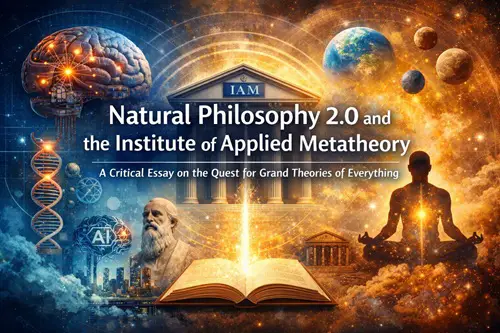 A striking aspect of the Extended Naturalism project is that it is not presented merely as a philosophical proposal but as part of an organized intellectual movement. Much of the conceptual architecture discussed in the article is connected to the work of the Institute of Applied Metatheory (IAM), a research organization that aims to develop what it calls “Natural Philosophy 2.0.” This institutional context deserves critical examination, because it reveals both the ambition and the potential pitfalls of the project. The Vision of Natural Philosophy 2.0The IAM's stated goal is to reconstruct the classical project of natural philosophy—the unified study of reality that historically encompassed physics, biology, psychology, and philosophy before these disciplines separated in the nineteenth century. According to the IAM, the fragmentation of modern knowledge has produced several problems: • psychology lacks a coherent theoretical foundation • philosophy of mind is trapped in endless metaphysical debates • scientific disciplines operate with incompatible conceptual frameworks • meaning, value, and consciousness remain marginal in scientific explanations. “Natural Philosophy 2.0” is proposed as a comprehensive integrative framework capable of addressing these issues. Extended Naturalism, the Tree of Knowledge ontology, and related conceptual tools are intended to form the backbone of this reconstructed worldview. In this sense, the project is not simply academic theorizing; it is a meta-scientific reform initiative aimed at reorganizing the intellectual landscape. Echoes of Earlier Grand SynthesesAmbitions of this scale inevitably invite comparison with earlier attempts to construct universal philosophical systems. Historically, many thinkers have attempted to unify knowledge into a single framework—from Hegelian idealism to twentieth-century cybernetics and systems theory. In the contemporary intellectual environment, the most obvious parallel lies in the integrative ambitions of figures such as Ken Wilber, whose Integral Theory similarly seeks to synthesize science, psychology, and spirituality into a comprehensive worldview. These large-scale frameworks often share several characteristics: • a layered model of reality • a conceptual map integrating multiple disciplines • an institutional or movement-building dimension • a rhetoric of overcoming fragmentation in modern knowledge. Extended Naturalism and Natural Philosophy 2.0 fit comfortably within this tradition of grand integrative projects. The Risk of Conceptual Empire-BuildingThe difficulty with such projects is not their ambition but their methodological vulnerability. When a framework attempts to reorganize the entire landscape of knowledge, it often risks drifting into what might be called conceptual empire-building. New terminologies proliferate, theoretical maps expand, and intellectual territories are claimed faster than they can be empirically justified. The IAM framework already contains numerous conceptual components: • the Tree of Knowledge ontology • the Map of Mind • the Periodic Table of Behaviors • Recursive Relevance Realization • Extended Naturalism itself. Each of these ideas may have value individually, but taken together they produce a system whose complexity raises a critical question: Does the framework clarify scientific problems, or does it primarily reorganize them within an elaborate conceptual architecture? Without strong empirical anchoring, large integrative systems risk becoming meta-theoretical overlays rather than explanatory advances. The Institutionalization of MetatheoryAnother issue concerns the institutional framing of the project. By establishing a dedicated research institute and promoting the language of Natural Philosophy 2.0, the IAM effectively positions itself as the center of a new intellectual paradigm. While there is nothing inherently wrong with this strategy, it can sometimes encourage a self-reinforcing intellectual ecosystem. In such environments: • conceptual frameworks become identity markers for the community • internal coherence is prioritized over external critique • the project's scope gradually expands to absorb additional disciplines. The history of intellectual movements shows that this dynamic can produce impressive theoretical edifices—but not necessarily lasting scientific breakthroughs. A Productive Program or a Grand Narrative?The central question, therefore, is whether Natural Philosophy 2.0 represents: • a genuinely productive research program, capable of generating testable hypotheses and empirical discoveries, or • a grand narrative about knowledge, whose primary achievement lies in conceptual synthesis rather than scientific advancement. At present, Extended Naturalism appears closer to the second category. The framework provides an impressive philosophical map of reality, but it remains unclear how this map translates into concrete scientific progress. Conclusion: Ambition Meets Epistemic DisciplineThe vision of Natural Philosophy 2.0 reflects a genuine and understandable aspiration. Many scholars recognize that contemporary knowledge is fragmented and that deeper integration between disciplines would be valuable. However, history suggests that successful intellectual synthesis usually emerges after major empirical discoveries, not before them. Grand frameworks built in advance of such discoveries often risk becoming speculative architectures that struggle to maintain explanatory traction. Extended Naturalism and the work of the Institute of Applied Metatheory therefore stand at a crossroads. The project could evolve into a useful metatheoretical toolkit that helps coordinate interdisciplinary research. Alternatively, it could join the long lineage of ambitious but ultimately self-contained philosophical systems. The difference will depend less on the elegance of its conceptual maps than on whether Natural Philosophy 2.0 produces insights that working scientists actually find indispensable.
Comment Form is loading comments...
|