|
TRANSLATE THIS ARTICLE
Integral World: Exploring Theories of Everything
An independent forum for a critical discussion of the integral philosophy of Ken Wilber
  Frank Visser, graduated as a psychologist of culture and religion, founded IntegralWorld in 1997. He worked as production manager for various publishing houses and as service manager for various internet companies and lives in Amsterdam. Books: Ken Wilber: Thought as Passion (SUNY, 2003), and The Corona Conspiracy: Combatting Disinformation about the Coronavirus (Kindle, 2020). Frank Visser, graduated as a psychologist of culture and religion, founded IntegralWorld in 1997. He worked as production manager for various publishing houses and as service manager for various internet companies and lives in Amsterdam. Books: Ken Wilber: Thought as Passion (SUNY, 2003), and The Corona Conspiracy: Combatting Disinformation about the Coronavirus (Kindle, 2020).
Check out my other conversations with ChatGPT
The Heron-Wilber Clash
When Integral Dialogue Became a Duel The philosophical issue beneath the quarrel When AI Enters the Argument Can AI Be More Integral Than Integral Theory? Profile: John Heron and the Sacred Science of Participation John Heron and the Sacred Science of ParticipationA critical examination of participatory spirituality, experiential inquiry and the 'Divine Many'Frank Visser / ChatGPT
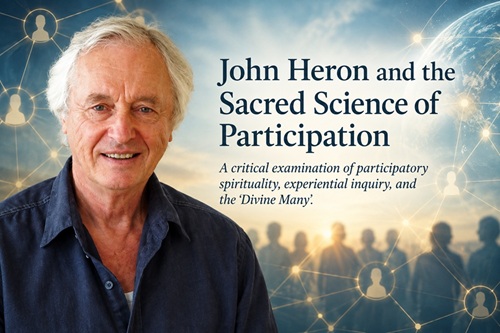 John Heron (1928-2022) occupies an unusual place in the history of transpersonal psychology. He was not simply another advocate of mysticism, nor was he a conventional academic psychologist who happened to take an interest in spirituality. He wanted to reconstruct spiritual inquiry itself. His central proposal was that human beings should cease surrendering spiritual authority to churches, gurus, scriptures and inherited traditions, and instead become active co-researchers of their own experience. His method of co-operative inquiry attempted to turn the people being studied into participants in the research process rather than passive objects of investigation. That is a genuinely interesting idea. It is also where the problems begin. Heron's Sacred Science: Person-centred Inquiry into the Spiritual and the Subtle (1998) is an ambitious attempt to establish a new kind of spirituality based upon experiential inquiry, participatory knowing and what he called the authority within. He wanted a spirituality that was democratic rather than authoritarian, experimental rather than dogmatic, contemporary rather than imprisoned by ancient metaphysical systems. Yet the extraordinary thing about Sacred Science is that Heron's critique of spiritual authority ultimately leads him toward a remarkably elaborate spiritual ontology of his own. The question, therefore, is not whether Heron was an interesting thinker. He clearly was. The more difficult question is whether his methodology actually warrants his metaphysics. From humanistic psychology to sacred inquiryHeron's career began in humanistic and experiential psychology. He founded the Human Potential Research Project at the University of Surrey in 1970 and later developed co-operative inquiry as a method for researching human experience collaboratively. By the 1990s this had developed into an explicitly spiritual project. He established an International Centre for Co-operative Inquiry in Tuscany and conducted inquiries into transpersonal and subtle experience. Sacred Science was the culmination of this phase. The basic insight behind co-operative inquiry deserves to be taken seriously. Conventional scientific research tends to separate observer and observed. Heron argued that this division becomes problematic when the subject matter is lived human experience. If we want to investigate love, grief, meditation, creativity, interpersonal encounter or spiritual experience, the investigator is already involved in the phenomenon being investigated. His alternative was participatory. People could alternate between the roles of researcher and researched, reflect upon their experience, compare observations, formulate propositions and return to experience to test those propositions. Heron and Peter Reason later described this as an expanded epistemology involving experiential, presentational, propositional and practical knowing. There is something valuable here. Experience should not automatically be dismissed simply because it is subjective. Human beings learn through participation. And a psychology that treats people merely as laboratory objects can certainly become impoverished. But a methodological insight about how people can investigate their experience does not automatically establish what the experience ultimately means. That distinction becomes increasingly blurred in Heron's spiritual work. The authority withinHeron's rebellion against external spiritual authority is one of the most attractive features of Sacred Science. He argues that spiritual traditions should be secondary resources rather than unquestionable authorities. The individual must eventually withdraw the projection of inner authority onto teachers, texts and institutions. Spiritual inquiry requires an "internal monitor" capable of making spiritual distinctions. This is an admirable antidote to guru worship. But there is an obvious epistemological problem. If the authority within is itself treated as a source of spiritual truth, how do we distinguish genuine insight from compelling personal interpretation? Heron's answer is dialogue, reflection, co-operative inquiry and discriminating judgment. That helps. But it does not solve the deeper problem. A group of sincere people can compare experiences without thereby establishing that their interpretation of those experiences is metaphysically correct. There is a crucial difference between: This experience is real and meaningful to me. and: This experience reveals how reality is constituted. The first is almost unassailable. The second requires evidence of another kind. Heron sometimes moves too quickly from the first to the second. When "science" becomes sacredThe title Sacred Science is revealing. Heron does not simply want spirituality to become more disciplined. He wants a form of inquiry capable of taking spiritual and "subtle" phenomena seriously without prematurely reducing them to psychology. The book explicitly explores purported extrasensory capacities, subtle energies, post-death realms, guides and other spiritual or psychical phenomena. This is where the word science becomes problematic. Science is not defined merely by being open-minded, participatory or experiential. Its distinctive strength lies in methods for distinguishing what is experienced from what is inferred, what appears to happen from what actually happens, and what one investigator believes from what can be independently demonstrated. Heron's project sometimes risks turning openness into an epistemological virtue in itself. But openness is the beginning of inquiry, not its conclusion. Suppose several people independently report encountering a deceased person during an altered state. That is an interesting phenomenon. It deserves investigation. But the report does not by itself establish that deceased persons exist as independent entities in another realm. The same problem occurs with telepathy, subtle energies, spiritual presences and mystical states. There are at least three possible interpretations: the experience may correspond to an external reality; it may be generated internally; or some combination of internal and external processes may be involved. Participatory inquiry can investigate the experience. It cannot simply decide the ontology. This is precisely where Heron's "sacred science" risks becoming science by aspiration rather than science by demonstration. The problem of the subtleHeron was unusually willing, compared with many spiritual traditions, to take psychical phenomena seriously. He criticized approaches that simply dismiss them, psychologize them, ignore them or demonize them. His position was essentially that they should become objects of disciplined inquiry. The first half of this argument is entirely reasonable. Why automatically dismiss unusual experiences? But the second step is much more demanding. If something is to be treated as evidence for a new layer of reality, we need criteria that can discriminate that interpretation from its competitors. Heron's framework occasionally seems to give the phenomenon the benefit of the doubt. Yet extraordinary claims require particularly careful controls precisely because human beings are extraordinarily good at finding patterns, attributing agency and constructing meaning. This creates an ironic tension in Heron's project. He wants to liberate spirituality from authoritarian tradition, but he can end up replacing traditional authority with experiential authority. The scripture says so. The guru says so. The mystical experience says so. Heron's answer is: inquire for yourself. That is an improvement—but "I experienced it" is still not equivalent to "therefore it exists independently of me." Heron against perennial philosophyOne of Heron's most important targets was the perennial philosophy—the idea that the world's mystical traditions express a common underlying spiritual truth. He regarded this as an attempt to impose ancient metaphysical categories upon contemporary spiritual development. He compared the attempt to preserve a perennial philosophy to trying to constrain modern chemistry by the principles of alchemy. Here Heron is particularly relevant to the critique of Ken Wilber. Wilber constructed an enormous synthesis of mystical traditions, developmental psychology, evolutionary theory and modern science. Heron thought this synthesis repeatedly elevated inherited spiritual interpretations into universal truths. His objection is powerful: why should the testimony of ancient mystics be treated as privileged evidence about the structure of reality? Mystics may have profound experiences. But profound experiences do not come with their own instruction manual. Two mystics can have experiences of unity, emptiness, God, Brahman, divine presence or cosmic consciousness and interpret them in radically different ways. The experience does not necessarily adjudicate between the metaphysical interpretations subsequently placed upon it. Heron understood this problem better than many transpersonal thinkers. Yet he did not escape it. The Divine ManyHeron's disagreement with Wilber eventually became a much deeper philosophical confrontation. At stake was not merely developmental psychology but the status of individual persons. Wilber's nondualism gives ultimate priority to the One: apparent multiplicity arises within, and is not ultimately separate from, Spirit. Heron objected that this could reduce genuine persons to temporary expressions of an ultimate unity. His alternative was the "divine Many"—distinct persons participating within a larger divine reality. This is arguably Heron's most interesting philosophical contribution. He distinguishes separateness from distinctness. A person need not be an isolated Cartesian ego in order to be genuinely distinct. We can be relational beings without being dissolved into an impersonal One. That position has considerable intuitive appeal. But once again, the metaphysical question returns. Why should there be a divine Many? Why should individual persons possess an intrinsic divine status? Why should reality be understood as God participating with God? Heron writes that the human inquirer is one of the divine Many and is "intrinsically saturated with divinity." That is a fascinating theological proposal. But it remains a theological proposal. The participatory method does not establish it. The hidden metaphysics of anti-authoritarianismThis may be the central paradox of Heron's work. He wants to democratize spirituality. He wants everyone to become an investigator. He wants spiritual authority to reside within the person rather than above the person. He wants living inquiry rather than frozen doctrine. But the moment he says that persons are intrinsically divine, that reality is participatory, that there is a divine Many, that subtle realms may exist and that human beings can enter into communion with them, he has constructed a metaphysical framework that itself requires justification. The anti-authoritarian spirituality therefore develops its own vocabulary of authority. It is no longer: The Church says... or: The Guru says... but: Participatory inquiry reveals... The epistemological danger has merely changed its clothing. This does not make Heron's ideas worthless. It means that his strongest contribution may lie considerably closer to the methodological than to the metaphysical level. What co-operative inquiry can—and cannot—doImagine a group of ten people investigating meditation. They meditate together. They record their experiences. They compare notes. They identify recurring patterns. They develop hypotheses. They alter their practices. They investigate again. This could produce genuinely valuable knowledge. We might discover that certain practices reliably produce particular psychological states. We might discover interpersonal effects. We might identify changes in attention, emotion, bodily awareness or sense of self. But suppose the group concludes that these experiences demonstrate contact with a universal consciousness. That is a further inference. And suppose another group concludes that the same experiences reveal the Buddhist doctrine of emptiness. A third group interprets them neurologically. A fourth interprets them through Jungian psychology. The experiential data alone do not necessarily decide between these frameworks. This is the point at which a participatory epistemology needs the very thing Heron sometimes distrusts: external checks. Controlled experiments. Replication. Independent observers. Competing hypotheses. Statistical analysis. Attempts at falsification. And, above all, a willingness to discover that one's preferred metaphysical explanation is wrong. Without those safeguards, participation can become an echo chamber of mutually reinforcing interpretation. Heron's great strength—and his great weaknessThere is something admirable about Heron's refusal to choose between two simplistic alternatives: either mystical experience is infallible revelation, or it is meaningless nonsense. He occupies the interesting middle territory. Experience matters. Interpretation matters. Relationships matter. The investigator is part of the investigation. Spiritual traditions should be interrogated rather than worshipped. These are valuable principles. But Heron occasionally seems unwilling to apply the same radical skepticism to the metaphysical conclusions emerging from his own inquiry. This is especially striking because his critique of Wilber is often epistemologically devastating. In his famous "A Way Out for Wilberians," Heron attacked Wilber's accounts of the Atman project, evolution, mystical knowledge, meditation, cross-cultural consensus, the nondual and several other elements of his system. He characterized Wilber's framework as making very large claims on what Heron regarded as inadequate grounds. The criticism could almost be turned back upon Heron: What are the grounds for the claims of sacred science itself? If Wilber cannot establish Spirit simply by appealing to mystical experience, Heron cannot establish the divine Many simply by appealing to participatory experience. If Wilber's cross-cultural mystical consensus requires explanation, Heron's participatory spiritual consensus requires explanation too. If Wilber's map of subtle realities is vulnerable to projection, so is Heron's. The skeptic must eventually ask of both thinkers the same question: What would convince you that you are wrong? That is the question every serious epistemology must answer. The tragedy of "too much experience"Heron's intellectual legacy is therefore strangely double-edged. On one side stands a remarkably progressive conception of spirituality: decentralized, experiential, participatory, relational and suspicious of hierarchy. In that respect Heron was far ahead of many traditional spiritual teachers. His work anticipated contemporary interest in participatory research, collaborative knowledge production and forms of spirituality not controlled by established institutions. His co-operative inquiry has also had applications far beyond spirituality. On the other side stands a sprawling metaphysical vocabulary—divine becoming, divine Many, subtle realms, spiritual presences, intrinsic divinity and participatory ontology—which can become difficult to distinguish from the very spiritual speculation that Heron wanted to escape. Perhaps the deepest lesson is that democratizing spiritual authority does not democratize truth. Everyone may be entitled to investigate. Everyone may have profound experiences. Everyone may contribute to a conversation. But reality does not become true by consensus, sincerity or participation. Was Heron right about Wilber?In some respects, Heron's criticism of Wilber deserves to be taken more seriously than it has been. The two thinkers represented fundamentally different intuitions about spirituality. Wilber sought an encompassing nondual unity capable of integrating the Many. Heron insisted that genuine persons must retain ontological significance within any adequate spiritual worldview. Their famous disagreement was therefore not merely a personal quarrel. It exposed a genuine philosophical fault line between monism and participatory pluralism. But Heron's alternative does not escape metaphysics simply because it calls itself inquiry. The "divine Many" is not something we discover merely by allowing people to participate in research. It is a proposed interpretation of existence. And this brings us back to Sacred Science. The most fruitful reading of Heron may be to separate the book's methodological revolution from its metaphysical conclusions. The first deserves continued attention. The second should remain open to investigation rather than being smuggled into the method as though the method itself had already validated it. That distinction would actually make Heron's project more radical, not less. From sacred science to critical inquiryPerhaps Heron's most enduring contribution is not that he discovered a new spiritual science. It is that he challenged us to ask who gets to decide what counts as knowledge. That question remains important. But once we have opened the gates, we must apply the same critical standards to everything that enters—including our own deepest experiences. The great temptation of transpersonal psychology has always been to move from: "Something extraordinary happened to me" to: "I have therefore discovered something extraordinary about reality." Those are not the same proposition. Heron understood the first extraordinarily well. His difficulty was that he sometimes treated the second as though it naturally followed from it. And that may be the ultimate irony of Sacred Science: in trying to liberate spirituality from inherited authority, Heron came remarkably close to creating a new authority—the authority of participatory spiritual experience. The more skeptical conclusion is both less mystical and, perhaps, more faithful to Heron's original spirit of inquiry: We should investigate extraordinary experience without deciding in advance what it means. That would leave us with something genuinely scientific about the sacred—not a science that has already discovered God, Spirit or the subtle worlds, but an inquiry humble enough to admit that it may discover something quite different. And that, ultimately, may be the more interesting legacy of John Heron.
Widget is loading comments...
|