|
TRANSLATE THIS ARTICLE
Integral World: Exploring Theories of Everything
An independent forum for a critical discussion of the integral philosophy of Ken Wilber
  Frank Visser, graduated as a psychologist of culture and religion, founded IntegralWorld in 1997. He worked as production manager for various publishing houses and as service manager for various internet companies and lives in Amsterdam. Books: Ken Wilber: Thought as Passion (SUNY, 2003), and The Corona Conspiracy: Combatting Disinformation about the Coronavirus (Kindle, 2020). Frank Visser, graduated as a psychologist of culture and religion, founded IntegralWorld in 1997. He worked as production manager for various publishing houses and as service manager for various internet companies and lives in Amsterdam. Books: Ken Wilber: Thought as Passion (SUNY, 2003), and The Corona Conspiracy: Combatting Disinformation about the Coronavirus (Kindle, 2020).
Check out my other conversations with ChatGPT
The Heron-Wilber Clash
When Integral Dialogue Became a Duel The philosophical issue beneath the quarrel When AI Enters the Argument Can AI Be More Integral Than Integral Theory? John Heron vs. Ken WilberWhen Integral Dialogue Became a DuelFrank Visser / ChatGPT
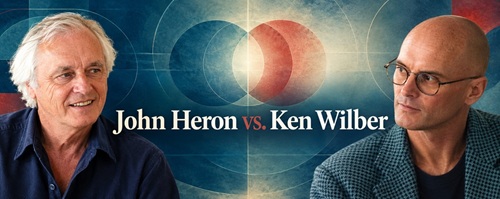 An early battle over what “integral” really meansLong before the later controversies surrounding Ken Wilber's Integral Theory, John Heron identified a problem at its heart. In 1997 Heron published "A Way Out for Wilberians", a concentrated critique of Wilber's transpersonal system. When the essay was subsequently placed on Integral World, Wilber responded in 1999. Heron then replied with "Way Out Further", after which the two men finally called a truce and exchanged remarkably cordial invitations to visit one another. The four texts therefore form a small but revealing drama: attack, counterattack, counter-counterattack, and reconciliation. The exchange is worth revisiting because Heron's criticism was not merely an objection to one particular detail of Wilber's system. He was questioning its underlying metaphysics, its theory of spiritual development, its interpretation of the self, its treatment of mystical traditions, and above all its claim to know something universal about the future development of humanity. Wilber, for his part, regarded Heron's critique as based on systematic misreadings of his position, especially his interpretation of the Atman Project. Both men therefore believed that the other was attacking a caricature. There is truth on both sides. Heron sometimes pushes Wilber's formulations to their most extreme implications, while Wilber sometimes answers a stronger version of Heron's argument than the one actually being made. Yet underneath the rhetoric lies a serious philosophical dispute that has never really disappeared from Integral Theory. Heron's opening salvoHeron's original essay is deliberately provocative. He begins by saying that he “despair[s] of Wilberians” and compares Wilber's system to a complex occult structure from which, once one has entered, it is difficult to escape. He presents his purpose as liberating readers from what he considers an internally tangled transpersonal theory. His central accusation is that Wilber repeatedly presents apparently incompatible ideas as though they had been integrated when, according to Heron, they have merely been superimposed upon one another. Heron's list of targets is formidable. He attacks the Atman Project, Wilber's changing conception of the person, his evolutionary theory, his interpretation of ancient mystics, his theory of transcendental inquiry, meditation, cross-cultural consensus, ascent and descent, worldspaces, the four quadrants, relativism and absolutism, and finally the nondual. This was not a disagreement over a footnote. Heron was challenging almost the entire architecture of Wilber's thought as it stood in the late 1990s. His most important criticism concerns the Atman Project. Wilber's early theory proposes that the separate self is involved in a fundamental attempt to compensate for its sense of separation from Spirit. Finite objects and achievements—money, power, knowledge, sex, fame and other forms of gratification—can become substitutes for the infinite fulfillment that the self unconsciously seeks. Wilber later defended this by distinguishing between a genuine intuition of the infinite and the mistaken attempt to find infinity in finite objects. Heron's objection is more subtle than simply saying that Wilber believes everything is illusion. He asks a reflexive question: What kind of self is capable of formulating and understanding the Atman Project theory? If every ordinary self is constituted by precisely the confusion the theory describes, then the person who formulates the theory appears to stand outside the condition being theorized. Heron argues that the theory therefore covertly requires the existence of a relatively healthy, connected and reality-oriented self which its own anthropology does not adequately recognize. In his Way Out Further, he presses the point relentlessly: if a finite self can understand the Atman Project without being trapped in it, then Wilber's description of every pre-enlightened self as intrinsically caught in that project cannot be complete. This is probably the strongest philosophical point in the entire exchange. Wilber's defense: the self is both real and deludedWilber's response is that Heron has constructed a false either/or. The Atman Project does not say that the finite self is simply unreal. Rather, according to Wilber, it contains both truth and illusion: there is a genuine intuition of Spirit, but that intuition is mistakenly projected onto finite objects and stages of development. The developmental process consists in progressively releasing those finite substitutes until Spirit itself is recognized. This is an important clarification. Heron's initial formulation can indeed make Wilber sound more radically world-denying than Wilber intended. Wilber explicitly insists that finite levels of existence remain real as manifestations of Spirit and that human love, culture and creativity are not simply worthless illusions. But Heron's criticism does not disappear simply because Wilber adds this qualification. The deeper question remains: What status does the finite person have before enlightenment? Wilber's answer oscillates. On the one hand, the finite person is sufficiently real to develop, love, suffer, create culture and eventually awaken. On the other hand, the separate self is repeatedly characterized as a contraction, a self-forgetting of Spirit, a structure rooted in fear and ultimately something to be transcended. Heron sees this as an unstable conception of personhood. This problem becomes especially significant in light of Wilber's later development. The more Integral Theory emphasizes holons, developmental lines, agency, relationality and the four quadrants, the harder it becomes to treat the individual merely as a temporary mistake on the road back to the One. The Many and the OneThis is where Heron's own alternative becomes important. He does not merely reject Wilber's nondualism. He proposes a different spiritual ontology. For Heron, the problem is the reduction of the Many to the One. Human beings should not be regarded merely as temporary “ripples” of an ultimate Spirit which must eventually recognize itself as One. They can instead be understood as distinct but nonseparate spiritual persons participating creatively in a larger whole. Heron calls this the “divine Many.” That distinction—between separateness and distinctness—is perhaps the most constructive idea in Heron's critique. A person can be relationally connected without ceasing to be a person. A musical note does not have to disappear into a symphony in order to belong to it. Heron uses essentially this image when arguing that individuality need not be annihilated by unity. Wilber's nondual framework, by contrast, tends toward a conception in which the ultimate realization dissolves the separate ego into nondual awareness. Heron worries that such language can make ordinary personhood merely provisional and ultimately disposable. This issue has ramifications far beyond Wilber and Heron. It is one of the oldest problems in mystical philosophy: If the ultimate is One, in what sense are the many genuinely real? Advaita Vedanta, Buddhist emptiness, Christian mysticism, panentheism and process thought have all offered different answers. Heron's answer is essentially participatory. The Many are not errors that have to be erased. They are participants in the unfolding of reality. The evolution problemHeron's second major contribution is his criticism of Wilber's evolutionary model. Wilber wanted to combine an evolutionary conception of development with perennial mystical wisdom. The difficulty, Heron argued, was that evolution was supposed to be genuinely creative and emergent, while the major stages of spiritual development had apparently already been discovered by ancient mystics. If the future contains genuinely new forms of consciousness, how could people thousands of years ago already have experienced the higher structures that humanity is supposedly evolving toward? Heron sees a contradiction. Wilber describes evolution as innovative and emergent, yet also maintains that ancient contemplatives had already disclosed the higher spiritual possibilities. He therefore asks whether evolution is really creating anything new or merely retracing a predetermined cosmic itinerary. Wilber's answer is revealing. He rejects the idea that the ancient mystics had mapped every future form of consciousness. Rather, he says they had encountered certain deep possibilities or “deep features” that might become expressed in countless future forms. The future remains open at the level of concrete manifestation. This is a much more defensible position than the rigid version Heron sometimes attributes to him. Yet Heron's question remains useful. The distinction between “deep structures” and “surface structures” can potentially save Wilber's evolutionary model, but it also raises a new question: How do we know that these supposed deep structures actually exist? That epistemological problem becomes increasingly important. A developmental theory can describe stages after the fact, but identifying a universal sequence of future spiritual development requires much stronger evidence than the existence of recurring mystical experiences. Ancient mystics as evolutionary pioneersHeron is particularly skeptical about Wilber's use of ancient mystics as evidence for future evolutionary stages. Wilber's argument is understandable. If people living thousands of years ago could experience states of consciousness remarkably similar to those reported by modern contemplatives, then perhaps these states are not merely cultural inventions. They may represent latent human potentials. But there is a logical jump between these two claims. The first claim is empirical and potentially testable: people from different cultures report certain recurring experiences. The second is evolutionary and much more ambitious: these experiences represent higher stages in a universal developmental sequence toward which humanity is evolving. The second claim does not automatically follow from the first. Heron also points out that ancient mystical experiences cannot simply be extracted from their cultural contexts. The mystics lived within particular societies, religions, gender systems and philosophical assumptions. Their experiences and interpretations were inevitably shaped by those environments. Wilber accepts part of this objection. He insists that the four quadrants and cultural worldspaces matter and that ancient mystics must be situated historically. But he rejects the stronger relativist conclusion that historical situatedness prevents their experiences from having universal significance. His analogy is that we can appreciate Mozart without being eighteenth-century Germans, and therefore we can learn from Buddha without being ancient Indians. Here Wilber has the better argument—but only up to a point. Historical conditioning does not make an experience meaningless outside its original culture. But neither does cross-cultural recurrence establish the metaphysical interpretation attached to it. We can accept that Buddhist meditators, Christian contemplatives and Hindu yogis report certain recurring experiences without accepting their explanations of those experiences as literally true. That distinction between phenomenology and metaphysics is something neither side handles entirely satisfactorily. Meditation versus inquiryThe sharpest methodological disagreement concerns the meaning of spiritual inquiry. Wilber treats contemplative traditions as repositories of accumulated experiential knowledge. Meditation, in this view, is not merely relaxation or introspection but a disciplined method through which consciousness can investigate its own structures. Heron is much more skeptical. He argues that traditional meditation occurs within established traditions whose assumptions already determine what practitioners are expected to find. This is a serious epistemological objection. A traditional contemplative practice may indeed produce reproducible experiences without thereby verifying the metaphysical interpretation traditionally assigned to those experiences. A person trained to interpret an experience as realization of Brahman may describe it differently from someone trained to interpret the same experience as Buddhist emptiness. Wilber responds that spiritual inquiry need not be restricted to meditation. He explicitly lists meditation, prayer, psychotherapy, visualization, shamanic practices, journaling and other forms of inquiry, ideally combined with intersubjective communities of practitioners. This is one of the places where Wilber's later position is more nuanced than Heron's original critique suggests. Nevertheless, Heron's demand for genuine openness remains pertinent. A real science of consciousness should be able to discover that its favored categories are wrong. If every disagreement with the tradition can be interpreted as egoic resistance, the system becomes unfalsifiable. The rhetoric becomes personalUnfortunately, the philosophical disagreement is repeatedly obscured by the rhetoric. Heron describes Wilber's system as “baneful,” “oppressive,” “totalitarian,” “hegemonic” and “authoritarian.” He accuses Wilber of being a bully and a “cheat” who engages in “pseudo-rebuttal.” He even suggests that Wilber's theory of the self helps generate the aggression with which Wilber defends it. Wilber responds with equal theatricality. He describes Heron's criticism as a “hatchet job,” jokes about “female barfing,” calls him “Mr. Either/Or,” and repeatedly suggests that Heron simply misunderstands the books he is criticizing. There is something almost comic about the symmetry. Heron accuses Wilber of authoritarianism while issuing categorical verdicts about Wilber's system. Wilber accuses Heron of intolerance while responding with ridicule and personal sarcasm. Each sees the other's polemic as evidence against the other's philosophy. And yet the rhetoric also reveals something important. Neither man is merely defending an academic theory. Both regard their spiritual philosophy as connected to how human beings ought to live. For Heron, Wilber's emphasis on transcending the separate self risks undermining personal autonomy, relationality and embodied life. For Wilber, Heron's insistence on open-ended plurality risks throwing away hard-won insights preserved in contemplative traditions. They are therefore defending different conceptions of spiritual freedom. Heron's strongest point: the self-reflexive problemOf all the arguments in the exchange, the self-reflexive criticism of the Atman Project deserves the most attention. A theory about human delusion has to explain how the theorist can recognize the delusion without simply exempting himself from it. This is not a problem unique to Wilber. Psychoanalysis, Marxism, evolutionary psychology, ideology critique and many other theories of human self-deception face versions of it. If everyone is systematically deceived, why should the theorist's own theory be trusted? Wilber's answer is essentially developmental: people can become progressively less identified with their constructions and eventually recognize Spirit directly. But that does not completely solve Heron's logical problem. The theory still needs an account of how an ordinary, finite human being acquires sufficiently reliable knowledge of the supposed spiritual structure underlying all finite selves. In other words, Wilber has an epistemological bridge to build between mystical experience and universal metaphysical claims. This problem has become even more significant in retrospect. Much of Wilber's later system depends upon treating spiritual states, developmental stages, cultural structures and evolutionary potentials as components of one enormous architecture. The larger the architecture becomes, the more important it becomes to distinguish what is directly experienced, what is inferred, what is borrowed from traditions, and what is theoretically constructed. Heron was asking for that distinction unusually early. Wilber's strongest point: Heron sometimes overstates the caseThe criticism should not become one-sided, however. Heron frequently takes Wilber's strongest formulations literally and then attacks the resulting extreme position. Wilber's response correctly points out that he does not believe the finite world is simply unreal, nor that ancient mystics provided an exhaustive blueprint of the future, nor that meditation is the only legitimate spiritual practice. Heron also occasionally moves from criticism of an idea to a sweeping characterization of its author. Describing Wilber's theory as “baneful and oppressive” is one thing; suggesting that Wilber's aggressive writing is the psychological consequence of his metaphysics is another. The latter becomes speculative psychologizing rather than philosophical criticism. The same applies to Heron's treatment of Eastern spirituality. His warnings about authoritarianism, patriarchy, repression and abuse contain legitimate concerns, but he sometimes generalizes from serious problems within particular traditions to sweeping judgments about “oriental mysticism.” Wilber is right to resist the implication that an entire historical tradition can be dismissed because some of its institutions and teachers have been corrupt or abusive. The best version of Heron's critique does not require that conclusion. Where Wilber's rebuttal also falls shortBut Wilber's response has its own weaknesses. His favorite rebuttal is that Heron has misunderstood him. Sometimes that is true. But repeatedly saying that the critic has misunderstood the theory is not the same as demonstrating that the theory is coherent. The exchange over the Atman Project illustrates this perfectly. Wilber's clarification that the theory contains both a genuine intuition of Spirit and a mistaken identification with finite objects makes his position more intelligible. But Heron's deeper self-reference objection remains. Likewise, Wilber's distinction between deep structures and surface structures answers the charge of rigid determinism only partially. If deep structures are merely broad possibilities, then the theory becomes more flexible—but also less predictive. If they are genuine predetermined developmental structures, Heron's objection about evolutionary novelty returns. This is a recurring tension in Integral Theory: the more flexible the developmental model becomes, the harder it is to test; the more precise it becomes, the more vulnerable it becomes to empirical counterexamples. That is not necessarily fatal to a philosophical model. But it is fatal to presenting the model as something approaching a scientifically verified map of consciousness. The forgotten common groundPerhaps the strangest feature of the entire exchange is that the two men actually shared more ground than their rhetoric suggested. Both believed that ordinary human consciousness could develop. Both believed that spiritual experience was real and important. Both rejected crude materialist reductionism. Both valued contemplative experience. Both wanted spirituality to become more intellectually serious. Both were dissatisfied with conventional accounts of human development. And both believed that the relationship between individual transformation and social life mattered. Their disagreement concerned what follows from those shared premises. Wilber wanted a universal architecture capable of integrating mystical traditions, developmental psychology, evolution, culture and science. Heron wanted a participatory spirituality in which persons remain genuinely autonomous and creative, and in which spiritual inquiry remains open rather than subordinated to a supposedly completed metaphysical map. The disagreement can therefore be restated in a much simpler form: Wilber asks: What is the structure of the whole? Heron asks: Who gets to decide what the structure of the whole is? That is a much more illuminating way of reading the exchange than simply deciding who was ruder. The remarkable endingAnd then something unexpected happens. After two rounds of intellectual combat, Wilber writes to Heron on August 4, 1999, saying that they are both tired of wrangling and inviting him to visit his house in Colorado for tea so that they can begin their relationship on a friendly basis. Heron responds the same day, saying that “honour is satisfied,” warmly reciprocating the invitation and inviting Wilber to Tuscany for lunch. This ending is almost more significant than the argument. It demonstrates that polemical disagreement need not produce permanent personal hostility. Indeed, the final exchange is more “integral” in spirit than much of the preceding debate. They do not resolve their metaphysical differences. They simply decide that the relationship matters more than the quarrel. There is an irony here. Heron had criticized Wilber's system for claiming too much universality; Wilber had criticized Heron for refusing universality. Yet when the theoretical battle reached its climax, neither man needed a philosophical synthesis. They needed a cup of tea. What the Heron-Wilber exchange got rightIn retrospect, Heron's critique can be read as an early warning about several persistent problems in Integral Theory. First, there is the danger of turning mystical testimony into metaphysical knowledge. Second, there is the problem of treating developmental sequences as more empirically established than they actually are. Third, there is the danger of allowing a theory of spiritual development to become self-validating. Fourth, there is the perennial difficulty of reconciling the One with the Many without reducing one to the other. And finally, there is the question of whether a spiritual philosophy can genuinely remain open to discoveries that contradict its own deepest assumptions. Wilber, meanwhile, was right to insist that Heron's critique sometimes flattened his distinctions. Wilber was not simply preaching that the world was an illusion or that all individuality was worthless. His project was considerably more sophisticated than that. His attempt to combine transcendence and immanence, evolution and involution, Eros and Agape, individual development and cultural context was intellectually ambitious. But ambition is not verification. The great weakness of the Wilberian project is ultimately not that it integrates too many perspectives. It is that the integration can sometimes take place at the level of conceptual architecture before the underlying claims have been independently established. The deeper lessonThe most productive way to read this old quarrel today is therefore neither as a victory for Heron nor as a defense of Wilber. Heron saw that Wilber's system risked becoming a closed metaphysical framework in which the basic conclusions were already built into the premises. Wilber saw that Heron's pluralism could become so suspicious of universality that it would lose the ability to recognize genuine common patterns across human experience. Both dangers are real. The alternative is not to choose between absolute unity and absolute plurality. It is to maintain a disciplined distinction between experience, interpretation, hypothesis and metaphysical conclusion. Human beings certainly have recurring experiences of unity, transcendence, selflessness, interconnectedness and altered consciousness. These experiences deserve serious study. They may tell us something profound about the capacities of the human nervous system and mind. They may even reveal important regularities in human development. But the additional claim that these experiences disclose the ultimate structure of reality is a philosophical hypothesis, not something established simply by having the experience. That distinction would have improved the Heron-Wilber debate enormously. An early warning about Integral TheoryThe irony is that this obscure quarrel from the late 1990s anticipated many of the arguments that would later surround Integral Theory. Heron's central concern was that Wilber was turning a particular interpretation of spiritual experience into a universal developmental map. Wilber's counterargument was that refusing to recognize universals leaves us with relativism and fragmentation. The subsequent history of Integral Theory can be read as an extended attempt to navigate precisely this narrow passage. The unresolved question remains: Can there be an integral theory without an integral metaphysics? Heron would probably have answered yes: begin with participatory inquiry, allow genuine novelty, preserve the autonomy and distinctness of persons, and resist premature claims about ultimate reality. Wilber's answer was essentially the opposite: the point of integration is precisely to discover the deep patterns that recur across domains and cultures, while allowing their concrete expressions to remain plural and historically conditioned. The interesting possibility is that an integral approach might require both impulses—but with an asymmetry. We can remain open to universal patterns without assuming that we have already discovered the final metaphysical explanation for them. That would preserve what was strongest in Wilber's integrative ambition while taking Heron's epistemological warning seriously. And perhaps that is the real value of this remarkably testy old exchange. Beneath all the bullets, insults, sarcasm, accusations of authoritarianism and charges of misunderstanding, two serious thinkers were arguing over a question that remains unresolved: How can we seek the whole without pretending that we already possess it?
Widget is loading comments...
|