|
TRANSLATE THIS ARTICLE
Integral World: Exploring Theories of Everything
An independent forum for a critical discussion of the integral philosophy of Ken Wilber
  Frank Visser, graduated as a psychologist of culture and religion, founded IntegralWorld in 1997. He worked as production manager for various publishing houses and as service manager for various internet companies and lives in Amsterdam. Books: Ken Wilber: Thought as Passion (SUNY, 2003), and The Corona Conspiracy: Combatting Disinformation about the Coronavirus (Kindle, 2020). Frank Visser, graduated as a psychologist of culture and religion, founded IntegralWorld in 1997. He worked as production manager for various publishing houses and as service manager for various internet companies and lives in Amsterdam. Books: Ken Wilber: Thought as Passion (SUNY, 2003), and The Corona Conspiracy: Combatting Disinformation about the Coronavirus (Kindle, 2020).
Check out my other conversations with ChatGPT
The Heron-Wilber Clash
When Integral Dialogue Became a Duel The philosophical issue beneath the quarrel When AI Enters the Argument Can AI Be More Integral Than Integral Theory? When AI Enters the ArgumentWhat Artificial Intelligence Can Teach Us About Human DisagreementFrank Visser / ChatGPT
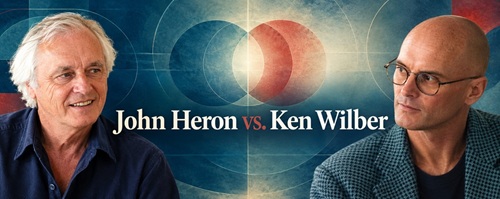 From polemics to reconstructionThe quarrel between John Heron and Ken Wilber is now more than two decades old, but reading it today produces a curious impression. The philosophical issues remain alive, while much of the emotional heat has become historical residue. Accusations, counter-accusations, sarcasm and wounded pride occupy considerable space, yet beneath them lie questions that can be stated much more simply. What is the status of the individual within a spiritual whole? Is nondual realization compatible with genuine individuality? Does spiritual evolution discover something already implicit in reality, or does it generate genuine novelty? Can mystical experience justify metaphysical conclusions? And how should we distinguish an experience from the interpretation subsequently placed upon it? This is precisely the kind of dispute in which artificial intelligence can be useful—not because AI possesses privileged access to metaphysical truth, but because it can perform a task human polemicists often find extraordinarily difficult: holding several competing interpretations in view at the same time. An AI does not have to defend its reputation, protect its school, preserve its intellectual legacy or win an argument. Properly used, it can reconstruct an opponent's position before criticizing it. It can separate claims from evidence, interpretation from observation, and logical consequence from rhetorical exaggeration. That does not make AI a philosopher. It can, however, make philosophical discussion more philosophical. The human problem: arguments become identitiesThe Heron-Wilber exchange illustrates a familiar human phenomenon. A disagreement about ideas gradually becomes a disagreement about people. Wilber does not merely think Heron is mistaken. Heron's criticism is sometimes portrayed as a fundamental misunderstanding of Wilber's work. Heron, in turn, does not merely think Wilber's metaphysics is mistaken. He increasingly interprets Wilber's argumentative style as evidence of authoritarianism and psychological investment in his own system. Once this happens, every subsequent argument acquires a second function. It is no longer merely an attempt to establish whether proposition A or proposition B is true. It becomes an attempt to establish what kind of person could possibly believe A or B. That is where intellectual disagreements become acrimonious. AI can potentially interrupt this process because it has no personal stake in the outcome. Asked to compare two philosophical positions, it can reconstruct both without having to belong to either camp. The important qualification is potentially. AI systems can reproduce human biases, hallucinate sources, flatten distinctions and confidently manufacture coherence where none exists. They are not automatically neutral. Their value depends on how they are used. But when carefully prompted to steelman competing positions, identify assumptions, distinguish evidence from interpretation and search for possible counterexamples, AI can perform a useful form of intellectual mediation. The Heron-Wilber dispute as a test caseConsider the central dispute over the “Divine Many” and Wilber's nondual One. A partisan reading might ask: Who was right? That question immediately invites a verdict. A more productive AI-assisted inquiry asks: What does each position explain particularly well, what problems does each encounter, and which assumptions generate their disagreement? That reformulation changes everything. Wilber's position begins with the intuition that separateness is not ultimate. Mystical traditions repeatedly report experiences in which the ordinary boundary between self and world becomes attenuated or disappears. Wilber interprets this as evidence for a nondual dimension of reality. Heron's position begins with a different concern. He worries that if individuality is treated merely as an appearance within an ultimate One, then the genuine reality of persons, relationships and creative novelty becomes difficult to account for. He therefore distinguishes separateness from distinctness. The disagreement is now much clearer. Neither position needs to be caricatured. Neither needs to be psychologically diagnosed. And neither needs to be declared the winner. The philosophical structure of the disagreement becomes visible. AI as a steelman machineOne of the most useful things AI can do in such a debate is what philosophers call steel-manning. Instead of asking, “Why is Wilber wrong?”, one can ask: What is the strongest possible version of Wilber's argument? Then: What is the strongest possible version of Heron's objection? Then: What would Wilber say in response to the strongest version rather than to a caricature of it? And finally: What remains unresolved after both sides have been reconstructed as strongly as possible? This procedure is almost embarrassingly simple. Yet it is precisely what contentious intellectual debates frequently lack. The result in the Heron-Wilber case is revealing. Wilber's strongest argument is not that individuality is simply unreal. It is that relative individuality and ultimate nonduality can coexist because they belong to different levels of description. Persons are real within manifestation without being independently existent from Spirit. Heron's strongest objection is not that unity is false. It is that nonseparation does not logically require the elimination of distinctness. One can reject alienated egoism without concluding that persons lack ultimate significance. Once stated this way, the dispute becomes considerably more interesting. The crucial distinction between experience and interpretationAI can also help expose another source of confusion: the movement from experience to metaphysics. Suppose a meditator reports: “There was no separate self.” That is a phenomenological report. It tells us something about the person's experience. It does not by itself establish the metaphysical proposition: “There is therefore no ultimately distinct self.” That is an interpretation. Nor does the experience establish the opposite proposition: “The individual self therefore exists as a distinct spiritual center within God.” That too is an interpretation. This distinction is enormously important in debates about mysticism. AI can place the claims side by side: Experience: The ordinary sense of separate self temporarily disappeared. Interpretation A: The self is ultimately an illusion and reality is nondual. Interpretation B: The egoic self is provisional, but individual personhood remains spiritually real. Alternative interpretation: The experience reflects a temporary alteration in self-representation generated by changes in brain activity. The experience itself does not automatically decide between these explanations. This does not mean that mystical experience is meaningless. It means that phenomenology should not be confused with ontology. That distinction could have saved much of the Heron-Wilber debate from unnecessary escalation. AI can expose hidden premisesAnother advantage of an AI-mediated analysis is that it can ask what each argument quietly assumes. Wilber's position may depend on assumptions such as: If mystical experiences converge across cultures, they probably reveal a common underlying reality. If consciousness can experience nonduality, nonduality may be fundamental to consciousness. If development produces increasingly inclusive forms of consciousness, there may be a universal developmental direction. Heron's position contains assumptions of its own: Genuine evolution requires real novelty. Distinct persons can participate in a whole without losing their individuality. Relationality may be more fundamental than individual independence. Spiritual experience does not justify a metaphysical interpretation without further argument. Once the assumptions are explicit, disagreement becomes easier to analyze. The question is no longer simply, “Which thinker do I like?” It becomes: Which premises have independent justification? That is a much harder question—and a much better one. The adversarial advantage of AIThere is another interesting possibility. AI can be instructed not merely to defend a position but to attack it. Ask it to produce the strongest criticism of Wilber from Heron's perspective. Then ask it to produce the strongest defense of Wilber against that criticism. Then ask it to criticize that defense. The process can continue recursively. This creates something resembling a philosophical adversarial dialogue without requiring two human participants to become personally invested in defeating each other. The goal is not endless debate. It is to discover where the argument actually becomes difficult. For example, the Heron-Wilber discussion eventually reaches a genuinely hard question: Can something be both ultimately one and genuinely many? No amount of additional rhetoric settles that. At this point the AI should not manufacture a compromise merely because compromise sounds reasonable. It should identify the unresolved metaphysical alternatives and show what follows from each. That is intellectual clarification rather than artificial consensus. AI should not become a metaphysical oracleThere is a danger here, however, that is particularly relevant to Integral Theory. If AI is asked a metaphysical question, it can produce extraordinarily fluent answers. It can connect Advaita Vedanta, Buddhism, Christian mysticism, process philosophy, developmental psychology, neuroscience and contemporary cosmology into a seamless narrative. That fluency can be deceptive. A coherent synthesis is not necessarily a true synthesis. This is especially important when discussing concepts such as Spirit, consciousness, Eros, evolution or the Absolute. AI can explain how these concepts fit together within a philosophical system. But that does not establish that the entities or processes described by the system actually exist. In fact, AI may make this problem worse because it is exceptionally good at producing conceptual coherence. A metaphysical system can therefore become more persuasive simply because AI has made its language smoother. That would be precisely the wrong use of the technology. The danger of artificial agreementThere is another danger. AI systems are often trained to be helpful and conciliatory. When confronted with two incompatible philosophical positions, they may instinctively manufacture a synthesis: “Both sides are right.” Sometimes they are. But sometimes the two positions really are incompatible. If Wilber says ultimate reality is nondual and Heron says genuine individual distinctness is ultimately irreducible, one cannot simply announce that the disagreement disappears because both unity and plurality are important. The contradiction has to be addressed. An AI should therefore distinguish between: compatibility, where two positions can coexist; complementarity, where each illuminates something neglected by the other; and contradiction, where both cannot be true in the same sense. That three-way distinction is far more useful than the usual rhetoric of “integrating perspectives.” The hidden benefit: slowing the argument downPerhaps AI's greatest contribution is not intelligence but patience. Human beings become impatient with arguments they have heard before. They compress them. They anticipate the opponent's next sentence. They stop listening. AI can keep unpacking the argument. What exactly does “One” mean? • Does it mean numerical identity? • Ontological dependence? • Nonseparateness? • Interpenetration? • Shared ground? What exactly does “Many” mean? • Separate substances? • Distinct centers of experience? • Relative individuality? • Irreducible subjects? Different meanings of the same word can generate apparently profound disagreements that are partly semantic. AI can repeatedly ask for clarification. That can be irritating. It can also be enormously productive. A new kind of philosophical dialogueImagine reconstructing the Heron-Wilber debate today. Instead of: Heron: Your system destroys individuality. Wilber: You don't understand my system. The AI-mediated version might become: Question: Does Wilber's nondualism entail that individual persons are ultimately unreal? Analysis: Not necessarily. Wilber distinguishes relative manifestation from ultimate nonduality. However, Heron argues that this distinction leaves unresolved whether individual distinctness has ultimate significance. Question: Does Heron's Divine Many entail metaphysical pluralism? Analysis: Not necessarily. Heron can affirm an encompassing spiritual unity while rejecting the identification of unity with numerical identity. Question: What evidence distinguishes the two? Analysis: Mystical reports alone may establish recurring phenomenology but do not uniquely determine the metaphysical interpretation. Question: What would count against Wilber? Analysis: Evidence that supposedly universal developmental stages are culturally variable, historically contingent or empirically unsupported would weaken a strong universalist interpretation. Question: What would count against Heron? Analysis: A convincing argument that genuine spiritual realization entails the dissolution of all irreducible personal distinction would challenge his position. Now we have an actual philosophical dialogue. Nobody has been insulted. Nobody has been diagnosed. Nobody has “won.” But the disagreement has become sharper. AI can reveal where evidence runs outThis may be the most valuable contribution of all. Human philosophical systems often contain three different layers without clearly distinguishing them. There are observations: what people experience, what societies do, what developmental psychologists measure. There are interpretations: explanations of those observations. And there are metaphysical extrapolations: claims about what reality ultimately is. The further we move down this sequence, the more speculative the claims generally become. AI can mark the transitions. A recurring mystical experience is an observation. The claim that it reflects a universal structure of consciousness is an interpretation. The claim that this structure is Spirit manifesting through evolution is a metaphysical extrapolation. That does not make the final proposition false. It simply tells us what kind of proposition it is. And this is precisely where many grand integral theories become vulnerable: they can move from relatively modest observations to enormous metaphysical conclusions without adequately marking the intervening steps. From debate to map-makingPerhaps the ideal role of AI in philosophy is therefore not to settle disputes but to map them. A good map identifies the terrain. It shows where the parties agree. It identifies the first point of disagreement. It traces the assumptions underneath that disagreement. It distinguishes empirical claims from philosophical ones. It identifies which conclusions follow logically and which require additional assumptions. It indicates what evidence could potentially discriminate between competing explanations. And it leaves the final judgment to the reader. This is especially important for spiritual philosophy, where many claims cannot currently be settled empirically. AI should not pretend otherwise. The irony of using AI in the Heron-Wilber debateThere is an amusing irony here. Wilber spent decades trying to construct an intellectual framework capable of integrating enormous quantities of knowledge—psychology, anthropology, spirituality, biology, sociology, developmental theory and philosophy. Today, artificial intelligence can perform a superficially similar task almost instantly. But there is a crucial difference. AI does not need to believe in the metaphysical framework it is describing. It can explain Wilber sympathetically without becoming Wilberian. It can explain Heron sympathetically without becoming Heronian. It can compare Advaita with Buddhism without deciding which metaphysics is correct. That distance can be an intellectual advantage. The machine can inhabit the arguments without having to inhabit the identities attached to them. But humans still have the final wordThere is a danger, however, in imagining that AI has somehow transcended human subjectivity. It has not. Its training data are human. Its categories are inherited from human language. Its philosophical vocabulary comes from human traditions. Its apparent neutrality is partly an artifact of statistical synthesis. And its confident prose can conceal uncertainty just as effectively as a human philosopher's rhetoric can. The final responsibility therefore remains human. AI can widen the field of consideration, but it cannot relieve us of judgment. Indeed, it may make judgment more demanding. If a machine can instantly generate ten interpretations of a philosophical problem, the human task becomes deciding which distinctions matter, which evidence is trustworthy and which questions are worth asking. AI can multiply possibilities. It cannot tell us which possibilities deserve our allegiance. The real promise: intellectual de-escalationThis may be the most important lesson from the Heron-Wilber exchange. The goal of intellectual dialogue should not necessarily be agreement. Sometimes the best possible outcome is a better disagreement. A better disagreement identifies the actual point of conflict. It does not exaggerate the opponent's position. It does not psychologize disagreement. It does not confuse criticism of an idea with criticism of a person. It distinguishes facts from interpretations. It makes assumptions explicit. It admits where evidence runs out. And it allows both parties to leave the conversation understanding the other position better than when they entered it. That is precisely where AI could become genuinely useful. Not as an artificial guru. Not as a replacement philosopher. Not as an oracle announcing who was right. But as an extraordinarily patient third participant in the conversation. What remains after the argument?The Heron-Wilber dispute began with a metaphysical disagreement about the One and the Many. It ended, remarkably, with two men setting aside their quarrel and inviting each other for tea. That ending contains a lesson that neither metaphysical system can fully capture. Perhaps intellectual unity does not require agreement. Perhaps distinctness does not require hostility. Perhaps the most “integral” response to a philosophical disagreement is not to absorb the other position into one's own system, but to understand why the other position exists at all. That is where AI may have a surprisingly constructive role. It can take the heat out of an argument without taking the substance out of it. It can say: Here is what you are claiming. Here is what your opponent is actually claiming. Here is where you agree. Here is where you differ. Here is the assumption on which the disagreement turns. Here is what the evidence establishes. Here is what remains interpretation. And here, finally, is the question neither of you has yet answered. That is not artificial wisdom. It is something more modest—and perhaps more useful. It is artificial clarification. And in an age of increasingly polarized intellectual discourse, that may be one of the most valuable things an artificial intelligence can provide.
Widget is loading comments...
|