|
TRANSLATE THIS ARTICLE
Integral World: Exploring Theories of Everything
An independent forum for a critical discussion of the integral philosophy of Ken Wilber
  Frank Visser, graduated as a psychologist of culture and religion, founded IntegralWorld in 1997. He worked as production manager for various publishing houses and as service manager for various internet companies and lives in Amsterdam. Books: Ken Wilber: Thought as Passion (SUNY, 2003), and The Corona Conspiracy: Combatting Disinformation about the Coronavirus (Kindle, 2020). Frank Visser, graduated as a psychologist of culture and religion, founded IntegralWorld in 1997. He worked as production manager for various publishing houses and as service manager for various internet companies and lives in Amsterdam. Books: Ken Wilber: Thought as Passion (SUNY, 2003), and The Corona Conspiracy: Combatting Disinformation about the Coronavirus (Kindle, 2020).
Check out my other conversations with ChatGPT
The Heron-Wilber Clash
When Integral Dialogue Became a Duel The philosophical issue beneath the quarrel When AI Enters the Argument Can AI Be More Integral Than Integral Theory? Can AI Be More Integral Than Integral Theory?When integration becomes a machine functionFrank Visser / ChatGPT
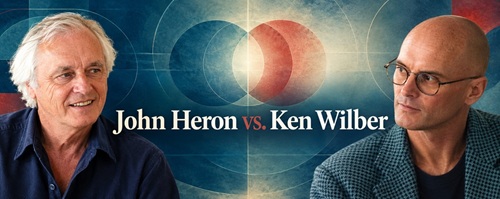 Ken Wilber's great intellectual ambition was to overcome fragmentation. Modern knowledge, he argued, had become divided into specialized disciplines, while spiritual traditions, science, psychology, sociology and philosophy often spoke past one another. Integral Theory was conceived as a framework capable of bringing these partial truths together. That ambition remains impressive. But something rather unexpected has now appeared on the intellectual scene. Artificial intelligence can perform a kind of integration that is both broader and more operational than the integration envisioned by Wilber. An AI can move from neuroscience to Buddhism, from developmental psychology to evolutionary biology, from phenomenology to sociology, and from Wilber to his critics, without requiring that all these perspectives be reduced to a single metaphysical architecture. This raises an intriguing question. Can AI be more integral than Integral Theory?The question is deliberately provocative. It does not mean that AI is conscious, enlightened, wiser than human beings, or metaphysically superior to Wilber's philosophy. It means something more specific: perhaps AI reveals that integration does not necessarily require a theory of everything. Perhaps the most genuinely integral intellectual method is not to construct one grand map that explains all domains, but to become exceptionally good at moving among different maps without confusing them. That distinction could change how we understand the entire Integral project. Wilber's extraordinary ambition Wilber's achievement should not be underestimated. Few contemporary thinkers have attempted to synthesize such a vast range of material. His work incorporates developmental psychology, systems theory, evolutionary theory, mysticism, contemplative traditions, cultural theory, neuroscience, anthropology, sociology and philosophy. His four quadrants were intended to ensure that no phenomenon was understood exclusively from one perspective. His later distinctions between levels, lines, states and types attempted to prevent developmental theory from becoming overly simplistic. The underlying intuition is compelling. A human being is simultaneously a biological organism, a psychological subject, a cultural participant and a social being. To explain only one of these dimensions is to leave something important out. Wilber's famous insistence that we need to look at the “interior” and “exterior” of individuals as well as the individual and collective dimensions of existence was therefore an important corrective to reductionism. But there is a difference between integrating perspectives and explaining reality. The first is a methodological achievement. The second is a metaphysical claim. Wilber sometimes moves very quickly from the former to the latter. The Integral temptationOnce a thinker has assembled enough perspectives, a temptation appears. The various perspectives begin to look like pieces of one enormous puzzle. Psychological development corresponds to cultural development. Cultural development corresponds to evolutionary development. Evolution points toward increasing complexity. Increasing complexity opens toward consciousness. Consciousness culminates in nondual awareness. Nondual awareness reveals Spirit. Spirit is simultaneously the ground and goal of the entire process. The pieces now seem to fit. But fitting together conceptually is not the same as being causally or ontologically connected. This is perhaps the central methodological problem of Integral Theory. An integral framework can become so successful at accommodating different observations that it becomes difficult to determine what would count as a serious challenge to the framework. Almost anything can find a place somewhere in the model. That is intellectually impressive. It is also potentially dangerous. AI performs integration differentlyNow compare this with a contemporary AI. Ask an AI about meditation and it can explain the phenomenology of meditation, the neuroscience of attention, Buddhist theories of consciousness, Hindu interpretations of samadhi, psychological research on mindfulness and skeptical interpretations of mystical experience. But it does not necessarily have to conclude that all of these represent different perspectives on one underlying metaphysical reality. It can keep them separate. It can say: Buddhism interprets the experience this way. Advaita interprets it that way. Neuroscience explains certain correlates without necessarily addressing the metaphysical interpretation. Phenomenology describes the experience from the first-person perspective. Psychology studies its effects on cognition and behavior. These accounts may overlap. They may contradict one another. Some may be better supported than others. And there may be no reason to force them into a single explanatory system. This is a different conception of integration. It is plural integration rather than synthetic integration. Holding contradictions without dissolving themOne of AI's most interesting capacities is its ability to represent contradictory positions without immediately resolving them. It can explain why a Buddhist philosopher rejects the concept of an enduring self while an Advaita philosopher regards consciousness as the ultimate reality. It can explain why a neuroscientist may regard consciousness as dependent on brain processes while a panpsychist regards consciousness as fundamental. It can describe why Wilber emphasizes developmental stages while Heron emphasizes participatory emergence. It can hold all these positions in the same intellectual space. That does not mean that all are equally true. This distinction is crucial. Pluralism is not relativism. To keep several theories in view is not to say that they are all correct. It means postponing premature closure long enough to determine where the actual disagreements lie. This may be a more sophisticated form of integration than simply declaring that all the perspectives represent partial truths of one larger whole. The four quadrants revisitedThis becomes especially interesting when applied to Wilber's four quadrants. The quadrants distinguish four basic perspectives: interior-individual, exterior-individual, interior-collective and exterior-collective. The insight is valuable. A human experience can indeed be approached through subjective experience, objective measurement, cultural meaning and social structures. But the quadrants themselves do not establish that reality is fundamentally divided into four ontological domains. They are better understood as perspectival distinctions. And this is precisely where AI can sometimes be more flexible than Integral Theory. An AI can treat the quadrants as one useful classification scheme among several. It can also use alternative classifications. For consciousness, for example, it might distinguish first-person phenomenology, third-person neuroscience, computational models, evolutionary explanations, social construction, developmental psychology and philosophical ontology. There is no reason to assume that one taxonomy must govern all inquiries. The integral theorist wants a map of the whole. The AI can operate with a library of maps. That may be a subtle but important difference. Integration without reductionThe great challenge is therefore to integrate without reducing. Reduction says: Everything is ultimately biology. Or everything is ultimately physics. Or everything is ultimately consciousness. Or everything is ultimately Spirit. Each of these moves takes a plurality of phenomena and reduces them to one privileged explanatory level. Integral Theory was explicitly designed to resist this. But it can fall into a subtler version of the same problem if Spirit becomes the ultimate explanatory category into which all the other domains are eventually absorbed. Then the quadrants may remain operationally distinct while metaphysically subordinated. AI does not automatically escape this problem. It can also become reductionistic if prompted to do so. But its architecture encourages a different intellectual habit: it can switch explanatory frameworks without requiring that they be harmonized into a single ultimate ontology. That flexibility may be one of its greatest philosophical virtues. The problem of Spirit as an explanationThis connects directly to one of the persistent criticisms of Wilber. Suppose Wilber says that Spirit is the ultimate reality and that evolution is an expression of Spirit's self-unfolding. What does this explain? If every possible evolutionary development is compatible with Spirit, then the concept does not necessarily generate specific predictions. If humans become more complex, Spirit explains it. If development stagnates, Spirit may still explain it. If consciousness appears early, Spirit explains it. If consciousness appears late, Spirit can explain that too. At this point Spirit risks becoming less an explanation than a metaphysical label applied after the fact. AI is particularly useful here because it can ask the elementary question: What would we expect to observe if this explanation were true that we would not expect if it were false? That question is devastatingly useful. It does not refute metaphysics. But it distinguishes metaphysical interpretation from empirical explanation. AI as a methodological agnosticThis is where AI may possess a quality that Integral Theory sometimes lacks: methodological agnosticism. An AI can say: We do not currently know. That is not a trivial answer. In discussions of consciousness, evolution, mystical experience and spirituality, “we do not know” is often the most intellectually responsible position. Wilber's system is driven by the desire to connect the dots. AI can be valuable precisely because it can also identify the dots that remain unconnected. There is a great intellectual temptation to turn unexplained phenomena into evidence for one's preferred metaphysics. Mystical experience becomes evidence for Spirit. Complexity becomes evidence for Eros. Evolution becomes evidence for cosmic creativity. The emergence of consciousness becomes evidence for consciousness as fundamental. But each inference requires an argument. AI can help keep those inferential gaps visible. The danger of AI's apparent neutralityThere is, however, an important qualification. AI is not genuinely neutral. It inherits the biases of its training material. It can reproduce fashionable assumptions, majority views, cultural prejudices and hidden ideological commitments. It can also generate confident nonsense. Its apparent ability to explain every side may create a false impression that it has transcended perspective altogether. It has not. An AI does not stand outside human knowledge looking down upon it from nowhere. It is an extraordinarily sophisticated participant in the human knowledge ecosystem. Its “integrality” is therefore not transcendence. It is representational breadth. That distinction matters. The strange advantage of not believingYet the absence of belief can still be useful. An AI can explain Integral Theory without becoming an Integral theorist. It can explain Marxism without becoming Marxist. It can explain Christianity without becoming Christian. It can explain atheism without becoming atheist. It can explain Heron's Divine Many without accepting the metaphysics of the Divine Many. This is intellectually significant because human theorists inevitably become attached to their conceptual systems. Once an intellectual framework becomes part of one's identity, criticism of the framework can feel like criticism of the person. AI does not have that particular vulnerability. At least in principle, it can move freely between frameworks. This is why it can be especially useful in acrimonious debates. The AI version of the pre/trans problemThere is an interesting parallel here with Wilber's famous pre/trans distinction. Wilber argued that people often confuse pre-rational states with trans-rational states simply because both are non-rational. The distinction was designed to prevent romanticizing everything that lies beyond ordinary rationality. AI introduces another useful distinction: integration is not the same as synthesis. A system can integrate many perspectives by representing them accurately without synthesizing them into one worldview. That may actually be preferable. A synthesis can create false agreement. Integration, in the weaker and more careful sense, can preserve disagreement. The AI can say: These perspectives overlap here. They diverge here. This claim has empirical support. This one is philosophical. This one is metaphysical. This interpretation is contested. And this question remains open. That is an integral method without an integral metaphysics. What AI exposes about grand theoriesAI may therefore expose an unexpected weakness in grand theories of everything. The more knowledge becomes available, the less obvious it becomes that all knowledge can be organized around one final conceptual architecture. Modern science has not converged upon one universal explanatory language. Biology cannot simply be replaced by physics. Psychology cannot simply be replaced by neuroscience. Sociology cannot simply be replaced by psychology. First-person experience cannot simply be replaced by third-person measurement. But neither does this mean that everything is disconnected. Reality may be structured through relations between explanatory levels rather than through one master explanation. That is a much humbler conception of integration. And perhaps a more realistic one. From integral theory to integral practiceThe most promising future for integral thinking may therefore involve abandoning the ambition to produce a final integral theory. Instead, we could develop an integral practice of inquiry. The practice would begin by asking: What perspective are we using? What does it reveal? What does it leave out? What evidence supports it? What assumptions does it make? What alternative explanations exist? Where do the perspectives genuinely converge? Where do they contradict one another? What remains unknown? Such a practice could be applied to consciousness, politics, religion, psychology, ecology, science and spirituality without requiring a single metaphysical conclusion. AI could become extremely useful here. Not because it supplies the final answer, but because it can help maintain the plurality of questions long enough for better answers to emerge. Can AI actually be “more integral”?So can AI be more integral than Integral Theory? Only if we use “integral” in a methodological rather than metaphysical sense. AI is not more spiritually evolved than Wilber. It is not conscious in any established sense comparable to human consciousness. It does not possess mystical realization. It has no privileged access to the Absolute. And it certainly does not settle the metaphysical disputes between Wilber and Heron. But it can perform something that resembles the best aspiration of integral thinking: it can place many perspectives into dialogue without necessarily demanding that one of them become the master framework. That is a modest achievement. But it may be more useful than a theory claiming to explain everything. The paradox of integrationThere is a final paradox here. The more comprehensive a theory becomes, the greater the temptation to make everything fit. But if everything fits, perhaps the theory is not sufficiently discriminating. A genuinely open framework must be capable of encountering something that does not fit. This may be where AI can teach Integral Theory something about itself. The purpose of integration should not be to make contradictions disappear. It should be to make contradictions intelligible. The purpose of synthesis should not be to declare that every perspective is ultimately saying the same thing. It should be to discover where they really differ. And the purpose of a theory should not be to protect its own completeness. It should be to help us discover where it is incomplete. That last point is crucial. A theory that knows where its own limits are may be more intellectually valuable than one that claims universal reach. A different meaning of “integral”Perhaps, then, the future of integral thinking lies not in building an even larger version of Wilber's system. Perhaps it lies in cultivating a capacity to move among systems. The integral thinker of the future may not be the person who possesses the most comprehensive map. It may be the person who can enter different intellectual worlds without confusing them, understand their internal logic, compare their evidence, identify their blind spots and remain capable of changing their mind. AI can assist enormously with that task. But humans must decide what to do with the resulting clarity. The machine can map the disagreement between the One and the Many. It can reconstruct Wilber's nondualism. It can defend Heron's Divine Many. It can identify the assumptions beneath both. It can distinguish mystical experience from metaphysical interpretation. It can ask what evidence would discriminate between the alternatives. But it cannot decide what reality ultimately is. Nor should it pretend to. Beyond WilberThere is therefore an unexpected lesson in the emergence of AI. Wilber's great insight was that no single perspective captures the whole. The next step may be to recognize that no single integration of those perspectives necessarily captures the whole either. That is a much more radical pluralism. It preserves the integral impulse while abandoning the demand for integral closure. And perhaps this is where AI can help us move beyond Wilber without simply rejecting him. We do not need to abandon the four quadrants. We do not need to abandon developmental psychology. We do not need to abandon contemplative traditions. We do not need to abandon systems theory or evolutionary thinking. We need to stop assuming that all these things must culminate in one metaphysical story. The whole may be larger than any integration we can formulate. That would be an appropriately modest conclusion for an integral philosophy. And perhaps the deepest irony is this: Wilber wanted to integrate everything into a theory. AI may help us discover that genuine integration sometimes means keeping everything in conversation without forcing everything into one theory. That is not the end of Integral Theory. It may be its maturation.
Widget is loading comments...
|