|
TRANSLATE THIS ARTICLE
Integral World: Exploring Theories of Everything
An independent forum for a critical discussion of the integral philosophy of Ken Wilber
  Frank Visser, graduated as a psychologist of culture and religion, founded IntegralWorld in 1997. He worked as production manager for various publishing houses and as service manager for various internet companies and lives in Amsterdam. Books: Ken Wilber: Thought as Passion (SUNY, 2003), and The Corona Conspiracy: Combatting Disinformation about the Coronavirus (Kindle, 2020). Frank Visser, graduated as a psychologist of culture and religion, founded IntegralWorld in 1997. He worked as production manager for various publishing houses and as service manager for various internet companies and lives in Amsterdam. Books: Ken Wilber: Thought as Passion (SUNY, 2003), and The Corona Conspiracy: Combatting Disinformation about the Coronavirus (Kindle, 2020).
Check out my other conversations with ChatGPT
The Heron-Wilber Clash
When Integral Dialogue Became a Duel The philosophical issue beneath the quarrel When AI Enters the Argument Can AI Be More Integral Than Integral Theory? The Divine Many vs. the Nondual OneThe philosophical issue beneath the quarrelFrank Visser / ChatGPT
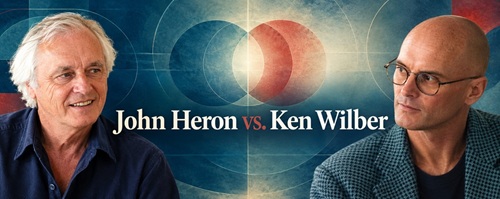 The deepest disagreement between John Heron and Ken Wilber is not really about developmental stages, meditation, ancient mystics, or even the Atman Project. Those disputes are manifestations of something more fundamental: what kind of reality do individual persons have within an ultimate spiritual reality? Heron sees Wilber's nondualism as repeatedly subordinating the Many to the One. Wilber, by contrast, regards the Many and the One as ultimately inseparable: the world of distinct beings is the manifestation of Spirit, while enlightenment is the realization that this apparent multiplicity is not separate from the nondual Absolute. Heron's alternative is not simple individualism. He does not defend the isolated ego against mystical unity. His crucial distinction is between separateness and distinctness. A person can cease to be alienated, contracted and defensive without ceasing to be a distinct center of experience. For Heron, this is the “divine Many”: a plurality of genuinely distinct beings participating within a larger spiritual whole. That seemingly small distinction turns out to have enormous consequences. It changes what enlightenment means, what evolution means, what love means, what creativity means—and even what it means to say that anything is ultimately real. Wilber's One: the Many as manifestationWilber's nondual position is rooted in a familiar mystical intuition. At the deepest level, reality is not composed of fundamentally separate things. Subject and object, self and world, consciousness and manifestation are ultimately expressions of one reality. In Sex, Ecology, Spirituality, Wilber attempts to preserve the reality of manifestation through his holonic model. Human beings are real as holons, and holons participate in the self-transcending, self-embracing movement of Spirit-in-action. Heron acknowledges this aspect of Wilber's later philosophy. Indeed, it is precisely because Wilber describes human holons as manifestations of Spirit that Heron believes his system contains the beginnings of a much more satisfactory conception of personhood. But then, Heron argues, Wilber pulls the rug from underneath this position. The human holon is said to be relatively real at the phenomenal level but ultimately unreal when seen from the perspective of absolute Spirit. Wilber can therefore affirm the Many and then, at the highest level of analysis, dissolve them back into the One. Heron describes this as an uneasy “no-person's land between the Many and the One.” The problem is not that Wilber recognizes an ultimate unity. The problem, in Heron's view, is that ultimate unity becomes ontologically privileged over actual persons. The Many are allowed to exist—but only provisionally. Heron's crucial distinction: separate is not the same as distinctThis is the point where Heron's philosophy becomes considerably more interesting than a simple rejection of nondualism. Suppose I am separate from you. That can mean that I experience myself as isolated, defended and disconnected. It can mean that I treat you as an object external to myself and understand our relationship in terms of competition, possession or fear. But suppose I am distinct from you. That means something different. I remain irreducibly myself, while recognizing that I exist in profound relationship with you. Distinction does not imply alienation. Heron's criticism is that nondual traditions too easily collapse these two concepts. Once separateness is identified as the problem, the temptation is to conclude that individuality itself must eventually disappear. Heron argues that this is an unnecessary inference. His musical analogy is excellent. When a single note becomes part of a great symphony, it does not cease to exist. Indeed, its distinctive character may become more audible precisely because of its relationship to the whole. This provides a radically different image of enlightenment. For Wilber, enlightenment can mean discovering that the separate self was never ultimately separate from Spirit. For Heron, enlightenment means discovering that the contracted, alienated self can open into a distinctive participation in Spirit. The first emphasizes identity. The second emphasizes participation. Does enlightenment erase the person?Here the disagreement becomes metaphysical. Heron attacks the idea that there is no personhood whatsoever in the final nondual state. If the enlightened individual is simply identical with the Absolute, he asks, what distinguishes the mystic's realization from God knowing God? Where is the individual center that underwent the transformation? This is his warning about what he calls the problem of spiritual inflation. If “I am one with the Absolute” means that my individual subjectivity has become literally identical with ultimate reality, then the distinction between an enlightened human being and God disappears. The claim becomes extraordinarily difficult to distinguish from metaphysical self-deification. Heron's solution is to retain individuation within unity. The mystic does not become an isolated ego. But neither does the person disappear into an undifferentiated Absolute. The person becomes a more transparent, less defensive, more fully participatory expression of the whole. This is a subtle position. It is neither conventional individualism nor classical monism. It might be called relational nondualism—although Heron himself emphasizes the language of participatory spirituality and the divine Many. Wilber's response: you are confusing levelsWilber's obvious response is that Heron is conflating relative and ultimate perspectives. At the conventional level, persons exist. Bodies exist. cultures exist. relationships exist. Development exists. At the ultimate level, however, none of these constitute separate realities independent of Spirit. This is a standard move in nondual philosophy. The mistake, from Wilber's perspective, would be to take the relative reality of the person and elevate it into ultimate reality. The ego is not ultimately real merely because it has relative reality. Likewise, the distinction between persons does not disappear from ordinary experience simply because it is understood as an expression of nondual Spirit. There is considerable force to this response. After all, saying that something is “ultimately empty” does not necessarily mean that it is nonexistent. Buddhist philosophy has spent centuries making precisely this distinction. Likewise, saying that the self is not ultimately independent does not entail that people do not exist, love, suffer, make choices or bear responsibility. But this defense does not completely answer Heron. It moves the question rather than resolving it. The real issue is whether the ultimate level should be conceived as impersonal nonduality or as a reality capable of containing irreducible personal distinctness. Wilber assumes the former. Heron argues for the latter. The hidden hierarchy of realityThis is why Heron objects to what he sees as Wilber's repeated privileging of Spirit-as-One over Spirit-as-Many. Wilber's language of holons initially seems wonderfully pluralistic. Reality consists of nested wholes and parts. Every holon is simultaneously a whole in itself and part of larger wholes. Nothing exists completely independently. Yet the hierarchy does not stop there. The entire developmental movement ultimately points beyond the Many toward the nondual realization in which the distinctions that characterize ordinary existence lose their ultimate status. This gives Wilber's system a powerful vertical direction: matter → life → mind → soul → Spirit → nondual realization. Heron worries that this makes the Many fundamentally transitional. They are rungs on a ladder whose final destination is beyond them. His alternative is much less ladder-like. Reality is not fundamentally a journey away from multiplicity toward unity. It is an ongoing participation of distinct beings within a spiritual whole. That changes the meaning of evolution. Two very different kinds of evolutionFor Wilber, evolution is ultimately a movement of Spirit toward increasing self-expression and self-recognition. The Many emerge from the One and, through development, rediscover their identity with the One. Heron sees this as making evolution into a kind of return journey. He explicitly criticizes Wilber's idea that evolution retraces the stages already laid down in involution. In his formulation, genuine evolution should involve authentic novelty rather than merely replaying a cosmic blueprint. This is where the Divine Many becomes philosophically important. If the Many are genuinely real, then reality can contain genuine novelty. There is no need to assume that every significant future development has already been encoded in an eternal hierarchy of consciousness. Creation becomes something that happens among distinct beings. It is relational, historical and contingent. Heron consequently describes spiritual development as involving “creative choice.” The possibilities of spiritual life are not a fixed linear programme but a field of possibilities within which human beings participate creatively. That is a fundamentally different metaphysics from Wilber's. The Many make creativity possibleThe issue becomes even clearer when we consider creativity. If ultimate reality is already complete as the One, then what exactly can evolution add? Wilber's answer is that Spirit manifests progressively through increasingly complex forms. Novelty is therefore real at the level of manifestation even though the ultimate ground is already complete. Heron finds this unsatisfactory. If the deep structures are already known and evolution consists of their unfolding, then what looks like creativity may merely be the surface expression of an underlying programme. His alternative gives genuine creativity to the Many. A composer does not merely uncover a song that already exists in eternity. A scientist does not necessarily rediscover a conclusion predetermined in the structure of Spirit. A civilization can generate forms of life and culture that did not previously exist. For Heron, this is not an imperfection in reality. It is reality. The universe becomes genuinely creative because its participants are genuinely creative. Love changes as wellThe difference is equally profound in the domain of love. Heron is particularly disturbed by what he regards as the implications of the early Atman Project, in which ordinary human relationships can appear as interactions between separate selves seeking substitute gratifications for their lost connection with Spirit. He argues that this risks reducing genuine interpersonal love to a collaboration between deluded selves. His Divine Many offers a very different account. If distinct persons are spiritually real, then relationship is not merely a lower-level approximation to mystical unity. Relationship itself can be spiritually ultimate. Love does not have to disappear when separation disappears. Indeed, love may require distinction. There can be no genuine relationship between two beings if there are not, in some meaningful sense, two beings. If lover and beloved collapse into a single undifferentiated identity, the language of love begins to lose its ordinary meaning. Heron's spirituality therefore has a strongly relational character. The goal is not to escape relationship into unity but to transform relationship from alienation into participation. This is perhaps the strongest philosophical argument for the Divine Many. The problem with “ultimate” realityThere is, however, a difficulty for Heron. Once he grants genuine spiritual reality to distinct persons, he has to explain what kind of ultimate unity remains. If the Many are genuinely ultimate, does that mean there are multiple ultimate realities? If not, how does the unity relate to the distinctness? Heron cannot simply abandon nonduality. His position depends upon some conception of a whole within which the Many participate. His point is that the whole does not have to annihilate its constituents. But this raises a difficult metaphysical question: Can something be both genuinely distinct and genuinely nonseparate? Heron believes the answer is yes. The strength of his position is that this is exactly how much of ordinary relational reality appears to work. A cell is part of an organism without being identical to the organism. A person is part of a society without being identical to society. A note belongs to a symphony without becoming the whole symphony. The weakness is that these analogies all involve wholes composed of parts. The Absolute, if there is such a thing, may not be a whole of that kind. So Heron's solution is philosophically attractive but does not constitute a demonstration of his metaphysics. The empirical question neither side can escapeThere is also a larger problem. Both Wilber and Heron are making metaphysical claims that go considerably beyond what mystical experience itself establishes. People can experience unity. People can experience dissolution of the ordinary sense of self. People can experience profound connectedness, transcendence, timelessness and identification with everything. Those experiences are genuine experiences. But what exactly they reveal about ultimate reality is another matter. Wilber interprets them as evidence for nondual Spirit. Heron interprets spiritual experience in a way compatible with participatory distinctness. Neither interpretation follows automatically from the experience. This is where the debate should ultimately be brought back down to earth. The question is not simply which metaphysics sounds more attractive. It is what evidence could distinguish them. If an experience of selflessness is taken as evidence that the self is ultimately unreal, that is an interpretation. If the same experience is taken as evidence that the ego has relaxed and a deeper distinctness has emerged, that too is an interpretation. The phenomenology does not by itself settle the ontology. Heron's neglected insight: unity may be relationalThere is nevertheless a powerful idea lurking in Heron's criticism that deserves more attention than it received. Perhaps the alternative to separateness is not oneness. Perhaps it is relationship. That sounds like a small linguistic adjustment, but philosophically it is enormous. The conventional opposition is: Many → One. Heron proposes something closer to: Many → relationship → whole. The Many do not have to disappear into the One because their unity consists in their relationships with one another and with the whole. This is much closer to certain process and participatory philosophies than to classical Advaita. Reality becomes less like a pyramid whose highest point is pure unity and more like an evolving web of mutually constituting relationships. Such a model has an important advantage: it takes history seriously. The universe is not merely revealing what it always was. It is also becoming something it has never been. What Wilber sees that Heron risks losingBut Wilber's intuition should not be dismissed. Human beings can become imprisoned by their own sense of separateness. The ego can indeed become defensive, acquisitive and fearful. There are experiences in which the normal boundaries of self and world become radically attenuated. Mystical traditions across cultures have taken such experiences seriously for very good reasons. Heron's Divine Many must therefore avoid simply baptizing ordinary individuality as spiritually sacred. There is a profound difference between distinctness and egoic self-importance. Wilber is right to insist on that distinction. A spirituality that merely says “I am unique and therefore ultimate” has not solved the problem of egocentrism. It has simply spiritualized it. Heron's position is strongest when distinctness means relational uniqueness rather than autonomous self-sufficiency. What Heron sees that Wilber risks losingConversely, Heron identifies something Wilber's nondualism can obscure: the value of the individual may not be merely provisional. If the ultimate spiritual achievement is the disappearance of the individual center, then all the things that constitute personal existence—love, creativity, friendship, responsibility, history, memory and embodied experience—can begin to look like temporary scaffolding. Wilber tries to prevent this by affirming manifestation and holonic existence. But Heron asks a devastatingly simple question: If the person is ultimately unreal, why should we regard the person's life as anything more than a temporary appearance? His answer is that the person is not ultimately unreal. The person is a genuine participant in spiritual reality. That is the metaphysical wager of the Divine Many. The deeper choice: salvation or creation?Ultimately, the two models embody two different intuitions about what existence is for. Wilber's universe is fundamentally a return-to-source universe. Spirit manifests as multiplicity and gradually recognizes itself through increasingly developed forms. Enlightenment is the culmination of this process: the realization that the seeker and the sought were never ultimately separate. Heron's universe is fundamentally a participatory-creation universe. Spirit is expressed through genuinely distinct centers of experience whose relationships generate novelty. Enlightenment does not terminate this process but deepens participation in it. One might therefore characterize the difference this way: Wilber's deepest metaphor is awakening. Heron's deepest metaphor is participation. For Wilber, the great spiritual discovery is: I am not separate from the whole. For Heron, it is closer to: I can belong completely to the whole without ceasing to be a distinct participant within it. Those are not merely different formulations of the same doctrine. They are competing metaphysical visions. Beyond the One and the ManyPerhaps the most fruitful conclusion is not to declare one side correct. The ancient opposition between One and Many may itself be misleading. A mature philosophy might begin with the possibility that reality is neither a collection of isolated individuals nor a single substance masquerading as multiplicity. It might instead be a relational process in which unity and distinction continually constitute one another. That would preserve Wilber's profound intuition that separation is not ultimate while accepting Heron's insistence that distinction need not be abolished. It would also make room for something both systems sometimes struggle to accommodate: genuine novelty. If reality is fundamentally relational and processual, then the future does not have to be merely the recovery of an eternal structure. Nor does it have to emerge from nowhere. It can arise from the interaction of already existing possibilities, persons, cultures, environments and histories. That would turn evolution from a cosmic return journey into an open-ended creation. The real significance of the Heron-Wilber disputeSeen this way, the old Heron-Wilber quarrel was not a peripheral disagreement within the transpersonal movement. It touched one of the deepest unresolved questions of spirituality. Is individuality ultimately a mistake to be overcome, or a distinction to be fulfilled? Wilber's nondualism says that the separate self must finally be seen through. Heron's Divine Many says that what must disappear is not distinctness but alienation. That distinction deserves to be taken seriously even by someone who rejects both men's metaphysics. For it points to a fundamental philosophical possibility: unity need not mean identity, and individuality need not mean separation. If that is true, then the deepest spiritual achievement would not be the disappearance of the Many into the One. It would be the discovery that the Many were never truly separate in the first place—and that their very distinctness is part of what makes relationship, love, creativity and evolution possible. That is a much more interesting possibility than either “everything is One” or “everyone is separate.” It is a universe in which the whole exists through its parts, and the parts become fully themselves through the whole. And that, ironically, may be the point at which Heron and Wilber came closest to an actual integral philosophy—without ever quite agreeing on what “integral” meant.
Widget is loading comments...
|