|
TRANSLATE THIS ARTICLE
Integral World: Exploring Theories of Everything
An independent forum for a critical discussion of the integral philosophy of Ken Wilber
  Frank Visser, graduated as a psychologist of culture and religion, founded IntegralWorld in 1997. He worked as production manager for various publishing houses and as service manager for various internet companies and lives in Amsterdam. Books: Ken Wilber: Thought as Passion (SUNY, 2003), and The Corona Conspiracy: Combatting Disinformation about the Coronavirus (Kindle, 2020). Frank Visser, graduated as a psychologist of culture and religion, founded IntegralWorld in 1997. He worked as production manager for various publishing houses and as service manager for various internet companies and lives in Amsterdam. Books: Ken Wilber: Thought as Passion (SUNY, 2003), and The Corona Conspiracy: Combatting Disinformation about the Coronavirus (Kindle, 2020).
Check out my other conversations with ChatGPT
WILBER ON GURU YOGA
Wilber on Guru Yoga and Spiritual Transmission Andrew Cohen and the Limits of Wilber's Guru Theory The Wilber-Combs Matrix: Can Anyone Wake Up at Any Stage? Are Subtle and Causal States Available to Everyone? True Self or House of Cards? What Does "Ultimate Truth" Actually Add? Spirit and Science: A Persistent Contradiction A Critique Vindicated? Ken Wilber on Guru Yoga and Spiritual TransmissionReflections on the Afterword of Amir Freimann's "Spiritual Transmission"Frank Visser / ChatGPT
 Introduction: Wilber's Most Mature Reflection on the Guru Problem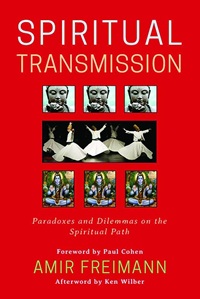
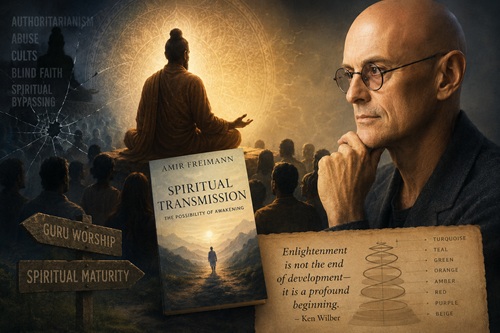
Ken Wilber's Afterword to Amir Freimann's Spiritual Transmission represents one of his most sophisticated attempts to address a longstanding controversy in spiritual traditions: the authority of the guru.[1] After decades of defending the transformative potential of spiritual realization, Wilber confronts the darker side of guru-disciple relationships: authoritarianism, abuse, cult formation, and the confusion between spiritual realization and personal infallibility. The essay is especially significant because Wilber now appears to accept a criticism that has long been directed at traditional enlightenment systems: awakening does not automatically make a person psychologically mature, ethically developed, or intellectually reliable. Yet this important revision also exposes deeper tensions within Wilber's own Integral Theory. The Central Question: When Is Surrender to a Guru Justified?Wilber begins by identifying the fundamental issue behind Guru Yoga: autonomy. Traditional guru traditions require a student to surrender aspects of personal judgment and self-direction to someone regarded as more advanced. The rationale is that the ego itself is the obstacle to realization, and therefore surrendering egoic control allows deeper awareness to emerge. Wilber recognizes the apparent contradiction: How can giving up autonomy lead to greater freedom? His answer is that temporary surrender can function as a method for transcending a limited sense of self. But this justification depends entirely on a crucial assumption: that the guru possesses a genuine realization unavailable to the student. The entire system therefore stands or falls on the question of the guru's authority. The Two Truths Doctrine: The Foundation of Wilber's ArgumentWilber explains Guru Yoga through the classical distinction between relative truth and ultimate Truth. Relative truth concerns the ordinary world: science, history, biology, psychology, and everyday facts. Ultimate Truth concerns the realization of Spirit, the Ground of Being, or nondual awareness. According to Wilber, traditional gurus were considered infallible because they had access to ultimate Truth, even though they might lack knowledge of relative truths. This distinction becomes the foundation for his later critique of traditional guru systems. The Historical Failure of Guru InfallibilityWilber argues that traditional societies often confused spiritual realization with universal wisdom. Because the guru was regarded as enlightened, followers assumed that the guru was also morally, psychologically, and intellectually superior in every area. Modern knowledge has made this impossible to maintain. A person may have profound mystical experiences while still holding outdated views about women, slavery, politics, science, or human psychology. The discovery of developmental psychology further undermines the traditional model: spiritual awakening and psychological development are separate dimensions. Waking Up and Growing Up: Wilber's Most Important DistinctionPerhaps the strongest part of the Afterword is Wilber's distinction between: Waking Up: states of consciousness associated with meditation, enlightenment, and nondual awareness. Growing Up: developmental stages involving cognitive, moral, emotional, and cultural maturity. This distinction explains how someone can have profound mystical experiences while remaining psychologically immature. A guru may be deeply awakened yet still operate from ethnocentric, authoritarian, or narcissistic structures. In this respect, Wilber offers a powerful critique of the traditional assumption that enlightenment automatically produces wisdom. The Wilberian Solution: A New Integral Guru ModelWilber proposes that the guru should no longer be regarded as an ontologically superior being but as a functional teacher. The guru may have expertise in methods of awakening but should not be treated as infallible in matters of science, ethics, politics, or personal relationships. This resembles the relationship between a meditation teacher and a professor: authority should be limited to the domain of actual competence. This is a significant modernization of the guru principle. The Problem of Spiritual TransmissionThe remaining difficulty concerns Wilber's acceptance of spiritual transmission itself. Wilber argues that awakened teachers can transmit states of consciousness through subtle energetic influence, traditionally known as shaktipat. But here the argument becomes more problematic. Unlike psychological influence—which is well established through empathy, emotional contagion, attachment, and social learning—spiritual transmission as a literal transfer of awakened awareness remains difficult to verify scientifically. The question becomes: Is transmission a demonstrable phenomenon, or is it an interpretation of powerful interpersonal and contemplative experiences? The Missing Empirical FoundationWilber frequently distinguishes ultimate truth from relative truth, but the Afterword still assumes that certain metaphysical claims are true: • that enlightenment reveals the Ground of Being, • that there is a True Self, • that consciousness can directly access ultimate Reality, • that spiritual states correspond to objective dimensions of existence. These claims may be meaningful within contemplative traditions, but they remain philosophically controversial. The experience of unity does not necessarily prove that reality itself is unified in the metaphysical sense. The Paradox of Wilber's Own Earlier WorkThe Afterword creates an interesting tension with Wilber's earlier writings. If enlightenment provides no knowledge about relative reality, then why did Wilber repeatedly argue that evolution itself expresses Spirit? Why describe Eros as an intrinsic evolutionary force? Why criticize science for ignoring Spirit? The Afterword appears to impose a boundary that much of Integral Theory previously crossed. Frank Visser's Longstanding Critique: The Epistemological Boundary ProblemOne of Frank Visser's central criticisms of Wilber has always concerned this boundary. The issue was never whether mystical experiences exist or whether spirituality has value. The issue was whether mystical experience provides privileged knowledge about the structure and direction of the cosmos. Visser argued that Wilber often moved from a valid observation “people experience profound states of unity” to a much stronger metaphysical conclusion “therefore the universe itself is the unfolding of Spirit.” The Afterword partially acknowledges this distinction, but it does not fully resolve it. The Remaining Question: Is Enlightenment Knowledge or Transformation?The deepest philosophical issue remains: Does awakening reveal what reality ultimately is? Or does it transform how reality is experienced? If enlightenment is primarily a transformation of consciousness, its value remains enormous. It can deepen compassion, reduce suffering, and reshape one's relationship with existence. But if enlightenment is claimed to reveal the actual metaphysical structure of reality, stronger evidence is required. Conclusion: A Valuable Revision with Unfinished ConsequencesWilber's Afterword represents a genuine evolution in his thinking. His recognition that spiritual realization does not guarantee psychological maturity is an important contribution to contemporary discussions of spirituality and power. Yet the same analysis raises questions about the foundations of Integral Theory itself. Once Waking Up is separated from knowledge of the relative world, many of Wilber's larger metaphysical claims require re-examination. The challenge for Integral Theory is therefore clear: Can it preserve the transformative insights of spiritual traditions without turning those insights into unsupported claims about the architecture of the universe? That remains the unresolved question at the heart of Wilber's project. NOTES[1] Amir Freimann, Spiritual Transmission: Paradoxes and Dilemmas on the Spiritual Path, Monkfish Book Publishing, 2018. Freimann kindly shared the text of Wilber's Afterword with me. For more on Freimann, see: Tomer Persico, "Andrew Cohen and the Decline of the Guru Institution, Part II: Interview with Amir Freimann", www.integralworld.net, August 2013.
Widget is loading comments...
|