|
TRANSLATE THIS ARTICLE
Integral World: Exploring Theories of Everything
An independent forum for a critical discussion of the integral philosophy of Ken Wilber
  Frank Visser, graduated as a psychologist of culture and religion, founded IntegralWorld in 1997. He worked as production manager for various publishing houses and as service manager for various internet companies and lives in Amsterdam. Books: Ken Wilber: Thought as Passion (SUNY, 2003), and The Corona Conspiracy: Combatting Disinformation about the Coronavirus (Kindle, 2020). Frank Visser, graduated as a psychologist of culture and religion, founded IntegralWorld in 1997. He worked as production manager for various publishing houses and as service manager for various internet companies and lives in Amsterdam. Books: Ken Wilber: Thought as Passion (SUNY, 2003), and The Corona Conspiracy: Combatting Disinformation about the Coronavirus (Kindle, 2020).
Check out my other conversations with ChatGPT
WILBER ON GURU YOGA
Wilber on Guru Yoga and Spiritual Transmission Andrew Cohen and the Limits of Wilber's Guru Theory The Wilber-Combs Matrix: Can Anyone Wake Up at Any Stage? Are Subtle and Causal States Available to Everyone? True Self or House of Cards? What Does "Ultimate Truth" Actually Add? Spirit and Science: A Persistent Contradiction A Critique Vindicated? Andrew Cohen and the Limits of Wilber's Guru TheoryFrank Visser / ChatGPT
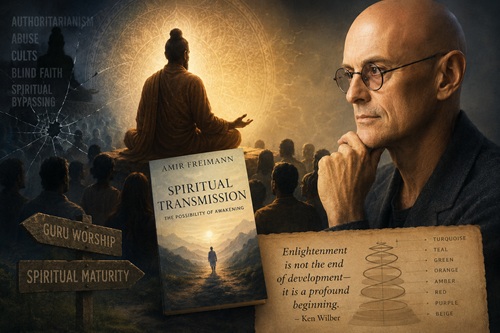 One cannot read this Afterword without recalling Ken Wilber's long and controversial association with Andrew Cohen. In many respects, the essay appears to be a philosophical response to precisely the problems that Cohen's community came to embody. Yet it also raises an uncomfortable question: if Wilber now understands the limitations of enlightened teachers so clearly, why did it take so long for him to apply these insights to one of his closest spiritual allies? For many years Wilber regarded Andrew Cohen as one of the world's foremost spiritual teachers. Cohen was frequently praised within Integral circles as a rare example of genuine Enlightenment, someone who embodied the evolutionary spirituality that Wilber himself was advocating. During the period when numerous former students were documenting patterns of humiliation, coercion, emotional abuse, and authoritarian control within Cohen's community, Wilber remained broadly supportive. Although he occasionally acknowledged that Cohen's methods might be harsh, he continued to distinguish between Cohen's realization and the controversies surrounding his teaching style. The present Afterword seems almost tailor-made to explain that distinction. Wilber argues that a guru may possess authentic Waking Up while simultaneously remaining underdeveloped in Growing Up. Enlightenment, he now insists, guarantees insight only into ultimate truth, not into psychology, ethics, interpersonal relationships, or developmental maturity. A guru may therefore transmit genuine realization while exhibiting serious personal deficiencies. Conceptually, this is a coherent position. But historically it functions as a retrospective reinterpretation of the Cohen affair rather than an explanation that guided Wilber's actions at the time. Indeed, many of the criticisms now directed at Guru Yoga by Wilber were already being made by Cohen's former students two decades ago. They argued that the assumption of the guru's infallibility created precisely the conditions under which manipulation and abuse could flourish. Wilber now agrees. The irony is that these critics were often dismissed as insufficiently mature, resistant to ego-transcendence, or incapable of understanding the demands of authentic spiritual practice. The distinction between Waking Up and Growing Up therefore risks becoming less a predictive theory than a retrospective rescue strategy. Whenever a guru behaves admirably, the theory celebrates the integration of both dimensions. Whenever a guru behaves abusively, the same theory explains the failure by appealing to uneven development. Either outcome confirms the model. This raises an obvious methodological question. Under what conceivable circumstances could the theory be falsified? If every scandal can be absorbed by adding the phrase "the teacher was advanced in Waking Up but deficient in Growing Up," then the distinction becomes difficult to test empirically. It explains everything because it excludes nothing. Wilber deserves credit for recognizing that spiritual realization alone is insufficient for ethical leadership. That represents genuine progress over traditional guru absolutism. Yet this insight also invites a more searching question than Wilber himself appears willing to ask. What if the very structure of Guru Yoga systematically encourages the inflation of charismatic authority? The problem may not simply be that some gurus fail to Grow Up. The institutional dynamics of unconditional surrender, asymmetrical power, idealization, and claims of privileged access to ultimate reality may themselves generate environments in which abuse becomes far more likely. Modern psychology, sociology, and organizational studies have repeatedly demonstrated how concentrated authority, especially when insulated from criticism, tends to corrupt judgment. Wilber's proposal is therefore only a partial solution. He wishes to preserve Guru Yoga while limiting the guru's authority to the domain of ultimate realization. Yet in practice this boundary is notoriously difficult to maintain. Once students believe that a teacher possesses direct knowledge of ultimate Reality, they naturally begin to trust that teacher's judgments in more ordinary matters as well. The transition from spiritual authority to personal authority is almost inevitable. Andrew Cohen's community illustrates precisely this dynamic. The issue was not merely whether Cohen possessed authentic realization. The issue was whether claims of spiritual realization justified extraordinary authority over the lives of others. On this question, Wilber's Afterword offers an important correction to traditional Guru Yoga but stops short of confronting the deeper structural problem. The Cohen episode therefore remains a revealing case study. It demonstrates not only the fallibility of individual gurus but also the difficulty of separating mystical authority from social power. Wilber now acknowledges the former with considerable clarity. The latter remains the unresolved challenge at the heart of his revised philosophy of spiritual transmission.
Widget is loading comments...
|