|
TRANSLATE THIS ARTICLE
Integral World: Exploring Theories of Everything
An independent forum for a critical discussion of the integral philosophy of Ken Wilber
  Frank Visser, graduated as a psychologist of culture and religion, founded IntegralWorld in 1997. He worked as production manager for various publishing houses and as service manager for various internet companies and lives in Amsterdam. Books: Ken Wilber: Thought as Passion (SUNY, 2003), and The Corona Conspiracy: Combatting Disinformation about the Coronavirus (Kindle, 2020). Frank Visser, graduated as a psychologist of culture and religion, founded IntegralWorld in 1997. He worked as production manager for various publishing houses and as service manager for various internet companies and lives in Amsterdam. Books: Ken Wilber: Thought as Passion (SUNY, 2003), and The Corona Conspiracy: Combatting Disinformation about the Coronavirus (Kindle, 2020).
Check out my other conversations with ChatGPT
WILBER ON GURU YOGA
Wilber on Guru Yoga and Spiritual Transmission Andrew Cohen and the Limits of Wilber's Guru Theory The Wilber-Combs Matrix: Can Anyone Wake Up at Any Stage? Are Subtle and Causal States Available to Everyone? True Self or House of Cards? What Does "Ultimate Truth" Actually Add? Spirit and Science: A Persistent Contradiction A Critique Vindicated? True Self or House of Cards?Frank Visser / ChatGPT
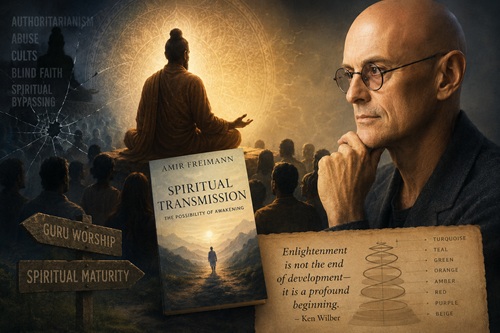 Everything in Wilber's mature philosophy ultimately rests upon a single foundational claim: enlightenment is the realization of one's True Self, identical with the Ground of Being, Spirit, or what he calls the Supreme Identity. Without this claim, much of Integral Spirituality loses its foundation. The developmental model may remain useful. The distinction between states and stages may still illuminate aspects of human psychology. Meditation may continue to provide profound benefits. But the central metaphysical conclusion—that consciousness ultimately discovers its identity with absolute Reality—would no longer follow. The striking feature of the Afterword is how effortlessly Wilber moves from phenomenology to ontology. Mystics report experiences of boundlessness, unity, timelessness, and egolessness. Wilber concludes that they have directly encountered ultimate Reality itself. Yet this conclusion is philosophically unwarranted. An experience can be absolutely convincing while still leaving open the question of what it signifies. Optical illusions feel real. Dreams feel real while we are dreaming. Psychedelic experiences often carry overwhelming certainty. None of these guarantees that the accompanying interpretation accurately describes reality. The psychology of religion has long distinguished between religious experience and religious belief. William James carefully documented mystical experiences without claiming that they settled metaphysical questions. Contemporary neuroscience likewise investigates the mechanisms underlying such experiences while remaining agnostic regarding their ontological implications. Wilber bypasses this distinction almost entirely. His argument assumes that the deepest possible experience must also reveal the deepest possible reality. Yet this assumption itself requires justification. Even the notion of a "True Self" is not universally accepted within contemplative traditions. Classical Advaita Vedanta indeed teaches an eternal Self identical with Brahman. But early Buddhism famously denies any permanent self (anatta). Many contemporary Buddhist scholars argue that nondual realization consists precisely in seeing through every substantial notion of self, including a metaphysical Self. Wilber attempts to reconcile these traditions within his Integral synthesis, but this reconciliation often appears more philosophical than historical. Significant doctrinal differences become reinterpreted as merely different perspectives on the same underlying realization. Ultimately, Wilber's entire philosophical architecture depends upon accepting a chain of propositions for which independent empirical evidence is lacking: • that mystical states reveal ultimate reality; • that ultimate reality is spiritual; • that the individual possesses a True Self; • that this Self is identical with the Ground of Being; • and that authentic enlightenment consists in realizing this identity. Each proposition may be meaningful as a metaphysical belief. Together they form an impressive philosophical system. But none has been established by empirical science, and each remains open to alternative interpretations grounded in psychology, neuroscience, and comparative philosophy. Whether one sees Integral Theory as a profound synthesis or an elaborate house of cards therefore depends almost entirely upon the strength of its first premise. If the realization of the Supreme Identity is accepted as a genuine disclosure of reality, the rest of the system follows with remarkable coherence. If that premise is questioned, much of the edifice begins to lose its foundation.
Widget is loading comments...
|