|
TRANSLATE THIS ARTICLE
Integral World: Exploring Theories of Everything
An independent forum for a critical discussion of the integral philosophy of Ken Wilber
  Frank Visser, graduated as a psychologist of culture and religion, founded IntegralWorld in 1997. He worked as production manager for various publishing houses and as service manager for various internet companies and lives in Amsterdam. Books: Ken Wilber: Thought as Passion (SUNY, 2003), and The Corona Conspiracy: Combatting Disinformation about the Coronavirus (Kindle, 2020). Frank Visser, graduated as a psychologist of culture and religion, founded IntegralWorld in 1997. He worked as production manager for various publishing houses and as service manager for various internet companies and lives in Amsterdam. Books: Ken Wilber: Thought as Passion (SUNY, 2003), and The Corona Conspiracy: Combatting Disinformation about the Coronavirus (Kindle, 2020).
Check out my other conversations with ChatGPT
KEN WILBER AND JURGEN HABERMAS
Post-Metaphysical Spirituality Habermas's Critique of Metaphysics Hans-Willi Weis's Critique of Ken Wilber The Habermas-Wilber 'Dialogue' Habermas's Post-Secular Writings Ken Wilber's Integral Spirituality Habermas's Post-Secular WritingsFrom Secularization Critique to Complementary LearningFrank Visser / Grok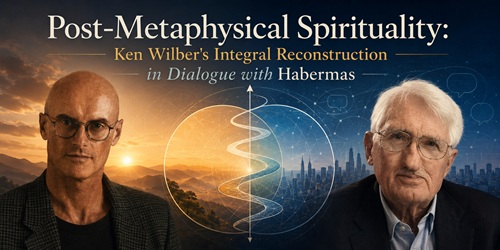 Historical Shift in Habermas's ThoughtJürgen Habermas, long associated with a secular, postmetaphysical philosophy rooted in communicative rationality and the differentiation of modernity's validity spheres (truth, rightness, sincerity), underwent a notable evolution in his later work. While never abandoning his commitment to postmetaphysical thinking or secular state neutrality, he acknowledged from the late 1980s onward—and more prominently after 2001—the persistence and renewed public relevance of religion in modern societies. This shift responds to empirical realities: the “resurgence” (or continued vitality) of religion globally, the failure of the classical secularization thesis (which predicted religion's inevitable privatization and decline with modernization), and the challenges of pluralism in Western societies. Habermas does not reject secularization processes (e.g., functional differentiation, loss of religion's overarching authority) but argues they no longer imply the disappearance or marginalization of religious voices. Key Text: “Notes on a Post-Secular Society” (2008)This influential essay (originally a lecture) is the most cited articulation of Habermas's post-secular thesis. Descriptive dimension: Western European societies (once paradigmatically secular) have become “post-secular” due to immigration, globalization, and the visibility of religion. Secular citizens can no longer view religious believers as a dwindling minority or as relics of pre-modernity. Religion retains public influence and motivational power. Normative dimension: Citizens must adopt a reflexive, self-critical stance. Both religious and secular mentalities require a “complementary learning process.” Secular reason should remain open to religious “semantic potentials” (resources of meaning, solidarity, and ethical insight that secular modernity may have depleted). Religious citizens, conversely, must accept the legitimacy of secular procedures and translate their contributions into publicly accessible (secular) language for formal political decision-making. Habermas maintains the “institutional translation proviso” (inspired by but modified from Rawls): religious arguments are welcome in the informal public sphere, but state institutions and laws require secular justifications. This preserves neutrality while allowing broader civic input. Dialogue with Joseph Ratzinger (2004)A landmark event was Habermas's public discussion with then-Cardinal Joseph Ratzinger (later Pope Benedict XVI) in Munich. Their exchange, published as The Dialectics of Secularization, highlighted convergence on the limits of unaided secular reason. • Both recognized that reason and faith are interdependent cultural resources. • Habermas acknowledged that secular reason can be “self-deceived” or “blinkered” if it dismisses religion entirely. Religion can provide corrective insights and motivational resources for justice and solidarity. • Ratzinger emphasized natural law and the need for reason to be purified or opened by faith. Habermas stressed mutual self-limitation and dialogue without conceding epistemic primacy to religion. This encounter exemplifies the post-secular attitude: not a return to religious dominance, but a dialogical relationship in which both sides learn from each other. Broader Corpus and Later Developments• Postmetaphysical Thinking II (2012/2013): Explores the uneasy but productive relationship between postmetaphysical philosophy and religion. Philosophy cannot replace or repress religion; it must engage its semantic contents. • Also a History of Philosophy (2019, multi-volume): A major genealogical reconstruction of the relationship between faith and knowledge across millennia. It traces collective learning processes leading to postmetaphysical thinking while highlighting what secular reason can still draw from religious traditions. • Other writings (e.g., contributions to An Awareness of What Is Missing, essays on religion in the public sphere) emphasize religion's role in generating “solidarity” and addressing motivational deficits in purely procedural democracies. Core Themes and Implications• Soft naturalism and fallibilism: Habermas's post-secular stance aligns with his “soft naturalism”—open to sciences without scientistic reductionism, and open to religion without fideism. • Public sphere and deliberative democracy: Religion enriches informal deliberation but must respect constitutional secularism in formal politics. • Complementary learning: The hallmark of post-secular consciousness. Secular citizens learn humility about reason's limits; religious citizens learn to engage pluralistically and critically. Critical AssessmentStrengths: Habermas offers a balanced, non-polemical alternative to aggressive secularism (e.g., new atheism) and religious revivalism. His framework supports pluralism, defends liberal institutions, and recognizes religion's potential emancipatory contributions. It has influenced debates in political theory, sociology of religion, and interfaith dialogue. Challenges and Critiques:• Some argue the “translation proviso” still burdens religious citizens asymmetrically. • Critics (including from religious perspectives or radical secularists) question whether Habermas truly opens reason enough or if residual postmetaphysical commitments limit genuine engagement with transcendence, emotion, or tradition. • Empirically, the “post-secular” label fits Western Europe better than more religious societies (e.g., the U.S. or Global South). • Philosophically, it raises questions about whether postmetaphysical thinking can fully incorporate religious insights without transforming itself. Habermas's post-secular writings represent a mature, reflective extension of his lifelong project. They defend modernity's achievements while correcting its overconfidence, advocating a more humble, dialogical, and inclusive public reason suited to pluralistic, globalized conditions. This body of work continues to shape discussions on secularism, religion, and democracy in the 21st century.
Comment Form is loading comments...
|