|
TRANSLATE THIS ARTICLE
Integral World: Exploring Theories of Everything
An independent forum for a critical discussion of the integral philosophy of Ken Wilber
  Frank Visser, graduated as a psychologist of culture and religion, founded IntegralWorld in 1997. He worked as production manager for various publishing houses and as service manager for various internet companies and lives in Amsterdam. Books: Ken Wilber: Thought as Passion (SUNY, 2003), and The Corona Conspiracy: Combatting Disinformation about the Coronavirus (Kindle, 2020). Frank Visser, graduated as a psychologist of culture and religion, founded IntegralWorld in 1997. He worked as production manager for various publishing houses and as service manager for various internet companies and lives in Amsterdam. Books: Ken Wilber: Thought as Passion (SUNY, 2003), and The Corona Conspiracy: Combatting Disinformation about the Coronavirus (Kindle, 2020).
Check out my other conversations with ChatGPT
KEN WILBER AND JURGEN HABERMAS
Post-Metaphysical Spirituality Habermas's Critique of Metaphysics Hans-Willi Weis's Critique of Ken Wilber The Habermas-Wilber 'Dialogue' Habermas's Post-Secular Writings Ken Wilber's Integral Spirituality The Habermas-Wilber 'Dialogue'A One-Sided but Influential EngagementFrank Visser / Grok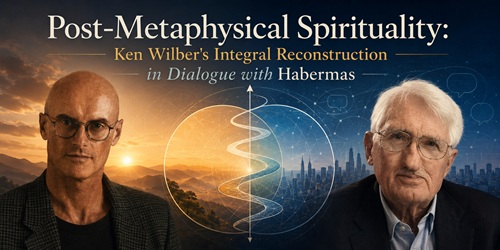 There was no direct, personal conversation or mutual exchange (e.g., letters, joint interviews, or Habermas publicly responding to Wilber). Instead, the relationship is best described as Wilber's deep, appreciative, yet critical appropriation of Habermas's ideas, culminating in Wilber's 2001 essay "On the Nature of a Post-Metaphysical Spirituality: Response to Habermas and Weis." This piece, framed as responses to questions from Edith Zundel and Frank Visser, explicitly addresses Habermas's Postmetaphysical Thinking (Nachmetaphysisches Denken) alongside a critique from Hans-Willi Weis. Wilber's Longstanding Engagement with HabermasWilber has drawn on Habermas since at least the early 1980s (e.g., in works like Up from Eden and A Sociable God). Key borrowings include: • Differentiation of validity spheres (truth, rightness, sincerity/authenticity)—which maps onto Wilber's quadrants and methodological pluralism. • Communicative action and discourse ethics—influencing Wilber's emphasis on intersubjectivity and reconstructive science. • Theory of social evolution and the lifeworld/system distinction—Wilber extends these into transpersonal and spiritual domains. Wilber has referred to Habermas as one of the greatest living philosophers and credits him with articulating the post-metaphysical turn that modernity demands. Wilber's 2001 Response: Alignment and ExtensionIn the essay, Wilber aligns with Habermas's critique of traditional metaphysics (no more totalizing ontology from a “view from nowhere,” no fusion of facts/values/meanings, emphasis on fallibilism and intersubjective justification). He accepts the need for a post-Kantian, post-Hegelian approach grounded in reconstructive methods rather than dogmatic speculation. Key extensions and differences:• Wilber agrees philosophy/science must move beyond premodern metaphysics but argues Habermas stops too early—at rational/centaur levels—missing higher transpersonal stages and states (subtle, causal, nondual). • Spirituality can be thoroughly post-metaphysical if reframed via AQAL (All Quadrants, All Levels), reconstructive science, and “broad/deep science” (injunctions like meditation + phenomenology + empiricism across quadrants). Higher realizations are not posited ontologically but reconstructed from the reports and competencies of those who attain them. • Evolution is tetra-evolutionary (all quadrants), open-ended, and produces “Kosmic habits” (empirical patterns, not Platonic forms). This avoids strong teleology while allowing directional trends (Eros/self-organization). • Wilber defends his “Great Nest” as a morphogenetic field of potentials rather than a fixed metaphysical hierarchy. Wilber sees his integral framework as fulfilling and transcending Habermas's project: honoring modernity's differentiations while integrating premodern wisdom and postmodern insights into a post-metaphysical spirituality. Habermas's Side: No Direct ResponseHabermas does not appear to have engaged Wilber's work directly or responded to the 2001 essay. His post-metaphysical thinking remains anchored in communicative rationality, discourse ethics, and a “soft naturalism” that is generally agnostic or reserved about transpersonal claims. Later Habermas (post-secular writings) shows openness to religious “semantic potentials” for meaning and solidarity, but he translates these into secular, procedural terms without endorsing higher stages of consciousness or meditative epistemologies. Secondary Interpretations and Broader Context• Supporters of the engagement: Some integral scholars (e.g., Erik Haines, Marc Gafni-influenced thinkers) see Wilber's absorption of Habermas as architecturally foundational—especially for Integral Methodological Pluralism and 8 Zones in Integral Spirituality. It grounds Wilber in pragmatist traditions via Habermas. • Critics: Figures like Weis, later integral critics, and others (e.g., in deep ecology debates) argue Wilber overextends Habermas or imports metaphysical elements (Eros, Kosmic habits, Urgrund) that Habermas would reject. Some see Wilber's system as still totalizing despite protests. • Philosophical tension: Habermas prioritizes horizontal emancipation (freeing discourse within levels) and linguistic intersubjectivity. Wilber adds vertical transformation (growth through stages/states) and a more expansive epistemology that includes contemplative modes. Significance of the EncounterThis one-sided dialogue exemplifies a broader pattern: Wilber as a synthetic thinker who engages major modern/postmodern philosophers (Kant, Habermas, postmodernity) not to refute them but to include their valid insights within a larger integral container. It highlights the challenge of extending critical theory into spiritual/transpersonal realms while remaining post-metaphysical. The exchange remains productive for debates in integral theory, transpersonal psychology, and post-secular philosophy. It raises enduring questions: Can spirituality be fully post-metaphysical? How far can reconstructive science go into contemplative domains? Where do Habermas's procedural limits meet Wilber's developmental openness? For primary reading, Wilber's 2001 essay (available in web archives) is the central document. Habermas's Postmetaphysical Thinking provides the essential backdrop. The “dialogue” continues indirectly through scholars bridging critical theory and integral approaches.
Comment Form is loading comments...
|