|
TRANSLATE THIS ARTICLE
Integral World: Exploring Theories of Everything
An independent forum for a critical discussion of the integral philosophy of Ken Wilber
  Frank Visser, graduated as a psychologist of culture and religion, founded IntegralWorld in 1997. He worked as production manager for various publishing houses and as service manager for various internet companies and lives in Amsterdam. Books: Ken Wilber: Thought as Passion (SUNY, 2003), and The Corona Conspiracy: Combatting Disinformation about the Coronavirus (Kindle, 2020). Frank Visser, graduated as a psychologist of culture and religion, founded IntegralWorld in 1997. He worked as production manager for various publishing houses and as service manager for various internet companies and lives in Amsterdam. Books: Ken Wilber: Thought as Passion (SUNY, 2003), and The Corona Conspiracy: Combatting Disinformation about the Coronavirus (Kindle, 2020).
Check out my other conversations with ChatGPT
KEN WILBER AND JURGEN HABERMAS
Post-Metaphysical Spirituality Habermas's Critique of Metaphysics Hans-Willi Weis's Critique of Ken Wilber The Habermas-Wilber 'Dialogue' Habermas's Post-Secular Writings Ken Wilber's Integral Spirituality Hans-Willi Weis's Critique of Ken Wilber'Transpersonal System Speculation'Frank Visser / Grok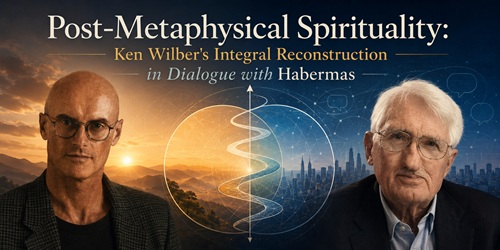 Hans-Willi Weis, a German scholar writing in the journal Transpersonale Psychologie und Psychotherapie (2001), offered one of the more substantive early European critiques of Ken Wilber's integral framework. His article, titled something like "Ken Wilbers Transpersonale Systemspekulation: Eine kritische Auseinandersetzung" ("Ken Wilber's Transpersonal System Speculation: A Critical Examination"), directly prompted Wilber's 2001 response essay "On the Nature of a Post-Metaphysical Spirituality: Response to Habermas and Weis." Weis's piece is framed within transpersonal psychology but engages broader philosophical issues, particularly around metaphysics, science, and the legitimacy of grand theoretical systems. Core of Weis's Critique Hans-Willi Weis Weis targets Wilber's evolutionary-hierarchical model (the "Great Chain/Nest of Being," later reframed as waves, streams, states, etc.) as overly speculative and insufficiently grounded. Key points include:Metaphysical Residue Despite Claims: Wilber presents his system as empirical and reconstructive, yet it retains strong metaphysical undertones. Concepts like the Great Nest, Eros (evolutionary drive), Kosmic habits, morphogenetic fields of potentials, and a teleological arc toward greater complexity/consciousness function like subtle metaphysical posits. Weis argues this "system speculation" imports perennial philosophy elements (hierarchical ontology, ultimate Spirit/Urgrund) under the guise of evidence-based reconstruction. Over-Reliance on Speculation Over Empirical Rigor: While Wilber appeals to "reconstructive science" (observing advanced individuals today to infer future/past patterns), Weis sees this as circular or selective. It privileges reports from those already aligned with Wilber's stages (e.g., transpersonal realizations) without sufficient independent verification or falsifiability. The integration of science, psychology, and spirituality risks distorting each domain to fit the AQAL map. Tension Between States and Stages: Weis (like some other critics) emphasizes direct spiritual states (e.g., meditative experiences) over Wilber's developmental stages. He questions whether the rigid stage model adequately captures the fluidity, context-dependence, and ineffability of transpersonal phenomena. Cultural and interpretive variability (e.g., self vs. no-self) may undermine claims of universal deep structures. Risk of Systematization Over Openness: Building a comprehensive "theory of everything" can lead to Procrustean fitting—shoehorning diverse traditions, data, and experiences into pre-set quadrants/levels. This risks dogmatism or authoritarianism in transpersonal contexts, where humility and direct experience should prevail. Weis's tone is critical but engaged, not dismissive. He acknowledges Wilber's ambition and contributions to transpersonal studies while urging greater caution against speculative overreach. Wilber's Response in ContextIn his reply (Part II specifically addresses Weis), Wilber defends his approach as thoroughly post-metaphysical: •He distinguishes "waves and streams" (developmental) from states, types, and the timeless Urgrund. • Levels are not rigid Platonic forms but emerge from tetra-evolution (all four quadrants) and become "Kosmic habits" via empirical patterns (echoing Sheldrake/Peirce). • Future evolution remains open and plastic; reconstruction from current pioneers provides evidence without metaphysics. • He aligns with Habermas's post-metaphysical turn while extending it into transpersonal realms via broad/deep science (phenomenology + empiricism + injunctions like meditation). Wilber argues his model honors more truths from more sources than alternatives and is grounded in evidence from those demonstrating competence in higher stages. Broader Assessment of the CritiqueStrengths of Weis's View:• It anticipates later criticisms (e.g., from Frank Visser, Jeff Meyerhoff) about Wilber's selective use of sources, potential confirmation bias in "reconstructive science," and lingering grand-narrative elements. • Highlights a genuine tension: How post-metaphysical can a system be if it posits an underlying Eros, evolutionary directionality toward nonduality, or Kosmic potentials? • Underscores verification challenges in transpersonal claims—who adjudicates "higher" stages or competence? Limitations:• Wilber's defenders note that he explicitly rejects dogmatic metaphysics in favor of fallible, evidence-oriented reconstruction. "Metaphysics" here often means pre-Kantian/Hegelian totalizing ontology, which Wilber disavows. • Weis's focus on speculation may underplay Wilber's engagement with developmental psychology (e.g., Piaget, Graves, Loevinger), phenomenology, and cross-cultural data. • The critique is strongest philosophically but may not fully engage the pragmatic, injunctive value of Wilber's maps for practitioners. Weis's intervention was timely, coinciding with Habermas's influence and Wilber's shift toward "Wilber-5" (post-metaphysical integral). It forced clarification on foundational issues that remain debated in integral circles: the balance between map-making and territory-dwelling, universality vs. contextualism, and science vs. spirituality. While Wilber integrated the challenge into his evolving framework, critics like Weis continue to remind integral theorists of the need for ongoing humility, falsifiability, and openness to disconfirmation. The exchange exemplifies productive tension between ambitious synthesis and cautious critique in transpersonal studies.
Widget is loading comments...
|