|
TRANSLATE THIS ARTICLE
Integral World: Exploring Theories of Everything
An independent forum for a critical discussion of the integral philosophy of Ken Wilber
  Frank Visser, graduated as a psychologist of culture and religion, founded IntegralWorld in 1997. He worked as production manager for various publishing houses and as service manager for various internet companies and lives in Amsterdam. Books: Ken Wilber: Thought as Passion (SUNY, 2003), and The Corona Conspiracy: Combatting Disinformation about the Coronavirus (Kindle, 2020). Frank Visser, graduated as a psychologist of culture and religion, founded IntegralWorld in 1997. He worked as production manager for various publishing houses and as service manager for various internet companies and lives in Amsterdam. Books: Ken Wilber: Thought as Passion (SUNY, 2003), and The Corona Conspiracy: Combatting Disinformation about the Coronavirus (Kindle, 2020).
Check out my other conversations with ChatGPT
KEN WILBER AND JURGEN HABERMAS
Post-Metaphysical Spirituality Habermas's Critique of Metaphysics Hans-Willi Weis's Critique of Ken Wilber The Habermas-Wilber 'Dialogue' Habermas's Post-Secular Writings Ken Wilber's Integral Spirituality Post-Metaphysical SpiritualityKen Wilber's Integral Reconstruction in Dialogue with HabermasFrank Visser / Grok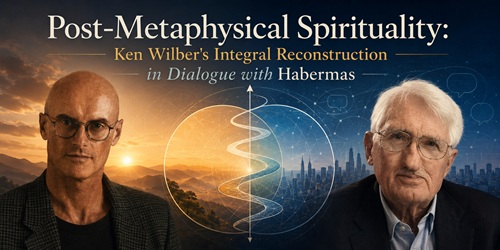 Introduction: Beyond Metaphysics and DogmaKen Wilber's 2001 piece, "On the Nature of a Post-Metaphysical Spirituality: Response to Habermas and Weis," responds to Jürgen Habermas's Post-Metaphysical Thinking and a critical article by Hans-Willi Weis.[1] Framed as an interview-style Q&A (with questions from Edith Zundel and Frank Visser), it articulates Wilber's vision of an empirically grounded, evolutionary spirituality that avoids traditional metaphysical pitfalls. Wilber positions his Integral Theory (often summarized via AQAL: All Quadrants, All Levels) as a post-Kantian, post-metaphysical framework. It integrates truths from premodern, modern, and postmodern sources while grounding higher states and stages in reconstructive science rather than ontological speculation or dogmatic authority. This approach treats spirituality as accessible through direct experience, developmental patterns, and evidence-based investigation—compatible with a scientific worldview yet open to transpersonal realities. Core Elements of Wilber's Post-Metaphysical ViewWilber rejects the perennial philosophy's rigid "Great Chain of Being" as separate ontological levels. Instead, he describes the "Great Nest" as a morphogenetic field of potentials—a gradient of evolutionary creativity (Eros, self-organization) shaped by all four quadrants: intentional (Upper-Left), behavioral (Upper-Right), cultural (Lower-Left), and social (Lower-Right). Development is partial and open: Only "waves" (levels) and "streams" (lines) are evolutionary. States (e.g., meditative), types, and the timeless "Urgrund" (Spirit/Emptiness) are not inherently developmental. Future evolution remains plastic and tetra-evolutionary—determined by interactions across quadrants, not predetermined Platonic forms. Once deep patterns emerge (e.g., Spiral Dynamics stages like purple/magic or blue/mythic-rational), they become "Kosmic habits" repeatable in individual development, akin to Sheldrake's morphic fields. Reconstructive science as method: Wilber draws on empirical and phenomenological evidence from those who have attained higher (post-rational, transpersonal) stages. This is not speculation but reconstruction: observe pioneers who reach advanced competencies today to infer likely general patterns for future collective evolution. It parallels observing rare molecular-to-cellular transitions in biology. Spirituality as post-rational and experiential: Higher stages (subtle, causal, nondual) are investigated via "broad science" or "deep science"—including meditative practices yielding repeatable satori-like experiences. These are correlated with narrow science (e.g., brain states) via quadrants. Normative claims (e.g., development toward greater compassion) are grounded in realized higher states (e.g., "Because of nirvana," per Buddha), not imposed metaphysics. Cultural and interpretive flexibility: Experiences like cosmic consciousness have universal deep features (due to human potentials) but context-bound surface expressions shaped by culture. The four quadrants help navigate debates like self vs. no-self. Wilber explicitly aligns with Habermas's post-metaphysical turn—rejecting dogmatic, pre-Kantian ontology—while extending it into transpersonal domains that Habermas's framework stops short of (e.g., at rational/centaur levels). Strengths: Integration and OpennessWilber's model is ambitious and inclusive. It honors diverse traditions without privileging any via authority, offering a "map" that integrates more truths than narrower systems. By emphasizing practice alongside theory, it supports real meditative paths while warning against reductionism (e.g., mythic religion mistaken for all spirituality). Its openness to tetra-evolution and rejection of closed teleology addresses postmodern critiques of grand narratives. The reconstructive approach provides a pragmatic bridge between science and spirituality, potentially appealing in a secular age. Critical Assesesment: Ambiguities and ChallengesDespite its strengths, Wilber's post-metaphysical claim invites scrutiny. He disavows metaphysics vigorously ("If metaphysics means thought without evidence, there is not a metaphysical sentence in this entire book"), yet retains concepts like Spirit, Eros, Urgrund, and Kosmic habits that risk functioning as subtle metaphysical posits. The "morphogenetic field of potentials" and self-organizing creativity echo process philosophy or emergentism but still posit an underlying drive toward complexity and transcendence. Critics like Weis (as addressed) argue this imports perennial assumptions under empirical guise. The reliance on "those who have demonstrated competence" in higher stages raises questions of verification and authority. Who adjudicates competence? How does one avoid circularity or in-group bias in reconstructive science? Cross-cultural evidence for deep structures exists, but surface variability and interpretive issues (e.g., cultural mediation of states) complicate universality claims. Wilber acknowledges this via quadrants but may underplay radical incommensurability.Evolutionarily, the predictive power is modest: general deep patterns yes, but specific forms remain open. This humility is admirable yet leaves the framework more descriptive than strongly falsifiable in its transpersonal extensions. Normative grounding in higher realization ("IF you value compassion...") is pragmatic but depends on accepting those realizations as desirable or "higher"—a move that some strict naturalists or pluralists will reject as smuggling in evaluation. Finally, while Wilber critiques both mythic dogma and narrow scientism, practical application can blur into over-systematization (AQAL as a "theory of everything"), potentially limiting the "fresh eyes" approach to spirituality he sometimes endorses. Weis's emphasis on states over stages highlights a valid tension: maps are useful, but lived experience and integration matter most. Conclusion: A Valuable but Incomplete ProjectWilber's post-metaphysical spirituality represents a sophisticated attempt to salvage evolutionary and contemplative wisdom after the critiques of Kant, Habermas, and postmodernity. It offers a compelling framework for those seeking integration in a fragmented world—one that is evidence-oriented, developmentally nuanced, and spiritually aspirational. However, it does not fully escape the metaphysical shadows it critiques, and its empirical claims require ongoing rigorous, intersubjective validation. As a map rather than the territory, it excels at orientation but reminds practitioners that concrete practice, guided experience, and openness remain essential. In an era demanding both depth and critical rigor, Wilber's vision merits engagement—even if its full realization stays, fittingly, open-ended. NOTES[1] Ken Wilber, "On the Nature of a Post-Metaphysical Spirituality, Response to Habermas and Weis", March 2006, archived from shambhala.com. The interview appeared first in German in Transpersonale Psychology und Psychotherapie, 7(2), 2001, pp. 33-49. The interview questions were supplied by Frank Visser and Edit Zundel.
Widget is loading comments...
|