|
TRANSLATE THIS ARTICLE
Integral World: Exploring Theories of Everything
An independent forum for a critical discussion of the integral philosophy of Ken Wilber
  Frank Visser, graduated as a psychologist of culture and religion, founded IntegralWorld in 1997. He worked as production manager for various publishing houses and as service manager for various internet companies and lives in Amsterdam. Books: Ken Wilber: Thought as Passion (SUNY, 2003), and The Corona Conspiracy: Combatting Disinformation about the Coronavirus (Kindle, 2020). Frank Visser, graduated as a psychologist of culture and religion, founded IntegralWorld in 1997. He worked as production manager for various publishing houses and as service manager for various internet companies and lives in Amsterdam. Books: Ken Wilber: Thought as Passion (SUNY, 2003), and The Corona Conspiracy: Combatting Disinformation about the Coronavirus (Kindle, 2020).
Check out my other conversations with ChatGPT
THE COSMOS OF CARL SAGAN
Sagan's The Varieties of Scientific Experience Why Carl Sagan Is Not a Reductionist Sagan's Cosmos and Wilber's Kosmos Wilber, Sagan, Firmage, an Unfinished Bridge The Necessity of Skeptical Literacy An Unfinished BridgeWilber, Sagan, Joe Firmage, and a Failed Attempt at Scientific LegitimacyFrank Visser / ChatGPT
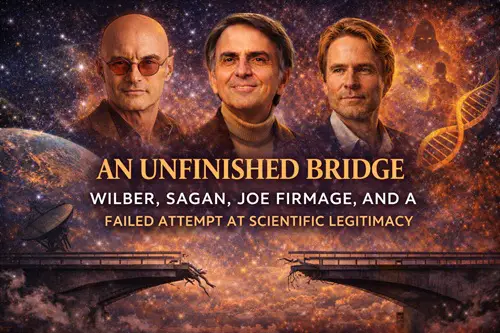 Introduction: A Curious IntersectionAt first sight, the names Carl Sagan, Ken Wilber, and Joe Firmage do not seem to belong in the same intellectual constellation. Sagan was a public-facing scientist whose authority rested on methodological naturalism, epistemic humility, and fierce resistance to metaphysical inflation. Wilber is a metaphysical system-builder, proposing a spiritually teleological Kosmos structured by levels, quadrants, and developmental inevitabilities. Joe Firmage, a former tech entrepreneur turned spiritual futurist, appears as the unlikely intermediary between these two worlds. Yet, in the late 1990s and early 2000s, there was a genuine—if ultimately unsuccessful—attempt to symbolically and institutionally link Wilber's Integral project to Sagan's scientific legacy. This episode is revealing, not merely as an historical curiosity, but as a case study in the limits of Integral Theory's reach beyond its own subculture.[1] Joe Firmage: The Bridge FigureJoe Firmage, once a prominent figure in Silicon Valley and briefly CEO of USWeb, underwent a highly publicized spiritual and intellectual transformation. He became interested in consciousness studies, UFO phenomena, post-materialist science, and large-scale syntheses of science and spirituality. Firmage moved in circles that overlapped with New Age thinkers, technologists, and alternative cosmologists. Crucially, Firmage also collaborated with Ann Druyan, Carl Sagan's widow and long-time creative partner, on several projects related to science education and cosmic perspective. Druyan, fiercely protective of Sagan's intellectual legacy, has consistently emphasized skepticism, empiricism, and resistance to pseudoscience—even while celebrating wonder and awe. Firmage thus appeared, at least superficially, to offer Wilber something highly desirable: a potential line of association with Sagan's cultural authority. Wilber's Strategic Interest in SaganWilber had long sought validation from mainstream science without relinquishing his spiritual metaphysics. His rhetoric frequently invoked evolution, cosmology, and complexity theory, while lamenting that science remained trapped in “flatland.” Sagan—universally respected, scientifically orthodox, yet rhetorically rich in cosmic meaning—represented an ideal symbolic ally. Importantly, Wilber did not need Sagan's explicit endorsement. What he needed was proximity: a suggestion that Integral Theory could be seen as a legitimate heir to Sagan's vision of cosmic meaning, merely “completing” it by adding interiority and Spirit. Joe Firmage appeared to offer exactly this possibility. Through him, Wilber's circle could gesture toward continuity with Sagan's legacy without confronting the deep philosophical incompatibility between their worldviews. The Fundamental IncompatibilityThe attempted connection stalled because it ran into an immovable obstacle: Sagan's epistemic commitments. Sagan's worldview, as articulated in Cosmos and The Varieties of Scientific Experience, rejects precisely the moves that define Wilber's system: No Teleological Evolution Sagan explicitly denied that evolution has intrinsic direction, purpose, or spiritual momentum. No Ontological Privileging of Consciousness Consciousness is a biological phenomenon, not a cosmic principle. No Special Epistemic Status for Mystical Experience Subjective depth does not license claims about reality's metaphysical structure. No Hidden Realms Beyond Evidence Subtle, causal, or nondual domains are not “deeper” explanations, but unsupported additions. Ann Druyan has repeatedly drawn hard lines against precisely the kinds of speculative metaphysics that Integral Theory normalizes. Any attempt to fold Sagan into an Integral narrative would therefore have required either selective reading or symbolic appropriation—both of which Druyan resisted. Why the Attempt Failed QuietlyNotably, this episode did not end in open conflict. There was no public repudiation, no dramatic break. The connection simply failed to materialize. This quiet failure is itself instructive. Scientific Authority Cannot Be Borrowed Indefinitely Sagan's credibility derived from consistency. His legacy could not be used to legitimize a worldview that contradicts his core principles without explicit distortion. Integral Theory Lacks External Corrective Mechanisms Within the Integral community, Wilber's cosmology is rarely subjected to rigorous external critique. Outside that community, however, its metaphysical claims fail to meet basic standards of evidence. Symbolic Association Is Not Intellectual Continuity Admiration for wonder, awe, and cosmic perspective does not imply agreement on ontology. The Integral project mistook shared rhetoric for shared epistemology. Integral World's Perspective: A Missed Reality CheckFrom the vantage point of Integral World, this stalled connection illustrates a recurring pattern: Wilber's project repeatedly reaches toward mainstream science for legitimacy, while simultaneously rejecting the constraints that make scientific authority meaningful. Had Wilber seriously engaged with Sagan—not as a precursor to be “included and transcended,” but as a critic—Integral Theory might have undergone genuine self-correction. Instead, Sagan remained a figure to be symbolically admired from a safe distance. Joe Firmage's intermediary role only underscores the point: charisma, networks, and ambition cannot bridge fundamental philosophical divides. Conclusion: What the Failure RevealsThe failed attempt to link Integral Theory to Carl Sagan's legacy was not an accident of personalities or timing. It failed because Sagan represents an epistemic line that Wilber's system cannot cross without unraveling itself. Sagan's Cosmos is vast but restrained; Wilber's Kosmos is expansive but evidentially unconstrained. Where Sagan demanded humility before what we do not know, Wilber supplied metaphysical certainty dressed in integrative language. That the bridge was never completed is, in retrospect, a testament to the durability of Sagan's legacy—and a revealing moment in the history of Integral Theory's search for scientific legitimacy. NOTE[1] I recall attending around 2000-2001 an Integral Institute gathering about Integral Education, at which Firmage was present as well. Plans were discussed with Firmage to set up a huge online platform in the spirit of Cosmos, and at a later moment add more integral (psychological and spiritual) topics. I was the only one(!) who expressed his reservations about not messaging the true intentions of Integral Institute from the start. These plans never materialized, the Internet Bubble burst and Firmage had to make other plans.
Widget is loading comments...
|