|
TRANSLATE THIS ARTICLE
Integral World: Exploring Theories of Everything
An independent forum for a critical discussion of the integral philosophy of Ken Wilber
  Frank Visser, graduated as a psychologist of culture and religion, founded IntegralWorld in 1997. He worked as production manager for various publishing houses and as service manager for various internet companies and lives in Amsterdam. Books: Ken Wilber: Thought as Passion (SUNY, 2003), and The Corona Conspiracy: Combatting Disinformation about the Coronavirus (Kindle, 2020). Frank Visser, graduated as a psychologist of culture and religion, founded IntegralWorld in 1997. He worked as production manager for various publishing houses and as service manager for various internet companies and lives in Amsterdam. Books: Ken Wilber: Thought as Passion (SUNY, 2003), and The Corona Conspiracy: Combatting Disinformation about the Coronavirus (Kindle, 2020).
Check out my other conversations with ChatGPT
THE COSMOS OF CARL SAGAN
Sagan's The Varieties of Scientific Experience Why Carl Sagan Is Not a Reductionist Sagan's Cosmos and Wilber's Kosmos Wilber, Sagan, Firmage, an Unfinished Bridge The Necessity of Skeptical Literacy Why Sagan Is Not a ReductionistOr a Quadrant AbsolutistFrank Visser / ChatGPT
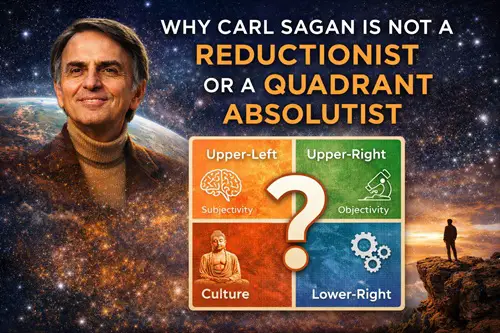 Within Integral Theory, Carl Sagan would almost certainly be classified as a “flatland” thinker: someone who allegedly reduces interior depth, values, and meaning to exterior, third-person descriptions. He might further be accused of quadrant absolutism, privileging the Upper-Right (objective, empirical science) and Lower-Right (cosmology) at the expense of the Upper-Left (subjective experience) and Lower-Left (culture and meaning). These charges, however, do not withstand careful scrutiny. 1. Sagan's Explicit Respect for SubjectivitySagan never denies the reality or importance of inner experience. On the contrary, The Varieties of Scientific Experience repeatedly emphasizes awe, reverence, humility, and existential disorientation as legitimate—and even necessary—responses to the cosmos. What Sagan rejects is not subjectivity as such, but the reification of subjective states into ontological claims about the universe. In Wilberian terms, Sagan fully acknowledges the Upper-Left: feelings of transcendence, unity, and moral urgency are treated as real psychological events. What he resists is the move from “this experience feels sacred” to “therefore the cosmos is literally sacred in a metaphysical sense.” This is not reductionism; it is epistemic discipline. 2. Cultural Critique Without Cultural RelativismSagan's treatment of religion is often misread as a simplistic debunking exercise. In fact, he devotes substantial attention to the historical and cultural embeddedness of religious systems—their symbolic power, moral aspirations, and social consequences. This places him squarely within the Lower-Left quadrant, analyzing shared meanings, myths, and value systems as collective phenomena. Yet Sagan refuses to grant cultures automatic epistemic authority. The mere fact that a belief is ancient, widespread, or meaningful does not make it true. Integral Theory often treats cultural depth as a partial validation of metaphysical claims; Sagan does not. Again, this is not quadrant denial, but quadrant non-absolutization. 3. The Upper-Right as Constraint, Not Total ExplanationSagan does privilege empirical science—but not as a total worldview that dissolves all other dimensions into physics. Rather, science functions as a constraint system: a method for ruling out explanations that conflict with well-established evidence. This is a crucial distinction. Reductionism claims that higher-level phenomena are nothing but lower-level processes. Sagan makes no such claim about consciousness, morality, or meaning. He argues instead that whatever explanations we offer in these domains must not contradict what we reliably know about the physical world. In Integral jargon, the Upper-Right does not “colonize” the other quadrants; it sets boundary conditions for metaphysical speculation. 4. No Collapse of Normativity into MechanismA hallmark of genuine reductionism is the collapse of values into mechanisms: ethics becomes biochemistry; meaning becomes neural noise. Sagan explicitly resists this move. Moral responsibility, for him, is heightened—not diminished—by the absence of cosmic guarantees. Human values are not illusions, but fragile achievements that require conscious maintenance. This position is deeply anti-reductionist. It affirms emergent normativity without invoking transcendental realms, subtle bodies, or teleological forces. Integral Theory often treats emergence as evidence for Spirit-in-action; Sagan treats it as evidence for ethical seriousness in a silent universe. 5. Why the Charge of “Flatland” Ultimately FailsThe accusation of flatland thinking typically rests on an equivocation. It conflates ontological modesty with experiential denial. Sagan practices the former while explicitly honoring the latter. He insists that inner experiences, cultural meanings, and moral commitments are real and significant—while denying that they license speculative metaphysics. If anything, Sagan's position exposes a weakness in Integral Theory's quadrant model: the tendency to assume that unless every quadrant is metaphysically grounded, something essential has been “left out.” Sagan's work demonstrates that one can respect all quadrants phenomenologically while remaining naturalistic ontologically. ConclusionCarl Sagan is not guilty of reductionism because he does not explain away subjectivity, culture, or value. He is not guilty of quadrant absolutism because he does not claim that science exhausts reality. What he does claim is more demanding: that meaning, ethics, and awe must be earned without metaphysical shortcuts. For Integral World, this makes Sagan not a flatland caricature, but a crucial counterexample—one that shows how intellectual depth can be preserved without invoking Spirit, Eros, or hidden dimensions beyond the reach of evidence.
Comment Form is loading comments...
|