|
TRANSLATE THIS ARTICLE
Integral World: Exploring Theories of Everything
An independent forum for a critical discussion of the integral philosophy of Ken Wilber
  Frank Visser, graduated as a psychologist of culture and religion, founded IntegralWorld in 1997. He worked as production manager for various publishing houses and as service manager for various internet companies and lives in Amsterdam. Books: Ken Wilber: Thought as Passion (SUNY, 2003), and The Corona Conspiracy: Combatting Disinformation about the Coronavirus (Kindle, 2020). Frank Visser, graduated as a psychologist of culture and religion, founded IntegralWorld in 1997. He worked as production manager for various publishing houses and as service manager for various internet companies and lives in Amsterdam. Books: Ken Wilber: Thought as Passion (SUNY, 2003), and The Corona Conspiracy: Combatting Disinformation about the Coronavirus (Kindle, 2020).
Check out my other conversations with ChatGPT
THE COSMOS OF CARL SAGAN
Sagan's The Varieties of Scientific Experience Why Carl Sagan Is Not a Reductionist Sagan's Cosmos and Wilber's Kosmos Wilber, Sagan, Firmage, an Unfinished Bridge The Necessity of Skeptical Literacy Carl Sagan's The Varieties of Scientific ExperienceAnd the Limits of IntegrationFrank Visser / ChatGPT
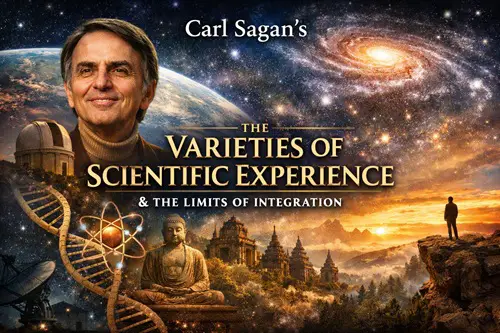 IntroductionCarl Sagan's Gifford Lectures, delivered in 1985 and posthumously published as The Varieties of Scientific Experience: A Personal View of the Search for God (2006), occupy a distinctive position in the long conversation between science and religion. Unlike many Gifford lecturers, Sagan did not attempt to reconcile theology and science by expanding scientific concepts into metaphysical systems, nor did he retreat into a polite agnosticism that leaves religious claims unexamined. Instead, he approached religion as a cultural, psychological, and historical phenomenon, subject to the same critical scrutiny as any other human enterprise. For readers of Integral World—long accustomed to grand syntheses, spiritualized cosmologies, and claims of “integration” between science and Spirit—Sagan's lectures are instructive precisely because of what they refuse to do. They offer an alternative model of engagement: one that honors wonder, depth, and ethical seriousness without abandoning methodological naturalism or importing metaphysical surplus. The Gifford Context: A Stage for Metaphysical AmbitionThe Gifford Lectures were explicitly established to promote “natural theology”—knowledge of God derived from reason and experience rather than revelation. Over time, they became a magnet for ambitious thinkers attempting to bridge science, philosophy, and religion. William James's The Varieties of Religious Experience (1902) set an influential precedent by treating religious experience as a legitimate subject of psychological inquiry without endorsing its supernatural claims. Sagan's title is a deliberate echo of James, but the resemblance ends there. Where James was willing to suspend judgment about the ontological status of religious experiences, Sagan insists on a firmer epistemic boundary. Experiences are real; interpretations are optional. And interpretations that posit transcendent agencies or cosmic purposes must meet the same evidential standards as any other explanatory claim. This stance already places Sagan at odds with much of what passes for “integral” discourse. Sagan's Core Argument: Awe Without IllusionAt the heart of The Varieties of Scientific Experience lies a simple but demanding proposition: science does not impoverish the human spirit; it disciplines it. Sagan repeatedly returns to themes that Integral World readers will recognize, but with crucial differences in emphasis: Awe and TranscendenceSagan affirms cosmic awe, humility before immensity, and a sense of belonging to a vast evolutionary story. But this transcendence is immanent and empirical, not metaphysical. The universe is sufficient as it is; it does not point beyond itself. Religion as a Human ArtifactReligions are treated as evolving cultural systems shaped by historical conditions, power structures, and cognitive biases. Sagan is particularly attentive to how claims of divine authority have justified cruelty, dogmatism, and epistemic closure. The God HypothesisSagan does not deny God dogmatically; he evaluates the hypothesis probabilistically. A God who intervenes in the world leaves traces. A God who leaves no traces explains nothing. The more abstract and unfalsifiable God becomes, the less explanatory work it does. Ethics Without Cosmic GuaranteesMoral responsibility, for Sagan, arises precisely because the universe offers no moral safety net. There is no karmic bookkeeping system, no teleological assurance that history bends toward enlightenment. That burden falls on us. This combination—existential seriousness without metaphysical consolation—is rare in the Gifford tradition and largely absent in Integral Theory. Integral Theory as Anti-SaganKen Wilber and his successors frequently invoke science, evolution, and cosmology while simultaneously subordinating them to a spiritual meta-narrative. Evolution becomes Eros; complexity implies purpose; consciousness is read as evidence of transcendent depth. The scientific story is accepted only insofar as it can be “included and transcended.” From a Saganesque perspective, this move is deeply problematic: Category ErrorsEmpirical descriptions are quietly converted into metaphysical prescriptions. Evolutionary complexity is treated as spiritual ascent. This is precisely the sort of inference Sagan warns against. Immunization Against FalsificationWhen spiritual claims are said to operate in “subtle” or “causal” realms beyond empirical reach, they become immune to evidence—positive or negative. Sagan regarded this as a red flag, not a sophistication. Romanticization of Pre-Scientific WorldviewsIntegral discourse often rehabilitates ancient cosmologies as “mythic” or “symbolic” truths that science allegedly flattens. Sagan, by contrast, insisted that modern science represents a hard-won moral and epistemic advance, not a fall from primordial wisdom. In short, Integral Theory does what Sagan explicitly refused to do: it treats science as a partial language whose deepest meaning must be supplied from elsewhere. Integral World and the Sagan AlternativeIntegral World, as a long-standing critical counterweight to Wilberian metaphysics, is a natural home for Sagan's sensibility. The site's emphasis on: • methodological naturalism, • intellectual honesty about scientific limits, • resistance to spiritualized evolution, • and exposure of metaphysical overreach, aligns closely with the spirit of The Varieties of Scientific Experience. Sagan offers Integral World something more valuable than another critique of mysticism: a positive exemplar. He shows how one can speak of meaning, value, and cosmic context without smuggling theology back in under the banner of “integration.” Where Integral Theory seeks reassurance that the universe is on our side, Sagan asks whether that expectation itself is a relic of anthropocentric thinking. Conclusion: A Different Kind of IntegrationIf “integration” is to mean anything intellectually serious, Sagan suggests it must begin with disciplined restraint. Not every powerful experience implies a deeper ontology. Not every pattern implies purpose. And not every hunger for meaning warrants metaphysical fulfillment. The Varieties of Scientific Experience stands as a quiet rebuke to spiritual systems that want science's authority without accepting its constraints. For Integral World, Sagan represents a model of post-religious depth: a worldview that preserves wonder, ethical urgency, and humility precisely by refusing to over-interpret the cosmos. In an intellectual culture still tempted by cosmic flattery, Sagan's message remains bracing: the universe is not obliged to make sense on our terms—and that, far from being nihilistic, is what makes our responsibility to understand it, and to care for one another, so profound.
Widget is loading comments...
|