|
TRANSLATE THIS ARTICLE
Integral World: Exploring Theories of Everything
An independent forum for a critical discussion of the integral philosophy of Ken Wilber
  Frank Visser, graduated as a psychologist of culture and religion, founded IntegralWorld in 1997. He worked as production manager for various publishing houses and as service manager for various internet companies and lives in Amsterdam. Books: Ken Wilber: Thought as Passion (SUNY, 2003), and The Corona Conspiracy: Combatting Disinformation about the Coronavirus (Kindle, 2020).
Check out my other conversations with ChatGPT
Spiral Dynamics Classics:
Don Beck and the Spiral of Development Clare W. Graves: The Man Behind Spiral Dynamics Clare W. Graves and the Momentous Leap A critical review of Spiral Dynamics A critical review of Spiral Dynamics in Action Spiral DynamicsA Critical Review of Don Beck and Christopher Cowan's Developmental TheoryFrank Visser / ChatGPT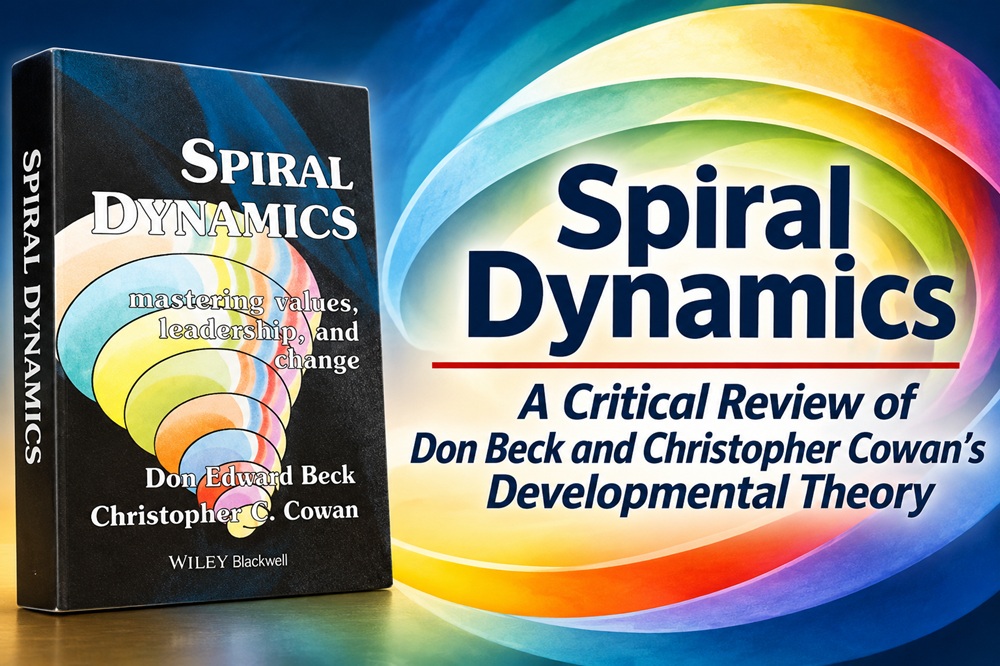
Introduction: A theory that promises to explain everythingFew developmental theories have achieved the cultural influence of Spiral Dynamics: Mastering Values, Leadership, and Change (1996), written by Don Edward Beck and Christopher C. Cowan. Inspired by the psychological work of Clare W. Graves, the book presents an ambitious account of the evolution of human values, worldviews, and organizational behavior. Its central proposition is that human beings and societies develop through successive systems of thinking, each emerging in response to changing life conditions. The theory has proved remarkably attractive to consultants, organizational developers, leadership trainers, political strategists, and the broader integral community. Its appeal is easy to understand. It offers a relatively simple vocabulary for discussing cultural differences, ideological conflicts, historical change, and personal development. By assigning colors to different value systems, it makes an otherwise complicated developmental model accessible to a wide audience. But accessibility is not the same as scientific validity. And a framework that appears capable of explaining almost every human worldview should invite particular scrutiny. The central question of this review is therefore not whether Spiral Dynamics offers interesting observations. It certainly does. The question is whether Beck and Cowan have established a sufficiently reliable developmental theory, whether its categories correspond to identifiable psychological realities, and whether its claims about the evolution of human consciousness are supported by evidence. My conclusion is mixed but ultimately critical: Spiral Dynamics is a useful interpretive framework for discussing value differences, but its status as a scientifically established theory of human development is considerably less convincing.1. From Clare Graves to Spiral DynamicsBeck and Cowan did not invent the underlying developmental architecture. Their principal intellectual source was American psychologist Clare W. Graves (1914-1986), whose research led him to formulate what he called the Emergent Cyclical Levels of Existence Theory. Graves proposed that human psychological systems develop through interactions between two factors: the conditions of existence confronting individuals and the neurological or psychological capacities available to respond to those conditions. Human development, in this account, is neither simply an unfolding of innate potential nor merely a product of environmental conditioning. It is an interaction between the individual and the surrounding world. Graves identified a sequence of alternating value orientations, which Beck and Cowan subsequently translated into a memorable color scheme:
2. The eight value systems: an attractive but problematic classificationThe book's most recognizable feature is its classification of human value systems. Each color represents a particular way of organizing experience, responding to problems, and making sense of existence. Beige - Survival The priority is biological survival: food, shelter, safety, and immediate physical needs. This is the most basic orientation, associated with instinctive responses. Purple - Tribalism Security through kinship, tradition, ritual, and belonging. The world is understood through ancestral customs, magical thinking, and group identity. Red - Power Self-assertion, dominance, immediate gratification, and the exercise of power. The individual seeks recognition and freedom from constraints. Blue - Order Authority, discipline, duty, moral codes, and enduring truths. Society is organized around rules, legitimate institutions, and transcendent principles. Orange - Achievement Rationality, scientific inquiry, competition, individual achievement, technological progress, and material success.Green - PluralismEquality, inclusion, empathy, dialogue, ecological awareness, and sensitivity to cultural differences. Yellow - Integrative thinking Systems thinking, flexibility, complexity, functional hierarchies, and the capacity to integrate competing perspectives. Turquoise - Holistic consciousness Global interconnectedness, ecological integration, collective well-being, and a holistic understanding of existence. There is an intuitive appeal to these descriptions. Most readers will recognize aspects of their own experience and of the societies around them. We can identify tribal loyalties, authoritarian tendencies, entrepreneurial ambition, egalitarian ideals, and systems-oriented thinking without much difficulty. But this recognition is not sufficient to validate the developmental sequence. The categories are broad enough to accommodate a considerable variety of human behaviors. They also combine several different dimensions: cognitive complexity, moral orientation, social organization, religious belief, political ideology, and motivational priorities. These dimensions do not necessarily develop together. A person can be scientifically sophisticated, politically authoritarian, religiously traditional, and economically egalitarian. Another person can be technologically advanced while remaining deeply tribal in social relationships. A successful entrepreneur may be generous and community-oriented, while an academic intellectual may be highly competitive and status-conscious. Which color should we assign to such individuals? The problem is not that human beings are complicated. The problem is that the model sometimes gives the impression that this complexity can be adequately captured by assigning people or groups a dominant developmental color.The problem of classificationThe eight categories are not mutually exclusive psychological compartments. They are idealized descriptions, and their boundaries are difficult to establish objectively. If someone displays authoritarian behavior, is that evidence of Blue, Red, or perhaps an Orange strategy employing authoritarian methods? If someone advocates ecological sustainability, is that Green or Turquoise? If a political movement combines nationalism, technological modernization, and social welfare, which value system defines it? The answer often depends on the interpreter. This introduces a serious methodological difficulty: different Spiral Dynamics practitioners may classify the same individual or organization differently, especially when the evidence is ambiguous. A scientifically useful classification system would need clear operational definitions, independent assessments, and evidence of inter-rater reliability. Recognition by sympathetic readers is not an adequate substitute.3. The developmental ladder: does history really move in this direction?The most ambitious claim of Spiral Dynamics is that these value systems emerge in a broadly ordered sequence as human beings respond to increasingly complex life conditions. The model is not simply a collection of cultural types. It is a developmental theory. The transition from one value system to another supposedly occurs when existing ways of thinking and organizing life become inadequate to meet new environmental and social demands. There is something plausible here. Historical societies do change, and technological, economic, demographic, and political transformations create new problems that require new responses. But does this justify the particular sequence proposed by Graves, Beck, and Cowan? Consider the historical implications. Traditional societies did not simply disappear when modern scientific and industrial societies emerged. Religious authority, tribal loyalties, and hierarchical social arrangements continue to coexist with technological modernity. The contemporary world contains advanced scientific institutions alongside magical beliefs, authoritarian governments, fundamentalist religions, and sophisticated democratic movements. These are not necessarily temporary remnants waiting to be replaced by higher developmental stages. They are persistent and sometimes actively reinforced features of human social organization. Nor does technological advancement automatically produce moral or political development. Highly sophisticated societies can engage in warfare, repression, ethnic discrimination, and systematic exploitation. The twentieth century provides particularly uncomfortable examples. Scientific and technological modernity coexisted with Nazism, Stalinism, colonial domination, and unprecedented industrialized warfare. Can these developments be understood as expressions of higher developmental capacity? Certainly, in some technical respects. But they also reveal the inadequacy of equating increasing complexity with increasing wisdom.Development is not necessarily a ladderHuman development is multidimensional. Cognitive abilities, emotional maturity, moral reasoning, political commitments, and social behavior do not necessarily advance at the same speed. There may be genuine developmental sequences in particular domains. But it is another matter to claim that they converge into one universal hierarchy of value systems. A more realistic approach would recognize that individuals and societies can develop in some respects while regressing in others. They can also combine different orientations depending on circumstances. The Spiral Dynamics model does acknowledge that multiple value systems can coexist. Nevertheless, its overall architecture encourages readers to interpret them as successive levels of an overarching developmental process. That is a much stronger claim than the evidence appears to warrant. Albion Butters provides a useful historical analysis of how Graves's original theory was translated into Beck and Cowan's color-coded system and subsequently adapted by other integral thinkers. He also discusses the disagreements and competing interpretations that developed around the model.4. The first-tier/second-tier distinction: a hierarchy of consciousness?One of the most consequential features of the theory is the division between first-tier and second-tier thinking. The first six value systems are considered relatively constrained by their particular perspectives. Yellow, by contrast, supposedly recognizes the validity and limitations of the preceding systems and can work with them in a more flexible and integrative manner. Turquoise extends this orientation toward holistic interconnectedness. This distinction is particularly attractive to the integral movement. It provides an explanation for why supposedly more advanced thinkers can appreciate perspectives that others experience as mutually exclusive. A Yellow-oriented person, for example, can recognize the legitimate functions of traditional authority, scientific rationality, and egalitarian pluralism without identifying exclusively with any of them. This is an interesting intellectual ideal. However, the distinction introduces a potential problem of self-validation. Who determines that Yellow is more advanced than Green? The answer is generally the person who already accepts the developmental framework. Those who disagree with the hierarchy can be classified as operating from an earlier developmental level. Their objections then become evidence of the very limitation the theory attributes to them. This creates a circular argument:
Yellow and Turquoise: what exactly is being measured?The descriptions of Yellow and Turquoise are especially ambitious. They move beyond recognizable differences in social values toward claims about increasingly sophisticated forms of consciousness. But what does it mean, precisely, to possess a Yellow or Turquoise consciousness? Is it a particular cognitive ability? A stable personality characteristic? A moral orientation? A philosophical worldview? A capacity for systems thinking? These are different things, and they require different methods of assessment. Systems thinking can be investigated through performance on specific cognitive tasks. Moral reasoning can be studied through established psychological methods. Ecological attitudes can be measured through questionnaires and behavioral research. But a general claim that someone has entered a new level of human consciousness requires considerably more evidence. The book does not establish that evidence to the degree its developmental language might suggest.5. The scientific problem: where is the empirical foundation?This is perhaps the most important criticism. Graves was a psychologist who developed his theory through decades of research and observation. His work deserves to be taken seriously as an attempt to understand differences in human values and motivations. However, the scientific status of his findings is more problematic than enthusiastic presentations of Spiral Dynamics sometimes acknowledge. Graves published an important article, "Levels of Existence: An Open System Theory of Values" (1970), in the Journal of Humanistic Psychology. He described his research and proposed a developmental framework. But the extensive underlying research data and detailed methodology were never published in the comprehensive form he had promised. This creates a major problem for independent scientific evaluation. What were the samples? How were participants selected? How were responses coded? How were alternative explanations excluded? Could independent researchers reproduce the findings? Without adequate access to the original evidence, these questions cannot be satisfactorily answered. It is important not to confuse the existence of decades of observation with the scientific validation of the conclusions drawn from those observations. Nor does the fact that a theory was developed by an academic psychologist automatically make its subsequent applications scientifically established. A 2023 analysis by Y. A. Mirov explicitly distinguishes between the more defensible propositions of Graves's theory, its hypotheses requiring further experimental verification, and popular interpretations that go beyond the evidence. izvestiapsy.isu.ruWhat would proper validation require?A scientifically credible Spiral Dynamics would need to demonstrate at least five things. First, reliable measurement. Independent researchers should be able to assess individuals and organizations and arrive at reasonably consistent classifications. Second, developmental sequencing. Longitudinal research should demonstrate that individuals actually move through the proposed stages in the predicted order. Third, predictive validity. Knowing someone's developmental position should allow researchers to predict something meaningful about their future behavior or responses to changing circumstances. Fourth, cross-cultural validity. The model should demonstrate that its developmental sequence applies across substantially different cultural environments, rather than simply reflecting a particular interpretation of Western history. Fifth, independent replication. Researchers without a professional or ideological investment in the theory should be able to reproduce its central findings. These requirements are not unreasonable demands for a theory that claims to explain the evolution of human value systems. The difficulty is that the evidence available in the published literature remains limited. A useful overview of this problem is provided by the critical assessment of the empirical literature on Graves and Spiral Dynamics. It is entirely possible that some of Graves's observations were accurate. But that is not the same as demonstrating that his complete developmental architecture is correct.6. The danger of confusing cultural evolution with moral progressAnother weakness concerns the relationship between increasing complexity and moral improvement. Spiral Dynamics tends to associate the later value systems with greater flexibility, inclusiveness, and integrative capacity. This creates an implicit narrative of progress. The problem is that human history does not follow a straightforward trajectory from primitive to enlightened. Modern societies have developed extraordinary scientific and technological capacities, but these have not eliminated tribalism, religious intolerance, authoritarianism, or aggression. Indeed, modern communication technologies can amplify these tendencies. Nationalism can be technologically sophisticated. Propaganda can employ advanced psychology. Authoritarian movements can mobilize digital platforms and scientific expertise. The distinction between traditional and modern worldviews therefore cannot simply be mapped onto a distinction between lower and higher human development. There is also a moral problem with the hierarchy. Does an egalitarian worldview necessarily represent a lower developmental achievement than a systems-oriented worldview? Is a person who devotes their life to community solidarity less developed than someone who talks about integrating multiple perspectives? And does the capacity to understand different value systems necessarily translate into the capacity to behave ethically? These questions expose an important gap between cognitive sophistication and moral character. A person may understand the mechanisms of authoritarianism perfectly well and still support authoritarian politics. A sophisticated systems thinker may be perfectly capable of rationalizing exploitation. Understanding more perspectives does not automatically make someone a better human being.7. The political implications: who gets to classify whom?Spiral Dynamics becomes particularly problematic when applied to political movements and entire populations. The color scheme offers a convenient vocabulary for describing ideological differences. Conservatives can be characterized as Blue, market liberals as Orange, progressives as Green, and integral thinkers as Yellow. But political movements are rarely so homogeneous. Take contemporary populism. It can combine traditional religious values, authoritarian leadership, economic nationalism, technological modernization, and anti-establishment rhetoric. Different components may reflect quite different motivations. Similarly, democratic movements can combine liberal individual rights, collective solidarity, traditional religious commitments, and ecological concerns. Reducing such movements to a single developmental color can obscure more than it reveals. There is also a danger of using the model as a political weapon. If an opponent is categorized as Red or Blue, their arguments can be dismissed as products of an allegedly inferior worldview. This is not a serious way to conduct political analysis. Political disagreements should be evaluated through evidence, institutional analysis, historical context, and moral argument. Assigning developmental colors does not replace these activities. The model is particularly vulnerable to misuse when its practitioners assume that their own political preferences represent the most advanced stage of human consciousness. In that situation, Spiral Dynamics becomes less an instrument of understanding than a sophisticated form of self-congratulation.8. The practical appeal: why Spiral Dynamics nevertheless worksHaving criticized the theoretical foundations, it would be unfair to dismiss the book entirely. There are good reasons why Spiral Dynamics has attracted so many practitioners. Its greatest strength is that it encourages people to recognize that others may operate from different assumptions about what matters in life. A person who values stability and tradition may not be persuaded by arguments about individual freedom and economic efficiency. Someone who prioritizes equality and inclusion may be deeply uncomfortable with competitive hierarchies. A systems-oriented thinker may recognize that these apparently conflicting priorities can serve different functions under different circumstances. This is an important insight for leadership, organizational development, education, and conflict resolution. The book also makes a valuable distinction between people's stated opinions and the underlying motivations that inform them. Two people may support the same policy for entirely different reasons, while people who disagree politically may nevertheless share important values. Furthermore, the emphasis on changing life conditions is useful. Human values are not formed in isolation. Economic insecurity, technological transformations, institutional structures, family circumstances, and historical experiences all influence how people think and behave. These insights do not require the entire Gravesian developmental hierarchy to be correct. Indeed, one could retain much of the practical usefulness of Spiral Dynamics while abandoning its more speculative claims about universal developmental stages. The book's organizational applications are also worth acknowledging. Its emphasis on adapting communication and management strategies to the motivations of different groups is sensible, provided that the color classifications are treated as tentative interpretive tools rather than objective psychological diagnoses. The getAbstract review similarly recognizes the book's practical value while noting its structural and stylistic weaknesses. getAbstract9. What happened to the original theory? Beck, Cowan, and WilberAn additional complication is that Spiral Dynamics has never remained a completely unified intellectual project. The original book by Beck and Cowan appeared in 1996, but their subsequent intellectual and professional trajectories diverged. Different interpretations and applications of Graves's work emerged, including the later development of Spiral Dynamics Integral, associated with Beck and Ken Wilber. Wilber incorporated the color-coded developmental framework into his broader Integral Theory, connecting it with his four quadrants, developmental lines, states of consciousness, and stages of human development. This gave Spiral Dynamics a considerably more ambitious philosophical setting. Within the Integral community, the colors became almost a common language for discussing cultural and psychological development. They were applied to political ideologies, religious traditions, social movements, organizational cultures, and individual personalities. But this expansion also introduced additional theoretical assumptions. The original Gravesian framework was already ambitious enough. Incorporating it into a comprehensive theory of everything did not automatically strengthen its empirical foundations. In fact, it sometimes made the system even more difficult to test, because observations could be interpreted through several overlapping theoretical frameworks. Albion Butters's historical account is particularly useful here because it distinguishes the different versions and intellectual camps that developed around the original theory. We should therefore distinguish three things:
10. What would a more defensible model look like?Rather than abandoning the study of human values, we should reconsider how it is approached. A more scientifically defensible framework would begin by separating dimensions that Spiral Dynamics tends to combine. For example, we could distinguish:
Conclusion: A useful map mistaken for the territorySpiral Dynamics by Don Beck and Christopher Cowan is an influential and intellectually stimulating book. Its central ambition—to understand how human values respond to changing conditions of existence—is worthwhile. Its color-coded vocabulary is memorable, and its practical applications can stimulate useful conversations about leadership, cultural differences, and social change. But its theoretical ambitions exceed its demonstrated scientific achievements. The eight value systems are broad interpretive categories rather than clearly established psychological stages. Their boundaries are difficult to operationalize, their developmental sequence remains insufficiently validated, and their application to entire societies risks confusing cultural differences with hierarchical levels of human maturity. The distinction between first-tier and second-tier thinking is particularly problematic when it becomes a means of ranking people according to the theoretical preferences of the classifier. There is nothing inherently wrong with recognizing increasing complexity in human thought. There is something wrong with assuming that one's preferred form of thinking represents the culmination of a universal developmental process without providing adequate evidence. Ultimately, Spiral Dynamics suffers from a familiar problem in grand theories of human evolution: it begins with recognizable observations, organizes them into an appealing conceptual architecture, and then treats that architecture as an explanation of reality. But a classification is not yet an explanation. A developmental sequence is not established simply because its stages can be arranged in an appealing order. And a theory does not become scientifically convincing because it can accommodate almost every conceivable human behavior. Perhaps the most useful way to approach Spiral Dynamics is therefore to reverse its central ambition. Instead of asking which color a person, political movement, or society represents, we should ask which specific values, motivations, cognitive abilities, and social conditions are operating in a particular situation. That question is less elegant, less marketable, and considerably harder to answer. But it is also more likely to lead to genuine understanding. Spiral Dynamics may be a useful map of certain recurring human value orientations. It has not demonstrated that it is a reliable map of the evolution of human consciousness. And that distinction matters.
Comment Form is loading comments...
|