|
TRANSLATE THIS ARTICLE
Integral World: Exploring Theories of Everything
An independent forum for a critical discussion of the integral philosophy of Ken Wilber
  Frank Visser, graduated as a psychologist of culture and religion, founded IntegralWorld in 1997. He worked as production manager for various publishing houses and as service manager for various internet companies and lives in Amsterdam. Books: Ken Wilber: Thought as Passion (SUNY, 2003), and The Corona Conspiracy: Combatting Disinformation about the Coronavirus (Kindle, 2020).
Check out my other conversations with ChatGPT
Spiral Dynamics Classics:
Don Beck and the Spiral of Development Clare W. Graves: The Man Behind Spiral Dynamics Clare W. Graves and the Momentous Leap A critical review of Spiral Dynamics A critical review of Spiral Dynamics in Action Clare W. Graves: The Man Behind Spiral DynamicsA Critical Examination of His Theory of Human DevelopmentFrank Visser / ChatGPT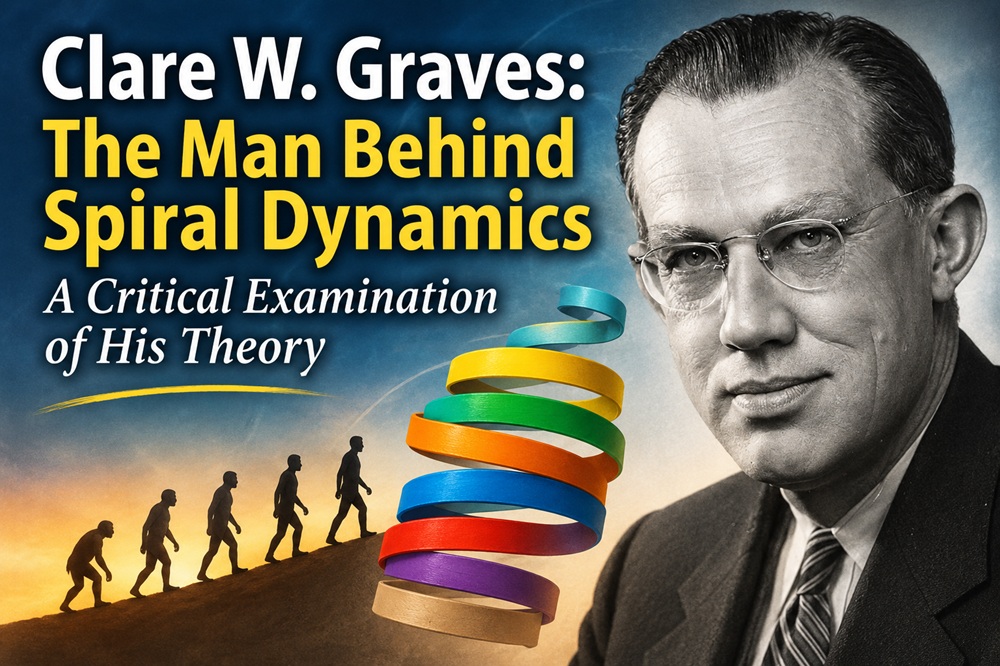 Introduction: The Origins of an Ambitious TheoryClare W. Graves (1914-1986) occupies an unusual position in the history of twentieth-century psychology. Although he never achieved the public recognition of figures such as Abraham Maslow, Carl Rogers or Jean Piaget, his ideas have had a considerable afterlife in the worlds of organizational consulting, leadership development, integral philosophy and spiritual psychology. His most influential legacy is the developmental model subsequently popularized as Spiral Dynamics by Don Beck and Christopher Cowan. Graves attempted to answer a deceptively simple but enormously ambitious question: How and why do human beings develop different systems of psychological existence, values and worldviews? His answer was that human consciousness evolves through successive, increasingly complex levels of existence, each emerging as a response to changing life conditions. Human beings do not merely acquire more knowledge as they grow older; they develop fundamentally different ways of interpreting and organizing reality. This was an attractive proposition. It promised to connect individual psychology, cultural evolution and social organization within a single explanatory framework. But there is an important distinction between an intriguing developmental hypothesis and an empirically established theory. Graves's work deserves serious consideration, not least because it anticipated some contemporary discussions about psychological complexity and cultural pluralism. At the same time, its scientific foundations, developmental assumptions and claims about universal evolutionary patterns require much more scrutiny than they typically receive in the integral community. 1. Clare Graves's intellectual backgroundGraves was an American psychologist and professor at Union College in Schenectady, New York. His research developed during the postwar period, when psychology was increasingly concerned with questions of personality, motivation, human potential and psychological maturity. One of his important intellectual reference points was Abraham Maslow. Maslow's hierarchy of needs had suggested that human motivation changes as basic physiological and security needs are satisfied. Graves considered this insight valuable but insufficient. He wanted a more comprehensive theory that could explain not simply what people need, but how their entire psychological organization changes in response to their circumstances. His own approach was initially developed independently of Maslow, although the two subsequently compared their ideas. In 1970, Graves published his influential article, "Levels of Existence: An Open System Theory of Values", in the Journal of Humanistic Psychology. This publication established the central outlines of his theory. The word open is important. Graves did not imagine development as a fixed sequence of psychological stages that unfolds independently of the environment. Rather, he proposed a continuing interaction between an individual's biological and psychological capacities and the changing conditions of existence. Human beings develop new ways of thinking because their existing ways of dealing with life become inadequate. New environmental challenges stimulate new psychological organizations, which in turn alter how people perceive and respond to their surroundings. This interaction between organism and environment is arguably the most interesting aspect of Graves's original contribution. 2. The eight levels of existenceGraves proposed a sequence of eight major systems of psychological existence. He originally identified them through a combination of letter codes, rather than the colors that subsequently became associated with Spiral Dynamics. The eight systems were designated A-N, B-O, C-P, D-Q, E-R, F-S, G-T and H-U. The first letter represented a particular neurological or existential system, while the second represented the corresponding set of life conditions. In simplified terms, the developmental sequence can be described as follows:
The colors were popularized by Beck and Cowan, not by Graves himself. Each system represents a different way of organizing psychological life. The transition from one to another occurs when existing coping mechanisms no longer adequately address the problems posed by changing life conditions. For example, an individual living in conditions of insecurity might prioritize physical survival. In a more stable social environment, tribal belonging and shared traditions may become increasingly important. Under different circumstances, personal autonomy, institutional order, individual achievement or egalitarian community may become dominant concerns. Graves also proposed an important alternation between two broad orientations. Odd-numbered systems emphasize self-expression, whereas even-numbered systems emphasize accommodation to the environment and the sacrifice of immediate personal desires. This gives the model its characteristic alternating structure. It is not simply a ladder in which every successive level is better than the preceding one. Each system addresses a different existential problem, and earlier systems remain potentially relevant when circumstances change. That qualification deserves emphasis. Graves was more sensitive to the contextual nature of psychological development than some later popular presentations of Spiral Dynamics suggest. 3. The evolutionary character of the theoryGraves's theory is developmental, but it is also explicitly evolutionary. He believed that human beings could develop increasingly complex psychological systems as their life conditions changed. In this respect, his theory belongs to a broader tradition of developmental thinking that includes Piaget, Kohlberg, Maslow and later integral theorists. However, Graves made a more ambitious claim than simply saying that people acquire new skills or become more knowledgeable. He proposed that the emergence of a new system represents a qualitative transformation in the organization of human consciousness. Someone operating predominantly within one system might have difficulty understanding the assumptions and priorities of someone operating within another. Different levels are not merely different opinions about the same world; they constitute different ways of interpreting that world. This is an interesting hypothesis, particularly when applied to political, religious and cultural disagreements. Consider the differences between an authoritarian worldview, a competitive individualistic worldview and an egalitarian communitarian worldview. Their adherents may disagree not only about policies but about the very criteria by which policies should be judged. Graves was attempting to explain these differences developmentally rather than simply classifying them as competing ideologies. Nevertheless, this is where his theory begins to encounter serious difficulties. 4. The empirical problem: where is the evidence?The first major question concerns the scientific status of Graves's developmental sequence. Graves was an academic psychologist, and his theory emerged from years of research and observation. It would therefore be unfair to dismiss it as merely an invented collection of personality types. However, the scientific documentation of his work is considerably less extensive than its subsequent reputation might suggest. His 1970 article describes the theoretical framework and refers to research that was supposed to appear in a book then in preparation. That comprehensive book was never published during his lifetime. His writings, research materials and lectures were subsequently assembled in The Never Ending Quest, edited by Christopher Cowan and Natasha Todorovic. This is valuable for understanding Graves's thinking, but a posthumous compilation is not equivalent to a fully documented research program published in peer-reviewed form. A doctoral dissertation by Marilyn Anne Hurlbut in 1979 attempted to translate Graves's levels into measurable psychological components and develop a test of the theory. This is relevant evidence that the model could be operationalized and investigated. It does not, however, establish the validity of the entire developmental sequence. Several questions remain insufficiently answered. Can the eight systems be reliably identified in individuals? Can independent researchers classify the same person in the same way? Do individuals actually progress through the proposed sequence? Are the transitions predictable? Can the theory distinguish genuine developmental change from changes in circumstances, education, social position or personal priorities? Most importantly, what evidence would demonstrate that the proposed eight systems constitute the correct underlying structure of psychological development? These are not minor technicalities. They concern the central claims of the theory. A theory that proposes universal developmental stages needs evidence for the stages themselves, their order, their characteristic properties and the mechanisms responsible for transitions between them. Anecdotal examples and retrospective interpretations are not enough. 5. The problem of developmental universalismA second problem concerns the universal character of the model. Graves believed that his systems described fundamental patterns of human existence. Although their expression would vary according to culture and historical circumstances, the underlying developmental sequence was supposed to be broadly applicable. But why should we expect the same sequence to apply to all human beings and societies? Human development is influenced by a remarkable range of factors: genetics, childhood experiences, education, economic conditions, political institutions, cultural traditions, historical circumstances and individual temperament. These influences do not necessarily produce a single orderly progression. A person can be scientifically sophisticated in one domain, religiously traditional in another, politically authoritarian in a third and emotionally dependent in a fourth. Indeed, this is probably closer to ordinary human experience than the idea that an individual can be adequately described by a single dominant developmental level. The same applies to societies. Modern technological societies can simultaneously contain sophisticated scientific institutions, traditional religious communities, authoritarian political movements, tribal loyalties and highly individualistic economic arrangements. These are not necessarily temporary remnants waiting to be superseded by a more advanced stage. They may be enduring features of complex societies. Graves's model can accommodate some of this diversity through its emphasis on changing life conditions. But the stronger the claim that humanity follows a universal developmental sequence, the more difficult it becomes to account for cultural variation and historical contingency. 6. The problem of hierarchy and developmental superiorityThe third problem is the hierarchical structure of the theory. Although Graves's model is more nuanced than a simple ranking of people from inferior to superior, it nevertheless establishes an unmistakable developmental hierarchy. Later systems are generally described as more complex, flexible and capable of integrating earlier systems. This creates an obvious danger: developmental classification can easily become a means of assigning social and intellectual superiority. People who agree with us are described as more developed, while those who disagree are diagnosed as operating from an earlier level. The problem becomes particularly apparent in the application of the model to politics and religion. A liberal egalitarian might be classified as Green, a conservative traditionalist as Blue, a competitive entrepreneur as Orange, and a systems thinker as Yellow. Such classifications can appear illuminating, but they can also become caricatures. Why should a traditional religious commitment automatically indicate less psychological development than a secular worldview? Why should egalitarian political convictions necessarily be less sophisticated than systemic thinking? Why should an individual who rejects fashionable progressive ideas be presumed to have failed to develop beyond an earlier stage? These questions expose an important methodological weakness: the danger of confusing a preferred value orientation with a higher level of psychological development. There is also a political danger. A developmental theory can become self-protecting when its adherents interpret criticism from lower levels as evidence that the critics are not sufficiently developed to understand the theory. That would make the theory difficult to challenge through rational discussion. A developmental hierarchy should never be allowed to function as an intellectual immunity mechanism. 7. The problem of circular reasoningClosely related is the possibility of circular reasoning. Suppose someone displays a worldview that the theorist considers relatively advanced. That worldview is then classified as evidence of a higher developmental stage. When someone questions the classification, the objection can itself be interpreted as evidence of insufficient developmental capacity. The theory thus risks becoming self-confirming. This is a familiar problem in psychological typologies. Once a classification system has been established, almost any behavior can be interpreted as confirmation of the categories. A rigorous theory must do more than accommodate examples after the fact. It must generate predictions that can be independently tested. For example, if Yellow represents a genuinely more complex cognitive organization than Green, what specific cognitive abilities should be demonstrable in people classified as Yellow? How could these abilities be measured independently of their agreement with the theory? Could two researchers who are skeptical of Spiral Dynamics independently identify the same developmental patterns without knowing the subjects' ideological commitments? Such questions would help distinguish a scientific developmental model from an elaborate interpretive vocabulary. 8. The missing mechanism of developmentAnother major weakness concerns the mechanism through which one level develops into another. Graves proposed that changing life conditions create existential pressures that eventually stimulate new psychological systems. This is plausible at a general level. Environmental pressures can certainly change human behavior, motivation and cognitive priorities. But a plausible general mechanism is not yet a sufficiently detailed developmental explanation. How exactly does a new psychological system emerge? What changes in the brain, cognitive architecture, emotional regulation or social learning make the transition possible? Is the transition primarily biological, psychological, cultural or institutional? How much is attributable to individual learning, and how much to collective historical change? Graves used neurological language to describe his systems, including the idea of distinct neurological organizations and threshold-like transitions. But describing developmental levels in neurological terms does not establish that they correspond to identifiable neurological systems. The familiar analogy of a quantum leap is also problematic. A sudden transition in a theoretical diagram does not demonstrate a corresponding discontinuity in the human brain. Modern developmental science offers more specific approaches to these questions, investigating cognitive development, executive functions, learning, social cognition, neural plasticity and the interaction between biological and environmental factors. Graves's theory would benefit from being connected to such research rather than relying on neurological terminology as an explanatory substitute. 9. The problem of reductionism: can complex human beings be classified by value systems?There is another difficulty that becomes apparent when the theory is applied to real individuals. Human beings are not simply collections of values. They have multiple identities, motivations, cognitive abilities and emotional dispositions that can vary across contexts. An individual might display considerable scientific sophistication while maintaining traditional religious beliefs. Another might champion egalitarian social values while behaving competitively in professional life. A third might demonstrate sophisticated systems thinking but have little emotional empathy. Which level should be assigned to these people? The answer often depends on which aspect of their behavior the observer chooses to emphasize. This suggests that Graves's categories may be more useful as descriptions of recurring patterns of motivation and value orientation than as comprehensive classifications of individual psychological development. That would be a more modest but also more defensible application. It would allow us to recognize that different value systems coexist within individuals without assuming that every aspect of personality must conform to a single developmental position. 10. From Graves to Spiral Dynamics: what changed?Graves's theory acquired a much wider audience through the work of Don Beck and Christopher Cowan, particularly their 1996 book Spiral Dynamics. Beck had studied under Graves and became one of his most influential interpreters. Together with Cowan, he translated the original framework into the now-familiar color-coded model. This transformation made the theory considerably more accessible. The colors provided memorable shorthand for complex patterns of motivation and worldview. They also made the model easier to apply to organizational development, political analysis, management consulting and cultural interpretation. However, popularization came with a price. The color scheme encouraged people to think in terms of recognizable social and ideological types. The original emphasis on changing life conditions and the interaction between organism and environment could become secondary to identifying which color a person supposedly represented. In addition, the model acquired an increasingly elaborate vocabulary and a growing number of applications. The question is whether this expansion was accompanied by a corresponding increase in empirical validation. It is important to distinguish Graves's original work from its later adaptations. Not every weakness of contemporary Spiral Dynamics can automatically be attributed to Graves himself. Nor should every criticism of the popular color model be taken as a refutation of his original insights. Nevertheless, the authority of the original psychologist is frequently invoked to lend scientific credibility to applications that have not themselves been scientifically established. That distinction deserves much more attention in the integral community. 11. Graves's historical importance: what did he get right?A critical examination should not obscure what was genuinely interesting about Graves's contribution. His first important insight was that human values are not fixed. They respond to changing circumstances, and different historical and social conditions can encourage different patterns of motivation. His second insight was that psychological development is not necessarily a smooth accumulation of knowledge. Qualitative changes in how people interpret their circumstances can occur. His third insight was that different value systems can coexist and that social conflicts often involve more than disagreements about particular policies. People may operate with fundamentally different assumptions about authority, individual freedom, community, achievement and human purpose. His fourth insight was that earlier motivational patterns do not simply disappear. Even technologically advanced societies continue to depend on basic survival motivations, group loyalties, power relationships and systems of social order. These observations remain useful. Indeed, one could argue that contemporary political polarization makes Graves's original questions more relevant than ever. Why do people living in the same society interpret the same events so differently? Why do some prioritize national identity, others individual liberty, others social equality, and still others technological or ecological transformation? Graves attempted to provide a developmental explanation for such differences. The problem is not that he asked these questions. The problem is that his proposed answer became more comprehensive than the available evidence could justify. 12. A comparison with other developmental theoristsGraves is sometimes discussed alongside Piaget, Kohlberg, Maslow and other developmental psychologists. But there are important differences between their approaches. Piaget investigated identifiable changes in children's cognitive capacities. Kohlberg developed a theory of moral reasoning and attempted to assess developmental differences through structured dilemmas. Both approaches have attracted substantial criticism and revision, but they also generated extensive empirical research. Maslow proposed a hierarchy of human needs, although his original formulation was less rigid than many popular representations suggest. Graves attempted something broader: a theory of the changing organization of human existence, connecting motivation, values, cognition and environmental conditions. This breadth is simultaneously his greatest attraction and his greatest weakness. The more phenomena a theory attempts to explain, the greater the burden of evidence required to establish its validity. There is also an important difference between explaining the emergence of new cognitive capacities and describing the historical popularity of different value orientations. These are related but distinct subjects. A society can become more technologically sophisticated without every individual becoming more cognitively complex. A population can become more egalitarian in certain respects while becoming more authoritarian in others. Development is not necessarily a single coordinated process. 13. The integral appropriation of GravesWithin the integral movement, Graves has acquired something approaching foundational status. His work supplied a developmental vocabulary that could be extended into an ambitious account of human consciousness, cultural evolution and social transformation. For Ken Wilber, Spiral Dynamics became an important component of his integral framework. It provided a sequence of value systems that could be integrated with other developmental lines and quadrants. But this raises a question that is particularly important for integral theory: does combining several developmental models strengthen their empirical foundations? Not necessarily. If a model of cognitive development, a model of moral development and a model of value systems each have their own limitations, placing them together in a comprehensive developmental map does not automatically resolve those limitations. The resulting framework may be intellectually impressive while remaining empirically underdetermined. There is also a tendency within integral circles to regard the higher stages of these models as evidence of humanity's evolutionary destination. Yellow and Turquoise become not merely descriptions of possible value orientations but indicators of an emerging planetary consciousness. That is a considerably stronger proposition than Graves's original observations about changing human systems of existence. It requires independent evidence. The temptation to transform a psychological theory into a grand narrative of cosmic or spiritual evolution should be resisted. A developmental sequence does not, by itself, demonstrate that humanity is moving toward an increasingly integrated consciousness. Nor does the existence of increasingly complex forms of organization establish a universal direction of moral or spiritual progress. Graves's model should not be used to smuggle metaphysical assumptions into psychology. 14. What would a scientifically stronger Gravesian theory look like?Rather than abandoning Graves altogether, we could ask how his insights might be reformulated into a more scientifically defensible framework. First, the eight levels should be treated as hypotheses about recurring patterns of human motivation and value organization, rather than established universal stages. Second, researchers should investigate whether these patterns can be reliably identified using independent assessment methods. Classification should not depend on the evaluator's ideological preferences or prior knowledge of the subject. Third, the developmental sequence itself should be tested longitudinally. It is not enough to identify different value orientations in different people. We need evidence that individuals actually move through the proposed sequence, under identifiable conditions, and that the order of transitions is sufficiently consistent to justify a stage theory. Fourth, the model should be compared with established research in developmental psychology, personality psychology, cultural psychology and neuroscience. Finally, the theory should be made genuinely falsifiable. Researchers should be able to specify what observations would count against its central claims. A theory that can explain every possible outcome after the fact is not necessarily a good explanatory theory. This would also require abandoning the assumption that the color sequence provides a universal ranking of human beings. Developmental complexity, moral maturity, emotional intelligence, scientific knowledge and political orientation are different dimensions. They should not be collapsed into one hierarchy. Conclusion: An Interesting Hypothesis, Not an Established ScienceClare W. Graves deserves recognition as an original thinker who attempted to understand the relationship between changing life conditions and changing human value systems. His central intuition—that people organize their lives through different motivational and interpretive systems, and that these systems are influenced by their circumstances—remains valuable. His emphasis on the interaction between organism and environment was also an important corrective to theories that treat development as an entirely internal process. But his theory has never achieved the level of empirical confirmation that its popularity in the integral movement might suggest. The eight levels remain insufficiently established as universal developmental stages. Their proposed neurological foundations are not adequately demonstrated. The mechanisms of transition remain underspecified, and the hierarchical structure invites subjective judgments about the relative sophistication of individuals and cultures. Perhaps the most important distinction is between recognizing recurring patterns in human values and claiming to have discovered the fundamental architecture of human psychological evolution. The former is a worthwhile research project. The latter requires considerably stronger evidence. Graves himself was more cautious and exploratory than some of his later followers. His original work should therefore be read as an ambitious research program rather than a completed scientific achievement. That is not a dismissal of his contribution. It is an invitation to take it seriously enough to subject it to critical examination. Spiral Dynamics may be a useful map of human value orientations, but a map should never be mistaken for the territory, and a developmental hierarchy should never be mistaken for a scientifically demonstrated history of human progress.
Comment Form is loading comments...
|