|
TRANSLATE THIS ARTICLE
Integral World: Exploring Theories of Everything
An independent forum for a critical discussion of the integral philosophy of Ken Wilber
  Frank Visser, graduated as a psychologist of culture and religion, founded IntegralWorld in 1997. He worked as production manager for various publishing houses and as service manager for various internet companies and lives in Amsterdam. Books: Ken Wilber: Thought as Passion (SUNY, 2003), and The Corona Conspiracy: Combatting Disinformation about the Coronavirus (Kindle, 2020).
Check out my other conversations with ChatGPT
Spiral Dynamics Classics:
Don Beck and the Spiral of Development Clare W. Graves: The Man Behind Spiral Dynamics Clare W. Graves and the Momentous Leap A critical review of Spiral Dynamics A critical review of Spiral Dynamics in Action Clare W. Graves and the Momentous LeapA Critical Review of a Grand Theory of Human EvolutionFrank Visser / ChatGPT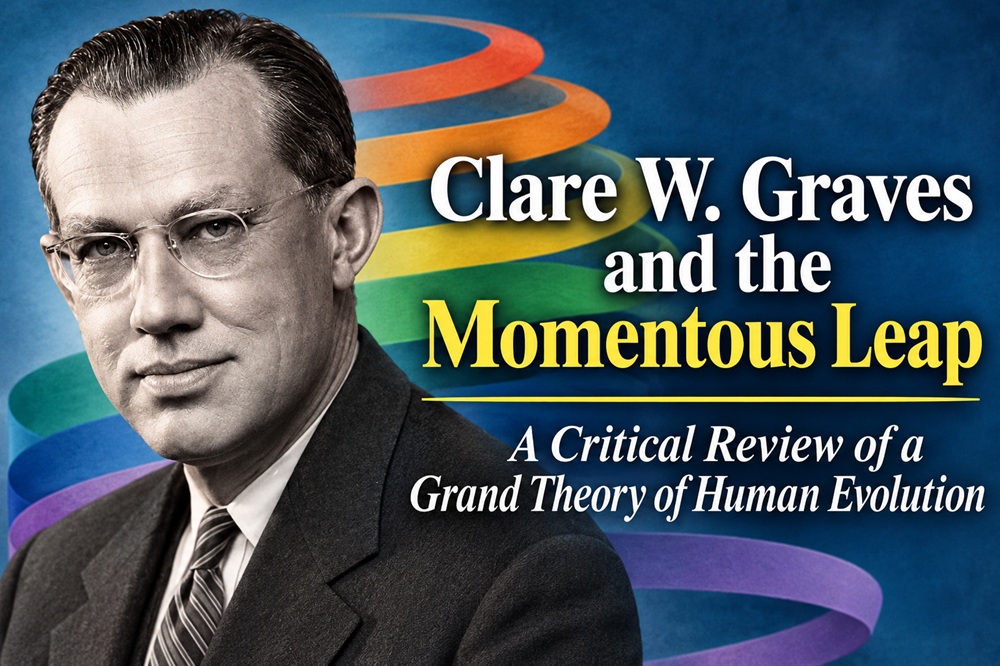
Introduction: The Promise of a New PsychologyClare W. Graves's 1974 article, "Human Nature Prepares for a Momentous Leap", published in The Futurist (April 1974, pp. 72-87), is one of the foundational documents of what would eventually become known as Spiral Dynamics. It is also an unusually ambitious attempt to explain the evolution of human psychology, values, morality, social organization and, ultimately, civilization itself. Graves was not satisfied with conventional personality psychology. He believed that human beings were not simply endowed with a relatively fixed nature, nor were they destined to follow one universally applicable set of moral principles. Rather, he proposed that human psychology changes in response to changing conditions of existence. Different existential problems activate different psychological systems, each producing its own characteristic motivations, values, beliefs and ways of understanding the world. His central proposition was that human development proceeds through a succession of qualitatively different levels of existence. These levels are not merely different opinions or personality types. According to Graves, each represents an entire psychological organization, involving neurological activation, learning mechanisms, emotional responses, ethical preferences and social behavior. His theory culminates in a prediction that Western humanity was approaching a particularly important transition: the emergence of a new, more inclusive and cognitively sophisticated way of being human. There is much to appreciate here. Graves recognized that human values are historically conditioned, that psychological development is influenced by environmental circumstances, and that different people respond differently to the same social arrangements. These are important observations. But the article also contains substantial theoretical, methodological and philosophical problems. Its grand developmental narrative repeatedly moves from plausible psychological observations to claims about neurological systems, evolutionary necessities and the future of humanity that are considerably less well established. The question is therefore not whether Graves identified something interesting about human development. He certainly did. The question is whether his proposed hierarchy adequately explains what he thinks it explains. 1. The Basic Architecture: Six Subsistence Levels and Two Being LevelsGraves begins by rejecting the assumption that human nature is fixed. He proposes that human psychology is an open, constantly evolving system, proceeding through what he calls quantum jumps from one relatively stable state to another. His formulation is particularly ambitious: "The psychology of the mature human being is an unfolding, emergent, oscillating, spiraling process." The mechanism supposedly driving this development is the interaction between two factors: the psychological capacities available to an individual and the existential problems confronting that individual. As circumstances change, previous psychological solutions become inadequate. New problems emerge, and new psychological systems become necessary. Graves initially distinguishes six subsistence levels, followed by two being levels.
The first six levels constitute what Graves calls the first ladder of existence. Their overarching concern is individual subsistence and dignity. The seventh level, G-T, represents a fundamental transition. Humanity supposedly moves beyond the psychological preoccupations it shares with other animals and begins to organize itself around the survival of the larger interconnected system of life. The eighth level, H-U, represents a further development, characterized by experiential understanding and acceptance of existential paradoxes. This architecture is elegant. It also anticipates many later discussions of developmental psychology, integral theory and the relationship between individual and collective values. But elegance should not be confused with empirical confirmation. 2. The Six Subsistence Levels: An Insightful but Highly Simplified History of HumanityGraves's descriptions of the first six levels are among the most accessible and interesting parts of the article. A-N: Automatic existenceAt the first level, behavior is governed by immediate physiological needs. Hunger, thirst, temperature regulation and other basic bodily requirements dominate existence. Graves suggests that this level is rarely encountered in the modern world except in pathological circumstances. There is little to criticize about recognizing physiological survival as a fundamental dimension of human behavior. However, Graves's description of this condition as an almost entirely non-cognitive state is an oversimplification of the complex cognitive and social capacities already present in human infancy and early development. B-O: Tribalistic existenceThe second level is organized around stability, tradition, ritual and belonging. Individuals follow established ways of life without necessarily understanding their origins or purposes. Graves associates this orientation with magical thinking, superstition and a mystical understanding of the natural world. His insight that traditions provide psychological security is valuable. Human beings do indeed inherit systems of meaning that help organize their lives. But his characterization of tribal societies as essentially unreflective and intellectually undeveloped is problematic. Anthropological research has demonstrated that traditional societies can possess highly sophisticated ecological knowledge, social institutions and systems of reasoning. Tradition is not simply the absence of rationality. C-P: Egocentric existenceThe third level introduces individual self-assertion, power, conquest and immediate gratification. Graves describes it as Promethean and Machiavellian. The powerful impose their will, while the less powerful develop strategies for surviving within systems dominated by others. This is a recognizable dimension of human social behavior. Power struggles, domination and opportunism are hardly imaginary. Yet Graves's treatment risks reducing a wide range of motivations to one psychological category. Ambition, courage, self-defense, entrepreneurship, political leadership and criminal exploitation are not necessarily expressions of the same underlying psychological organization. D-Q: Saintly existenceThe fourth level introduces order, authority, moral absolutes, sacrifice and salvation. People accept that earthly existence involves suffering and inequality, and seek lasting security through adherence to prescribed rules. Religious traditions provide prominent examples, but Graves also extends this category to ideological systems such as communism. This is one of his more interesting observations: seemingly opposing worldviews can share an underlying psychological structure. Nevertheless, grouping Christianity, Islam, Hinduism, Gandhi's nonviolence and atheistic communism into one general sacrificial orientation is an extraordinary compression of historical and philosophical differences. A shared emphasis on discipline or collective purpose does not make these systems psychologically or ethically equivalent. E-R: Materialistic existenceThe fifth level represents rationality, scientific investigation, individual achievement, technological mastery and material progress. Here humanity learns to understand the external world rather than simply submit to it or attempt to dominate it through brute force. Graves recognizes the enormous achievements of scientific and technological civilization. But he also identifies its limitations: material success does not automatically produce meaningful relationships, psychological fulfillment or ecological responsibility. His criticism of the excesses of competitive individualism is still relevant. However, his characterization of scientific rationality as a particular developmental stage creates a problem that will become increasingly important throughout this review. Scientific inquiry is not simply one psychological preference among others. It is also a method of correcting errors, testing explanations and distinguishing knowledge from speculation. F-S: Personalistic existenceThe sixth level emphasizes interpersonal relationships, emotional sensitivity, community, cooperation, acceptance and inner harmony. Graves associates this development with the counterculture of the 1960s and early 1970s, including yoga, encounter groups, humanistic psychology, Esalen and participatory management. His account is historically interesting. He correctly recognizes that the cultural conflicts of the period involved more than generational differences. They reflected competing ideas about authority, achievement, material success, personal fulfillment and social responsibility. But his account also caricatures the personalistic orientation. He portrays F-S individuals as excessively concerned with approval, consensus and group harmony, sometimes at the expense of productivity and independent judgment. This is a legitimate criticism of certain forms of group-oriented culture, but it is not a sufficient description of humanistic psychology or the counterculture as a whole. 3. The Momentous Leap: From Individual Survival to Universal ResponsibilityThe most important transition in Graves's theory is the movement from F-S to G-T. He regards this as a fundamentally different kind of development. The first six levels are concerned with individual survival, security, achievement and belonging. The seventh level supposedly transcends these concerns by making the survival of the entire interconnected system of life the central problem. Graves formulates the new ethical orientation as follows: "Express self so that all others, all beings, can continue to exist." This is an attractive ethical proposition. It anticipates contemporary concerns about ecological sustainability, global interdependence, systems thinking and the long-term survival of humanity. Graves also identifies an important limitation of the personalistic movement. If everyone becomes preoccupied with inner harmony and interpersonal relationships, who will maintain the technological infrastructure upon which modern civilization depends? His amusing image of the person sitting in a yoga position while the roof falls on his head illustrates the problem. The ecological crisis, energy shortages and population growth would eventually force humanity to reconsider its relationship with the external world. Graves therefore expects F-S to give way to G-T: a return to external engagement, but now informed by a broader understanding of interdependence. This is arguably the strongest conceptual contribution of the article. It avoids treating human development as a simple movement from individualism to collectivism. Instead, the external orientation of scientific and technological achievement is supposedly recovered in a more comprehensive form. Yet there is a serious difficulty. Why should ecological awareness, systems thinking and global responsibility constitute a qualitatively higher psychological level rather than simply new applications of existing scientific, ethical and political capacities? A climate scientist, an environmental activist, an economist and a political authoritarian may all recognize ecological problems while disagreeing profoundly about what should be done. Recognizing interdependence does not automatically produce wisdom, cooperation or morally desirable behavior. Nor does an awareness of global problems guarantee the capacity to solve them. Graves's G-T ideal is therefore better understood as a normative vision of responsible humanity than as an established psychological stage. 4. The Problem of the Neurological ExplanationOne of the most ambitious aspects of Graves's theory is its proposed neurological foundation. He does not merely suggest that people adopt different values under different circumstances. He claims that different levels of existence correspond to different neurological systems and that changing existential conditions activate higher-order neurological organizations. The two-letter designations reflect this assumption. The first letter refers to the neurological system, while the second refers to the existential problems that system can address. For example, G-T refers to a neurological system capable of dealing with a new class of existential problems. Graves also invokes quantum mechanics and brain physiology to suggest that human development follows principles of hierarchical organization found elsewhere in nature. This is where the theory becomes scientifically vulnerable. The article does not provide the neurological evidence necessary to establish that the eight levels correspond to distinct brain systems. Nor does it identify the relevant neural structures, activation patterns or biochemical mechanisms in sufficient detail to allow independent testing. The use of terms such as quantum jumps, neurological systems and biochemical activation gives the theory a scientific appearance, but scientific terminology is not a substitute for scientific demonstration. There is a legitimate possibility that psychological development involves qualitative reorganizations rather than merely gradual accumulation. Developmental psychology has explored such possibilities extensively. But this does not establish that Graves's particular eight-level sequence is biologically encoded. The distinction is crucial: a theory may be compatible with general principles of brain development without having demonstrated its own proposed neurological mechanism. Graves moves too quickly from psychological observations to biological explanations. 5. The Evidence Problem: What Exactly Did Graves Research?Graves repeatedly refers to more than twenty years of research into human values. The article mentions his work with students at Union College, including experiments in which students were grouped according to their supposed levels of existence and asked to solve problems together. He reports characteristic differences:
He also reports that the proportion of students classified as D-Q and G-T changed substantially between 1952 and the early 1970s. These observations are potentially interesting. They suggest that different assumptions about authority, cooperation and leadership may influence group behavior. But the article leaves several fundamental methodological questions unanswered. How were participants classified into levels? What instruments were used? How many people were studied? How representative were the samples? Were classifications made independently by multiple researchers? Were alternative explanations considered? Most importantly, how were the predictions tested? The group experiments are presented as illustrations of the theory, but they do not establish that the observed differences resulted from eight distinct psychological systems. Students may behave differently because of education, social background, personality, political attitudes, group composition, task design or the expectations of the experimenter. Without adequate controls, the same observations can support multiple interpretations. There is also a potential circularity: People are classified according to their behavior, and their behavior is subsequently explained by the level to which they have been assigned. If a person seeks consensus, this is interpreted as evidence of F-S. If that person subsequently acts competitively, the behavior may be explained as a temporary regression or the activation of another level. A theory that can accommodate virtually every possible behavior risks becoming difficult to falsify. This is not an accusation that Graves conducted no serious research. He clearly did. It is a criticism of the evidential case actually presented in this particular article. The article offers considerably more theoretical interpretation than methodological documentation. 6. The Hierarchy Problem: Who Decides What Is Higher?Perhaps the most consequential philosophical problem concerns the hierarchy itself. Graves insists that the levels are not simply different ways of living. They are successive developments in psychological complexity. The first six are described as subsistence levels, while G-T and H-U represent a new category of being. He even describes the transition to G-T as crossing the boundary between animalistic and genuinely human existence. This is an extraordinary claim. It implies that people operating predominantly within the first six systems are, in some important sense, less fully human than those who have reached the being levels. Such language creates an uncomfortable developmental hierarchy in which some people are implicitly more evolved than others. It also raises a difficult question: what independent criteria establish that one system is superior to another? Graves's answer is largely functional. A new system is higher because it addresses existential problems that the previous system could not solve. But this does not necessarily establish moral superiority. A technological civilization may be more capable of manipulating its environment than a traditional society, but that does not automatically make it ethically superior. A highly educated individual may possess sophisticated analytical abilities while remaining profoundly selfish, prejudiced or politically authoritarian. Conversely, a person with traditional religious commitments may demonstrate extraordinary compassion, intellectual independence and moral courage. The distinction between cognitive complexity and moral worth needs to be maintained. Graves's framework frequently blurs it. There is another problem. The levels are presented as an evolutionary succession, but people and societies do not necessarily develop in a uniform direction. Scientific sophistication can coexist with religious fundamentalism. Democratic institutions can coexist with authoritarian political movements. Technological progress can accompany ecological destruction. Indeed, the history of the twentieth century provides abundant evidence that advanced technological societies are perfectly capable of barbarism. A hierarchy of values cannot simply be equated with a hierarchy of human beings. 7. The Problem of Cultural GeneralizationGraves's model is presented as a general theory of human development, but many of its descriptions are strongly influenced by the history of Western civilization. The sequence from tribal tradition to power-based societies, religious authority, scientific materialism and personalistic humanism resembles a particular interpretation of Western historical development. Graves extends this sequence to humanity as a whole. He even suggests that technologically advanced Western nations are approaching the completion of the first six levels, while other populations remain at earlier stages. This creates a potential ethnocentric problem. Are societies that maintain traditional cultural practices necessarily less developed than industrialized societies? Are religious communities necessarily less psychologically complex than secular ones? Are people living in poverty psychologically located at lower developmental levels, or are they responding rationally to difficult material circumstances? The article's discussion of welfare illustrates this problem particularly clearly. Graves visits five families and interprets their circumstances through five different levels of existence. He concludes that conventional welfare systems fail because they do not adequately accommodate the different psychological needs of their clients. His practical recommendations are often sensible. Exhausted families may need direct assistance rather than abstract advice. People experiencing medical emergencies may need mobile health services. Others may require immediate employment assistance, financial security or more personal guidance. This is an important argument for pluralistic social services. But the classification of these families is much less convincing. Poverty, exhaustion, disability, unemployment and family crises are not necessarily expressions of different developmental levels. A person's behavior under extreme economic pressure cannot safely be interpreted as evidence of a particular psychological organization. The risk is that structural social problems become translated into individual developmental deficiencies. Instead of asking why people are poor, institutions might begin asking why they have not developed sufficiently. That would be a serious misuse of the theory. 8. The Six Conditions for Psychological TransformationOne of the more interesting sections of the article concerns what Graves considers necessary for a transition to a higher level. He identifies six conditions.
This is a more sophisticated account of psychological development than a simple progression through increasingly sophisticated stages. In particular, Graves argues that satisfying existing needs is not enough. Growth often requires a crisis in which previous solutions cease to work. This is a valuable observation. People sometimes change their fundamental assumptions only when circumstances make their previous worldview untenable. However, Graves again goes beyond what his argument establishes. He claims that biochemical changes during a regressive search through earlier ways of behaving trigger the emergence of higher neurological systems. But the article does not provide the physiological evidence required to demonstrate this mechanism. Moreover, psychological crises do not necessarily produce growth. They can result in trauma, depression, radicalization, withdrawal or long-term psychological deterioration. The existence of crisis is not evidence of impending development. Graves acknowledges the possibility of arrested development and regression, but his overall narrative remains strongly oriented toward upward movement. His theory needs a more explicit account of why some crises lead to constructive change while others do not. 9. The Prediction That Western Humanity Was Ready for G-TGraves's article is particularly interesting as a historical document because it was written in 1974. He believed that Western civilization was moving from E-R materialistic values through F-S personalistic values toward G-T cognitive existence. The counterculture of the 1960s had challenged conventional materialism, technological domination and competitive individualism. The emerging ecological consciousness was supposedly creating the existential conditions for a new psychological organization. Graves expected this transition to occur relatively rapidly. He even suggested that human development was accelerating, with successive levels taking progressively shorter periods to emerge. His comparison was striking: millions of years for the development of tribalistic existence, but perhaps only twenty years for the transition from E-R through F-S toward G-T in technologically advanced societies. More than fifty years later, we can evaluate this prediction. Some of Graves's expectations have been partially realized. Environmental awareness has become a central political and scientific concern. Systems thinking is increasingly important in economics, ecology and public policy. International cooperation has become indispensable for addressing problems such as climate change, pandemics and nuclear proliferation. But the broader developmental prediction is much harder to sustain. The twenty-first century has also witnessed renewed authoritarianism, nationalism, religious fundamentalism, political polarization, conspiracy movements and aggressive forms of materialism. Technological sophistication has not eliminated tribal loyalties or power politics. In fact, modern communication technology has sometimes amplified them. The coexistence of these tendencies challenges the idea that humanity is moving collectively through a relatively orderly developmental sequence. One might respond that Graves anticipated regression and that different levels can coexist. That is true. But the more qualifications a theory requires to explain historical developments, the less predictive power its original developmental narrative may possess. The world has not obviously moved beyond the earlier levels. It has become more technologically interconnected while retaining, and sometimes intensifying, many of the psychological and political tendencies Graves associated with them. 10. The Management and Education Applications: A More Defensible ContributionInterestingly, some of the most practically useful parts of the article concern management and education rather than the grand theory of human evolution. Graves criticizes organizations that assume everyone should be managed in the same way. Some employees prefer clearly defined responsibilities and established procedures. Others want independence, personal initiative or opportunities for collective decision-making. A management system that works well for one group may frustrate another. Graves also challenges the assumption that participatory management is universally desirable. This is an important corrective to simplistic management philosophies. Similarly, his discussion of education suggests that students have different learning preferences and different capacities for dealing with abstract, analytical or interpersonal material. His broader recommendation is that education should accommodate these differences rather than impose one uniform instructional method. These arguments remain relevant. However, there is a danger in turning the levels into rigid classifications. A student who prefers structured instruction is not necessarily at a lower developmental level than one who prefers open-ended discussion. A manager who values hierarchy is not necessarily less cognitively sophisticated than one who favors autonomy. Effective management and education require attention to individual differences, task requirements, institutional conditions and changing circumstances. Graves's framework can stimulate useful questions, but it should not be treated as a validated diagnostic instrument. His strongest practical insight is that different people may need different forms of support. His weakest assumption is that these differences can reliably be organized into a universal developmental hierarchy. 11. From Graves to Spiral Dynamics: What Happened to the Original Theory?The importance of this article extends beyond Graves himself. His work became the foundation for the later development of Spiral Dynamics, particularly through the work of Don Beck and Christopher Cowan. They popularized Graves's framework by assigning colors to the different levels, making the model more accessible and easier to communicate. The familiar color-coded sequence is not the terminology used in this 1974 article. Graves uses the two-letter designations A-N through H-U. This distinction matters because the popularized version sometimes gives the impression that the model is a straightforward map of universal human development, with each color representing a recognizable stage of consciousness. But Graves's original article is more tentative in certain respects, and it contains unresolved questions that subsequent popular presentations have not necessarily answered. In particular, the neurological foundation, the empirical identification of levels and the prediction of a collective transition to higher existence remain insufficiently established in the article. There is also a potential danger in the way the model is used. Once people begin classifying themselves and others according to developmental levels, the framework can become a status system. People identify with supposedly advanced levels, while assigning their critics or political opponents to supposedly less developed ones. The model then risks becoming self-confirming: agreement demonstrates higher development, disagreement demonstrates lower development. This is especially ironic given Graves's original intention to understand the diversity of human values rather than simply impose one uniform psychological ideal. A developmental framework should help us understand differences, not provide an intellectual justification for dismissing people who disagree with us. 12. What Graves Got RightA critical review should not overlook the genuine strengths of the article. Graves challenged the idea that human nature is static. He recognized that values are influenced by changing existential conditions and that psychological development involves more than accumulating knowledge. He also understood that people can become attached to ways of life that once served them well but have become inadequate under new circumstances. His distinction between external and internal orientations is particularly interesting. The movement from material achievement to interpersonal harmony, and then toward a renewed engagement with the external world, captures a recognizable pattern in modern cultural history. His emphasis on the coexistence of different motivational systems is also valuable, even though his developmental hierarchy is questionable. Finally, his insistence that social institutions should respond to different human needs rather than treat everyone identically is a genuinely constructive proposition. These insights do not require acceptance of his entire theory. Indeed, they may be more useful when separated from its stronger evolutionary and neurological claims. Conclusion: A Valuable Framework, Not an Established Science of Human EvolutionClare W. Graves's "Human Nature Prepares for a Momentous Leap" is an important document in the history of developmental psychology and integral thinking. It contains an ambitious attempt to connect individual psychology, social values, historical change, neurological development and the future of civilization. Its central insight is worth retaining: human beings do not operate according to one fixed psychological orientation. Their values, motivations and conceptions of the good life are influenced by the problems they face and the conditions under which they live. But the article repeatedly overreaches. Its eight levels are insufficiently established as distinct psychological systems. Its neurological explanations are asserted more confidently than demonstrated. Its historical sequence is heavily influenced by a particular interpretation of Western development. Its classification of individuals and societies risks confusing economic and cultural differences with developmental superiority. And its prediction of an imminent collective transition to a higher form of human existence has not been convincingly borne out. The most serious problem is the tendency to transform a useful descriptive framework into a comprehensive evolutionary theory. Graves's observations about changing human values do not establish that humanity follows a universal staircase of psychological development. Nor do they demonstrate that the future necessarily belongs to increasingly sophisticated levels of consciousness. Human history is less orderly than that. Scientific progress can coexist with political regression. Greater material prosperity can coexist with social fragmentation. Increased awareness of global interdependence can coexist with aggressive nationalism. And psychological sophistication does not guarantee moral responsibility. Perhaps the most productive way to approach Graves today is therefore to separate his descriptive insights from his grand developmental claims. His account of changing existential conditions, competing values and the need for adaptable institutions remains useful. His claim that these phenomena reveal a universal, neurologically grounded sequence of increasingly advanced human existence requires considerably more evidence. There is also an irony in his theory. Graves argues that each new level must recognize the limitations of the previous one. But should we not apply precisely the same principle to his own theory? Perhaps the next step in understanding human development is not another higher level in the Gravesian hierarchy, but a more critical understanding of why we are so attracted to hierarchical explanations of ourselves in the first place. The momentous leap we need may be less about ascending to a supposedly higher level of existence and more about learning to distinguish genuine psychological development from the seductive narratives we construct around it.
Comment Form is loading comments...
|