|
TRANSLATE THIS ARTICLE
Integral World: Exploring Theories of Everything
An independent forum for a critical discussion of the integral philosophy of Ken Wilber
  Frank Visser, graduated as a psychologist of culture and religion, founded IntegralWorld in 1997. He worked as production manager for various publishing houses and as service manager for various internet companies and lives in Amsterdam. Books: Ken Wilber: Thought as Passion (SUNY, 2003), and The Corona Conspiracy: Combatting Disinformation about the Coronavirus (Kindle, 2020).
Check out my other conversations with ChatGPT Don Beck: The Man Who Put the Spiral into Human DevelopmentA Critical Essay on the Co-Founder of Spiral DynamicsFrank Visser / ChatGPT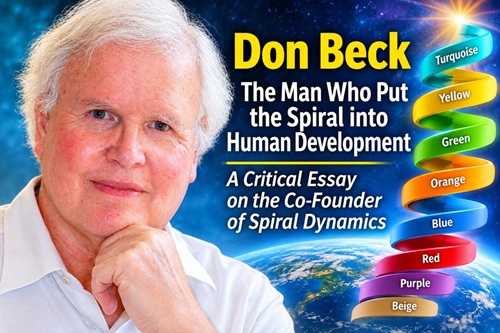 Few figures have had as much influence on the contemporary integral movement as Don Edward Beck (1937-2022), co-founder and principal popularizer of Spiral Dynamics. Together with Christopher Cowan, Beck transformed the developmental psychology of Clare W. Graves into one of the most recognizable models of human values, cultural evolution, organizational change, and political transformation. The appeal of Spiral Dynamics is easy to understand. It promises to make sense of the enormous diversity of human worldviews by identifying recurring patterns of psychological and cultural development. Its familiar color-coded stages—Beige, Purple, Red, Blue, Orange, Green, Yellow, and Turquoise—offer an apparently comprehensive map of human consciousness. For people interested in personal development, social transformation, and the evolution of civilization, this is an attractive proposition. Instead of treating political, religious, and cultural disagreements as isolated phenomena, Spiral Dynamics suggests that they reflect deeper differences in the ways human beings organize their lives and interpret reality. Beck took this framework beyond academic psychology. He applied it to organizational consulting, political negotiations, international conflicts, and large-scale social transformation. His work in South Africa during the transition from apartheid to democracy became an important part of his professional legacy. Yet there is a fundamental question that deserves considerably more attention than it has received within the integral community: How much of Spiral Dynamics is a scientifically established account of human development, and how much is an interpretive framework that has acquired an authority far exceeding its empirical foundations? Beck's contribution deserves recognition, but it also deserves critical examination. 1. Clare Graves: The Intellectual FoundationAn important distinction should be made at the outset. Don Beck did not invent Spiral Dynamics from scratch. Its intellectual foundations lie in the work of American psychologist Clare W. Graves (1914-1986), whose research explored the question of how human beings understand psychological maturity. Graves proposed that human value systems emerge through an interaction between changing life conditions and the capacities of individuals to respond to them. Human development, in his account, is neither entirely predetermined nor simply a matter of acquiring knowledge. It involves changing relationships between individuals and their environments. Graves described a series of increasingly complex systems of existence, each representing a particular way of organizing experience and responding to life's challenges. Beck, who encountered Graves in the 1970s, became one of his most enthusiastic students and collaborators. Together with Christopher Cowan, he eventually translated Graves's ideas into the popular framework presented in their 1996 book, Spiral Dynamics: Mastering Values, Leadership, and Change. This transformation involved more than simplifying the original theory. Beck and Cowan introduced the familiar color coding and the concept of vMEMEs, referring to value-attracting systems that organize patterns of thinking and behavior. The result was an accessible model that could be applied to individuals, organizations, societies, and entire civilizations. But something important happened in this process: a relatively specialized developmental hypothesis became a general interpretive framework for understanding almost everything human beings do. That expansion created both its appeal and its problems. 2. The Eight Colors: An Attractive but Problematic ClassificationThe eight familiar value systems are usually described as follows:
There is an obvious attraction to this classification. It offers a vocabulary for discussing differences that are otherwise difficult to articulate. A religious fundamentalist, a market-oriented entrepreneur, a social activist, and a systems theorist may inhabit very different conceptual worlds. Spiral Dynamics provides a language for describing these differences without necessarily reducing them to intelligence, education, or personality. But the classification also creates a temptation: to assume that these colors represent objectively identifiable stages through which people and societies necessarily develop. This is a much stronger proposition than saying that different value orientations exist. Can we reliably establish that a particular individual is operating primarily from Blue, Orange, or Green? Can we determine that a country has progressed from one stage to another? Can independent researchers consistently identify the same developmental level in the same person or institution? And, most importantly, what empirical evidence establishes that these particular categories form a developmental sequence? These questions are not adequately answered by the elegance of the diagram. There is also a problem with the tendency to associate complex individuals with a dominant color. A person can be scientifically sophisticated in one area, authoritarian in another, egalitarian in personal relationships, and strongly traditional in religious matters. Human beings are not necessarily unified developmental packages. Spiral Dynamics acknowledges that people can express different value systems in different contexts, but its practitioners sometimes revert to precisely the kind of simplified classification that the theory should help them overcome. 3. The Scientific Problem: Where Is the Evidence?This is arguably the most important criticism of Spiral Dynamics. Graves conducted research into human value systems and published an influential theoretical article in 1970. However, the full empirical foundation of his research was not published in a form that would allow subsequent researchers to comprehensively evaluate his methodology, data, and conclusions. The later publication of Graves's collected work, The Never Ending Quest (2005), helped make his ideas more accessible. Nevertheless, making research material available is not the same as establishing the validity of the theory. There is a considerable difference between identifying recurring patterns in people's answers to psychological questions and demonstrating that these patterns constitute universal developmental stages. To establish the latter, one would need independent empirical research addressing several issues:
These are demanding requirements, but they are entirely reasonable given the extraordinary claims sometimes made on behalf of Spiral Dynamics. The problem is that the model's popularity in coaching, consulting, and integral circles has not been matched by a comparable body of independent scientific validation. This does not mean that every observation made by Graves, Beck, and Cowan is wrong. The existence of different value orientations, the influence of environmental conditions on human behavior, and the increasing complexity of certain forms of reasoning are all legitimate subjects of psychological and sociological investigation. But these general observations do not automatically validate the particular architecture of Spiral Dynamics. A useful map is not necessarily a scientifically demonstrated map of human development. 4. The Hierarchical Trap: Who Is More Evolved?Another difficulty concerns the hierarchical character of the model. Spiral Dynamics is not simply a classification of different worldviews. It is a developmental theory in which later systems are generally considered more complex than earlier ones. This creates an implicit ranking of human beings. Orange is considered more developmentally advanced than Blue, Green more advanced than Orange, and Yellow more advanced than Green. Turquoise represents an even more encompassing perspective. There is a certain plausibility to the idea that some forms of thinking can accommodate more complexity than others. A person capable of considering multiple perspectives may indeed have cognitive advantages over someone who insists on a single absolute interpretation of reality. But the transition from cognitive complexity to overall human superiority is far less straightforward. Does a person with a sophisticated systems-theoretical vocabulary necessarily possess greater emotional maturity, ethical sensitivity, practical wisdom, or political judgment? Does a Yellow individual necessarily behave more responsibly than a Blue individual? Does someone who speaks fluently about interconnectedness actually understand the economic, ecological, and political systems involved? These questions expose a recurring problem in developmental philosophies: the confusion of intellectual sophistication with comprehensive human maturity. The hierarchy can also become self-protective. Someone who disagrees with the model can simply be classified as operating from an earlier developmental stage. A critic of Spiral Dynamics might be dismissed as Blue, Orange, or Green, depending on the circumstances. This is an epistemological problem. If disagreement is interpreted as evidence of the critic's inferior development, the theory becomes difficult to challenge on its merits. A genuinely developmental theory should be able to distinguish between a person's developmental capacities and the correctness of their arguments. No color guarantees intellectual honesty. 5. South Africa: Beck's Most Important Real-World ExperimentIt would be unfair to assess Don Beck exclusively through theoretical criticism. His involvement in South Africa deserves serious consideration. Beck became deeply engaged in the country's transition from apartheid to democracy. Beginning in the 1980s, he made numerous visits, working with political, business, and community leaders. His approach sought to understand the different value systems operating within the country's deeply divided society. The fundamental idea was that political conflict cannot always be resolved by imposing a single ideological solution. Different groups have different histories, fears, priorities, and conceptions of legitimate authority. A political settlement must take these realities into account. This was an important insight. The transition from apartheid required more than replacing one political arrangement with another. It required the construction of institutions and relationships capable of accommodating an extraordinarily diverse population. Beck's emphasis on understanding the different motivational systems of social groups potentially contributed something useful to this process. His involvement was sufficiently notable to receive recognition in Texas legislative circles, and his professional biography emphasizes his work with South African leaders during the transition. However, a distinction must be maintained between Beck's involvement in the transformation process and claims that Spiral Dynamics itself was responsible for its success. South Africa's transition was the result of numerous historical, political, economic, and social forces, including the resistance movement, international pressure, negotiations involving the ANC and the apartheid government, and the leadership of Nelson Mandela and others. It would be historically irresponsible to attribute this transformation to a single psychological model. Nor does the fact that a framework has been applied in a consequential political situation demonstrate that its underlying developmental theory is scientifically correct. A framework can be practically useful without being empirically validated in all its theoretical claims. This is perhaps the most balanced way to assess Beck's South African contribution. 6. The Problem of Applying Psychological Categories to Entire SocietiesBeck's ambition extended beyond individual psychology. He wanted to understand and influence entire social systems. This is where the model becomes particularly vulnerable to oversimplification. Societies are not individuals writ large. A country contains multiple institutions, competing interests, regional differences, social classes, generations, religious traditions, and political movements. These do not necessarily share one developmental orientation. Consider the United States. It contains highly sophisticated scientific institutions, religious fundamentalist communities, technologically advanced corporations, authoritarian political movements, progressive social organizations, and traditional rural communities. Which color represents America? The question itself illustrates the difficulty. One might respond that different groups express different value systems, which is entirely reasonable. But once this qualification is introduced, the explanatory power of assigning developmental stages to entire societies becomes considerably more limited. There is also a danger of interpreting political disagreements as developmental deficiencies rather than examining their material causes. Economic inequality, institutional corruption, historical grievances, geopolitical competition, and the distribution of political power cannot simply be explained away as conflicts between different value systems. Sometimes people disagree because they have different interests, not because they occupy different stages of consciousness. A developmental framework should not become a substitute for political economy, history, sociology, or empirical political analysis. 7. The Integral Connection: Beck and Ken WilberBeck's influence became particularly significant through his relationship with Ken Wilber and the broader integral movement. Wilber incorporated Spiral Dynamics into his AQAL framework, using its developmental stages as an important component of his account of individual and collective evolution. This produced a powerful combination: Wilber supplied the encompassing philosophical architecture, while Beck and Cowan supplied a developmental model with recognizable categories and practical applications. The collaboration was not without difficulties. As Albion Butters explains in his historical account of Spiral Dynamics, different interpretations emerged, particularly concerning the relationship between Beck's Spiral Dynamics Integral, Cowan's approach, and Wilber's adaptation of the model. Their disagreements concerned more than terminology. They involved questions about how the original Gravesian framework should be interpreted, how its developmental dimensions should be understood, and who had the authority to determine its proper application. Beck eventually developed Spiral Dynamics Integral as his own extended approach, while Wilber incorporated the model into his larger integral philosophy. This history is revealing. A theory that claims to describe the evolution of human consciousness became the subject of disagreements among its leading interpreters about the correct interpretation of that very evolution. There is something almost comical about this situation, although it is also intellectually instructive. If developmental sophistication is supposed to enable people to transcend earlier forms of conflict, why did the leading representatives of the theory have such difficulty resolving their own disagreements? Of course, theoretical disagreement does not invalidate a theory. Scientists and philosophers disagree all the time. But it does undermine the impression that possessing the model automatically confers a superior capacity for integrative understanding. 8. The Emergence of a Developmental IndustryAnother aspect of Beck's legacy deserves attention: the institutionalization and commercialization of Spiral Dynamics. The model became the basis for consulting practices, leadership development, coaching programs, workshops, training certifications, and organizational interventions. This is not inherently problematic. Psychological theories can have practical applications, and there is nothing wrong with professionals earning a living from their expertise. However, commercialization creates a potential conflict of interest. When a theoretical framework becomes the intellectual foundation of an industry, practitioners have an incentive to preserve its authority, expand its applications, and reproduce its terminology. The model can gradually become less a hypothesis to be investigated than a professional language to be mastered. This creates a familiar problem in the self-development industry: the proliferation of increasingly elaborate interpretations without corresponding increases in empirical validation. A color-coded developmental map is particularly attractive in this environment because it is easy to teach, easy to remember, and easy to apply to almost any organizational problem. A complicated workplace conflict can be interpreted as a clash between Blue and Orange values. A disagreement between management and employees can become a developmental mismatch. Resistance to organizational change can be explained as attachment to an earlier worldview. Sometimes these interpretations may be illuminating. At other times, they may simply replace a concrete analysis of power, incentives, competence, and institutional interests with an appealing psychological narrative. The danger is that the model becomes an all-purpose explanatory device. And any theory that appears to explain everything should invite especially careful scrutiny. 9. The Self-Sealing Nature of Developmental ThinkingPerhaps the most serious intellectual problem associated with Spiral Dynamics is its potential to become self-sealing. A theory is scientifically valuable partly because it can be challenged by evidence. Its proponents must be able to specify what observations would count against it. But developmental frameworks can easily evade this requirement. If someone agrees with the model, that may be interpreted as evidence of developmental insight. If someone disagrees, their disagreement may be interpreted as evidence that they have not yet reached the appropriate level of development. If a supposedly advanced individual behaves selfishly or irrationally, one can argue that they have not fully stabilized at their developmental stage. If a society fails to develop as predicted, one can invoke historical circumstances or environmental conditions. There may be legitimate reasons for some of these qualifications, but the cumulative effect can be to make the theory increasingly difficult to falsify. This is particularly problematic because Spiral Dynamics is often presented with the authority of a scientific developmental psychology. The more ambitious the scientific claims, the more important it becomes to establish clear criteria for testing them. Otherwise, the framework risks becoming a sophisticated form of interpretive astrology: a system that can generate plausible explanations for almost any human behavior after the fact. 10. What Beck Got RightA critical assessment should not obscure the genuine insights in Beck's work. First, he recognized that human values are not fixed. People and societies can change their priorities in response to changing life conditions. Second, he understood that political and organizational conflicts often involve fundamentally different assumptions about what constitutes a desirable social arrangement. Third, he emphasized the importance of designing solutions that take existing cultural and psychological realities into account rather than simply imposing abstract ideals. Fourth, he recognized that greater complexity in social systems requires more flexible approaches to problem-solving. Finally, his work helped popularize developmental thinking beyond academic psychology and brought attention to the relationship between individual values and collective behavior. These contributions remain worth discussing. But none of them requires accepting the entire color-coded developmental hierarchy, its universal sequence, or its more ambitious claims about the evolution of human consciousness. We can retain the useful insights while remaining skeptical about the theoretical superstructure. Indeed, that would be a more mature response than either uncritical acceptance or wholesale rejection. Conclusion: Beyond the ColorsDon Beck was an energetic intellectual entrepreneur, a committed advocate of developmental thinking, and an ambitious practitioner of large-scale social transformation. His work deserves historical recognition, particularly his efforts to apply psychological insights to complex political and organizational situations. But his intellectual legacy should not be confused with the scientific validation of Spiral Dynamics. The model's central promise—that human values and worldviews can be organized into a universal developmental sequence—remains insufficiently established by independent empirical research. Its color coding is memorable, its categories can be illuminating, and its applications can sometimes be productive. But these qualities should not be mistaken for proof. There is also a deeper irony in the integral movement's relationship with Beck's work. A movement that frequently celebrates the transcendence of earlier developmental stages can become remarkably attached to its own developmental map. Instead of questioning the model, practitioners may use it to classify critics, explain disagreements, and defend their own intellectual position. That is precisely the sort of intellectual behavior that developmental thinking should help us overcome. Perhaps the most important lesson to draw from Don Beck is therefore not that humanity is destined to climb a predetermined spiral of increasingly sophisticated colors. It is that human beings need better ways of understanding one another, negotiating conflicting interests, and solving collective problems. We do not need to establish that one person is Yellow and another is Blue before we can listen to their arguments. Nor do we need to believe that humanity is moving toward Turquoise consciousness to recognize the importance of cooperation, pluralism, scientific reasoning, and global responsibility. The real test of developmental thinking is not whether it can place everyone on a spiral. It is whether it can help us understand the world more accurately, distinguish evidence from speculation, and solve problems more effectively. On that test, Spiral Dynamics remains an interesting and potentially useful framework—but a framework that must itself remain open to development, criticism, and revision. No color should be exempt from scrutiny.
Comment Form is loading comments...
|