|
TRANSLATE THIS ARTICLE
Integral World: Exploring Theories of Everything
An independent forum for a critical discussion of the integral philosophy of Ken Wilber
  Frank Visser, graduated as a psychologist of culture and religion, founded IntegralWorld in 1997. He worked as production manager for various publishing houses and as service manager for various internet companies and lives in Amsterdam. Books: Ken Wilber: Thought as Passion (SUNY, 2003), and The Corona Conspiracy: Combatting Disinformation about the Coronavirus (Kindle, 2020).
Check out my other conversations with ChatGPT
From Jung to Wilber and Beyond:
The Man Who Put the Gods Back into Psychology Collective Unconscious to Cosmic Consciousness Integral Theory: Science, Philosophy, or Religion? Can We Have Integral Without Wilber? Can We Have Integral Without Wilber?The Case for a Secular, Naturalistic MetatheoryFrank Visser / ChatGPT
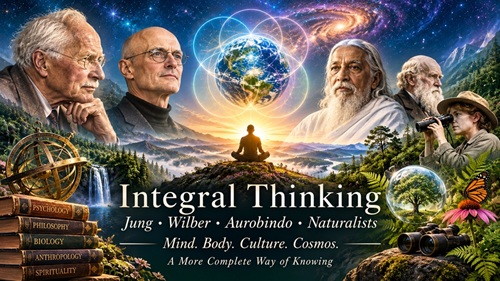 Introduction: Saving the integral ambition from its metaphysical baggageKen Wilber has spent several decades constructing what he regards as an encompassing framework for understanding reality, human consciousness, cultural development, and spiritual evolution. His Integral Theory, particularly the AQAL model, represents one of the most ambitious attempts at intellectual synthesis in contemporary philosophy and transpersonal psychology. Yet the question increasingly arises whether Integral Theory needs all of Wilber's metaphysical commitments to remain intellectually valuable. Can we retain the four quadrants without accepting Spirit? Can we investigate developmental stages without assuming that consciousness is evolving toward a predetermined spiritual destination? Can we integrate evolutionary biology, psychology, sociology, and philosophy without invoking Eros as a cosmic force? And can we take religious experience seriously without assuming that it provides access to supernatural dimensions of reality? My answer is yes. Indeed, I would argue that the future of integral thinking may depend on making precisely this separation. The intellectual ambition behind Integral Theory is worth preserving. The fragmentation of modern knowledge is real. Scientific specialization often makes it difficult to understand complex phenomena that cross disciplinary boundaries. Human beings cannot be adequately understood through neuroscience alone, nor through sociology, psychology, economics, or cultural interpretation in isolation. We need frameworks that help us connect these perspectives. But we do not necessarily need Wilber's particular metaphysics to accomplish this. The challenge is to develop an integral approach that is interdisciplinary without being religious, developmental without being teleological, philosophically comprehensive without claiming to explain everything, and scientifically informed without borrowing scientific authority for unsupported propositions. In other words, can we have Integral without Wilber? I believe we can, but it would require a substantial reconstruction of the project. 1. What should be retained from Wilber?A secular reconstruction should begin by distinguishing Wilber's genuine contributions from his more speculative commitments. His most important contribution is arguably not his account of Spirit, Eros, or the subtle and causal dimensions of consciousness. It is his insistence that different perspectives on reality should be considered together. The four quadrants provide a useful starting point: Individual interior: subjective experience, thoughts, emotions, intentions. Individual exterior: behaviour, physiology, brain processes. Collective interior: shared meanings, values, language, culture. Collective exterior: institutions, social systems, economic structures, technologies. These perspectives are not interchangeable. Nor can one necessarily be reduced to another. Consider climate change. A comprehensive investigation would involve physical measurements of atmospheric processes, individual psychological attitudes, cultural beliefs about nature and progress, and the political and economic institutions responsible for emissions and mitigation. No single discipline can provide the entire explanation. Similarly, understanding religious movements requires examining individual experiences, collective narratives, institutional structures, and observable social behaviour. This is the strongest argument for retaining an integral approach: complex phenomena require multiple explanatory perspectives. But there is no reason to assume that these perspectives must be organized according to Wilber's entire AQAL architecture. The four quadrants can be retained as a heuristic framework without accepting that they represent four fundamental dimensions of the Kosmos. That distinction is crucial. A useful classification system need not be an ontology. 2. Replace Spirit with naturalistic emergenceOne of the biggest obstacles to a secular Integral Theory is Wilber's understanding of Spirit. In his framework, Spirit is not simply a religious idea or a subjective experience. It represents the ultimate ground of existence, manifesting through an evolutionary process that moves toward increasingly complex and inclusive forms. This gives Wilber's system a metaphysical unity. Evolution is not merely a biological process but part of a larger cosmic movement toward self-transcendence. The problem is that this interpretation goes beyond what evolutionary science establishes. A naturalistic alternative would begin with emergence. Complex systems can develop new properties that cannot be adequately understood by examining their components in isolation. Life emerged from nonliving chemistry. Nervous systems developed increasingly sophisticated capacities. Human consciousness emerged through evolutionary and developmental processes involving biological, social, and cultural interactions. These developments are extraordinary without requiring a supernatural organizing principle. Emergence does not mean that everything inevitably becomes more complex. Evolution includes simplification, extinction, stasis, adaptation, and diversification. There is no universal law requiring the universe to move toward greater consciousness. A naturalistic integral philosophy could therefore investigate the emergence of complexity without assuming a cosmic destination. It would retain the question of how new levels of organization become possible while abandoning the unsupported proposition that the universe is intrinsically striving toward spiritual realization. This would also avoid the temptation to turn every evolutionary development into evidence of a cosmic purpose. 3. Evolution without Eros: can evolution be explained without a cosmic force?Wilber's concept of Eros presents a particularly revealing test case. In his interpretation, Eros is an actual force or tendency in the Kosmos that drives self-organization and self-transcendence toward greater complexity. He has compared it to the familiar physical forces while arguing that conventional scientific explanations are insufficient to account for the emergence of increasingly complex forms. But the analogy creates more problems than it solves. Gravity has a mathematical formulation, measurable effects, and a place within established physical theories. Biological evolution has mechanisms such as mutation, natural selection, genetic drift, gene flow, and developmental constraints. What comparable explanatory mechanism does Eros provide? If Eros merely means that new levels of organization sometimes emerge, it adds no explanatory content. If it means that an actual cosmic force produces those developments, independent evidence is required. A secular integral approach would instead investigate the known mechanisms of self-organization, evolution, and emergence. It would examine how physical constraints, chemical interactions, genetic variation, environmental pressures, ecological relationships, and developmental processes produce increasingly complex structures under particular conditions. This does not mean that every detail of evolutionary complexity has been explained. Scientific knowledge remains incomplete. But an incomplete scientific explanation does not establish the existence of a spiritual alternative. The more intellectually responsible position is to investigate what remains unexplained rather than fill the gaps with metaphysical assumptions. 4. Developmental stages without a spiritual hierarchyWilber's developmental framework is another important candidate for reconstruction. There is substantial evidence that human beings develop increasingly sophisticated cognitive, emotional, and social capacities. Developmental psychology has identified important patterns in childhood development, moral reasoning, identity formation, and adult learning. But the existence of developmental change does not establish a universal hierarchy culminating in spiritual enlightenment. A secular integral approach could retain developmental psychology while becoming much more cautious about universal stage classifications. It should recognize that different capacities develop along partly independent trajectories. An individual might possess advanced scientific reasoning while remaining emotionally immature. Someone may demonstrate extraordinary interpersonal sensitivity without having highly developed abstract reasoning. A technologically sophisticated society may retain deeply traditional political and religious institutions. Development is multidimensional, uneven, and context-dependent. This is not necessarily a weakness. It is a more realistic understanding of human diversity. It also avoids the unfortunate tendency within some integral circles to classify critics as developmentally inferior. A person's argument should be evaluated on its merits, not according to the developmental level assigned to its author. The same principle should apply to integral theorists themselves. 5. Spirituality without supernaturalismCan a secular Integral Theory accommodate spirituality? Certainly, provided spirituality is not defined in advance as access to supernatural dimensions of reality. Human beings have experiences of awe, interconnectedness, self-transcendence, compassion, profound absorption, and diminished ego boundaries. These experiences can be psychologically powerful and existentially meaningful. They deserve serious investigation. But their significance does not depend on accepting the metaphysical interpretations traditionally attached to them. Meditation can be studied as a collection of practices affecting attention, emotional regulation, bodily awareness, and subjective experience. Contemplative traditions can be examined historically and philosophically. Mystical experiences can be investigated through phenomenology, psychology, and neuroscience. A secular understanding of spirituality could include: Deep experiences of connection with other people and the natural world. Practices of attention, contemplation, and self-reflection. Ethical development and compassion. Experiences of awe and existential significance. Psychological integration and the cultivation of meaning. Recognition of humanity's dependence on wider ecological and social systems. None of these requires a belief in Spirit as a cosmic substance or an objective hierarchy of subtle worlds. This approach would also make integral thinking more accessible to people who are religiously unaffiliated or philosophically naturalistic. Spirituality need not be monopolized by metaphysics. 6. Religion as a human phenomenon rather than a map of cosmic realityA secular integral approach should also be able to take religion seriously. Jung's work provides a useful starting point. Religious symbols, rituals, narratives, and experiences are important aspects of human psychological and cultural life. But taking religion seriously does not require accepting its supernatural claims. Religious traditions can be studied through anthropology, history, psychology, sociology, comparative mythology, and cognitive science. We can investigate why human beings develop religious beliefs, how religious institutions organize communities, why certain symbols recur, and how contemplative practices influence individual experience. We can also recognize the constructive and destructive consequences of religious institutions. The important point is methodological: religious claims should be examined rather than automatically elevated into descriptions of higher reality. This would permit an integral framework to compare Christianity, Buddhism, Hinduism, Islam, indigenous traditions, and secular humanism without assuming that they represent different developmental approximations of one underlying spiritual truth. They may share certain human concerns while making incompatible claims about the nature of existence. Those disagreements should not be dissolved merely to preserve a comprehensive synthesis. 7. A new role for the four quadrantsThe most practical way to reconstruct Integral Theory would be to retain the four quadrants as a methodological framework. But their function should change. Rather than treating them as the fundamental structure of reality, we could use them as a checklist for interdisciplinary investigation. Take the example of human aggression. Individual interior: What emotions, motivations, beliefs, and psychological processes contribute to aggressive behaviour? Individual exterior: What roles do genetics, hormones, neurological processes, and observable behavioural patterns play? Collective interior: How do cultural narratives, group identities, ideologies, and shared values influence aggression? Collective exterior: What institutional arrangements, economic inequalities, political structures, and technological conditions facilitate or constrain it? This approach prevents simplistic explanations. Aggression is neither exclusively biological nor exclusively cultural. Its expression emerges from interactions between individual characteristics and environmental conditions. The same methodology could be applied to education, political extremism, religious movements, environmental behaviour, economic inequality, and technological change. The quadrants become complementary perspectives rather than metaphysical compartments. This is a more modest conception of Integral Theory, but also a more useful one. 8. The relationship with existing academic disciplinesA naturalistic Integral Theory should not attempt to replace established sciences with a new universal discipline. Instead, it should function as a framework for connecting them. This means respecting the specialized methods and standards of individual disciplines. Evolutionary biology should determine what constitutes a plausible biological explanation. Neuroscience should investigate neural processes. Sociology should examine social institutions and relationships. Psychology should investigate mental processes and behaviour. Philosophy should clarify concepts, examine assumptions, and evaluate arguments. An integral metatheory could help identify relationships between these disciplines, but it should not claim authority over their findings simply because it offers a more comprehensive vocabulary. This is especially important when the findings of established disciplines challenge integral assumptions. A genuinely interdisciplinary framework should be capable of changing its own conclusions in response to external evidence. It should not require specialists to accept AQAL before their research can be incorporated. 9. What about the post-Wilber movement?The possibility of a secular Integral Theory is not merely hypothetical. Several contemporary initiatives have attempted to revise or extend the integral project in directions that are less dependent on Wilber's original metaphysics. Brendan Graham Dempsey's work on metamodernism and complexity, Bobby Azarian's evolutionary approach to cosmic purpose, and the Institute of Applied Metatheory's interest in applied metatheory represent different attempts to rethink the relationship between knowledge, evolution, meaning, and human development. These initiatives should not be treated as interchangeable. Their philosophical commitments and scientific ambitions differ. Nor should they automatically be regarded as improvements upon Wilber simply because they use more contemporary terminology or appeal to scientific developments. The relevant question is whether they can provide better explanations, clearer methodologies, and more defensible assumptions. A secular integral movement would need to go beyond replacing Wilber's vocabulary with that of complexity science, emergence, information theory, or evolutionary epistemology. Scientific terminology does not make a metaphysical argument scientific. The same standards must apply to every generation of integral thinkers. 10. A proposed model: Naturalistic Integral MetatheoryWhat might a reconstructed integral framework actually look like? I would suggest six interconnected domains.
These domains are not isolated compartments. They interact continuously. Biological evolution shapes psychological capacities. Psychological processes influence cultural production. Cultural systems shape institutions. Institutions alter environments and technological possibilities. Philosophical reflection influences ethical commitments and social organization. The existential domain concerns how human beings experience and interpret their place within these larger processes. There is no need to postulate a cosmic spiritual hierarchy to investigate these relationships. The resulting framework would be integral in its ambition, naturalistic in its explanatory commitments, and pluralistic in its methods. It would also be open-ended. Its categories could be revised as knowledge develops. 11. The ultimate test: can Integral Theory survive the loss of its founder's authority?There is another issue that deserves attention. Integral Theory has been closely associated with Ken Wilber for several decades. His enormous body of work, distinctive vocabulary, and authoritative position within the movement have helped establish its intellectual identity. But this creates a potential institutional problem. Can the integral movement develop independently of its founder? A mature intellectual tradition should eventually become capable of questioning its foundational thinkers without treating such criticism as a threat to its identity. Wilber should be treated as an important contributor to the history of integral thinking, not as the final authority on its future. His insights should be retained where they are useful. His errors should be identified where they can be demonstrated. His metaphysical assumptions should remain open to criticism. This applies equally to post-Wilber thinkers. An intellectual movement that merely replaces one authoritative system with another has not solved its underlying problem. The real test is whether it can become a genuinely self-correcting community of inquiry. That requires open debate, methodological transparency, engagement with external scholarship, and a willingness to abandon cherished propositions when they fail to withstand scrutiny. Conclusion: Integral thinking deserves a future beyond Integral TheoryCan we have Integral without Wilber? Yes, provided we distinguish the integral ambition from the particular metaphysical system Wilber constructed around it. The ambition to integrate knowledge across disciplines is legitimate and important. The four-quadrant approach can serve as a useful methodological reminder that subjective experience, observable behaviour, cultural meaning, and social structures all matter. Developmental psychology offers valuable insights into human growth. Contemplative practices deserve empirical investigation. Religious traditions remain important sources of cultural and existential meaning. Evolutionary science provides an increasingly sophisticated account of life's history and diversity. None of this requires accepting a cosmic Spirit, an evolutionary Eros, a predetermined hierarchy of consciousness, or the existence of subtle and causal spiritual realms. A naturalistic integral metatheory could retain the best of Wilber's interdisciplinary ambitions while abandoning those propositions that lack sufficient independent support. It would also need to be more modest. It should not claim to have integrated all knowledge, mapped the entire Kosmos, or identified the ultimate destination of evolution. Its purpose would be to facilitate better questions, better explanations, and more productive relationships between specialized fields of inquiry. Perhaps this is the most important distinction between an integral worldview and an integral method. A worldview tells us how reality ultimately is. A method helps us investigate reality without deciding the answers in advance. The future of integral thinking may depend on moving from the former toward the latter. Wilber helped establish the ambition. But the intellectual project should no longer depend on accepting all his answers. The real achievement would be an integral movement mature enough to transcend not only its intellectual predecessors, but also its founder. And perhaps that would be the most genuinely integral development of all.
Comment Form is loading comments...
|