|
TRANSLATE THIS ARTICLE
Integral World: Exploring Theories of Everything
An independent forum for a critical discussion of the integral philosophy of Ken Wilber
  Frank Visser, graduated as a psychologist of culture and religion, founded IntegralWorld in 1997. He worked as production manager for various publishing houses and as service manager for various internet companies and lives in Amsterdam. Books: Ken Wilber: Thought as Passion (SUNY, 2003), and The Corona Conspiracy: Combatting Disinformation about the Coronavirus (Kindle, 2020).
Check out my other conversations with ChatGPT
From Jung to Wilber and Beyond:
The Man Who Put the Gods Back into Psychology Collective Unconscious to Cosmic Consciousness Integral Theory: Science, Philosophy, or Religion? Can We Have Integral Without Wilber? Integral TheoryScience, Philosophy, or a Modern Form of Religious Metaphysics?Ken Wilber's ambitious synthesis under epistemological examinationFrank Visser / ChatGPT
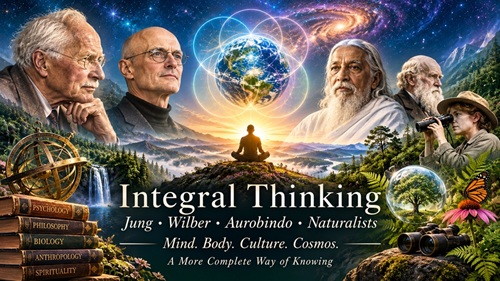
Introduction: The problem of being everything at onceFew contemporary intellectual systems have attempted to encompass as much as Ken Wilber's Integral Theory. Psychology, biology, sociology, anthropology, philosophy, religious studies, evolutionary theory, neuroscience, and contemplative spirituality all find a place within its elaborate architecture. Wilber's ambition is impressive. Rather than accepting the fragmentation of modern knowledge into specialized disciplines, he proposes an overarching framework capable of integrating their different perspectives. His famous AQAL model — All Quadrants, All Levels, All Lines, All States, and All Types — is intended to provide a comprehensive map of reality and human development. But this ambition raises a fundamental question: What kind of intellectual enterprise is Integral Theory? Is it a scientific theory, subject to empirical testing and possible falsification? Is it a philosophical framework, organizing knowledge and clarifying relationships between disciplines? Is it a developmental psychology, describing the evolution of human consciousness? Or is it, at bottom, a modern religious-metaphysical worldview expressed in the vocabulary of contemporary scholarship? These categories are not necessarily mutually exclusive. A philosophical framework can incorporate scientific findings, and a religious tradition can make claims about psychological development. But the distinctions matter enormously when a system presents itself as an integral account of reality. The central problem with Wilber's project is not that it attempts to connect different fields of knowledge. That is a legitimate intellectual ambition. The problem is that it sometimes moves between empirical findings, philosophical interpretations, spiritual testimonies, and metaphysical assertions without adequately distinguishing their respective evidential status. Integral Theory may be an impressive map of intellectual territory. But is the territory actually organized as the map suggests? This essay examines the question through five dimensions: science, philosophy, developmental theory, religious metaphysics, and the contemporary post-Wilber movement. 1. AQAL: a map of everythingThe starting point for understanding Integral Theory is the AQAL model. Its five principal components are:
The model is designed to prevent one-sided explanations. A human being cannot be adequately understood through brain chemistry alone, nor through subjective experience alone. Individual psychology is embedded in cultural meanings and social institutions. This is a reasonable starting point. Indeed, the four-quadrant distinction captures something that is frequently neglected in specialized research. The subjective experience of depression, its neurological correlates, the cultural interpretation of mental illness, and the institutional organization of mental healthcare are different dimensions of one complex phenomenon. A comprehensive account should take all of them into consideration. The difficulty is that a useful classification scheme is not automatically a scientific theory. AQAL provides a way of organizing perspectives and questions. It does not, by itself, establish causal relationships, explain developmental mechanisms, or generate precise predictions. A map can help us decide where to look. It cannot substitute for investigating what is actually there. This distinction is acknowledged even by sympathetic academic presentations of Integral Theory. For example, James D. Duffy's 2020 article, A Primer on Integral Theory and Its Application to Mental Health Care, describes AQAL as a metatheoretical framework for organizing different perspectives on human problems. That is a more defensible characterization than treating AQAL as an independently verified scientific account of reality. The question then becomes whether Integral Theory consistently respects this distinction. 2. Is Integral Theory a scientific theory?Let us begin with a relatively straightforward definition. A scientific theory should do more than organize observations. It should offer explanations of phenomena, specify relationships between variables, generate testable hypotheses, and expose itself to possible correction through empirical investigation. It need not be falsifiable in some simplistic, one-experiment sense. Complex scientific theories are often tested through networks of hypotheses, models, measurements, and converging evidence. But a scientific theory must make contact with empirical reality in a sufficiently precise way that evidence can count against it. Does Integral Theory meet these requirements? The answer is mixed. Some of its constituent elements can be investigated scientifically. Developmental psychology studies changes in cognitive and moral capacities. Neuroscience investigates brain processes associated with consciousness. Sociology examines institutional structures and collective behaviour. Psychology studies personality differences and subjective experience. These are legitimate research programmes. But AQAL as a whole is not a single scientific theory in the same sense as evolutionary theory, general relativity, or the germ theory of disease. It does not offer one integrated set of causal mechanisms from which its five components can be derived. Nor does it provide a unified set of operational definitions and predictive relationships that could establish the validity of the entire system. Its quadrants are primarily perspectives. Its levels draw on multiple developmental theories. Its lines refer to different capacities, and its states incorporate phenomenological and contemplative classifications. These components come from different intellectual traditions and have different evidential foundations. Consequently, evidence supporting one component does not automatically validate the others. For example, evidence that cognitive development follows certain relatively ordered patterns does not establish that consciousness evolves through Wilber's subtle, causal, and nondual stages. Likewise, evidence that meditation can alter subjective experience and measurable brain activity does not establish the existence of a causal spiritual realm. The distinction between empirical support for individual components and empirical support for the entire architecture is fundamental. The problem of scientific borrowingIntegral Theory frequently invokes established scientific disciplines to support its broader worldview. Evolutionary biology, systems theory, neuroscience, developmental psychology, and complexity science all feature prominently in its intellectual landscape. But citing a scientific discipline is not the same as demonstrating that its findings support a particular metaphysical interpretation. There is a recurring pattern in integral writing:
A scientific finding may be compatible with Integral Theory without actually supporting its distinctive claims. For example, biological evolution involves increasing complexity in certain lineages and circumstances. That does not establish a universal cosmic tendency toward greater consciousness. Nor does the emergence of human consciousness demonstrate that evolution is driven by an intrinsic spiritual force. Compatibility is not confirmation. This is particularly important in Wilber's treatment of evolution, where he has repeatedly argued that conventional evolutionary science cannot adequately explain the emergence of increasing complexity and consciousness. His proposed alternative invokes Eros as a fundamental creative tendency within the Kosmos. But calling this tendency Eros does not provide an evolutionary mechanism. The problem is not that science has answered every question about biological complexity. It has not. The problem is that an unexplained phenomenon does not become explained simply by assigning it a spiritual cause. This issue has been examined in detail by Frank Visser in the critique of Wilber's relationship with evolutionary science published in Integral Review in 2020. The central argument is that Wilber's spiritual interpretation of evolution has not been adequately integrated with the actual findings and explanatory mechanisms of evolutionary biology. The same methodological concern applies to Integral Theory more generally. 3. Integral Theory as philosophy: its most defensible identityIf Integral Theory is not a scientific theory in the conventional sense, perhaps it should be understood primarily as philosophy. This is considerably more promising. Philosophy has always attempted to relate different domains of knowledge, clarify conceptual distinctions, examine assumptions, and construct comprehensive interpretations of reality. Wilber's project belongs to this tradition of philosophical synthesis. His intellectual predecessors include Plato, Plotinus, Hegel, Schelling, Aurobindo, and numerous contemporary developmental theorists. He seeks to overcome the fragmentation of modern knowledge by identifying recurring patterns across different disciplines. His four quadrants, for example, can be interpreted as a philosophical argument against reducing subjective experience to objective description, or collective meaning to individual psychology. This is a legitimate philosophical position. Similarly, the distinction between states and stages raises worthwhile questions about the relationship between temporary experiences and lasting developmental transformations. The distinction between individual and collective development can help prevent the assumption that personal psychological growth automatically produces corresponding cultural or institutional change. These are useful conceptual contributions. However, philosophy must also submit to criticism. A comprehensive philosophical framework should clarify its premises, defend its inferences, and explain why competing interpretations are less satisfactory. Wilber sometimes presents AQAL not merely as one possible philosophical orientation but as the framework capable of including and transcending virtually all other approaches. That creates a problem. If every competing theory can be classified as containing a partial truth, while Integral Theory is automatically assigned the more comprehensive position, the system risks becoming self-confirming. Its comprehensiveness becomes a claim that is difficult to challenge because criticism itself can be interpreted as evidence of the critic's limited perspective. This is not a scientific problem alone. It is also a philosophical one. A philosophy that cannot clearly specify its own limitations risks becoming an intellectual enclosure. The difference between a metatheory and a theory of everythingThe distinction is worth emphasizing. A metatheory organizes relationships between different theories. It asks how different disciplines approach their subjects, what assumptions they make, and where their explanatory contributions overlap. A theory of everything, in the stronger sense, attempts to explain the fundamental structure of reality itself. Integral Theory frequently moves between these two ambitions. As a metatheory, it can be useful without proving that its particular developmental hierarchy is universally valid. As a theory of everything, it faces a much heavier burden of proof. The 2023 article On Integral Theory: An Exercise in Dialectical Critical Realism provides a further example of academic efforts to examine the philosophical and epistemological foundations of AQAL rather than simply adopting its categories. The more Integral Theory is treated as a philosophical framework, the more clearly its assumptions and limitations should be stated. 4. Integral Theory as developmental psychology: the hierarchy problemOne of Wilber's most influential contributions is his attempt to integrate developmental theories into a comprehensive account of human growth. He draws on thinkers such as Jean Piaget, Lawrence Kohlberg, Clare Graves, Jane Loevinger, and Sri Aurobindo, among others. The resulting picture is one of progressive development through increasingly inclusive structures of consciousness. In broad outline, humanity moves from archaic and magical forms of awareness through mythic, rational, pluralistic, and integral modes of consciousness, potentially culminating in transpersonal realization. There are several problems with this construction. Are developmental stages really universal?Developmental psychology has identified important regularities in human development. Children acquire increasingly sophisticated cognitive capacities, develop more complex understandings of other people, and learn to reason about increasingly abstract problems. But these findings do not necessarily establish one universal hierarchy encompassing cognitive, moral, emotional, cultural, and spiritual development. Different capacities develop at different rates. An individual can be highly sophisticated intellectually while remaining emotionally immature. Someone can possess advanced technical knowledge while maintaining authoritarian political attitudes. Even within a single developmental line, people do not necessarily follow identical trajectories. Wilber recognizes some of this through his concept of developmental lines, but the larger architecture still encourages an overarching hierarchical interpretation. There is also a danger of confusing the history of ideas with the development of individual consciousness. A modern scientist may employ sophisticated abstract reasoning while simultaneously participating in mythological or religious traditions. A person in an ancient society may have demonstrated extraordinary intellectual sophistication without possessing the cultural institutions of modern science. The emergence of different worldviews throughout history cannot simply be translated into a universal ranking of individual human beings. The problem of the integral eliteIntegral Theory sometimes encourages the impression that a relatively small group of people has reached a higher level of consciousness from which it can understand the limitations of everybody else. This creates an unfortunate intellectual asymmetry. Critics of Integral Theory may be classified as insufficiently developed, excessively rational, trapped in a lower worldview, or unable to appreciate the higher perspectives of integral consciousness. Such interpretations are particularly convenient because they protect the framework from criticism. But developmental sophistication should never be used as a substitute for answering an argument. Someone operating from an allegedly lower developmental stage can make a scientifically correct observation. Someone claiming a higher stage can make a factual mistake. Intellectual validity does not depend on the developmental rank assigned to the speaker. This is one of the most important methodological safeguards that Integral Theory needs. 5. Integral spirituality: where philosophy becomes religious metaphysicsHere we arrive at the most controversial dimension of Wilber's project. Integral Theory is not merely an attempt to organize academic knowledge. It also seeks to integrate the world's contemplative and religious traditions into a comprehensive account of spiritual reality. Wilber takes seriously the claims of mystics, contemplatives, and religious practitioners that consciousness can develop beyond ordinary egoic experience. His framework includes psychic, subtle, causal, and nondual states or dimensions, alongside corresponding developmental interpretations. The difficulty is that these categories are not merely descriptions of subjective experience. Wilber often associates them with different dimensions of reality. This introduces a metaphysical commitment. Consider the difference between these two propositions:
The first is an empirical and phenomenological proposition that can be investigated. The second is an ontological proposition requiring additional justification. Wilber's integral framework frequently brings these propositions close together. He draws on the testimony of contemplative traditions, particularly Buddhist, Hindu, and Neoplatonic sources, to support a spectrum of spiritual development. But there is a problem of verification. Different contemplative traditions describe different ultimate realities. Some emphasize a personal God, others impersonal awareness, emptiness, divine presence, or the dissolution of all metaphysical distinctions. Can these competing descriptions really be integrated into one universal hierarchy? Wilber argues that their apparent disagreements can often be understood as differences in perspective, developmental stage, or contemplative depth. This is an ingenious interpretive strategy, but it also risks immunizing the system against contradictory evidence. If agreement supports Integral Theory and disagreement is explained away through differences in developmental perspective, what could actually count against the framework? The problem of spiritual verificationWilber's appeal to contemplative practice deserves a more nuanced assessment. First-person experience is not scientifically irrelevant. Meditation, introspection, and phenomenological investigation can provide important information about consciousness. Contemplative neuroscience, for example, investigates relationships between meditation practices, subjective experience, and measurable physiological changes. But the fact that an experience is reproducible within a contemplative practice does not automatically validate the metaphysical interpretation attached to it. A practitioner may consistently experience a sense of boundless awareness. This establishes something about the phenomenology of the experience. It does not establish that awareness is the fundamental substance of the universe. Likewise, a meditation practice may produce experiences of unity, emptiness, or timelessness without proving that the universe itself possesses those properties. Wilber's framework would benefit from a much more explicit separation between:
Without these distinctions, spiritual testimony can become a substitute for external validation. 6. The religious character of Integral TheoryIs Integral Theory a religion? Wilber would probably resist that description. He has generally presented his project as a comprehensive philosophical framework that includes science, ethics, aesthetics, and spirituality without requiring adherence to a conventional religious institution. Nevertheless, Integral Theory exhibits several characteristics commonly associated with religious worldviews. It offers a comprehensive account of reality. It proposes a developmental purpose or direction to existence. It interprets human life within a larger spiritual context. It incorporates contemplative practices intended to transform consciousness. It provides an account of ultimate reality, frequently expressed through the language of Spirit, emptiness, or nonduality. It also has communities, teachers, specialized vocabulary, educational programmes, and institutions dedicated to communicating and applying its worldview. None of these features alone makes a philosophy a religion. But taken together, they suggest that Integral Theory functions partly as a form of modern spiritual worldview. The distinction becomes particularly important when discussing evolution. Wilber's concept of Eros, for example, proposes that the Kosmos contains an inherent tendency toward self-transcendence and the emergence of greater complexity. This is not simply a metaphor for biological evolution. Wilber has described Eros as an actual force in the universe, comparable in some respects to the fundamental forces of physics. In Finding Radical Wholeness (2024), he again presents Eros as an active principle of self-transcendence. But what is the independent evidence for such a force? Gravity, electromagnetism, and nuclear interactions are supported by mathematical formulations, experimental observations, and predictive applications. Eros has no comparable scientific status. It is invoked to explain the emergence of complexity, consciousness, and higher forms of organization, but it does not provide an independently established physical or biological mechanism. This is where Integral Theory moves decisively beyond a neutral metatheory. It adopts a particular metaphysical interpretation of evolution and presents it as part of its comprehensive understanding of reality. A philosophical or religious worldview is entitled to propose such an interpretation. But it should not be confused with an established scientific explanation. 7. Integral Theory and the problem of methodological pluralismOne of Wilber's attempts to address these difficulties is his concept of Integral Methodological Pluralism. The basic idea is that different aspects of reality require different methods of investigation. First-person experience calls for phenomenological inquiry. Second-person and collective meaning require interpretive and hermeneutic approaches. Third-person phenomena can be investigated through empirical observation and scientific measurement. Social and institutional structures require systems analysis. This is an attractive proposal because it acknowledges that no single method can answer every question. A neurological scan cannot tell us everything about the meaning of a religious experience. An interview cannot establish the biological mechanism of a disease. Statistical analysis cannot replace the interpretation of a literary text. But methodological pluralism creates another challenge: how do we adjudicate conflicts between the results of different methods? Suppose a contemplative practitioner reports an experience of timeless consciousness and interprets it as evidence of an eternal spiritual reality. A phenomenological investigation can describe the experience. A psychological investigation can examine its cognitive and emotional characteristics. Neuroscience can investigate associated brain activity. But none of these methods automatically establishes the practitioner's metaphysical conclusion. If Integral Theory gives equal epistemological standing to every perspective without distinguishing their respective capacities to establish particular claims, methodological pluralism becomes epistemological relativism. Conversely, if one perspective is allowed to determine the conclusions of all the others, the promised pluralism becomes hierarchical control. Wilber's system needs a clearer account of how different methods interact, how their findings are evaluated, and how conflicting claims are resolved. A useful metatheory should facilitate criticism between disciplines, not simply accommodate their claims within a predetermined worldview. 8. The academic status of Integral TheoryIntegral Theory has generated an academic literature, conferences, journals, educational programmes, and applications in fields such as management, healthcare, education, and organizational development. It would therefore be inaccurate to suggest that it exists entirely outside academic discussion. There are serious scholars who have attempted to clarify, develop, and criticize its foundations. For example, Sean Saiter's 2009 article on universal integralism examines the relationship between Wilber's epistemology and his methodological pluralism. Leon Schlamm's 2001 study questions the extent to which Wilber's spiritual hierarchy can accommodate the diversity of mystical traditions. More recently, Ritske Rensma's 2025 article examines later revisions to Wilber's theoretical framework and proposes that these developments constitute a sixth phase of his intellectual evolution. These contributions demonstrate that Integral Theory is a legitimate subject of academic inquiry. But having an academic literature is not the same as being an established academic discipline. We should distinguish several things:
Integral Theory clearly qualifies as an academic subject and an intellectual movement. It has developed some features of an interdisciplinary research field. Whether it constitutes a scientific discipline in its own right is much more questionable. Its research programmes remain heterogeneous, and its central metaphysical claims have not acquired the evidential status of established scientific theories. There is no contradiction in saying that Integral Theory deserves academic study while questioning its scientific credentials. In fact, serious academic study requires precisely that distinction. 9. The post-Wilber movement: what happens when the founder's system becomes an intellectual institution?The question of Integral Theory's intellectual status becomes particularly interesting when we look beyond Wilber himself. Over the years, a considerable network of post-Wilber thinkers, organizations, and initiatives has emerged. They attempt to extend, secularize, institutionalize, or otherwise revise the original integral framework. Among the developments worth examining are:
These developments should not all be treated as identical. Some are more explicitly spiritual, others more academically oriented, and still others seek to develop secular alternatives. Nevertheless, they inherit a common challenge: how to distinguish the usefulness of an integrative framework from the truth of the metaphysical worldview that may accompany it. There is also an institutional question. When an intellectual movement develops its own vocabulary, recognized authorities, conferences, publications, and educational structures, it can become increasingly self-referential. Criticism may be welcomed in principle but become difficult to accommodate when it challenges foundational assumptions. This is not unique to Integral Theory. It happens in established academic disciplines, religious institutions, and political movements as well. But for a movement that prides itself on integrating perspectives and transcending limitations, the willingness to expose its own foundations to serious external criticism should be especially important. The danger of endless integrationThere is a paradox in the post-Wilber landscape. Integral Theory was originally intended to overcome the fragmentation of knowledge. Yet its expansion has produced an increasingly elaborate vocabulary of developmental levels, perspectives, methodological distinctions, and metaphysical categories. The danger is that integration becomes an end in itself. Every new theory, discovery, or criticism generates another opportunity to extend the map. But does the map thereby become more accurate? Adding more categories does not necessarily improve explanatory power. Sometimes it simply makes a framework more difficult to challenge. A successful metatheory should ideally become simpler and more precise as it develops. It should identify which distinctions genuinely matter, which assumptions can be discarded, and which propositions have survived empirical and philosophical criticism. Integral Theory would benefit from such a process of intellectual consolidation. 10. A proposed classification: four possible identities of Integral TheoryThe preceding discussion suggests that Integral Theory should not be assigned a single identity without qualification. Its different dimensions have different intellectual statuses.
This classification does not mean that Integral Theory has no scientific components or that its philosophical contributions are without value. It means that different claims must be assessed according to different standards. A developmental model should be evaluated through developmental research. A philosophical argument should be evaluated through conceptual clarity and logical coherence. A metaphysical claim should be evaluated through the arguments and evidence offered in its support. One cannot use the success of one category to validate the others. 11. What would a more defensible Integral Theory look like?Rather than abandoning the integral ambition, we might ask how it could be reconstructed on more defensible foundations. I would suggest five requirements. First, distinguish the map from the territory. AQAL should be treated primarily as an organizing framework, not as a demonstrated description of the fundamental architecture of the Kosmos. Its categories should remain open to revision. Second, separate established science from philosophical interpretation. Evolutionary biology, neuroscience, cognitive psychology, and sociology should be represented according to their actual findings, not selectively interpreted to support a spiritual evolutionary narrative. Third, make developmental claims independently testable. If Integral Theory proposes that certain levels of consciousness exist, it should specify their characteristics, methods of measurement, developmental relationships, and possible disconfirming evidence. Fourth, allow naturalistic and secular interpretations. An integral approach need not assume that consciousness is ultimately spiritual, that evolution is driven by Eros, or that the universe has an intrinsic purpose. A secular integral philosophy could investigate meaning, value, cooperation, consciousness, and human flourishing without making supernatural or metaphysical commitments. Fifth, institutionalize criticism. A genuine integral movement should welcome external expertise, especially when criticism comes from disciplines whose findings challenge its foundational assumptions. This means that evolutionary biologists should not have to become integral theorists before their objections to Wilber's evolutionary claims are taken seriously. Neuroscientists should not have to accept a transpersonal ontology before their research is considered relevant. Philosophers should be able to question the coherence of AQAL without being classified developmentally. These requirements would make Integral Theory less grandiose, perhaps, but considerably more intellectually credible. Conclusion: Integral Theory needs to integrate its own limitationsKen Wilber's Integral Theory is an extraordinary intellectual construction. Its ambition to overcome the fragmentation of modern knowledge deserves recognition. Its insistence that subjective experience, cultural meaning, objective science, and social systems should all be considered is a useful corrective to reductionist approaches. But the ambition of a theory should not be confused with its explanatory success. AQAL is a comprehensive classification scheme, not a demonstrated theory of everything. Its developmental hierarchies draw on genuine psychological research but extend into contested territory. Its spiritual dimensions incorporate religious and contemplative traditions but do not thereby establish the metaphysical realities those traditions describe. The central problem is the movement between these different levels of discourse. Integral Theory can begin with an established scientific finding, interpret it through a philosophical framework, and eventually incorporate it into a spiritual account of cosmic evolution. At each transition, additional assumptions enter the argument. Those assumptions require independent justification. This is particularly important when Wilber invokes Eros as an actual evolutionary force, or when higher states of consciousness are treated as evidence for subtle and causal dimensions of reality. Such propositions may be philosophically or religiously meaningful. But their status should not be inflated by their incorporation into a framework that also contains legitimate scientific knowledge. Perhaps Integral Theory's most important future task is therefore not to become even more comprehensive, but to become more discriminating. It should distinguish what is scientifically established, what is philosophically defensible, what is psychologically useful, and what remains a matter of spiritual or metaphysical interpretation. This would not destroy the integral project. It would give it a more credible intellectual foundation. There is an irony here. A philosophy that prides itself on including all perspectives should be particularly willing to include perspectives that challenge its own assumptions. And a theory that claims to transcend earlier limitations should be willing to recognize its own. The real test of Integral Theory is not whether it can accommodate everything, but whether it can distinguish what is true from what is merely compatible with its worldview. That, ultimately, is the difference between an ambitious intellectual synthesis and a comprehensive belief system. Appendix: Some questions for the post-Wilber generationThe following questions might serve as a programme for a more critical and scientifically responsible integral movement.
The sixth question is perhaps the most important. A framework that cannot specify what would count against its central propositions risks becoming a closed worldview rather than an open research programme.
Comment Form is loading comments...
|