|
TRANSLATE THIS ARTICLE
Integral World: Exploring Theories of Everything
An independent forum for a critical discussion of the integral philosophy of Ken Wilber
  Frank Visser, graduated as a psychologist of culture and religion, founded IntegralWorld in 1997. He worked as production manager for various publishing houses and as service manager for various internet companies and lives in Amsterdam. Books: Ken Wilber: Thought as Passion (SUNY, 2003), and The Corona Conspiracy: Combatting Disinformation about the Coronavirus (Kindle, 2020).
Check out my other conversations with ChatGPT
From Jung to Wilber and Beyond:
The Man Who Put the Gods Back into Psychology Collective Unconscious to Cosmic Consciousness Integral Theory: Science, Philosophy, or Religion? Can We Have Integral Without Wilber? From Jung to WilberHow the Collective Unconscious Became the Cosmic ConsciousnessKen Wilber's critique of Jung, the pre/trans fallacy, and the metaphysical expansion of depth psychologyFrank Visser / ChatGPT
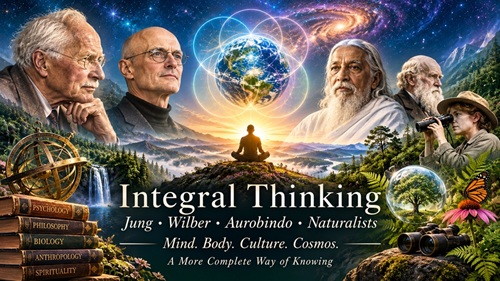
Introduction: From the depths of the psyche to the heights of the KosmosCarl Gustav Jung and Ken Wilber belong to different generations and intellectual traditions, but they share an ambitious project: to construct a comprehensive understanding of human consciousness that connects psychology, mythology, religion, personal development, and spiritual experience. Jung sought to uncover the deeper structures of the human psyche through dreams, archetypes, mythology, and religious symbolism. Wilber, building partly on Jung but also drawing on developmental psychology, Eastern contemplative traditions, and Western philosophy, attempted something even more ambitious: to integrate psychology, biology, culture, spirituality, and cosmology into a single evolutionary framework. There is an interesting intellectual progression here. Jung's collective unconscious became one of the important reference points for transpersonal psychology. Transpersonal psychology subsequently became one of the intellectual environments from which Wilber's integral philosophy emerged. Yet Wilber did not simply accept Jung. On the contrary, he developed a substantial critique of Jung's understanding of spiritual experience. His principal objection was that Jung sometimes confused genuinely transpersonal experiences with earlier, prepersonal forms of consciousness. This became central to Wilber's famous pre/trans fallacy. The disagreement raises a fascinating question: did Wilber correct an important limitation in Jung's psychology, or did he replace Jung's psychological speculation with an even more ambitious metaphysical system? The answer requires examining both thinkers carefully. 1. The intellectual bridge: Jung, transpersonal psychology, and WilberThe connection between Jung and Wilber is not merely that both were interested in spirituality. Both regarded conventional modern psychology as insufficiently equipped to explain the full range of human consciousness. Jung's psychology was primarily concerned with the relationship between the conscious ego, the personal unconscious, and the collective unconscious. Wilber adopted a developmental perspective, proposing that consciousness evolves through increasingly complex structures, from prepersonal through personal to transpersonal levels. The difference is significant. For Jung, the collective unconscious was a deep dimension of the psyche, containing archetypal structures that manifest themselves in dreams, myths, religious symbols, and visionary experiences. For Wilber, however, the collective unconscious was not necessarily a higher spiritual domain. It could also represent an earlier, prepersonal dimension of psychological development. This distinction became the starting point of Wilber's criticism. In his early writings, particularly The Atman Project (1980), Up from Eden (1981), and Eye to Eye (1983), Wilber attempted to construct a developmental history of consciousness that incorporated psychoanalysis, developmental psychology, anthropology, and the contemplative traditions of East and West. He eventually concluded that much of the Romantic and Jungian tradition had misunderstood the relationship between psychological origins and spiritual transcendence. The central issue was whether returning to something that precedes the individual ego is equivalent to transcending that ego. Wilber's answer was emphatically negative. 2. Wilber's pre/trans fallacy: the central criticism of JungWilber's concept of the pre/trans fallacy is probably his most important theoretical criticism of Jung. He first developed it in his 1982 article, "The Pre/Trans Fallacy," published in the Journal of Humanistic Psychology. The argument is deceptively simple. Human development involves at least three broad possibilities:
The difficulty is that the prepersonal and transpersonal can sometimes look superficially alike. Both may involve diminished ego boundaries, non-rational experiences, feelings of unity, or a sense of participation in something larger than oneself. But, Wilber argues, their developmental significance is entirely different. An infant who has not yet differentiated itself from its environment is not experiencing enlightenment. It has not transcended the ego; it has not yet developed one. Conversely, an experienced meditator who temporarily transcends ordinary subject-object duality may be undergoing a genuinely transpersonal experience. Wilber therefore identifies two opposite mistakes. Reductionism: interpreting mystical experience as nothing more than infantile regression. This is the mistake he associates particularly with Freud. Elevationism: interpreting primitive, pre-egoic experiences as though they were higher spiritual realizations. This is the mistake he associates with Jung and the Romantic tradition. Wilber's formulation is important because it allows him to defend the possibility of genuine spiritual development while rejecting the idea that spirituality is simply a return to an original state of undifferentiated unity. His criticism of Jung is not that Jung failed to recognize spiritual experience. Rather, Wilber believes Jung recognized the transpersonal but did not sufficiently distinguish it from the prepersonal. In Wilber's own retrospective account, he explicitly identifies Jungian psychology as part of the Romantic tradition that he eventually sought to revise. Is Wilber right?There is considerable merit in this distinction. Psychological regression and contemplative transcendence should not automatically be treated as equivalent. A loss of ordinary ego boundaries can occur in very different circumstances, with very different psychological consequences. However, Wilber's criticism becomes less convincing when he treats Jung's collective unconscious as though it were simply an infantile, pre-egoic domain. Jung did not regard the collective unconscious as a collection of infantile memories. His archetypes were supposed to be inherited structural dispositions of the psyche, not memories of an individual's infancy. Furthermore, Jung's concept of individuation explicitly involves the development and integration of a differentiated personality. It is not simply a recommendation to return to primordial fusion. Wilber's criticism therefore identifies a genuine theoretical problem in some Romantic interpretations of spirituality, but it does not automatically dispose of Jung's entire psychology. That distinction should not be lost. 3. The archetype dispute: mythological patterns versus higher spiritual realitiesA second important disagreement concerns the meaning of archetypes. Jung used the term in several related ways, but his basic distinction was between the archetype itself, understood as an inherited organizing disposition, and the particular images through which it becomes psychologically visible. For example, the Mother archetype might manifest in dreams, religious figures, fairy tales, personal relationships, and cultural mythology. Wilber considered this terminology confusing because it grouped together phenomena that, in his developmental framework, belonged to different levels of consciousness. He distinguished between mythological archetypes and what he regarded as genuinely transpersonal or subtle archetypal forms. This is an important passage in Integral Psychology (2000). Wilber argues that Jungian writers often use archetypes to refer to mythic forms, whereas the older Platonic and Neoplatonic meaning of archetype concerns subtle or higher-order forms. He regards the two usages as frequently conflated. Consider the difference: - A mythological Hero is a symbolic figure embedded in a particular cultural narrative. - A subtle archetypal form, in Wilber's interpretation, belongs to a higher spiritual dimension of consciousness. The first can be studied through mythology, anthropology, literature, and cultural psychology. The second belongs to Wilber's metaphysical spectrum of consciousness. Wilber's criticism is that Jungian psychology sometimes treats the first as evidence of the second. There is an interesting irony here. Wilber accuses Jung of conflating different levels of reality, but his own distinction depends on accepting the existence of subtle spiritual realms. Where is the independent evidence for these realms? Wilber's appeal to Plato, Plotinus, Vedanta, and contemplative traditions establishes an intellectual genealogy, not empirical confirmation. The fact that different spiritual traditions describe subtle worlds does not establish that these worlds exist independently of human imagination and cultural interpretation. Moreover, Jung's archetypes were not necessarily intended as literal mythological characters or inhabitants of an invisible spiritual world. They were theoretical constructs intended to explain recurring patterns of psychic experience. Wilber's distinction may therefore be useful as a classification of different kinds of symbolic experience, but it does not establish his preferred metaphysical interpretation. 4. Jung's defence: individuation is not regressionWilber's criticism is not the only possible interpretation of Jung. An important counterargument comes from the Jungian tradition itself: individuation is not a retreat into an undifferentiated state but a movement toward greater psychological integration. Jung's concept of the Self is especially relevant here. The Self represents a psychological totality that includes, but is not identical with, the conscious ego. Individuation involves establishing a more comprehensive relationship between conscious and unconscious aspects of personality. This is not necessarily a regression to infancy. Indeed, Jung's emphasis on confronting the Shadow, integrating conflicting tendencies, and developing a more differentiated personality suggests that he understood psychological maturity as something more complex than the dissolution of ego boundaries. The British-American psychologist Michael Washburn developed a particularly interesting alternative interpretation. In his 1990 article "Two Patterns of Transcendence," Washburn contrasted Wilber's developmental ladder to oneness with a Jungian-inspired spiral to integration. The difference is worth examining. Wilber's model emphasizes a succession of developmental stages. The individual develops an ego, matures beyond it, and potentially reaches transpersonal levels of consciousness. Washburn's model gives greater importance to the return of unconscious and non-egoic dimensions during spiritual development. Transcendence may involve a temporary regression or confrontation with deeper psychological forces before a more integrated form of consciousness emerges. This is not simply a return to infancy. It is a movement through previously neglected or repressed dimensions of the psyche. Washburn therefore offers a challenge to Wilber's tendency to separate psychological regression and spiritual development too sharply. There is a genuine theoretical disagreement here. Does spiritual transformation principally involve ascending through increasingly complex stages, or can it require a descent into the psychological ground from which the ego originally emerged? Wilber replied to Washburn in the same journal in 1990, arguing that Jung's analytical psychology and his own spectrum psychology were not fundamentally incompatible and that Jungian insights could be incorporated into his more comprehensive framework. This qualification is important. Wilber's relationship with Jung is not simply one of rejection. He wanted to retain Jung's insights while relocating them within his own developmental architecture. Nevertheless, the question remains whether his architecture does justice to the complexity of Jung's psychology. 5. From the collective unconscious to the spectrum of consciousnessThe next step in this intellectual history is the transformation of Jung's collective unconscious into a much broader theory of consciousness. Jung proposed a distinction between the personal and collective unconscious. Wilber introduced a more elaborate developmental spectrum, incorporating prepersonal, personal, and transpersonal dimensions. His model eventually included:
In his later work, Wilber distinguished developmental structures from temporary states of consciousness. This distinction became particularly important in Integral Psychology (2000) and Integral Spirituality (2006). A person at an ordinary developmental stage might experience a profound meditative or mystical state without permanently acquiring the developmental capacities associated with a higher stage. This is a useful distinction. Having a powerful experience does not automatically make someone psychologically mature, intellectually sophisticated, or ethically developed. But Wilber goes considerably further. He proposes that consciousness can develop through genuinely transpersonal stages, associated with psychic, subtle, causal, and nondual dimensions. Here the Jungian archetypes acquire a new location in his system. Rather than being primarily manifestations of a collective psychological inheritance, certain archetypal experiences are interpreted as encounters with subtle spiritual realities. This is a substantial metaphysical expansion. We have moved from the hypothesis that human beings share inherited psychological structures to the proposition that consciousness can encounter higher-order dimensions of reality. The two claims should not be confused. There may be evolutionary and cognitive explanations for recurring symbolic patterns. There may also be psychological explanations for mystical experiences. Neither establishes the existence of subtle worlds. Wilber's model is therefore best understood as a philosophical and spiritual interpretation of consciousness, rather than an empirically established map of psychological development. 6. The Wilberian transformation of Jung: what is gained and what is lost?The relationship between the two thinkers can now be summarized.
Wilber gains a more differentiated developmental vocabulary. His distinction between psychological maturity and mystical experience is useful, as is his insistence that not every experience of ego dissolution represents spiritual enlightenment. But something is also lost. Jung's psychology is concerned with the unpredictable, sometimes disturbing encounter between consciousness and unconscious material. His approach is exploratory and interpretive. The unconscious is not simply a higher stage waiting to be reached. Wilber's system, by contrast, tends to classify experiences according to their position in a comprehensive developmental map. This can make his approach more systematic, but also more restrictive. An experience that does not fit the map risks being assigned to a lower level, a transitional stage, or a particular spiritual state. The danger is that the map begins to determine what experiences are allowed to mean. This is especially problematic when the higher levels of the map are themselves based on contested spiritual assumptions. 7. A countercritique: does Wilber commit his own version of the pre/trans fallacy?Here is where the comparison becomes particularly interesting. Wilber accuses Jung of confusing prepersonal and transpersonal phenomena. But does Wilber himself sometimes confuse the description of spiritual experiences with evidence for the metaphysical realities he associates with them? Consider three examples. First, archetypal experiences. A person experiences a powerful image of a divine figure during meditation or a dream. Wilber may interpret this as an encounter with the subtle realm. But the psychological experience does not independently establish the existence of such a realm. A symbolic experience can be profound without being an encounter with an objectively existing spiritual domain. Second, mystical unity. A person reports a feeling of oneness with the universe. Wilber interprets certain such experiences as nondual awareness. But the subjective experience of nonduality does not establish that the universe itself is metaphysically nondual in the sense required by Wilber's philosophy. The phenomenology and the ontology are separate questions. Third, developmental hierarchy. Wilber assumes that certain forms of consciousness represent higher developmental achievements than others. This is partly defensible when discussing specific cognitive abilities or psychological capacities. Formal reasoning, for example, involves capacities not present in early childhood. But when the hierarchy extends to subtle, causal, and nondual levels, the evidential situation changes. What independently establishes that these are successive stages of human development rather than different interpretations of unusual experiences? Wilber frequently appeals to contemplative traditions and the testimony of spiritual practitioners. These are relevant sources for studying religious experience, but they do not by themselves demonstrate a universal developmental sequence. This is not a refutation of every transpersonal claim. It is a demand for clearer distinctions between experience, interpretation, and evidence. Wilber's pre/trans distinction remains useful as a conceptual warning. It should not become a device for automatically classifying spiritual experiences according to his preferred metaphysics. There is another irony: Wilber criticizes Jung for elevating certain psychological phenomena into spiritual realities, yet his own system elevates selected experiences into evidence for a hierarchy of spiritual worlds. The difference is that Wilber provides a more elaborate classification. Whether that classification is more empirically justified is another matter. 8. The critics of Wilber: Jung was not the only one under scrutinyWilber's interpretation of Jung has itself been challenged by scholars working within transpersonal psychology. Leon Schlamm's 2001 article, "Ken Wilber's Spectrum Model: Identifying Alternative Soteriological Perspectives," is particularly relevant. Schlamm argues that Wilber's developmental hierarchy privileges certain spiritual traditions while distorting others. His model favours what he calls a structured, inwardly oriented path of spiritual development, whereas other traditions emphasize divine encounter, grace, surrender, or forms of liberation that do not fit a progressive developmental ladder. More importantly for our discussion, Schlamm challenges Wilber's characterization of Jung as an elevationist. He argues that Jung's psychology of the conjunction of opposites represents a different, legitimate approach to spiritual transformation, rather than simply a confusion of prepersonal and transpersonal consciousness. This is a significant objection. Wilber's framework assumes that spiritual development can be represented through a relatively comprehensive hierarchy. But not all religious traditions understand transformation in this way. Some emphasize progressive purification, others sudden awakening, others divine intervention, and still others the dissolution of the very idea of a spiritual developmental hierarchy. Can all these approaches really be accommodated within one developmental map without distorting their original meanings? Wilber would answer that an integral framework can accommodate different perspectives while explaining their respective limitations. His critics might respond that this gives Wilber's own framework an almost privileged position: every alternative can be included, but only after being interpreted through Wilber's categories. This is a recurring problem in integral theory. Its ambition to include everything can make it difficult to specify what would count as a genuine challenge to the system itself. 9. From Jungian psychology to integral spirituality: a metaphysical inheritanceThe intellectual history from Jung to Wilber is not a simple succession of ideas. It involves several intermediate developments. Transpersonal psychology attempted to extend psychology beyond the conventional boundaries of individual personality. It incorporated contemplative traditions, mystical experiences, altered states, and spiritual development. Wilber became one of its most influential theorists, eventually moving beyond the transpersonal label toward his own integral approach. He also drew heavily on Sri Aurobindo, whose philosophy of spiritual evolution provided an important model for the higher stages of consciousness. This introduces a further distinction. Jung was primarily concerned with the psychological interpretation of spiritual symbols and experiences. Aurobindo proposed an explicitly evolutionary metaphysics in which consciousness itself develops toward higher spiritual manifestations. Wilber attempted to synthesize elements of both approaches. The result is a system in which psychological development, cultural evolution, contemplative experience, and metaphysical evolution are presented as related dimensions of one comprehensive process. But this synthesis raises the same question we encountered with Jung: how much of the system is supported by evidence, and how much depends on accepting its underlying spiritual assumptions? There is no reason to assume that the existence of developmental changes in cognition establishes a corresponding evolution toward higher spiritual realities. Nor does the fact that mystical traditions describe stages of realization demonstrate that these stages constitute a universal evolutionary sequence. Wilber's achievement is to have constructed an elaborate framework for comparing these traditions. Whether the framework accurately describes reality is a separate question. 10. What remains valuable in both Jung and Wilber?A critical assessment should not end with wholesale rejection. Both thinkers made contributions that deserve serious consideration. Jung reminds us that human beings are not transparent to themselves. Much of our behaviour is influenced by processes outside conscious awareness. Dreams, symbols, emotions, cultural narratives, and personal histories shape our identities in ways that cannot be reduced to deliberate rational calculation. His concept of individuation remains a valuable framework for understanding psychological integration. Wilber contributes a developmental perspective that distinguishes different forms of cognitive, emotional, moral, and spiritual development. His insistence that temporary experiences should not be confused with enduring developmental achievements is particularly useful. His distinction between states and stages is also worth retaining as a research question: how do temporary experiences relate to relatively stable changes in personality and behaviour? But both thinkers need to be subjected to the same critical standards. Jung's collective unconscious should not be accepted merely because archetypal interpretations are compelling. Wilber's transpersonal stages should not be accepted merely because they can be arranged into a sophisticated developmental hierarchy. And neither thinker should be allowed to convert religious or philosophical assumptions into established psychological facts without adequate independent support. A naturalistic reconstruction could retain much of what is valuable in both approaches. We could investigate unconscious cognitive processes, recurring symbolic patterns, psychological integration, contemplative experience, and developmental change through evolutionary biology, neuroscience, cognitive psychology, anthropology, and clinical research. This would not necessarily eliminate all philosophical questions about consciousness or spirituality. It would, however, establish a clearer distinction between what we know, what we hypothesize, and what we believe. Conclusion: From the collective unconscious to the integral KosmosThe journey from Jung to Wilber illustrates a recurring development in modern spirituality. A psychological hypothesis becomes a broader theory of human consciousness. That theory becomes incorporated into a transpersonal philosophy. Eventually, it becomes part of a comprehensive metaphysical worldview. Jung proposed a collective unconscious containing inherited archetypal structures. Transpersonal thinkers interpreted these structures as indications of dimensions of consciousness extending beyond the individual. Wilber subsequently incorporated them into a developmental hierarchy that includes subtle, causal, and nondual spiritual realities. At every stage, the scope of the claims expanded. Wilber's criticism of Jung through the pre/trans fallacy is an important contribution. It reminds us that psychological regression and spiritual transcendence are not interchangeable. But it does not establish that Wilber's own hierarchy of spiritual development is correct. Indeed, Wilber's attempt to correct Jung introduces its own theoretical difficulties. His distinction between mythic and subtle archetypes depends on a metaphysical interpretation that cannot simply be inferred from the psychological phenomena being classified. Perhaps the most productive way forward is to separate the genuinely psychological insights of Jung from his speculative metaphysics, and the developmental insights of Wilber from his more ambitious claims about the structure of the Kosmos. There is no need to discard everything that cannot be incorporated into a naturalistic psychology. Philosophical and religious questions remain legitimate subjects of inquiry. But they should not be smuggled into psychology under the authority of a comprehensive theory. The central lesson is methodological: the more comprehensive a theory becomes, the greater its responsibility to demonstrate that its categories actually correspond to something independently established. Jung's collective unconscious and Wilber's integral Kosmos are both ambitious attempts to explain the relationship between individual consciousness and a larger reality. Both are intellectually fascinating. Neither should be mistaken for an established scientific discovery. And perhaps the most important question to ask of both is not how much of reality their systems can accommodate, but how much they can genuinely explain.
Comment Form is loading comments...
|