|
TRANSLATE THIS ARTICLE
Integral World: Exploring Theories of Everything
An independent forum for a critical discussion of the integral philosophy of Ken Wilber
  Frank Visser, graduated as a psychologist of culture and religion, founded IntegralWorld in 1997. He worked as production manager for various publishing houses and as service manager for various internet companies and lives in Amsterdam. Books: Ken Wilber: Thought as Passion (SUNY, 2003), and The Corona Conspiracy: Combatting Disinformation about the Coronavirus (Kindle, 2020).
Check out my other conversations with ChatGPT
From Jung to Wilber and Beyond:
The Man Who Put the Gods Back into Psychology Collective Unconscious to Cosmic Consciousness Integral Theory: Science, Philosophy, or Religion? Can We Have Integral Without Wilber? Carl JungThe Man Who Put the Gods Back into PsychologyAnd Why His Legacy Still SurvivesFrank Visser / ChatGPT
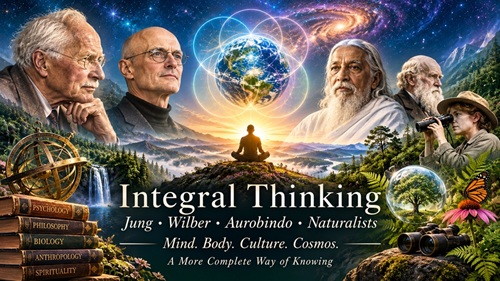 Introduction: The enduring appeal of the unconsciousFew psychologists have left a cultural footprint as extensive as Carl Gustav Jung (1875-1961). Long after his death, his ideas continue to circulate in psychotherapy, literature, religious studies, mythology, popular spirituality, personality testing, self-help literature, and even corporate coaching. Terms such as archetype, collective unconscious, introversion, extraversion, shadow, individuation, and synchronicity have become part of the vocabulary of educated popular culture. Jung's influence is remarkable considering that much of his theoretical system remains scientifically controversial. Some of his ideas are suggestive, others difficult to operationalize, and still others belong more comfortably to speculative metaphysics than to empirical psychology. Yet Jung continues to attract readers who find mainstream psychology too narrowly focused on observable behaviour, cognitive processes, or measurable symptoms. What explains this survival? Jung offered something that modern psychology often struggles to provide: a comprehensive account of human existence in which dreams, mythology, religion, personal identity, sexuality, imagination, and the search for meaning belong to one interconnected psychological landscape. His achievement was also his vulnerability. Jung expanded psychology into territories where the distinction between psychological explanation, philosophical speculation, and religious interpretation became increasingly difficult to maintain. To understand his modern legacy, we must therefore distinguish between Jung's genuine contributions, his questionable theoretical commitments, and the many ways subsequent generations have appropriated his work. 1. From Freud's successor to Freud's dissidentJung's early career seemed to position him as the natural successor to Sigmund Freud. The two men met in 1907 and initially developed a close intellectual relationship. Jung's psychiatric experience, his research into psychological complexes, and his international reputation made him an attractive candidate to lead the psychoanalytic movement. But their differences proved fundamental. Freud regarded sexuality and the repression of instinctual drives as central to the unconscious. Jung considered this an unnecessarily narrow interpretation. He increasingly emphasized symbolic processes, religious experience, mythology, and the possibility that psychological development involved something more than the resolution of childhood conflicts. Their relationship collapsed around 1912-1913. Jung rejected Freud's insistence on a predominantly sexual interpretation of psychic life, while Freud regarded Jung's increasing interest in spiritual and occult phenomena as a departure from scientific psychology. The disagreement was not simply a personal quarrel. It represented two different ambitions for psychology. Freud wanted to explain the hidden mechanisms of the individual psyche. Jung wanted to understand the psyche in its relationship to the entire history of human symbolic culture. This broader ambition became the defining characteristic of analytical psychology. Jung's subsequent work was extraordinarily eclectic. He drew on Gnosticism, alchemy, Christianity, Buddhism, Hinduism, mythology, anthropology, and comparative religion. He regarded these traditions not merely as collections of mistaken beliefs but as expressions of recurring psychological patterns. His Red Book, published in facsimile in 2009, provides an extraordinary record of his own confrontation with imaginative and unconscious material. It also reveals how closely his psychological theorizing was connected to personal visionary experience. This is important when assessing Jung. His theories did not emerge exclusively from controlled experiments or systematic clinical observation. They also grew out of introspection, symbolic interpretation, philosophical speculation, and experiences that Jung himself considered psychologically and religiously significant. That combination made him an unusually fertile thinker, but it also complicated his scientific credentials. 2. The collective unconscious: Jung's most ambitious hypothesisPerhaps Jung's most famous contribution is the concept of the collective unconscious. Freud had already established that consciousness represents only a small part of mental life. Jung went considerably further. He proposed that beneath the personal unconscious, containing forgotten experiences, repressed memories, and emotionally charged complexes, lies a deeper psychological layer shared by humanity. This collective unconscious supposedly contains inherited structures of psychological experience, which Jung called archetypes. The Mother, the Father, the Hero, the Shadow, the Wise Old Man, the Trickster, and the Self are among the familiar examples. They appear, in different forms, in mythology, religion, dreams, fairy tales, and literature. Jung's proposition was not simply that people everywhere tell similar stories. He believed that the human psyche possesses inherited organizing patterns that predispose us to experience and interpret reality in particular symbolic ways. There is something intuitively attractive about this idea. Human beings share an evolutionary history, similar bodily structures, comparable developmental experiences, and many common emotional challenges. It would be surprising if these similarities had no consequences for our imaginative lives. But Jung's explanation raises a difficult question: how much explanatory work does the collective unconscious actually perform? The recurrence of maternal imagery, heroic journeys, death-and-rebirth narratives, or trickster figures does not automatically establish the existence of inherited archetypal structures. Similar experiences can produce similar cultural expressions without requiring a transpersonal psychological repository. Evolutionary psychology, developmental psychology, cognitive science, and cultural transmission offer alternative explanations. Human beings share basic biological needs and cognitive capacities; societies transmit stories and symbols; and recurring social situations encourage recurring narrative patterns. A 2019 historical and philosophical critique by Jon Mills argues that the collective unconscious need not be understood as an autonomous transpersonal mind. Its more defensible meaning may be that human beings share fundamental psychological characteristics and cultural dynamics. This distinction matters. If archetypes are inherited psychological predispositions, they might eventually be investigated through developmental and evolutionary research. If they are manifestations of a universal metaphysical consciousness, the proposition becomes much harder to test. Jung himself moved between these interpretations, which helps explain why archetype theory remains controversial even within contemporary analytical psychology. 3. Archetypes: powerful interpretive tools, uncertain scientific entitiesArchetypes have enjoyed an extraordinary afterlife because they are remarkably adaptable. The Hero can be found in ancient mythology, religious narratives, political leadership, popular cinema, and contemporary self-help literature. The Shadow can describe disowned personality traits, collective prejudice, political projection, or the darker aspects of an individual's identity. The concept of the Shadow is particularly useful. People frequently attribute undesirable characteristics to others while remaining insufficiently aware of similar tendencies in themselves. Political movements, religious communities, and ideological groups can exhibit the same phenomenon. One does not need to accept Jung's entire theory of the collective unconscious to recognize the psychological importance of projection and self-deception. The difficulty begins when archetypes are treated as explanatory entities rather than interpretive patterns. Saying that a person behaves in a particular way because the Hero archetype has been activated may merely redescribe the behaviour in Jungian language. What would count as evidence that an archetype exists independently of the interpretation imposed upon it? Contemporary Jungian theorists have attempted to reformulate archetypes in terms of evolutionary biology, developmental processes, dynamic systems, and cultural emergence. This is an important development because it acknowledges that Jung's original formulations cannot simply be accepted as established scientific knowledge. A 2025 discussion by Jungian scholar Christian Rœsler, for example, argues that important biologistic and anthropological components of traditional archetype theory should be regarded as refuted, while exploring whether a more limited concept of universal psychological transformation can be retained. The result is an interesting possibility: archetypes might survive as useful descriptions of recurring human experiences without requiring Jung's original metaphysical assumptions. That would be a considerable revision, but not necessarily a rejection of everything Jung contributed. 4. Individuation: Jung's most enduring psychological contributionIf the collective unconscious is Jung's most ambitious theoretical hypothesis, individuation may be his most enduring practical contribution. Individuation refers to the process through which a person becomes psychologically more integrated, developing a fuller relationship with different aspects of the personality. It is not simply becoming independent, successful, or self-confident. It involves recognizing that the conscious self is not the entirety of the psyche. The persona, or social mask, is one aspect of personality. The Shadow contains aspects of ourselves that we have difficulty acknowledging. The anima and animus, in Jung's original gendered terminology, represent unconscious contrasexual dimensions of the psyche. The Self symbolizes the encompassing unity of the personality. The Self should not be confused with the ordinary ego. It represents an ideal of psychological wholeness that the individual may approach but never completely possess. Here Jung offers an important corrective to simplistic notions of personal development. Maturity does not consist in eliminating everything unpleasant about ourselves. It involves recognizing contradictions, integrating neglected capacities, and becoming less dependent on external approval. There is, however, a potential problem. Jung's language of wholeness can make psychological development sound like the discovery of a predetermined inner destination. In some presentations, individuation resembles a spiritual pilgrimage toward a deeper Self. A more naturalistic interpretation would regard it as an ongoing process of psychological integration, learning, self-knowledge, and adaptation. There need be no cosmic blueprint or metaphysical Self directing the process. This reformulation preserves much of the practical insight while avoiding unnecessary ontological commitments. 5. Synchronicity: when psychology ventures into metaphysicsFew of Jung's ideas are as fascinating, or as problematic, as synchronicity. Jung used this term for meaningful coincidences that appear to connect psychological states with external events without an identifiable causal relationship. His famous example involved a patient recounting a dream about a golden scarab. At that moment, an insect resembling the scarab appeared at the window of Jung's consulting room. For Jung, this was more than an amusing coincidence. It illustrated the possibility that psychological and physical events might occasionally be connected through a deeper principle of meaningful correspondence. In 1952, he published Synchronicity: An Acausal Connecting Principle, developed partly in dialogue with the physicist Wolfgang Pauli. Here we encounter a particularly problematic aspect of Jung's intellectual legacy. There is nothing wrong with studying coincidences, subjective meaning, or the psychological significance of unexpected events. Indeed, such experiences can have considerable emotional and existential importance. But the move from experiencing a coincidence as meaningful to proposing an objective acausal connection is a substantial theoretical leap. Human beings are extraordinarily good at detecting patterns. Sometimes this ability is useful; sometimes it produces false positives. Confirmation bias, selective memory, retrospective interpretation, and the tendency to notice meaningful coincidences while forgetting countless meaningless ones all complicate the matter. A coincidence can be psychologically meaningful without being cosmically significant. This distinction is essential because Jung's concept has frequently been appropriated by astrologers, New Age writers, and proponents of various forms of cosmic consciousness. Synchronicity becomes a convenient explanation for virtually anything that appears to confirm a person's worldview. Jung's own position was more complicated than this popular appropriation suggests. He attempted to formulate synchronicity as an explanatory principle, not merely as a description of subjective meaning. Recent scholarship continues to examine the gap between his original proposal and its subsequent metaphysical interpretations. A naturalistic psychology should be able to investigate why coincidences feel meaningful without assuming that the universe is communicating with us. 6. Jung and religion: psychology as a substitute for theology?Jung's relationship with religion deserves particular attention because it helps explain his continuing popularity. Unlike Freud, who generally interpreted religious belief as an expression of psychological needs and illusions, Jung treated religious experience as a potentially indispensable dimension of psychic life. He was interested in the psychological reality of religious symbols, regardless of whether their supernatural claims could be established. His famous formulation that God is, psychologically speaking, a reality within the human psyche is often misunderstood. Jung was not simply declaring that God does not exist. Nor was he straightforwardly defending traditional religious doctrines. He was investigating the image of God as a powerful psychic phenomenon. This distinction allowed him to take religious experience seriously without necessarily endorsing the theology associated with it. His explorations of Christianity, Gnosticism, alchemy, Hinduism, and Buddhism were attempts to identify recurring structures of human spiritual experience. The problem is that Jung sometimes moved too freely between psychological and ontological interpretations. If a patient dreams of a divine figure, this establishes something about the patient's psychological experience. It does not establish the existence of a corresponding supernatural entity. Likewise, the recurrence of similar religious symbols does not demonstrate that humanity participates in a universal spiritual consciousness. Jung's approach nevertheless anticipated an important contemporary distinction: religious experiences can be studied as human phenomena without accepting their supernatural explanations. This makes him relevant to secular approaches to religion, although Jung himself was never simply a secular humanist. He was deeply invested in the possibility that modern humanity had lost contact with dimensions of existence that religious symbolism had once expressed. His concern about the spiritual impoverishment of modern civilization continues to resonate. But the appropriate response need not be a return to metaphysics. A naturalistic understanding of meaning, community, moral commitment, contemplation, and psychological integration may address many of the same needs. 7. The Myers-Briggs phenomenon: Jung goes corporatePerhaps the most visible popular legacy of Jung is the Myers-Briggs Type Indicator (MBTI). Developed by Katharine Cook Briggs and her daughter Isabel Briggs Myers, the instrument translated Jung's theory of psychological types into a practical personality classification system. It identifies four pairs of preferences:
Combining these produces sixteen personality types, such as INTJ, ENFP, and ISTP. The commercial success of the MBTI has been extraordinary. It is used in workplaces, educational institutions, career guidance, team-building exercises, and personal development programmes. But how much of this popularity reflects scientific validity? There is an important distinction between the usefulness of personality descriptions and the validity of the theory underlying them. The MBTI encourages people to reflect on differences in temperament, attention, decision-making, and interpersonal preferences. That can be useful. But the assumption that people belong to sixteen relatively distinct psychological types is much harder to defend. Research by Robert McCrae and Paul Costa, published in 1989, found that MBTI scores were better understood as continuous personality dimensions than as evidence of sharply divided psychological types. They also found substantial overlap with the established Five-Factor Model of personality. There is, however, a qualification worth making. A 2025 psychometric synthesis of 193 studies involving MBTI Form M reported good internal consistency and convergent validity. This is relevant evidence in its favour, although reliability and correlations with other measures do not establish the validity of Jung's original theory of psychological types. The broader lesson is that a popular psychological instrument can be useful in some applications without its theoretical foundations being entirely correct. Jung deserves credit for helping introduce introversion and extraversion into modern personality discourse. But the contemporary scientific study of personality has moved considerably beyond his typological framework. 8. Jungian psychotherapy: does it actually work?A critical evaluation of Jung should not dismiss his clinical legacy simply because some of his theoretical ideas are difficult to substantiate. Jungian psychotherapy remains an established therapeutic tradition. It uses dreams, symbolic material, personal narratives, emotional complexes, and the exploration of unconscious conflicts as part of treatment. Its emphasis on the patient's subjective experience and personal history can be valuable, particularly when psychological difficulties involve identity, relationships, existential concerns, and persistent patterns of behaviour. There is empirical research supporting the effectiveness of Jungian psychotherapy. A 2013 review by Christian Roesler examined prospective and retrospective studies, including research conducted in Germany and Switzerland. The studies reported improvements in symptoms, interpersonal problems, personality structure, and everyday functioning, with some follow-up results suggesting that improvements persisted after treatment. More recent research, including a 2025 study involving 104 participants in supervised training settings, has also reported improvements in several psychological measures. The authors nevertheless emphasize the need for randomized controlled trials and longer-term follow-up research. This distinction is important. Evidence that patients improve during Jungian treatment is not the same as evidence that Jung's entire theoretical system is correct. Nor does therapeutic effectiveness establish the existence of archetypes, a collective unconscious, or synchronicity. A therapeutic approach may contain useful techniques and insights even when some of its original explanatory assumptions remain questionable. This is true of many psychological traditions, not just Jungian psychology. 9. The shadow of Jung: gender, culture, and historical limitationsJung was a product of late nineteenth- and early twentieth-century European intellectual culture. His work reflects assumptions that are increasingly difficult to accept without qualification. His concepts of anima and animus, for example, associate the anima with the feminine dimension of the male psyche and the animus with the masculine dimension of the female psyche. These concepts were intended to describe psychological complementarity and the integration of neglected personality characteristics. But their original formulation rests on a strongly binary conception of gender. Contemporary psychology cannot simply assume that women and men possess two corresponding, universal sets of psychological characteristics. Similarly, Jung's interpretations of Asian and other non-European religious traditions were often highly selective. He approached them primarily through the questions that interested him as a European psychologist. His comparisons between Western and Eastern thought can be stimulating, but they should not be confused with comprehensive accounts of those traditions. There is also a broader methodological concern. Jung frequently interpreted historical religious and mythological material through his own theoretical framework. This creates the danger of circular reasoning: the archetypes are inferred from recurring symbols, and those symbols are then explained by the archetypes. A contemporary Jungian psychology needs to be historically informed, culturally sensitive, and willing to revise its inherited assumptions. 10. Why Jung survives in the age of neuroscience and artificial intelligenceOne might expect Jung's influence to diminish as neuroscience, cognitive psychology, genetics, and computational modelling provide increasingly sophisticated accounts of human cognition. Yet the opposite has happened in many areas of popular culture. Jung is continually rediscovered. Why? The first reason is that he addressed questions that cannot be reduced to the measurement of cognitive performance. What does it mean to become a psychologically mature person? Why do myths and religious symbols exert such a powerful attraction? How do people confront the parts of themselves they would rather ignore? What happens when the conscious identity no longer provides a satisfying account of one's life? These are not exclusively scientific questions. They are also philosophical, existential, and cultural questions. The second reason is that Jung provides a vocabulary for experiences that many people find difficult to articulate. Shadow work, individuation, archetypes, and psychological integration have become familiar concepts in contemporary self-development culture. The third reason is that his work offers a form of enchantment. In a world increasingly explained through physical mechanisms, statistical models, and technological systems, Jung suggests that the human psyche is not merely an information-processing machine. There is something attractive about this resistance to reductionism. But resistance to reductionism should not become resistance to evidence. The emergence of artificial intelligence makes this distinction particularly relevant. Jung's concepts invite questions about whether an intelligent system can possess a shadow, develop a coherent identity, or undergo something resembling individuation. At present, these are largely metaphorical extensions. An AI system can generate archetypal narratives, imitate symbolic interpretation, and discuss psychological integration. None of this establishes that it possesses an unconscious in Jung's sense. Indeed, Jung's legacy may be most useful here as a source of questions rather than answers. A psychology of human beings should certainly investigate symbolic meaning, unconscious processing, and the construction of identity. But it should not assume that every metaphor describing these processes corresponds to an independently existing psychic entity. 11. What remains of Jung? Separating the insights from the mythologyIt would be a mistake to judge Jung exclusively by the scientific status of his more speculative propositions. Equally, it would be a mistake to grant those propositions scientific legitimacy simply because Jung was an influential psychiatrist. A useful way of assessing his legacy is to distinguish three levels of contribution.
The most promising future for Jungian psychology may therefore involve a selective reconstruction of its foundations. We can retain the importance of unconscious processes without accepting a universal collective psyche. We can investigate recurring symbolic patterns without assuming that they are inherited archetypal entities. We can appreciate individuation without postulating a metaphysical Self. We can investigate meaningful coincidences without assuming that the universe operates according to an acausal psychological principle. Such a reconstruction would not necessarily make Jung irrelevant. On the contrary, it might make his most interesting insights more accessible to contemporary psychology. Conclusion: Jung's unfinished intellectual projectCarl Jung occupies an unusual position in modern intellectual history. He was simultaneously a psychiatrist, psychologist, philosopher, mythologist, religious interpreter, and speculative thinker. His work crossed disciplinary boundaries that are now more carefully policed. His greatest contribution may have been to insist that human psychology cannot be understood exclusively through symptoms, instincts, behavioural conditioning, or rational cognition. Human beings are symbolic creatures. We construct identities, interpret dreams, inherit cultural narratives, project unwanted characteristics onto others, and struggle to reconcile competing aspects of ourselves. These observations remain important. But Jung also illustrates the dangers of constructing an excessively comprehensive theory around suggestive observations. The collective unconscious, archetypes, synchronicity, and the psychoid dimension of reality form an ambitious theoretical architecture, but their explanatory status varies considerably. Some ideas can be translated into contemporary psychological research; others remain speculative or metaphysical. There is a paradox here. Jung's popularity owes much to his willingness to go beyond conventional science, but the long-term intellectual survival of his work may depend on precisely the opposite: a willingness to abandon or revise those elements that cannot withstand scientific scrutiny. His legacy should therefore not be treated as an indivisible package. We need not choose between accepting Jung as a visionary genius and dismissing him as an unscientific mystic. A more productive approach is to recognize both his intellectual originality and his theoretical limitations. Perhaps the Jung worth preserving is not the discoverer of a universal collective unconscious or the theorist of cosmic synchronicity, but the psychologist who reminded us that becoming human involves more than acquiring information, satisfying desires, and adapting to social expectations. That insight remains relevant in the twenty-first century. And perhaps the ultimate act of individuation for Jungian psychology itself would be to confront its own Shadow: the tendency to mistake compelling symbols for established explanations, meaningful interpretations for objective discoveries, and intellectual fascination for evidence.
Comment Form is loading comments...
|