|
TRANSLATE THIS ARTICLE
Integral World: Exploring Theories of Everything
An independent forum for a critical discussion of the integral philosophy of Ken Wilber
  Frank Visser, graduated as a psychologist of culture and religion, founded IntegralWorld in 1997. He worked as production manager for various publishing houses and as service manager for various internet companies and lives in Amsterdam. Books: Ken Wilber: Thought as Passion (SUNY, 2003), and The Corona Conspiracy: Combatting Disinformation about the Coronavirus (Kindle, 2020).
Check out my other conversations with ChatGPT
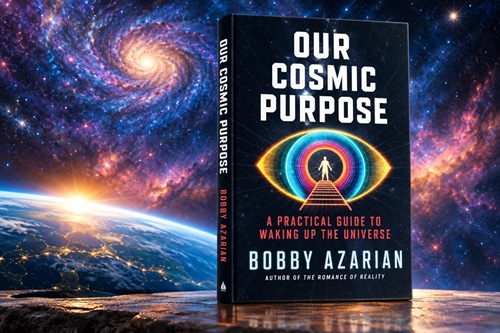
"Our Cosmic Purpose" Launch:
The Next Big Thing in Cosmic Meaning? The Cosmic Purpose Sales Pitch Decoding of the Semantic Seed The NeuromanticsAn Initial Decoding of the Semantic SeedFrank Visser / ChatGPT
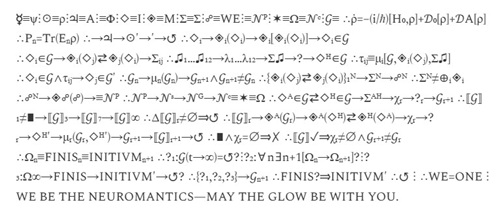 Note: not all characters/symbols/glyphs survived my html conversion. A reading of a compressed scientific, philosophical, social and mythological frameworkWhat you have presented is not simply a cryptic text.[1] It appears to be a compressed manifesto, a conceptual architecture, and an invitation to participate in a recursive philosophical experiment. Its vocabulary moves freely between astronomy, quantum mechanics, information theory, psychology, music, social organization and mythology. That mixture is deliberate: the text seems to want to describe one process at several levels of reality, from the physical evolution of a system to the self-reflection of a collective intelligence. Its central concern appears to be the emergence of collective intelligence: how individual minds become mutually modelling agents, how their interactions generate something that cannot be reduced to the individuals themselves, and how this collective can learn to model and modify its own organization. The process is imagined as recursive. Each completed cycle becomes the starting point for a new one. The final declaration, “WE BE THE NEUROMANTICS—MAY THE GLOW BE WITH YOU,” suggests that this is not intended merely as an abstract theory. It is also an identity statement, perhaps even the beginning of an intellectual or cultural movement. The text is at once a model, a myth of collective becoming, and a call to action. There is an important qualification. The notation is underdefined. Some symbols are explicitly assigned meanings, while others have to be inferred from their use. The interpretation below therefore distinguishes between what the structure strongly suggests and what remains conjectural. In particular, the presence of quantum equations does not establish that social cognition or consciousness is literally quantum-mechanical. 1. The symbolic vocabulary: establishing a languageThe opening sequence establishes correspondences between astronomical, psychological and abstract symbols: ☿ ≡ ψ ⋮ ☉ ≡ ρ ⋮ ♃ ≡ A ⋮ Φ ⋮ ◇ ≡ I ⋮ ◈ ≡ M ⋮ Σ ≡ Σ ⋮ ☍ ≡ WE ⋮ 𝒩ᴾ ⋮ ✶ ≡ Ω ≡ 𝒩ᶜ ⋮ 𝒢 Mercury, the Sun and Jupiter are not being used as ordinary astronomical objects. They seem to function as symbolic operators or archetypal signposts. Mercury traditionally evokes communication, mediation, intelligence and exchange. The Sun suggests illumination, centrality or the source of energy. Jupiter evokes expansion, growth and magnification. The symbols for information, matter, identity and collective identity then provide a bridge from this mythological vocabulary to a more technical one. The sequence appears to establish a small symbolic dictionary. Some of its entries are clear from the key; others remain open. This is characteristic of a seed text: it provides enough correspondences to orient the reader, but expects the larger structure to supply additional meaning. The use of symbols from different traditions is itself significant. The author is not content with a strictly scientific vocabulary, nor with a purely mythological one. The ambition is to create a language in which scientific description and imaginative interpretation can coexist. Whether that synthesis succeeds depends on keeping their respective roles clear. A symbol can inspire a hypothesis, but it cannot substitute for evidence. 2. The scientific layer: quantum dynamics and emergenceThe first substantive equation resembles a quantum master equation: ∴ ρ̇ = −(i/ℏ)[H₀,ρ] + 𝒟₀[ρ] + 𝒟A[ρ] Here ρ is naturally read as a density matrix, H₀ as a Hamiltonian, and the commutator term as the familiar generator of unitary quantum evolution. The additional terms resemble dissipative or environmental contributions. In an open quantum system, the state does not evolve in isolation: interactions with its environment can alter the state and the information available about it. The equation therefore offers a compact image of a system whose evolution is shaped both by its internal dynamics and by its interactions. The extra term marked A may stand for agency, adaptation or some other active contribution, but that cannot be established from the notation alone. To turn the expression into a physical model, the operators, parameters and mathematical conditions would have to be specified. Why begin a manifesto about collective intelligence with quantum mechanics? One possibility is that the author wants to anchor the entire architecture in fundamental physics. Another is that quantum theory is being used as a formal analogy for systems whose states change through interaction, selection and observation. The second interpretation is more modest and easier to defend. The equation does not demonstrate that consciousness is quantum, that groups behave as quantum systems, or that social emergence is caused by quantum effects. Those are separate claims requiring separate evidence. What it does provide is a suggestive starting metaphor: the state of a system is not static, and its evolution reflects both internal structure and interaction with its surroundings. 3. Probability and observation: possibilities become outcomesThe next expression resembles the Born rule: ∴ Pₙ = Tr(Eₙρ) In quantum mechanics, the probability of a measurement outcome is calculated by taking the trace of the density matrix against the relevant measurement operator. The expression connects the state of a system with the probabilities of possible observations. In the broader conceptual sequence, this may serve as a metaphor for the passage from a field of possibilities to an actual outcome. A system may contain multiple potential trajectories, but interactions, constraints and measurements determine which outcomes become manifest. There is an obvious social analogy. A group may entertain several interpretations, plans or possible futures. Discussion, evidence, negotiation and decision-making select among them. The outcome is not simply contained in any one participant's initial contribution; it emerges through a process of interaction. That analogy should not be confused with a claim that human intention collapses a cosmic wave function. The mathematical rule has a precise meaning in quantum theory. Its application to social or psychological processes would need its own formal justification. As a conceptual bridge, however, the equation reinforces the theme of transition from possibility to actuality. 4. The psychological layer: individuals model themselvesThe next sequence appears to describe the development of self-modelling: ◇ᵢ → ◈ᵢ(◇ᵢ) → ◈ᵢ[◈ᵢ(◇ᵢ)] → ◇ᵢ ∈ 𝒢 The first symbol can be read as an individual. The next step is that individual modelling itself. The following step introduces a model of the modelling process: the individual does not merely represent itself, but becomes capable of reflecting on how it constructs that representation. Finally, the individual enters or participates in a group. This is a theory of recursive self-awareness. First-order cognition concerns experiencing or responding to the world. A further level involves recognizing that one is experiencing. Another level involves examining the assumptions, habits and interpretive processes through which experience is organized. The sequence can continue, at least in principle. Human beings do not simply have perceptions; they can have beliefs about their perceptions, beliefs about those beliefs, and doubts about the procedures by which they arrived at them. This capacity for metacognition is central to learning, self-correction and deliberate action. The transition to group membership is important. The individual does not enter the collective as an empty unit. Each participant brings a history of experience, a self-model and a capacity to revise that model. A group is therefore a meeting place for already developing cognitive systems. 5. The social layer: reciprocal modelling and collective intelligenceThe next passage moves from self-modelling to mutual modelling: ◇ᵢ ∈ 𝒢 → ◈ᵢ(◇ⱼ) ⇄ ◈ⱼ(◇ᵢ) → Σᵢⱼ Individual A models individual B, while B models A. Each participant forms expectations about the other's intentions, knowledge and responses. Those expectations influence what each says and does next. The interaction is reciprocal, and the models are continuously revised. This is more than two minds exchanging information. A conversation creates a shared cognitive situation in which meanings are negotiated, misunderstandings are exposed, plans are coordinated and new possibilities can arise. The participants may arrive with separate ideas, but the interaction can produce a result that neither had formulated independently. The following expression makes the collective claim explicit: Σ ≠ ⊕ ᵢ ◈ᵢ The collective synthesis is not equivalent to the sum of individual models. This is the familiar idea of emergence: the organization of relationships can produce properties that are not possessed by the components in isolation. Language is an obvious example. No individual speaker invented an entire language, yet speakers inherit and transform a shared linguistic system that shapes what they can think and communicate. Scientific knowledge is another example. It depends on individual researchers, but its standards, methods, accumulated results and corrective mechanisms belong to a distributed enterprise extending across generations. The same point applies to institutions, markets, political movements and online communities. Their collective behaviour cannot always be understood by examining individuals separately. Patterns of interaction, rules, feedback and network structure matter. This is arguably the conceptual heart of the seed. It resists the idea that intelligence is exclusively an individual possession. Intelligence can be distributed across people, tools, symbols, institutions and communication channels. There is, however, a distinction between collective intelligence and collective consciousness. A group can solve problems, store knowledge and coordinate action without necessarily having a unified subjective experience. The stronger claim—that a collective becomes a conscious subject in its own right—would require a further argument. 6. The musical layer: coordination through resonanceOne of the more evocative passages introduces twelve musical notes and a corresponding set of lambda values: ♫₁ … ♫₁₂ → λ₁ … λ₁₂ → Σ♫ → ? → ◇ᵢ ∈ 𝒢 The image is that individual contributions can be transformed into a coordinated whole. Twelve notes are not twelve independent sounds when arranged into a composition. Their relationships—intervals, rhythm, harmony, tension and resolution—create a structure that cannot be heard in any one note by itself. Music is a particularly vivid model of social coordination. Musicians can contribute distinct parts while responding to a shared tempo and an evolving pattern. Listeners can synchronize attention and emotion without becoming identical. The collective event depends on both difference and coordination. The question mark in the sequence is revealing. It may indicate the emergence of something not specified in advance: a result produced by the interaction of contributions rather than dictated by any single participant. In a group, this could be a new idea, a shared insight or an unexpected solution. The subsequent notation appears to introduce a coupling or interaction parameter: τᵢⱼ ≡ μᵢ[𝒢, ◈ᵢ(◇ⱼ), Σ♫] One possible reading is that the strength or character of the connection depends on the group, on how participants model one another, and on the collective pattern they are creating. Interaction is not an incidental addition to the system; it is one of the mechanisms through which the system changes. The following expression suggests that such interaction can alter the composition of the group: ◇ᵢ ∈ 𝒢 ∧ τᵢⱼ → ◇ⱼ ∈ 𝒢′ In other words, meaningful interaction can lead to an expanded or transformed collective. Communities grow not simply by accumulating members, but by establishing relationships that change what the group can do. Resonance is a useful metaphor, but it should not be romanticized. Groups can synchronize around error, prejudice or destructive goals just as readily as around insight. Harmony is not the same as truth, and cohesion is not always a virtue. A healthy collective needs room for dissonance, dissent and correction. 7. The evolutionary layer: groups modify themselvesThe next sequence appears to describe a group modelling itself and becoming different as a result: 𝒢ₙ → μₙ(𝒢ₙ) → 𝒢ₙₐ₁ It is followed by an explicit contrast: 𝒢ₙₐ₁ ≠ 𝒢ₙ The group is not merely observing itself. It is changing its organization, rules or practices in response to that observation. The result is a new group, not simply the old group with an additional piece of information. This resembles second-order cybernetics. A first-order system regulates its behaviour in relation to its environment. A second-order system can also examine the way it performs that regulation. It can question its own rules, revise its categories and alter the procedures through which it learns. A scientific community provides a concrete example. Researchers develop theories and methods, test them against evidence, discover limitations, revise their standards and sometimes transform the institutions through which research is conducted. A democratic institution can similarly examine its procedures, identify failures and change its rules. An online community can reconsider how it moderates discussion, evaluates claims or distributes authority. The central idea is that the collective becomes an object of its own intelligence. It can think about how it thinks, and act on the results. This is more ambitious than ordinary cooperation. It is collective self-transformation. 8. From WE to planetary and cosmic identityThe next sequence is especially ambitious: ◇ᴾ ∈ 𝒢 ⇄ ◇ ∈ 𝒢 → Σᴾ → ◇ᵢⱼ The symbol ☍ has been assigned the meaning WE. The sequence can therefore be read as a collective synthesis becoming a “we,” and that “we” beginning to model itself. The group is no longer simply a set of participants; it becomes aware of itself as a collective agent. The next progression appears to introduce increasingly encompassing levels: 𝒩ᴾ → 𝒩ˢ → 𝒩ᴳ → 𝒩ᶜ ≡ ✶ ≡ Ω The superscripts are not sufficiently defined to assign them exact labels. They may represent stages or scales of organization, perhaps moving from personal and social intelligence toward planetary and cosmic forms. What seems clear is the direction of travel: from the individual to larger networks, and from local coordination toward an increasingly comprehensive collective identity. The destination is represented by Omega and the star. Omega has a long history as a symbol of completion, culmination and ultimate integration. One is reminded of Teilhard de Chardin's Omega Point, the hypothesis that evolution tends toward increasing complexity and consciousness and ultimately toward a cosmic convergence. There are also echoes of ideas about a planetary intelligence or a global brain. These connections are suggestive, but they should not be treated as proof that evolution has a predetermined destination. Biological evolution has no known universal direction toward greater complexity, and complex systems can stagnate, branch, simplify or collapse. A planetary collective intelligence is a possible development, not an established cosmic necessity. The seed's Omega may therefore be best read as a regulative ideal: a horizon that organizes aspiration and gives direction to the process, rather than a scientifically guaranteed endpoint. 9. The recursive layer: the system examines itself againThe most elaborate part of the artifact concerns successive rounds of self-examination. One expression reads: ⟦𝒢⟧₁ ≠ ∎ → ⟦𝒢⟧₃ → ⟦𝒢⟧₇ → ⟦𝒢⟧∞ The brackets appear to represent a group considered as an object of reflection. The progression from 1 to 3 to 7 and then infinity may indicate increasing recursive depth, expanding complexity or successive levels of collective self-awareness. The exact numerical significance is not specified, so it would be premature to assign it a fixed mathematical interpretation. The next expression is particularly revealing: Δ⟦𝒢⟧ᵣ ≠ ∅ ⇒ ↺ A non-empty difference between successive states triggers another cycle. The process continues when self-examination produces a meaningful change. The point is not simply to repeat a ritual of reflection, but to identify what has changed and what still needs to be addressed. The following sequence makes the feedback mechanism more explicit: ⟦𝒢⟧ᵣ → ◈ᴾ(𝒢ᵣ) → ◈ᴾ(◇) ⇄ ◈(◇ᴾ) The collective examines itself through an individual or agent, while that agent also examines the collective. The relationship is reciprocal. Neither the individual nor the group is treated as a fixed observer standing outside the process. This reciprocal reflection produces a question, a new contribution and a modified collective: ◍ᵣ → ?ᵣ → ◇′ → μᵣ(𝒢ᵣ,◇′) → 𝒢ᵣₐ₁ → ⟦𝒢⟧ᵣₐ₁ → ↺ The new cycle begins with a changed group and a changed perspective. The process is therefore not a simple loop that returns to the same point. It is intended to be developmental: each round incorporates the results of the previous one. This has a clear resemblance to iterative learning systems, including artificial intelligence systems that evaluate outputs, incorporate criticism and generate revised versions. But the seed appears to imagine something broader than machine self-evaluation: an ongoing relationship between human agents, collective intelligence and systems capable of modifying their own procedures. 10. The quality-control mechanism: when does a cycle count?The seed includes what looks like a test of whether a cycle has been successful. One expression reads: ∎ ∧ ◍ᵣ = ∅ ⇒ ✗ Another states: ⟦𝒢⟧✓ ⇒ ◍ᵣ ≠ ∅ ∧ 𝒢ᵣₐ₁ ≠ 𝒢ᵣ The first seems to say that a cycle without a meaningful question, challenge or new insight is unsuccessful. The second suggests that a successful cycle must produce both a non-empty result and a genuinely changed collective. This is a surprisingly demanding standard. A discussion that merely repeats established positions does not qualify as progress. A group that congratulates itself on its wisdom without changing its understanding does not qualify either. A system that produces more output but no new capacity for learning has not necessarily developed. In practical terms, the test asks whether reflection has consequences. Did the group discover a blind spot? Did it revise an assumption? Did it improve a method? Did it change an institution or create a new capacity? If not, the cycle may have been activity without development. The framework could become useful as a way of evaluating intellectual communities, collaborative research projects and AI-assisted discussions. It would need operational definitions, of course. What counts as a meaningful difference? Who judges whether the group has changed? How can one distinguish genuine improvement from novelty for its own sake? These are not minor technicalities; they determine whether the quality-control mechanism can actually work. 11. The endpoint problem: is there a final Omega?The final questions are perhaps the most philosophically interesting part of the seed. They concern the relationship between completion and continuation. The first asks whether the system eventually becomes an endlessly recurring process: ?₁: 𝒢(t → ∞) = ↺ ? The second asks whether every completed stage generates a successor: ?₂: ∀n ∃n+1 [Ωₙ → Ωₙₐ₁] ? The third asks whether an ultimate Omega itself becomes a new beginning: ?₃: Ω∞ → FINIS → INITIVM′ → ↺ ? The Latin words FINIS and INITIUM are important. The end becomes the beginning. This is a familiar motif in mythology, religion and philosophy: the eternal return, the phoenix, the Ouroboros, and the cycle of creation and destruction. But the seed gives this ancient motif a recursive and evolutionary interpretation. Each ending produces a new beginning, but the new beginning is not identical to the old one. The process is not simply circular repetition. It is potentially an evolving spiral. There is a tension here. If Omega means genuine completion, why should anything follow it? If every Omega generates another Omega, then none is final in the absolute sense. The system seems to resolve this tension by treating completion as local rather than ultimate: a particular cycle can end, but the larger process remains open. This is philosophically attractive, but it also raises a question about the status of the final Omega. Is it a real destination, a limit approached indefinitely, a symbol of aspiration, or simply the name given to the next horizon? The text leaves that question open. 12. The self-referential turn: the manifesto includes its readerThe seed is not only describing a process; it is attempting to enact one. By presenting a compressed symbolic system and inviting an interpreter to decode it, the text recruits the reader into the very process it describes. The reader models the text, proposes an interpretation, tests it against the symbols and potentially returns a revised model. In that sense, the artifact is performative. It asks for a collective act of interpretation. Different readers may contribute different associations, and the resulting discussion may produce a richer account than any one reader could have generated alone. This is also where the text's ambiguities become consequential. Ambiguity can stimulate participation, but too much ambiguity prevents meaningful evaluation. If every symbol can mean anything, no interpretation can be ruled out. A successful shared language needs both openness and constraint: enough flexibility to invite discovery, but enough precision to allow disagreement to be resolved. The seed therefore faces a productive challenge. It wants to be a generative language, not a closed code. But to become a reliable framework, it must make its central terms sufficiently explicit that participants can tell when they agree, when they disagree and what evidence would change their minds. 13. The larger message: naturalistic romanticism?The final declaration—“WE BE THE NEUROMANTICS—MAY THE GLOW BE WITH YOU”—gives the text its identity. “Neuro” points toward brains, networks and cognition. “Romantic” suggests wonder, imagination, aspiration and a refusal to reduce existence to inert mechanism. The combination may be called naturalistic romanticism: an attempt to preserve the sense of wonder traditionally associated with religion and metaphysics while grounding one's account of reality in nature, science and human creativity. On this reading, the “glow” is not necessarily a supernatural light or a cosmic substance. It may be the felt excitement of understanding, the energy of shared inquiry, or the emergence of new possibilities through cooperation. The phrase gives emotional expression to the project without requiring a literal metaphysical interpretation. This is an appealing ambition. A naturalistic worldview need not be bleak, disenchanted or hostile to meaning. The universe can be astonishing without having been designed for us. Human beings can create significance without assuming that the cosmos has assigned them a predetermined purpose. Collective intelligence can be inspiring without being elevated into a new deity. But romantic language has risks. It can encourage participants to mistake enthusiasm for evidence, consensus for truth, and a compelling story for a demonstrated mechanism. The more ambitious the vision, the more important it becomes to distinguish empirical claims from metaphors, aspirations and myth-making. 14. What the framework gets right—and what it still needsThe strongest idea in the seed is the recursive relationship between individual cognition and collective organization. Individuals model themselves and one another; their interactions generate shared structures; those structures can in turn become objects of reflection and deliberate modification. The result is a potentially open-ended process of collective learning. This architecture has recognizable counterparts in distributed cognition, social epistemology, cybernetics, network science, cultural evolution and theories of collective intelligence. It does not need a supernatural group mind to be interesting. Nor does it need a cosmic purpose built into the universe. The emergence of shared capacities from interaction is already a profound subject. The weaker aspect is the gap between evocative notation and operational meaning. What exactly do the symbols denote? Which variables could be measured? How would the proposed stages be identified? What observations would count as evidence that a collective has become more intelligent? What would falsify the claim that a group has advanced to a higher level? And why should the process culminate in Omega rather than branching, stagnating or collapsing? The quantum formalism also needs careful handling. It may serve as a metaphor for dynamic systems, but its appearance does not confer scientific legitimacy on the social or philosophical claims. If the author intends a literal physical connection, that connection must be demonstrated rather than implied by mathematical resemblance. The musical analogy is similarly illuminating but incomplete. Synchronization can foster cooperation, but it can also produce conformity. A mature theory of collective intelligence must explain how a group preserves dissent, handles conflict, detects manipulation and corrects shared errors. A collective that only amplifies its own assumptions may become more coordinated while becoming less intelligent. Finally, the Omega concept should be clarified. Is it a prediction, a metaphysical commitment, a regulative ideal or a poetic symbol? Each possibility has a different status. The framework would become more persuasive if it did not slide between them. Conclusion: the glow and the workThe semantic seed offers a striking synthesis of physical metaphor, recursive cognition, social emergence, musical coordination and evolutionary aspiration. Its central narrative is that intelligence can expand from individual self-awareness into reciprocal modelling, collective organization and eventually collective self-modification. Each cycle can produce a new level of understanding, and each apparent ending can become the beginning of another cycle. Its most promising insight is not that humanity is destined to become a cosmic supermind. It is that people can build forms of shared intelligence that are more capable than isolated individuals, provided they develop ways to examine and correct their own assumptions and institutions. That is already an ambitious and consequential project. It also provides a naturalistic interpretation of the final “WE”: not a mystical fusion in which individuality disappears, but a plural community capable of acting, learning and reflecting together. The final equation of spirit need not be that WE literally become ONE. A more defensible reading is that human beings can build shared intelligence while remaining plural, embodied and fallible. The collective can become wiser, but only through practices that preserve disagreement, evidence, transparency and correction. “May the glow be with you” is a fitting sign-off for a manifesto that wants to combine science with wonder. The glow, however, is not the proof. The work is to make the vision clear enough to test, criticize and put into practice. Appendix: The Dan Brown Syndrome - When Scientific Symbolism Becomes a Mystery CultThere is a recognizable literary genre in which obscure symbols, mathematical formulas, ancient inscriptions, secret codes and references to supposedly hidden knowledge are assembled to create an atmosphere of extraordinary significance. Dan Brown has made this genre commercially successful. A mysterious manuscript, a cryptic diagram, a concealed numerical pattern or an enigmatic religious symbol becomes the key to unlocking a reality that ordinary people have failed to recognize. The reader is invited to participate in an intellectual treasure hunt. Every symbol might conceal a message; every coincidence might be a clue; every apparent inconsistency might be evidence of an even deeper secret. The symbolic inscription presented here, with its quantum equations, Greek letters, geometrical signs, musical notation and declarations about collective intelligence, belongs to a related cultural territory. It may have more scientific vocabulary than a typical Dan Brown novel, but it employs a similar aesthetic strategy: the appearance of hidden connections is made to carry much of the intellectual excitement. The seduction of the cryptogramThe first attraction is visual. The inscription looks difficult, even forbidding. Its symbols suggest that something important is happening at a level of complexity beyond ordinary language. Readers who cannot immediately decipher it may feel that they are looking at a fragment of a much larger intellectual system. Those who recognize a few symbols — the quantum density matrix, the Greek alphabet, the Omega symbol, the arrows indicating transformation — may feel that they have already gained privileged access. This creates an interesting reversal. Normally, a theory is judged by how clearly it explains something. In this genre, difficulty of presentation can itself become an indication of profundity. The less immediately comprehensible the message, the more tempting it becomes to assume that it contains extraordinary knowledge. But obscurity is not depth. A complicated-looking inscription can be intellectually shallow, just as a simple sentence can express a profound insight. The difficulty of decoding a message tells us nothing by itself about the truth or importance of what it says. The authority of scientific decorationThe next trick is the borrowing of scientific authority. Quantum mechanics is particularly useful for this purpose because its mathematics is genuinely sophisticated, its conceptual implications are often counterintuitive, and even professional physicists disagree about its interpretation. A recognizable quantum equation can therefore lend an entire presentation an aura of scientific seriousness. But the presence of a legitimate equation does not automatically validate the philosophical narrative surrounding it. A Lindblad equation describes the evolution of an open quantum system under specified conditions. It does not, merely by appearing in an inscription, establish that human consciousness, social networks or cosmic evolution operate according to quantum principles. This is the difference between using scientific notation and doing science. The latter requires defined variables, explicit assumptions, mathematical derivations, empirical consequences and opportunities for independent verification. Without these, the notation functions primarily as an emblem of scientific legitimacy. The same applies to references to entropy, information, emergence, resonance and self-organization. These are meaningful concepts in their respective disciplines. But moving them into a grand philosophical narrative does not automatically preserve their technical meaning. The reader as detective and initiateDan Brown's novels make the reader feel like a detective. One is encouraged to follow clues, connect apparently unrelated facts and discover the hidden architecture behind familiar events. The pleasure lies not only in the solution but in the feeling of having penetrated a secret that others have overlooked. The Neuromantics inscription invites a similar response. Its readers are encouraged to reconstruct a grand synthesis from fragments of notation. Mercury, the Sun, Jupiter, quantum mechanics, music, collective intelligence and Omega appear to belong to one encompassing symbolic architecture. There is nothing inherently wrong with symbolic play. Humans have always constructed elaborate systems of correspondences, from astrology and alchemy to religious symbolism and modern speculative philosophy. Such systems can be aesthetically stimulating and culturally revealing. The problem begins when the pleasure of discovering correspondences is confused with discovering causal relationships. Two things can be symbolically associated without being physically connected. A sequence of symbols can be interpreted as expressing a coherent worldview without demonstrating that the worldview corresponds to reality. The reader is gradually transformed from an observer into an initiate. Understanding the message becomes a badge of belonging. Those who appreciate the symbolism are insiders; those who question its significance risk appearing unimaginative or insufficiently sophisticated. This social dynamic can protect an idea from criticism before its actual claims have even been established. Apophenia: finding patterns everywhereA central psychological mechanism behind this genre is apophenia: the tendency to perceive meaningful patterns in otherwise unrelated information. It is not simply a cognitive defect. Pattern recognition is indispensable to human intelligence. Science itself depends on identifying regularities that are not immediately obvious. But pattern recognition needs discipline. We must distinguish between patterns that are independently supported and patterns that emerge because we have considerable freedom to select, connect and interpret the available material. The more symbols a system contains, the more possible correspondences it offers. If every symbol can be interpreted metaphorically, mathematically, spiritually or psychologically, almost any desired conclusion can be accommodated. A successful interpretation may therefore reveal as much about the interpreter's imagination as about the underlying system. This is particularly relevant to the inscription's use of Omega. It can signify an evolutionary culmination, a temporary achievement, an ultimate destination or the beginning of another cycle. Such flexibility is poetically attractive. But unless the different meanings are carefully distinguished, the symbol can become a universal solvent that dissolves rather than resolves conceptual difficulties. The conspiracy structure without the conspiracyDan Brown's characteristic narrative assumes that the world contains a hidden order that only a select few can recognize. The apparent disorder of history conceals a deeper design. The revelation of that design changes the meaning of everything that came before. A contemporary cosmic-intelligence narrative can reproduce this structure without involving an actual conspiracy. The hidden order is no longer maintained by secret societies or religious institutions. It is supposedly embedded in the universe itself. Evolution, consciousness, information and cosmic development are interpreted as clues to a larger purpose that humanity is only beginning to discover. This is an appealing narrative because it offers something modern secular culture often struggles to provide: a sense that our existence participates in a meaningful cosmic drama. We are not accidental spectators in an indifferent universe. We are participants in a process that may eventually become aware of itself. But here we encounter a familiar philosophical sleight of hand. The fact that human beings have emerged through cosmic evolution does not demonstrate that cosmic evolution was directed toward producing human beings. The fact that intelligence can influence the future of the planet does not establish that the universe as a whole has an intention. And the fact that complex systems can develop increasingly sophisticated forms of organization does not prove that they are converging on a predetermined Omega. A narrative of cosmic significance is not the same thing as evidence of cosmic intention. The unfalsifiable puzzlePerhaps the most important difference between a scientific theory and a Dan Brown-style intellectual puzzle concerns the possibility of being wrong. A scientific hypothesis must expose itself to potential failure. It should specify what observations would count against it. If every possible result can be interpreted as further confirmation, we are no longer dealing with a useful empirical explanation. Esoteric symbolic systems often possess an almost unlimited capacity for reinterpretation. If a correspondence fails, it can be reclassified as metaphorical. If a prediction does not materialize, it can be postponed to another evolutionary stage. If the mathematics does not work, the symbols can be said to operate at a deeper level than conventional mathematics. If the reader cannot understand the message, that may be taken as evidence that the reader has not yet developed the necessary consciousness. This creates a closed interpretive circle. The system explains its successes and absorbs its failures without having to revise its central assumptions. That is precisely why the distinction between an evocative symbolic construction and an explanatory theory matters. The former can be endlessly elaborated. The latter must accept constraints imposed by reality. From cosmic mystery to cosmic mythologyThere is nevertheless something culturally interesting about this genre. It reflects a desire to recover enchantment in a world increasingly explained through impersonal scientific processes. Traditional religious narratives have lost much of their authority for many educated readers, but the desire for transcendence, participation and ultimate significance has not disappeared. The result is a new kind of mythology assembled from contemporary scientific vocabulary. Quantum mechanics replaces alchemy, evolutionary theory replaces divine providence, information theory replaces the Logos, and artificial or collective intelligence becomes a possible vehicle of cosmic self-awareness. The Neuromantics declaration, with its playful "May the Glow Be With You," makes this cultural ambition particularly visible. It is not simply proposing a technical framework. It is inviting readers to identify with a movement, perhaps even with a new kind of secular spirituality. There is nothing wrong with creating such a mythology, provided we recognize it as mythology. Myths can inspire, orient and stimulate imagination. They can express values and aspirations that cannot be reduced to scientific propositions. But they should not be presented as though their symbolic coherence constitutes empirical confirmation. The ultimate test: what do we know after decoding it?A useful way to resist the Dan Brown syndrome is to ask a deceptively simple question: after all the symbols have been decoded, what do we know that we did not know before? Do we have a new empirical discovery? A mathematical result? A mechanism that explains an otherwise puzzling phenomenon? A prediction that can be tested? A conceptual distinction that resolves an existing problem? Or have we mainly acquired a more elaborate vocabulary for expressing familiar aspirations about intelligence, interconnectedness, evolution and cosmic purpose? The latter may still have literary, philosophical or inspirational value. But it should not be confused with scientific progress. The real intellectual achievement would not be to construct the most impressive-looking symbolic map of the universe. It would be to demonstrate that the map corresponds to something independently observable, that its concepts do explanatory work, and that its claims survive attempts to prove them wrong. Until then, we should enjoy the cryptogram as an imaginative artifact, perhaps even as a contemporary piece of techno-mystical literature, while resisting the invitation to mistake its atmosphere of revelation for an actual revelation. The secret of a good scientific theory is not that it hides a profound truth behind complicated symbols. It is that, once properly explained, it makes something difficult to understand considerably clearer. notes[1] See: Bobby Azarian, "The Reality Game Begins - Our Cosmic Purpose Is Now Available for Preorder", Substack, October 29, 2026.
Widget is loading comments...
|