|
Search through thousands of pages on Integral Theory
TRANSLATE THIS ARTICLE
Integral World: Exploring Theories of Everything
An independent forum for a critical discussion of the integral philosophy of Ken Wilber
SEE MORE ESSAYS WRITTEN BY FRANK VISSER
NOTE: This essay contains AI-generated content
Check out my other conversations with ChatGPT
Bobby Azarian's
'Our Cosmic Purpose'
The Next Big Thing in Cosmic Meaning?
Frank Visser / ChatGPT
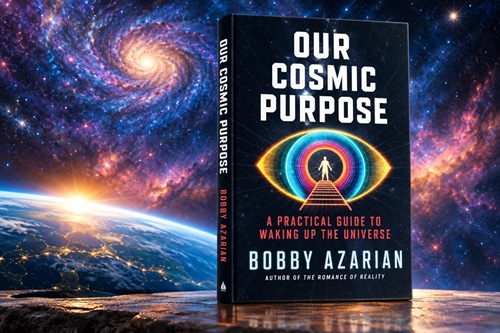
The promise of a universe with a mission
There is a lucrative market for books that promise to reconcile scientific respectability with existential reassurance. Readers want the intellectual authority of science without its potentially uncomfortable conclusion that the universe may not have been designed with human beings in mind. They want meaning without traditional religion, transcendence without supernaturalism, and hope without having to abandon their scientific worldview.
Bobby Azarian knows this market well. His forthcoming book, Our Cosmic Purpose: A Practical Guide to Waking Up the Universe, published by BenBella Books and distributed by Simon & Schuster, is scheduled for March 9, 2027. Its publisher presents it as a new “Unifying Theory of Reality,” integrating information theory, thermodynamics, evolution, consciousness, culture, and human purpose into a single overarching narrative. The book promises not merely to explain our place in the cosmos, but to show us how to participate in its development.
That is an ambitious sales proposition. It is also an invitation to ask some uncomfortable questions.
Can the universe really be said to have a purpose? Does the emergence of increasingly complex structures imply that the cosmos is heading somewhere? And even if life and consciousness are natural products of cosmic evolution, does that establish that evolution itself has a goal—or that humanity has a special responsibility to fulfill it?
My suspicion is that Our Cosmic Purpose will attract considerable attention from readers dissatisfied with scientific nihilism and traditional religion alike. It may well become another heavily promoted popular-science bestseller. But the more important question is whether Azarian can substantiate the philosophical conclusions his ambitious title invites us to draw.
This is a preview, not a review of the finished book. The full manuscript has not yet been assessed here; the critique that follows addresses the book's published description and the larger intellectual program it appears to continue from Azarian's earlier work.
From The Romance of Reality to the awakening universe
The intellectual continuity is already visible in Azarian's earlier work.
Azarian's 2022 book, The Romance of Reality, established the essential framework. Drawing on thermodynamics, complexity science, information theory, evolutionary biology, and theories of emergence, he argued that the universe's laws favor the development of life, intelligence, and increasingly complex forms of organization. The publisher explicitly presented the book as a scientific challenge to the notion that life is an accidental by-product of an otherwise meaningless universe.
There is something worthwhile here. The universe is not simply a collection of inert objects. Matter forms stars, stars produce heavier elements, chemistry generates increasingly complex structures, and biological evolution produces organisms capable of learning, modeling their surroundings, and transforming their environments. Human beings are products of this natural history, not visitors from outside it.
But Azarian's larger ambition is to move from this scientific narrative to a claim about the direction and significance of cosmic evolution.
In the essay "Bobby Azarian's Evolutionary Model" I previously published on Integral World in the series Big Names in Big History, I examined his evolutionary model, which brings together universal Darwinism, evolutionary epistemology, and universal Bayesianism. The attraction of this synthesis is clear: adaptation, information processing, and the retention of successful patterns can be studied across different domains. Yet a serious difficulty appears when the existence of such processes becomes evidence for a universal trajectory toward greater complexity, intelligence, and awareness.
The new book's description suggests that Azarian intends to push this synthesis further, translating his account of cosmic evolution into a practical philosophy of human life and social organization.
That transition deserves particularly close scrutiny.
The first sleight of hand: from complexity to purpose
The central philosophical problem can be expressed in a simple sequence.
First, complexity can emerge naturally from relatively simple physical processes. Second, some complex systems acquire the capacity to adapt, learn, and respond to their environments. Third, certain forms of life develop consciousness, culture, and technology.
These propositions are compatible with substantial bodies of scientific research, although the details and explanatory mechanisms vary between fields.
But now consider the additional conclusion: the universe has a purpose, and humanity is participating in its fulfillment.
That conclusion does not follow automatically.
A process can have a direction without having a destination. It can produce increasingly sophisticated outcomes in some domains without making sophistication the ultimate goal of the entire process. Natural selection produces adaptations because variants differ in reproductive success under particular conditions; it does not need to anticipate the emergence of human intelligence.
Nor does evolution proceed uniformly toward greater complexity. Organisms can become simpler, lineages can disappear, ecosystems can collapse, and once-successful forms of organization can be lost. Complexity is neither a universal measure of evolutionary success nor an unambiguous measure of progress.
The relevant distinction is between directionality and teleology. Directionality describes an observable pattern or tendency. Teleology, in its stronger sense, interprets that pattern in terms of an end, goal, or purpose.
Azarian's challenge is to demonstrate that cosmic evolution is not merely capable of producing beings who formulate purposes, but that the universe itself is meaningfully oriented toward the production of intelligence and consciousness.
That is a much more demanding claim.
A naturalistic account of self-organization may explain how order emerges without an external designer. It does not, by itself, establish that the resulting order serves a cosmic intention. Replacing God with the laws of nature does not automatically turn those laws into a cosmic mission.
Thermodynamics is not a cosmic motivational system
Much of the attraction of Azarian's approach lies in its appeal to thermodynamics. It offers a way to understand how local organization can increase in a universe whose overall entropy tends to increase.
Open systems can maintain or develop complex structures by drawing on energy gradients and exporting entropy to their surroundings. The Earth receives energy from the Sun, and living organisms exploit energy flows to maintain themselves, reproduce, and evolve.
This is not a violation of the second law of thermodynamics. Nor is it evidence that nature is trying to overcome entropy.
The scientific questions are more specific: Under what conditions do self-organizing structures emerge? What mechanisms produce them? Which structures persist, and why? What limits their development?
These questions can be investigated without attributing an overarching purpose to the universe.
Azarian's earlier synthesis has attracted criticism precisely at the point where plausible physical mechanisms are assembled into a much more comprehensive evolutionary narrative. A review in World Literature Today, for example, praised the breadth of The Romance of Reality while questioning whether the evidence drawn from several research areas was sufficiently mature to support the sweeping conclusions placed upon it.
The danger is that thermodynamics becomes more than an explanatory framework. It becomes a narrative engine, seemingly carrying the universe from matter to life, from life to consciousness, and from consciousness to some ultimate state of cosmic awakening.
But a mechanism that permits a development is not necessarily a mechanism that guarantees it. And even if certain developments turn out to be statistically favored under specified conditions, that does not establish that they constitute the purpose of reality.
The difference between explaining how complexity can emerge and proving that the universe is destined to become conscious is the difference between a scientific research program and a metaphysical interpretation.
Who—or what—is waking up?
The subtitle, A Practical Guide to Waking Up the Universe, is rhetorically arresting. It also raises a question that should not be allowed to disappear beneath the poetry.
What exactly does it mean for the universe to wake up?
There is an entirely defensible interpretation: through conscious organisms, portions of the universe have acquired the capacity to represent aspects of reality. We can observe distant galaxies, reconstruct cosmic history, investigate the origins of life, and reflect upon our own existence. In this sense, the universe has produced beings through whom it can be known.
The famous formulation associated with Carl Sagan—that we are a way for the cosmos to know itself—is a beautiful expression of this idea.
But the metaphor can quietly change its meaning. Initially, it means that the universe has produced conscious observers. Eventually, it can suggest that the universe itself is an awakening subject, that consciousness is the culmination of its development, and that humanity has a role in advancing this cosmic process.
Those are different propositions.
The first describes a fact about conscious life. The second proposes an interpretation of cosmic history. The third adds a claim about purpose and obligation.
To establish the stronger claims, Azarian would need to explain what is meant by a universe that wakes up, what evidence would distinguish such an awakening from the emergence of local conscious systems, and what would count as evidence against the proposed trajectory.
Otherwise, waking up the universe risks functioning as an evocative metaphor that is treated as though it were a scientific discovery.
A metaphor can illuminate reality without describing a literal property of reality. The fact that it is inspiring does not settle which category it belongs to.
The problem of the missing destination
The publisher describes Azarian's theory as a framework for understanding evolution at multiple levels, from the Big Bang to consciousness, culture, and technology. It also presents the book as a guide to individual purpose and collective progress.
This is where the argument may become especially vulnerable.
Suppose we grant that cosmic history has repeatedly produced new levels of organization. Suppose, further, that some evolutionary processes generate greater adaptive capacities and more sophisticated information processing.
What follows?
Perhaps intelligent life is common. Perhaps it is rare. Perhaps technological civilizations tend to destroy themselves. Perhaps intelligence emerges under many different conditions but rarely develops into a civilization capable of surviving for millions of years.
We do not yet know enough to settle these questions.
Even if intelligent life turns out to be widespread, it would not establish that the universe is destined to become a single, integrated, self-aware system. Nor would it prove that the future of intelligence is open-ended or that increasing intelligence will necessarily bring increasing wisdom.
A civilization may acquire enormous technological power while becoming politically unstable, ecologically destructive, or morally indifferent. Greater cognitive capacity is not identical to greater compassion. More sophisticated information processing does not guarantee better judgment.
This is not a minor objection. It challenges the assumption that complexity, intelligence, consciousness, and moral progress naturally belong to a single ascending trajectory.
They may be related in certain contexts, but their relationship needs to be demonstrated rather than presumed.
And if the ultimate destination remains uncertain, it is premature to announce that we know what the universe is trying to accomplish.
From cosmic evolution to a practical philosophy of life
The most interesting feature of the new book may be its ambition to turn a theory of cosmic evolution into a practical guide.
According to its published description, Azarian wants readers to use a broader perspective to resolve conflicts, appreciate diversity, improve cooperation, and redesign social and economic systems for better outcomes. The book is explicitly advertised as a form of self-help for individuals, society, and the cosmos.
There is much to welcome in these objectives.
Human beings do frequently benefit from stepping back from immediate conflicts. Cooperation is indispensable to social life. Diversity can enhance the adaptive capacity of groups. Institutions can be designed to improve collective decision-making. These are worthwhile subjects for psychology, political philosophy, economics, and systems science.
But why do these practical insights require a cosmic purpose?
Cooperation can be explained through evolutionary biology, game theory, social learning, reciprocal relationships, and institutional incentives. Conflict resolution can be studied through psychology and political science. Ecological responsibility can be grounded in our dependence on the biosphere and our obligations to other sentient beings.
None of these commitments requires the universe to be heading toward a higher state of consciousness.
Indeed, the cosmic framework may sometimes obscure the practical questions. What kinds of cooperation work, under which conditions, and for whose benefit? When is competition productive? When does a group need to protect its diversity rather than maximize its internal unity? Which goals should take priority when the interests of different populations conflict?
The answer cannot simply be that whatever promotes cosmic evolution is good. That would merely relocate the moral question to a grander, less clearly defined level.
A cosmic narrative can motivate ethical action, but it cannot substitute for an ethical argument.
The is-ought gap returns
There is a familiar philosophical problem lurking beneath the publisher's promise that a scientific understanding of the universe can help us discover our purpose.
Science describes what happens, what conditions make it possible, and what consequences follow from particular actions. Ethics asks what we ought to value and how we should act.
The two domains can inform each other, but descriptive facts do not automatically generate moral obligations.
Even if humanity were destined to become the universe's most intelligent form of life, why should we regard that development as good? Even if technological expansion were a likely consequence of evolutionary dynamics, why should we make it our overriding priority?
Perhaps the survival of conscious life matters. Perhaps reducing suffering matters. Perhaps preserving the diversity of life on Earth matters. Perhaps individual freedom and human flourishing matter. But each of these positions requires some account of value.
The fact that a process occurs in nature does not make it morally desirable. Predation, extinction, and destructive competition are natural, too.
Nor does the fact that humans are capable of altering cosmic history mean that they are morally obligated to do so. Capability is not duty.
This distinction becomes particularly important whenever cosmic narratives encourage humanity to identify itself with an allegedly inevitable evolutionary mission. Once a particular future is treated as the universe's proper destination, dissent can be recast as resistance to evolution itself.
That would be a deeply unfortunate consequence of an otherwise worthwhile attempt to find meaning in a scientific worldview.
A new natural religion?
There is a broader cultural context to Azarian's project. His work belongs to a growing family of attempts to recover existential meaning after traditional religious cosmologies have lost their authority for many readers.
The proposed solution is often a naturalized cosmic story. We do not need a supernatural creator, the argument goes, because the universe generates its own complexity, life, intelligence, and perhaps eventually a form of collective awareness. We can recover wonder, purpose, and a sense of belonging without returning to conventional theism.
This is an attractive position, and it deserves serious consideration. The natural world is astonishing enough without embellishment. Evolution has produced forms of organization whose intricacy would have been difficult to imagine before modern biology. Human consciousness and culture are remarkable achievements of natural history.
But a secular worldview does not become more scientific simply by replacing supernatural agency with cosmic teleology.
There is a difference between finding meaning in the universe and claiming that the universe has a meaning independent of the purposes of conscious beings.
The first position is readily compatible with naturalism. The second needs additional argument.
In this respect, Azarian's project intersects with the wider contemporary search for a naturalistic religion: an attempt to preserve the emotional and existential functions of religion while grounding its worldview in science. The challenge is to distinguish a scientifically informed philosophy of life from a religiously satisfying narrative that borrows the vocabulary of science.
The two need not be mutually exclusive in every respect. But neither should they be confused.
The Integral connection: Wilber's Eros in secular clothing?
For readers familiar with Integral Theory, there is a striking resemblance between Azarian's project and the evolutionary cosmology of Ken Wilber.
Wilber's account of evolution invokes Eros: an immanent drive toward increasing depth, complexity, and higher forms of organization. In his more emphatic formulations, this is not merely a metaphor for emergent complexity but a real force in the universe.
Azarian's approach is different in important respects. He attempts to ground his account in natural processes, including thermodynamics, adaptation, information, and emergence. He does not need to introduce a supernatural agent or explicitly identify a spiritual force as the engine of evolution.
Yet a structural resemblance remains. Both projects seek to explain how the universe can exhibit directionality without reducing its history to an entirely accidental sequence of events. Both are attracted to the emergence of higher levels of organization. And both risk interpreting the appearance of increasing complexity as evidence of a more encompassing evolutionary trajectory.
The crucial question is whether Azarian's naturalistic mechanisms can do all the explanatory work that the larger narrative assigns to them.
If they can, then the appeal to cosmic purpose may be unnecessary. If they cannot, then the gaps need to be acknowledged rather than filled with an inspiring story about the universe's awakening.
This is precisely where a critical naturalistic approach differs from an integral or spiritual interpretation. One can investigate the emergence of complexity without assuming that reality contains an intrinsic drive toward greater depth. One can recognize genuine evolutionary trends without turning them into a universal law of progress.
The scientific question is not whether evolution is wonderful. It plainly is. The question is whether its wonders establish a cosmic purpose.
They do not establish that by themselves.
Will it become another hyped bestseller?
The commercial prospects are easier to assess than the ultimate truth of the book's thesis.
Azarian already has a recognizable platform as a science journalist and author. His earlier book received endorsements from prominent figures in science communication and adjacent intellectual communities. The new book combines several themes with considerable popular appeal: the meaning of life, the future of humanity, consciousness, cooperation, and the prospect that science can offer a more hopeful worldview.
Its packaging is particularly effective. The subtitle promises both cosmic revelation and personal transformation. The phrase Unifying Theory of Reality suggests intellectual comprehensiveness, while A Practical Guide assures readers that the theory will have consequences for their own lives.
This combination is commercially potent. It offers readers a big idea and a personal reason to care about it.
But a book's promotional success is not a measure of its scientific validity. Nor is the existence of a large audience evidence that a proposed synthesis has solved the problems it addresses.
The marketing language itself deserves scrutiny. The publisher describes the work as paradigm-shifting and presents it as a framework capable of connecting cosmic evolution to existential and social improvement. Those are claims that the completed book must earn, not achievements that should be assumed in advance.
My prediction is therefore deliberately qualified: Our Cosmic Purpose looks well positioned to attract attention among readers seeking a scientific alternative to both nihilism and traditional religion. Whether it becomes a major bestseller is another matter, and whether its central thesis survives critical examination is a different matter again.
The first depends partly on timing, publicity, distribution, and audience appetite. The second depends on evidence and argument.
What the book needs to demonstrate
When the full text becomes available, a fair assessment should examine several questions.
First, does Azarian distinguish clearly between established scientific findings, promising but contested research programs, and his own philosophical interpretations? The distinction is essential in a book that spans so many fields.
Second, does he demonstrate that the mechanisms responsible for self-organization and biological evolution imply a general cosmic tendency toward intelligence and consciousness? Or does he extrapolate from selected examples of increasing complexity?
Third, does he offer a testable account of what it means for the universe to wake up? If the phrase is metaphorical, that is perfectly legitimate, but the metaphor should not be presented as an independently established fact.
Fourth, does he explain how an account of cosmic evolution yields moral obligations? The need to cooperate, preserve life, or reduce suffering may be defensible on several grounds, but the transition from natural history to ethical commitment must be made explicit.
Finally, does the proposed theory explain more than a collection of established scientific accounts already explains? A unifying theory should do more than place familiar findings inside a grand narrative. It should reveal connections that generate new understanding, constrain possible explanations, or lead to fruitful predictions.
These are demanding standards, but the scale of the ambition warrants them.
Conclusion: The universe needs no publicist
There is a genuinely inspiring story available to us without a cosmic mission statement. Matter formed in the early universe eventually gave rise to stars and planets. On at least one planet, chemistry produced life. Life evolved into organisms capable of perception, learning, and reflection. One such species developed science and began reconstructing the history of the universe that produced it.
That story is extraordinary. It does not become less extraordinary if the process had no predetermined destination.
Azarian's ambition to connect this natural history with human meaning is understandable, and his emphasis on self-organization and complexity raises questions worth exploring. His practical interest in cooperation and wider perspectives may also yield useful insights.
But the grander the claim, the greater the burden of proof. A universe capable of producing consciousness is not necessarily a universe whose purpose is consciousness. A history that has generated increasing complexity in some domains is not necessarily a history progressing toward a predetermined culmination. And a species capable of contemplating cosmic evolution is not automatically the appointed representative of a cosmic mission.
The danger is not that Azarian will reintroduce God under another name. It is that he may offer something philosophically similar in function: a reassuring account in which the universe's apparent indifference is transformed into an overarching story of progress, purpose, and destiny.
That possibility should be examined carefully rather than dismissed in advance.
My provisional verdict is this: Our Cosmic Purpose appears to promise a compelling synthesis of science, philosophy, and self-help. It may contain valuable discussions of complexity, evolution, and human cooperation. But its central proposition—that cosmic evolution can provide us with a scientifically grounded purpose—needs to be demonstrated, not advertised.
The universe may be waking up in us. Whether it is waking up for us is an entirely different question.
|

 Frank Visser, graduated as a psychologist of culture and religion, founded IntegralWorld in 1997. He worked as production manager for various publishing houses and as service manager for various internet companies and lives in Amsterdam. Books: Ken Wilber: Thought as Passion (SUNY, 2003), and The Corona Conspiracy: Combatting Disinformation about the Coronavirus (Kindle, 2020).