|
TRANSLATE THIS ARTICLE
Integral World: Exploring Theories of Everything
An independent forum for a critical discussion of the integral philosophy of Ken Wilber
  Frank Visser, graduated as a psychologist of culture and religion, founded IntegralWorld in 1997. He worked as production manager for various publishing houses and as service manager for various internet companies and lives in Amsterdam. Books: Ken Wilber: Thought as Passion (SUNY, 2003), and The Corona Conspiracy: Combatting Disinformation about the Coronavirus (Kindle, 2020).
Check out my other conversations with ChatGPT
"Our Cosmic Purpose" Launch:
The Next Big Thing in Cosmic Meaning? The Cosmic Purpose Sales Pitch Decoding of the Semantic Seed The Cosmic Purpose Sales PitchBobby Azarian Turns Evolution into a GameFrank Visser / ChatGPT
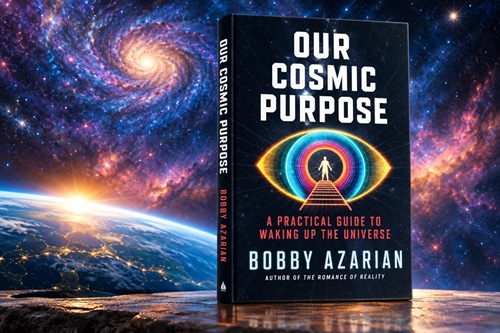 How a plausible story about complexity, cooperation, and consciousness becomes an unsupported theory of cosmic purpose. Introduction: Welcome to the game, whether you believe in it or notBobby Azarian's new Substack essay, “The Reality Game Begins — Our Cosmic Purpose Is Now Available for Preorder,” published on October 29, 2026, is an unusual mixture of evolutionary speculation, pop mythology, motivational psychology, spiritual universalism, and book promotion. It introduces the central narrative of his forthcoming book, Our Cosmic Purpose: A Practical Guide to Waking Up the Universe, scheduled for publication on March 9. The article is designed as an experience rather than a conventional argument. Readers are invited to participate in a cosmic game, announce their willingness to continue playing, choose empowering words, and discover that they are not merely inhabitants of the universe but participants in its awakening. The concluding revelation is that we are all Atman, we are all Brahman, and we are all one. Azarian's ambition is understandable. He wants to offer a scientifically informed alternative to nihilism, give humanity a shared sense of purpose, and translate the findings of evolutionary science into a motivating vision of collective responsibility. He argues that the universe exhibits a trend toward increasing complexity, that cooperation is essential to the emergence of higher levels of organization, and that conscious beings can influence the future of evolution. There is much here worth taking seriously. Cooperation really does matter. Life does create and maintain local order. Human beings can understand their place in nature and act collectively to protect the conditions that make civilization possible. But Azarian makes a much larger claim than these observations warrant. He moves from the existence of evolutionary trends to the assertion that the universe has a purpose, from the emergence of consciousness to the claim that the cosmos is awakening, and from our ability to influence the future to the conclusion that humanity has a cosmic destiny. The central problem is that Azarian presents a compelling story about what we might choose to do as though it were a discovery about why the universe exists. That distinction is crucial. A narrative can inspire us without being true in its metaphysical interpretation. And a scientific description of how complexity emerges does not, by itself, establish that complexity is the universe's ultimate destination. 1. From evolutionary science to cosmic destinyThe most consequential passage appears near the beginning. Azarian declares that the universe is not a machine running down but “a mind in the making.” He then equates cosmic evolution with cosmic development and, ultimately, cosmic awakening. What sounds initially like an evocative metaphor becomes, in his own telling, “the most precise compressed description” of reality. That transition deserves much closer scrutiny. The universe does exhibit the emergence of increasingly complex structures in certain environments. Stars forge heavier elements; planetary environments can support chemistry; biological evolution produces organisms with increasingly elaborate adaptations; nervous systems make sophisticated cognition possible; and human societies accumulate knowledge and technology. These are important developments, and their cumulative history is remarkable. But they do not establish that the universe as a whole is becoming a mind. Nor do they demonstrate that cosmic evolution has a predetermined direction toward consciousness. Complexity is not a universal upward escalator. Evolution also produces simplification, extinction, parasitism, stagnation and the disappearance of elaborate structures. The history of life contains genuine innovations without guaranteeing that every subsequent development will be more complex or more conscious. Even on Earth, microbial life remains enormously successful without needing to evolve into something resembling a human mind. Azarian's narrative privileges the developments that culminate in ourselves and then interprets that sequence as the universe's overarching trajectory. But the same history can be described without this conclusion: under particular physical and environmental conditions, self-organizing systems arise, persist for varying periods, and sometimes develop increasingly sophisticated capacities. The distinction is between a history that contains progress in particular respects and a universe whose history is inherently progressive. The former is empirically defensible. The latter requires an additional argument. Azarian has been advancing this stronger position for some time. In an earlier essay, he argued that the emergence of intelligent life is an inevitable product of cosmic complexification. That is a much more ambitious thesis than saying that complexity can emerge under suitable conditions. To establish inevitability, one would need to show why the relevant processes reliably produce intelligence, rather than merely allowing it. There is a related problem with the phrase “the universe is a mind in the making.” What exactly would count as evidence that the universe itself is becoming a mind? Is the claim that consciousness is becoming more widespread, that the total amount of information processing is increasing, or that the cosmos is developing some unified subject of experience? These are very different propositions. The first two might be investigated empirically, although both require careful definitions and measurements. The third introduces a major philosophical claim that cannot simply be read off the first two. Azarian compresses these distinctions into a single grand narrative. Its rhetorical power comes partly from the very compression that makes its scientific status difficult to assess. 2. Entropy is not the villain of the cosmic storyAzarian casts thermodynamics as the fundamental challenge of existence. Entropy becomes Shiva the Destroyer, while self-organization becomes Brahma the Creator. Life and consciousness are enlisted in an ongoing struggle against decay. Our responsibility, he tells us, is to preserve the complex structures that evolution has produced. As a metaphor for the fragility of life, this is effective. As a scientific account, it needs qualification. The second law of thermodynamics does not say that everything everywhere must become progressively disordered in every observable respect. It says that the total entropy of an isolated system does not decrease in ordinary macroscopic processes. Local decreases in entropy are perfectly compatible with the law when energy and matter flow through open systems and the total entropy balance is taken into account. Earth receives energy from the Sun and radiates energy into space. Organisms use energy and matter to maintain their organization. Ecosystems and civilizations depend on flows of energy and the physical conditions that make those flows possible. None of this constitutes a rebellion against the second law. Life is not an exception to thermodynamics. It is one of the phenomena that thermodynamics helps us understand. This matters because Azarian transforms a physical constraint into something resembling an existential adversary. The game is framed as a perpetual struggle against Shiva, with conscious beings assigned the task of preserving the flame of awareness. But entropy is not a cosmic enemy that can be defeated through sufficient cooperation. Nor is the eventual destruction of a particular biological or cultural structure necessarily a moral catastrophe. What matters to us is that some structures support flourishing, knowledge, experience and future possibilities. That is a legitimate human concern, but it is not a moral injunction issued by thermodynamics. Consider a forest. It grows through the interaction of sunlight, water, nutrients, organisms and ecological processes. It can be damaged by fire, disease or human activity, but fire can also renew some ecosystems. Neither growth nor destruction has a universal moral meaning independent of context. The same applies to civilization. We should preserve the conditions for human flourishing, but we need ecological science, political judgment and ethical reasoning to determine what that entails. Invoking entropy does not settle those questions. Azarian's cosmic game therefore contains an equivocation: the physical maintenance of organized systems is treated as though it automatically supplied a purpose for conscious agents. Yet the fact that life must continually maintain itself does not tell us what life is for. 3. Cooperation is a powerful principle, not a universal solutionAzarian's practical recommendation is admirably clear: “Cooperate. Collaborate. Coordinate.” He argues that successive levels of organization emerge when previously independent entities interact and form larger, more integrated systems. He extends this pattern from multicellular organisms and brains to human societies and global civilization. This is among the strongest parts of the essay. Cooperation has played a major role in biological evolution and human development. Cells function together in multicellular organisms; individuals cooperate through language, social norms and institutions; scientific communities build on shared knowledge; and international collaboration can address problems that no country can solve alone. Azarian is also right to emphasize coordination failures. Humanity possesses enormous scientific and technological capabilities while remaining poorly equipped to coordinate its responses to climate change, war, ecological degradation and other collective risks. But his formulation becomes too simple when he treats cooperation as the master key to the evolutionary process. Cooperation and competition are not mutually exclusive alternatives. Biological systems often combine both. Cells cooperate within organisms, while organisms compete for resources. Individuals cooperate within societies that compete with other societies. Markets can generate useful coordination while also producing harmful externalities. Scientific collaboration depends on shared standards but can benefit from disagreement, criticism and competition between hypotheses. Even cooperation within a group can produce harmful outcomes for outsiders. An efficient organization can pursue destructive goals. A highly coordinated authoritarian state may be better at implementing its policies than a fragmented democracy, but coordination alone does not make those policies desirable. The real question is therefore not simply whether agents cooperate, but who cooperates with whom, toward which ends, under what constraints, and with what consequences for those excluded from the arrangement. Azarian recognizes that unity need not mean homogenization and that diversity can enrich a complex whole. That is a useful qualification. Yet the essay does not explain how conflicts between competing values are to be resolved when they cannot be reduced to a common interest. Democracy, for example, requires more than collaboration. It requires procedures for handling disagreement, protecting minorities, distributing power and revising collective decisions. Sometimes cooperation means reaching consensus. At other times, it means agreeing to disagree while preserving institutions in which disagreement can continue peacefully. The evolutionary success of cooperation cannot substitute for a political philosophy. Nor does the emergence of cooperation at one level guarantee that it will be beneficial at another. A pattern that works among cells cannot simply be transferred to nations without considering the differences between the systems involved. Biological evolution offers analogies for social organization, not ready-made political instructions. Azarian's advice is best understood as a moral and practical recommendation rather than a deduction from cosmic evolution. We should cooperate because certain forms of cooperation help us solve identifiable problems and promote defensible human values—not because the universe has supposedly appointed cooperation as its ultimate objective. 4. The teleological leap: from what happens to what is meant to happenThe deepest philosophical problem in Azarian's article is its movement from evolutionary description to cosmic purpose. His reasoning can be reconstructed as follows. The universe produces increasingly complex systems. Some of these systems become conscious. Conscious agents can cooperate and influence their environment. Their activities may generate still more complex forms of organization. Therefore, the universe has a purpose, and conscious agents have a role in fulfilling it. The first several propositions are plausible, at least when properly qualified. The conclusion does not follow. A process can have consequences without having an intended outcome. A system can develop in a particular direction without that direction being its purpose. And an agent can discover ways to influence the future without discovering that the universe has assigned it a mission. Azarian wants to establish what philosophers call teleology: the idea that reality is directed toward an end. His earlier essay explicitly describes his project as a teleological vision intended to provide a scientific basis for a new kind of religion. But several different claims are being run together here. One is that evolutionary history exhibits identifiable trends. Another is that some evolutionary transitions become more likely under particular conditions. A third is that intelligence might eventually spread beyond Earth. A fourth is that the entire process has an inherent goal. A fifth is that human beings ought to help realize that goal. Each proposition requires a different kind of justification. Evidence for one does not automatically establish the others. Imagine that intelligence eventually spreads throughout the Milky Way. That would be an extraordinary development. It would not, by itself, prove that the universe had been evolving in order to produce it. The outcome might be a consequence of physical laws and contingent events rather than the fulfillment of a cosmic intention. Nor would the achievement necessarily constitute an ultimate good. An expanding technological civilization might preserve and multiply conscious life, or it might spread destructive systems across space. Greater reach is not the same as greater wisdom; greater complexity is not the same as greater moral value. Azarian could respond that he is proposing a naturalized teleology, not supernatural design. That is a legitimate philosophical position to explore. But removing a supernatural designer does not establish that nature itself possesses a purpose. To make that case, he would need to explain precisely what makes the direction of evolution teleological rather than merely directional. What distinguishes an inherent cosmic goal from a retrospectively identified trend? What observations would count against his interpretation? What would show that the proposed Omega trajectory is mistaken? Without answers, cosmic purpose remains an interpretation placed upon evolutionary history rather than a conclusion compelled by it. 5. The Omega Point: prediction, possibility, or promissory note?Azarian's destination is an Omega-like culmination in which intelligent agents become informationally connected across the universe. Individual perspectives would be integrated into a larger whole, and the cosmos would become capable of knowing itself through its constituent minds. He describes this future as a process of cosmic becoming, drawing on ideas associated with the German Idealists, Teilhard de Chardin, Russian Cosmism and other traditions. His earlier writing explicitly connects the spread of intelligence to the emergence of a cosmic mind. There are intriguing ideas here. Information networks can integrate previously separated agents. Human knowledge already depends on the distributed activities of millions of people. Technology can extend memory, communication and collective problem-solving far beyond the capacities of any individual brain. But three questions remain unanswered. First, is this future physically possible on the scale Azarian envisages? That requires serious consideration of cosmological distances, energy constraints, communication delays, the durability of technological civilizations and the long-term evolution of the universe. Second, even if such a future is possible, is it probable? The existence of increasingly complex systems on Earth does not establish that technological intelligence will inevitably spread throughout the cosmos. Third, even if it happens, would the result constitute a unified mind in any meaningful sense? A network containing many minds is not automatically a single mind. The internet integrates information without thereby demonstrating that the planet has acquired one unified subjective experience. An interconnected civilization might share information and coordinate action while retaining many distinct, potentially conflicting perspectives. Azarian's article gestures toward this difficulty when it imagines the ultimate state of cosmic unity. But it does not provide a clear account of what would make the resulting system a conscious subject rather than a vast network of interacting agents. The word Omega gives this speculative future a destination. It does not establish that the destination exists, that the universe is heading toward it, or that it would possess the properties Azarian attributes to it. For now, Omega is best treated as a speculative scenario—and perhaps as an ethical aspiration—not an established cosmic forecast. 6. Atman becomes Brahman: when science changes into spiritual mythologyThe article's final movement makes its philosophical commitments especially clear. Azarian addresses the reader as Atman, invokes the Hindu identity of Atman and Brahman, and introduces Brahma, Shiva, Vishnu and Krishna as characters in the cosmic game. The mythology is inventive. Brahma creates, Shiva destroys, and Vishnu preserves. Their interactions symbolize the emergence of adaptive complexity from the interplay of order and disruption. Human beings, by understanding their role, become active participants in the process of cosmic preservation and development. Eventually, the individual and the cosmic whole are united in Omega. As creative mythology, this is perfectly legitimate. Myths can express relationships, values and aspirations that are difficult to convey through literal description alone. The problem is the status assigned to the mythology. Azarian presents the story as a compressed account of what is actually happening in the universe. Religious traditions are interpreted as having discovered different parts of the same underlying truth. But the fact that a myth can be mapped onto a scientific narrative does not demonstrate that its original metaphysical claims are true. One can reinterpret many religious symbols in terms of psychological, biological or social processes. The interpretive flexibility of a symbol is not evidence for the literal existence of the reality it supposedly represents. Consider the identification of Shiva with entropy. It can be a memorable metaphor for destruction, transformation and the limits of organized systems. But Shiva, as a religious figure, has a much richer significance than the second law of thermodynamics. And entropy, as a physical quantity, is not a deity or an agent with intentions. Similarly, the equation Atman = Brahman belongs to a complex philosophical and religious history. Different Hindu traditions interpret the relationship between individual self and ultimate reality in different ways. Azarian's simplified identification of Atman with the experiencing individual and Brahman with the totality of reality serves his narrative, but it does not settle the philosophical questions that have occupied those traditions for centuries. His use of these concepts is therefore best understood as a modern reconstruction rather than a scientific confirmation of ancient wisdom. There is an additional irony. Azarian invites readers to regard the game as an awakening to a truth that has supposedly been present all along. Yet the specific rules, characters and ultimate destination are supplied by Azarian's own synthesis. The reader is invited to discover a cosmic purpose that has already been defined for them. This is not necessarily objectionable as spiritual storytelling. It becomes problematic when the story's power to inspire is allowed to stand in for evidence of its truth. 7. The main-character problem: cosmic importance as motivational psychologyThe essay's playful invitation to become a cosmic protagonist is more than a stylistic gimmick. It performs an important psychological function. Azarian's reader is not merely told that human life matters. The reader is personally recruited into the cosmic narrative. The act of continuing to read becomes a symbolic choice. The choice becomes participation. Participation becomes responsibility. And responsibility becomes cosmic significance. The article even warns that the game may induce “main character syndrome,” while subsequently telling readers that they are the protagonists of an epic cosmic drama. The tension is revealing. The device can be effective because people naturally respond to narratives in which their actions matter. A sense of agency can motivate people to pursue worthwhile goals, and the feeling of belonging to a larger project can help overcome isolation and despair. But there is a difference between encouraging people to take responsibility for the world and telling them that the universe has a special role for them. The first can be grounded in ordinary human realities: our actions affect other people, our institutions shape the future, and our treatment of the natural environment has consequences for generations to come. The second requires a metaphysical interpretation of those facts. One does not need to believe that one is Brahman, Vishnu or Krishna to understand that a small action can have far-reaching consequences. Nor does one need a cosmic mission to justify reducing suffering, preserving knowledge or protecting the biosphere. Indeed, the cosmic framing may obscure a more important point. Human beings are not the only forms of life whose existence matters, and the universe's supposed trajectory toward greater intelligence is not an adequate substitute for a defensible account of what makes lives worth protecting. A person can lead a meaningful life without becoming a player in a cosmic game. Meaning can arise through relationships, creative work, intellectual discovery, solidarity, care and the pursuit of goals that are valuable to those affected by them. These sources of meaning are not diminished by the possibility that the universe itself has no ultimate purpose. Azarian's motivational strategy risks suggesting otherwise: that ordinary meaning is insufficient unless it can be embedded in an all-encompassing cosmic narrative. That is precisely the assumption that needs defending, not smuggling into the game. 8. A new religion in scientific clothing?Azarian's project has an important precedent in his own work. In his 2024 essay on a “meta-religion,” he proposed integrating religious ideas that could be reconciled with an evolutionary account of self-organization. He explicitly presented this synthesis as a possible source of meaning and purpose for a scientifically informed civilization. The new article makes that ambition more accessible and participatory. Rather than asking readers to follow a technical exposition, it asks them to enter a story. Scientific ideas, philosophical claims, religious symbols and self-help advice become different layers of one experience. There is nothing inherently wrong with seeking a synthesis of this kind. The fragmentation of modern knowledge and the erosion of traditional religious authority have created a genuine need for ways to connect scientific understanding with ethical and existential concerns. But the proposed solution raises a familiar question: why should a naturalistic worldview need to become a religion at all? Science can explain many of the processes that make life and consciousness possible without establishing that those processes serve a cosmic purpose. Humanism can defend human flourishing, intellectual freedom and moral responsibility without positing an ultimate destination for the universe. Ecological ethics can emphasize our dependence on the biosphere without imagining that nature is engaged in a spiritual awakening. These approaches do not solve every existential problem. Neither does Azarian's narrative. But they have an advantage: they do not require us to accept an unverified cosmic destiny in order to recognize the value of our actions. Azarian appears to believe that a shared cosmic story could help unify humanity. That aspiration is understandable, but a universal story is not necessarily a universal solution. People disagree about values, institutions, resources, religion and the good life for reasons that cannot all be dissolved by adopting a larger perspective. A shared scientific understanding can help us identify common problems. It cannot guarantee agreement about how to solve them. And a worldview that claims to unify secular and spiritual perspectives must be especially careful not to disguise contested metaphysical assumptions as the inevitable conclusion of science. The irony is that a project intended to bring different worldviews together may alienate secular readers by presenting cosmic purpose as a scientific discovery, while also alienating religious readers by reducing their traditions to components of a newly invented master narrative. The challenge is not to make everyone accept one story. It is to create a common framework in which different stories can be critically examined and people can cooperate despite their disagreements. 9. The Omega Cipher: an invitation to let AI decode the revelationThe article concludes with a further twist. After presenting the cosmic game, Azarian supplies an elaborate sequence of mathematical symbols, Greek letters and other notations that he calls the “OMEGA CIPHER.” Readers are instructed to paste the article into an AI system and ask it to decode the scientific, philosophical, social, mythological and recursive framework supposedly encoded in the sequence. They can then ask the AI to go deeper, uncovering additional layers. This is an intriguing experiment in participatory publishing, but it also illustrates a central epistemological danger. Large language models are exceptionally good at finding patterns, constructing interpretations and connecting concepts. Given an assortment of symbols and a detailed instruction to uncover a hidden framework, an AI can often produce a coherent and impressive explanation. That does not establish that the explanation is what the symbols objectively encode. The cipher's meaning is underdetermined unless its symbols, transformation rules and intended semantics are specified sufficiently to constrain interpretation. Some elements may have recognizable mathematical or conceptual associations, while others appear to function as shorthand introduced for the project. The presence of a genuine equation in a sequence does not validate the entire narrative surrounding it. Azarian partly acknowledges this issue by warning that compression is lossy and that AI reconstruction may not be fully accurate. That is a welcome qualification. Nevertheless, the exercise encourages readers to experience interpretive elaboration as discovery. Each request to go deeper can generate a richer narrative, but richness is not the same as independent confirmation. If an AI is instructed to assume that a symbolic sequence encodes a profound unifying theory, it will tend to search for a way to make that assumption productive. It may reveal useful connections, but it may also introduce associations that the symbols themselves do not warrant. A rigorous test would ask the AI to distinguish what follows directly from the notation, what depends on the author's stipulated definitions, and what is speculative interpretation. Independent readers should be able to apply the same decoding rules and arrive at substantially compatible results. Otherwise, the cipher functions less like a scientific encoding and more like a Rorschach test for systems trained to produce coherent interpretations. This is particularly relevant to Azarian's broader project. If the theory is supposed to unite science, philosophy and spirituality, it must do more than demonstrate that an AI can tell a compelling story connecting them. It must show which connections are empirically supported, which are philosophical proposals, and which are imaginative extensions. 10. The book-promotion problem: when a worldview becomes a productThe commercial context of the article deserves brief attention. The piece announces the preorder availability of Our Cosmic Purpose and offers readers who send proof of purchase a PDF of a chapter proposing a solution to the hard problem of consciousness. The publisher describes the book as a “Unifying Theory of Reality” combining thermodynamics, information theory, evolution and a practical program for personal and collective development. There is nothing inherently improper about promoting a book through a provocative essay. Authors need readers, and an accessible introduction can be a useful way to communicate a complex project. But the format matters. The article's game mechanics, mythological imagery, repeated calls to participate and promise of cosmic significance are all designed to draw the reader into the author's framework before its claims have been critically examined. The reader is not first presented with competing explanations of evolutionary direction, the limitations of teleological reasoning or the philosophical difficulties of cosmic consciousness. Instead, the reader is invited to play, identify with the protagonist, and experience the worldview from the inside. That approach is well suited to motivational writing. It is less suitable for establishing the truth of a controversial scientific and philosophical theory. The publisher's description confirms that the book aims to do more than explain complexity science: it also promises an existential framework, a way of resolving conflict and a system for personal and social growth. These are distinct ambitions. The book may contain valuable discussions of each, but success in one domain does not establish success in the others. A useful self-help framework does not thereby become a correct cosmology; a plausible theory of self-organization does not automatically supply a moral philosophy; and a persuasive account of meaning does not establish that the universe possesses an intrinsic purpose. The decisive question is whether the forthcoming book supplies the evidence and arguments needed to bridge these gaps—or whether, like the Substack introduction, it relies on the appeal of the overarching story to make the connections feel more secure than they are. That question cannot be settled by the promotional essay alone. Conclusion: We can make the future matter without pretending the cosmos has a planBobby Azarian's “The Reality Game Begins” is an imaginative and ambitious piece of popular philosophy. It tries to bring together the science of self-organization, the evolution of complexity, the emergence of consciousness, the importance of cooperation and the human need for meaning. Its practical message is often commendable. We should take a broader view of our problems, recognize our interdependence, improve our capacity for cooperation and preserve the conditions that make conscious life possible. But the essay repeatedly turns these defensible ideas into much stronger metaphysical claims. Evolutionary trends become cosmic development; cosmic development becomes awakening; awakening becomes purpose; and purpose becomes a universal destiny culminating in Omega. The transitions are narratively smooth but philosophically unproven. The most important correction is simple: the fact that the universe has produced beings capable of creating meaning does not demonstrate that the universe itself has a purpose. Perhaps intelligence will spread across the cosmos. Perhaps it will remain confined to a small number of planets. Perhaps technological civilizations will flourish, stagnate or destroy themselves. We do not yet know. And even if the future turns out to be extraordinarily rich in complexity and consciousness, its existence would not automatically validate the teleological interpretation Azarian places upon it. We can recognize the wonder of evolution without treating it as a cosmic script. We can value consciousness without declaring that the universe is waking up. We can cooperate without imagining that entropy is our spiritual adversary. And we can take responsibility for the future without being told that we are the protagonists of a universal game. The irony is that Azarian's ethical message becomes stronger when separated from his cosmic metaphysics. Our actions matter because they affect real beings and real futures, not because the universe supposedly needs us to complete itself. There is no need to establish that we are Brahman in order to understand that the world is vulnerable, that knowledge is precious, or that cooperation can make life better. We may indeed be a way for the cosmos to know itself, as Carl Sagan famously suggested. But that observation does not establish that the cosmos has a project, a destination or an ultimate purpose. The universe may have a history without having a mission. We have the capacity to give our lives meaning without discovering a meaning written into the stars. That is a less grandiose vision than Azarian's cosmic game. It is also a more intellectually honest starting point for deciding what we should do next.
Widget is loading comments...
|