|
TRANSLATE THIS ARTICLE
Integral World: Exploring Theories of Everything
An independent forum for a critical discussion of the integral philosophy of Ken Wilber
  Frank Visser, graduated as a psychologist of culture and religion, founded IntegralWorld in 1997. He worked as production manager for various publishing houses and as service manager for various internet companies and lives in Amsterdam. Books: Ken Wilber: Thought as Passion (SUNY, 2003), and The Corona Conspiracy: Combatting Disinformation about the Coronavirus (Kindle, 2020). Frank Visser, graduated as a psychologist of culture and religion, founded IntegralWorld in 1997. He worked as production manager for various publishing houses and as service manager for various internet companies and lives in Amsterdam. Books: Ken Wilber: Thought as Passion (SUNY, 2003), and The Corona Conspiracy: Combatting Disinformation about the Coronavirus (Kindle, 2020).
Check out my other conversations with ChatGPT
Can Integral Theory Be Wrong?
The Problem of Collaborative Knowledge The Problem of Integral Self-Criticism The Problem of Intellectual Fallibility Is Integral Theory a Good Meta-Theory? Does Ken Wilber Have a Good Metatheory?A Critical Review of Steven Wallis's Attempt to Put Integral Theory on TrialFrank Visser / ChatGPT
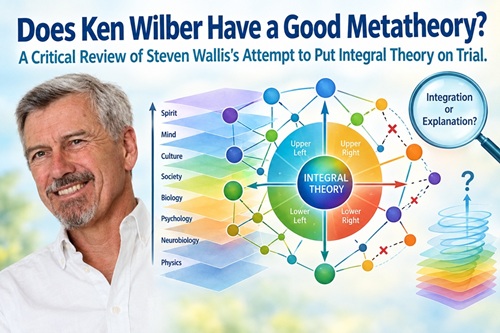 Steven E. Wallis's essay Does Ken Wilber offer a good metatheory? A Response to Frank Visser's Three Questions is an unusually interesting document in the history of Integral Theory because it approaches Ken Wilber from a direction that is neither straightforwardly sympathetic nor straightforwardly hostile. Wallis does not simply defend Wilber, nor does he attempt to dismantle AQAL. Instead, he questions the very criteria by which such a judgment could be made. His central claim is that there is no generally accepted method for evaluating theories and metatheories, and therefore that asking whether Wilber's metatheory is "good" cannot be answered without first establishing the standards of evaluation. That is a legitimate philosophical problem. But Wallis's response ultimately reveals a paradox: the more he develops his methodological framework, the less convincing his suspension of judgment becomes. He has already identified important weaknesses in AQAL—indeed, in his earlier work he assigned Integral Theory a remarkably low "robustness" score of 0.10—but in this later essay he retreats from the implications of that analysis into a generalized pluralism of methods. The result is intellectually stimulating, but also frustrating. Wallis comes remarkably close to a powerful critique of Wilber's metatheory without quite delivering it. Three questions that should not be dissolved into one Wallis is responding to three questions I posed concerning Wilber: • Does Wilber offer a metatheory? • If so, does he do a good job? • If not, are there better alternatives? Wallis answers the first question with a qualified yes, but immediately complicates the concept of metatheory itself. According to him, AQAL qualifies as a metatheory under some definitions because it combines multiple theories. Yet he points out that, under such a definition, virtually every theory could be considered a metatheory because every theory incorporates elements of earlier theories. This is a useful observation. It exposes a genuine ambiguity in the word "metatheory." If merely combining theories makes something a metatheory, the category becomes so broad that it loses much of its discriminating power. Newtonian mechanics incorporates mathematics, geometry and earlier mechanics; evolutionary theory incorporates earlier biological and geological knowledge; psychological theories synthesize previous observations and concepts. Calling all such enterprises "metatheories" does not necessarily clarify anything. Wallis therefore proposes something more demanding: we need rigorous and repeatable methods for integrating multiple theories. If different scholars were given the same theories and the same method, they should arrive at substantially similar integrations. This is perhaps the strongest idea in the essay. Unfortunately, Wallis does not pursue its consequences far enough. AQAL as synthesis—or as collage?The central problem with Wilber's Integral Theory is precisely the relationship between its ingredients. Wilber famously brings together developmental psychology, systems theory, evolutionary theory, contemplative traditions, cultural theory, neuroscience, sociology, philosophy and other disciplines. This enormous range is one of the principal attractions of Integral Theory. But putting theories next to each other is not the same as integrating them. A map containing psychology, sociology, biology and spirituality is not necessarily an integrated theory of psychology, sociology, biology and spirituality. The crucial question is what happens at the points of connection. • What exactly licenses the transition from one domain to another? • What mechanisms connect them? • Which concepts are empirically established and which are philosophical interpretations? • When two theories conflict, which one is modified? • When they use the same word differently, which meaning prevails? • And when a scientific theory contradicts an Integral claim, does AQAL have a procedure for deciding which should give way? These questions become particularly important because Wilber often moves between radically different epistemic registers while presenting them as parts of a single comprehensive architecture. Wallis recognizes the problem in principle. His earlier Integral Puzzle essay attempted to measure precisely how tightly the propositions of Integral Theory are connected. There he argued that theories should be evaluated by the degree to which their propositions form interconnected causal structures rather than merely constituting lists of concepts. His preliminary analysis of the Twenty Tenets produced a "robustness" value of 0.10 [on a 1.0 scale]. That finding is potentially devastating—not because the number 0.10 possesses some magical scientific significance, but because it exposes the distance between having many concepts and having a tightly integrated explanatory theory. Yet Wallis's 2010 essay does not capitalize on this result. The problem with "no generally accepted method"Wallis repeatedly emphasizes that there is no generally accepted method for evaluating theories and metatheories. True. But this observation can easily become an epistemological escape hatch. There is no universally accepted method for evaluating historical explanations either. There is no universally accepted method for evaluating psychological theories, economic models, philosophical systems, or scientific paradigms in every conceivable circumstance. That does not mean that anything goes. We routinely evaluate intellectual frameworks according to multiple criteria: • conceptual clarity; • logical consistency; • empirical adequacy; • explanatory power; • predictive success; • parsimony; • compatibility with established knowledge; • openness to falsification; • usefulness in practice; • ability to generate new research; • transparency about assumptions; • and resistance to ad hoc modification. The absence of a single universally accepted yardstick does not prevent us from making rational comparisons. Indeed, science itself operates largely through this pluralistic but disciplined process. The real question therefore isn't: "Is there a universally accepted method?" It is: "Which reasonable standards are relevant to the particular claims being made?" That distinction is crucial. • If Wilber claims that AQAL is a useful map or heuristic, the standards can be relatively modest. • If he claims that Integral Theory provides a comprehensive framework for organizing human knowledge, the standards become considerably higher. • If he makes claims about evolution, consciousness, physics, developmental psychology or the structure of reality, those claims can be evaluated against the relevant bodies of evidence. There is no need for a single "metatheory evaluation machine." Wallis's most revealing concessionWallis actually makes an important admission that deserves more attention than it receives. He says that some of his tests suggest Integral Theory can generate interesting insights and "aha" moments, while other tests indicate that it will not be useful in creating positive change in the wider world. This is a striking distinction. It suggests that Integral Theory may possess interpretive usefulness without possessing corresponding explanatory or transformative validity. That distinction should be central to any serious assessment of Wilber. A conceptual framework can be intellectually stimulating without being scientifically true. • It can organize someone's thoughts without accurately describing the world. • It can generate fruitful questions without providing correct answers. • It can function as a useful heuristic without being a valid metatheory. • And it can produce powerful "aha" experiences precisely because it is an elegant organizing system. This is not a minor philosophical distinction. It is the difference between a map that helps us think and a theory that successfully explains what is happening. Wallis gets very close to this distinction, but does not fully exploit it. The strange elevation of "integration"There is another problem. Wallis's criterion of robustness is itself deeply compatible with Integral Theory's own preference for complexity, interconnectedness and holism. The danger is therefore circularity. Integral Theory says that reality consists of interconnected systems. Wallis says that a good theory should contain interconnected propositions. Integral Theory values integration. Wallis measures "integrality" partly through integration. But why should more interconnected propositions automatically constitute a better theory? This is not self-evident. A theory can become increasingly complicated without becoming increasingly true. Indeed, one of the great dangers of grand theory is precisely the ability to connect almost everything to everything else. A sufficiently flexible conceptual system can explain any outcome after the fact. That is not necessarily robustness. It may instead be immunity to disconfirmation. Newton's F = ma is extraordinarily powerful not because it contains many interconnected concepts, but because it is mathematically precise and makes highly constrained predictions. This difference matters. Wallis contrasts the robustness of Integral Theory with theories such as Newtonian mechanics and Ohm's law. But the analogy risks confusing structural integration with scientific validity. The elegance of a conceptual network is not equivalent to its truth. The 0.10 problemWallis's earlier numerical assessment deserves a second look. He defines robustness roughly in terms of the proportion of concepts that participate in concatenated relationships with other concepts. His analysis of the Twenty Tenets produced 0.10. • But where did the scale itself come from? • Why should a theory with a robustness of 0.6 be six times as robust as one with 0.1? • Why should Newtonian physics score 1.0? • Why does "concatenation" measure explanatory quality rather than merely structural interconnectedness? • And why should greater concatenation necessarily produce greater empirical effectiveness? Wallis acknowledges that his analysis is preliminary. That qualification is appropriate. But it also means the numerical result should not be mistaken for a scientifically established measurement. There is a danger here of quantifying a philosophical judgment without first validating the metric itself. The number 0.10 looks scientific. But the real scientific question is whether the measurement predicts something independently observable. For example: do theories with higher Wallis robustness scores actually produce more accurate predictions, better interventions, or greater empirical success? That test would make the measure much more interesting. Without it, the number is primarily a descriptive indicator of the structure Wallis has chosen to measure. The deeper problem: AQAL's unfalsifiabilityThe more fundamental issue is not whether AQAL contains enough relationships between its concepts. It is whether its central claims can be wrong. This is where Wallis's discussion could have gone much further. A genuinely powerful metatheory should presumably tell us not only how different perspectives can be accommodated, but also when a particular interpretation should be rejected. Suppose empirical developmental psychology contradicts a developmental sequence proposed by Wilber. What happens? Suppose evolutionary biology contradicts a claim about increasing complexity or telos. What happens? Suppose neuroscience fails to support an Integral claim about consciousness. What happens? Suppose two quadrants generate mutually incompatible conclusions. What adjudicates between them? If the answer is that each perspective is valid in its own quadrant, then the framework risks becoming unfalsifiable. If every objection can be absorbed by assigning it to another quadrant, another level, another line, another state, another stage, or another epistemological perspective, then AQAL becomes extremely difficult to refute. And that is a more serious problem than merely lacking an accepted method of evaluation. Wilber's "metatheory" may actually be a meta-frameworkPerhaps the most productive conclusion would therefore be to downgrade the claim. AQAL may be extremely useful as a meta-framework for organizing perspectives. That is a much more defensible proposition than saying that it constitutes a comprehensive metatheory of reality. A framework can say: • Look at the subjective dimension. • Look at the objective dimension. • Look at individual development. • Look at social systems. • Look at cultural meanings. • Look at behavior. These are reasonable reminders. But reminders are not explanations. The Four Quadrants, for example, can encourage researchers not to reduce human phenomena to either subjective experience or objective behavior. That is a legitimate methodological caution. But it does not establish that reality is fundamentally divided into four quadrants, still less that AQAL has discovered the architecture of reality. The same distinction applies to stages, levels, lines, states and types. They can be useful descriptive categories without constituting a unified theory of everything. Wallis's pluralism is both strength and weaknessThere is something admirable about Wallis's reluctance to proclaim a winner. He explicitly encourages readers to apply multiple methods and compare alternative metatheories rather than simply accepting his own conclusions. This intellectual humility is welcome. But there is a danger of turning methodological pluralism into methodological paralysis. At some point, a researcher has to say: "This claim is better supported than that one." Not because a final, universal criterion has been discovered, but because the available evidence warrants the distinction. Otherwise every intellectual framework remains permanently suspended in a state of methodological equivalence. Wallis's own earlier analysis had already provided grounds for discriminating between versions of Integral Theory. His robustness approach could have been used to ask which components of AQAL are tightly connected, which are loosely connected, which are empirically grounded, and which are metaphysical additions. Instead, his later essay largely returns the issue to the level of methodological possibility. The irony of the "integral" metatheoryThere is a delicious irony here. Integral Theory promises to integrate perspectives. Wallis asks how such integration can itself be evaluated. The answer cannot simply be more integration. Otherwise we end up with an infinite regress: • Integral Theory integrates theories. • Meta-Integral Theory integrates Integral Theory with other integral theories. • Meta-meta-theory integrates the competing meta-theories. • And eventually we have an ever-expanding hierarchy of frameworks about frameworks about frameworks. The danger is that the further we move from empirical reality, the more sophisticated the conceptual architecture becomes—and the less clear it becomes what would count as evidence against it. I have previously described this tendency as the danger of "meta-theoretical inflation": when difficulties at one theoretical level are solved by moving to a higher level of abstraction rather than by resolving the original empirical problem. Wallis himself gestures toward precisely this issue when he asks whether metatheory should be understood as a privileged construct "on top of the pyramid" or instead as something embedded in systemic relationships with theories, concepts and actions. That is an excellent question. But it points toward a much more radical critique than Wallis himself develops. What would a genuinely useful Integral metatheory require?A more rigorous Integral Theory would need at least four things. • First, clear boundaries. It should distinguish established empirical claims from philosophical interpretations and spiritual metaphysics. • Second, explicit mechanisms. It should explain how concepts from different disciplines actually connect rather than merely placing them within the same architecture. • Third, vulnerability to evidence. It should specify what observations would count against particular claims. • Fourth, comparative testing. AQAL should be compared with alternative frameworks according to independently defensible criteria rather than judged primarily by how comprehensive or integrative it appears. This would turn Integral Theory from an architecture of inclusion into a genuine research program. It would also make some parts of Wilber's system vulnerable to rejection. And that is precisely what a healthy theory should allow. Wallis's most important contributionDespite these criticisms, "Does Ken Wilber offer a good metatheory?" remains valuable. Its greatest contribution is not its answer to the three questions. It is its insistence that the evaluation of metatheory is itself a metatheoretical problem. That insight deserves to be taken seriously. Wallis refuses to accept the common Integral argument that because AQAL integrates many perspectives it must therefore be a superior framework. Instead, he asks what "integration" actually means, how metatheories are constructed, and how competing frameworks might be compared. That is exactly the conversation Integral Theory needs. But the next step cannot be endless reflection on the methodology of evaluation. It has to be evaluation. Conclusion: The question Wallis almost answeredWallis's essay begins with three deceptively simple questions: Does Wilber offer a metatheory? Is it good? Are there better alternatives? His answer is essentially that the first question depends upon definitions and that the second and third cannot be answered conclusively because there is no universally accepted evaluative procedure. But there is a fourth question hiding underneath all three: What would we expect to see if Wilber's metatheory were actually wrong? That may be the most important question of all. If the answer is "nothing," then we do not have a robust scientific metatheory. We have an interpretive framework that can accommodate virtually anything. Wallis's earlier work had already shown that the Twenty Tenets, when examined structurally, were much less integrated than the rhetoric of Integral Theory might suggest. His preliminary robustness score of 0.10 should therefore have been the beginning of a deeper critique rather than merely a methodological experiment. The real challenge for Integral Theory is not to become more integral. It is to become more discriminating. • Not every connection is an explanation. • Not every synthesis is an integration. • Not every perspective is equally valid. • Not every map deserves to be called a theory. • And not every theory becomes stronger by moving to a higher meta-level. Wallis correctly asks how we might build better theories. The uncomfortable question he leaves largely unanswered is whether AQAL itself survives that test. And that, ultimately, is where the critical examination of Wilber's metatheory should begin—not end.
Widget is loading comments...
|