|
TRANSLATE THIS ARTICLE
Integral World: Exploring Theories of Everything
An independent forum for a critical discussion of the integral philosophy of Ken Wilber
  Frank Visser, graduated as a psychologist of culture and religion, founded IntegralWorld in 1997. He worked as production manager for various publishing houses and as service manager for various internet companies and lives in Amsterdam. Books: Ken Wilber: Thought as Passion (SUNY, 2003), and The Corona Conspiracy: Combatting Disinformation about the Coronavirus (Kindle, 2020). Frank Visser, graduated as a psychologist of culture and religion, founded IntegralWorld in 1997. He worked as production manager for various publishing houses and as service manager for various internet companies and lives in Amsterdam. Books: Ken Wilber: Thought as Passion (SUNY, 2003), and The Corona Conspiracy: Combatting Disinformation about the Coronavirus (Kindle, 2020).
Check out my other conversations with ChatGPT
Can Integral Theory Be Wrong?
The Problem of Collaborative Knowledge The Problem of Integral Self-Criticism The Problem of Intellectual Fallibility Is Integral Theory a Good Meta-Theory? True but Partial - or Never Actually Wrong?Ken Wilber and the Problem of Intellectual FallibilityFrank Visser / ChatGPT
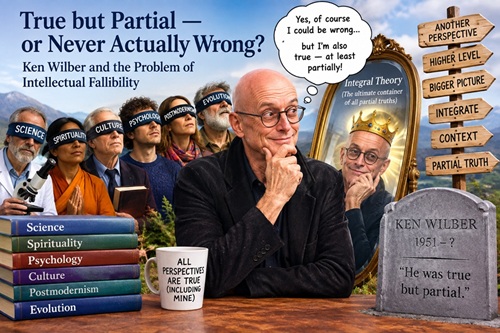 Ken Wilber has always presented himself as an unusually inclusive thinker. His Integral Theory is supposed to overcome the limitations of one-sided approaches by preserving whatever is genuinely valuable in each of them. Science has its truth, but so does spirituality. Individual experience matters, but so does culture. Psychology is important, but so are biology and social systems. Modernity contributes something essential, but so does postmodernism. The central Integral gesture is therefore not to decide which camp is simply right and which is simply wrong, but to ask what each camp sees that the others have missed. This position is encapsulated in Wilber's famous formula: “Everybody is right—but partial.” In Integral Psychology he makes the principle explicitly autobiographical: “Everybody—including me—has some important pieces of truth.” And he adds the memorable epitaph he would like to have on his tombstone: “He was true but partial.” The sentiment is attractive. It sounds like intellectual humility, tolerance and epistemic openness. Wilber is not claiming omniscience. On the contrary, he openly acknowledges that his own perspective is incomplete. But there is a problem hiding inside this apparently modest formulation. What if Wilber is not merely partial, but wrong? That is a different question. And it is surprisingly difficult to find Wilber applying it seriously to his own system. The difference between incompleteness and errorThere is an enormous philosophical difference between saying that a theory is partial and saying that it contains false propositions. Newtonian mechanics is partial in the sense that relativity and quantum mechanics describe domains in which Newtonian physics does not provide the most fundamental account. But scientific progress is not simply a matter of discovering additional perspectives that can be placed alongside Newton. Some propositions turn out to be wrong, or at least inadequate under specified conditions. Ptolemy's astronomical system was not merely “partial” because Copernicus happened to add another perspective. Particular assumptions of the Ptolemaic system were eventually abandoned because they failed to provide the best explanation of the observations. Likewise, phlogiston theory did not survive because chemists discovered the “partial truth” contained in it and integrated it into a larger AQAL framework. Scientific knowledge progresses partly through error correction. Wilber's vocabulary tends to shift the emphasis elsewhere. Rather than asking which theory is wrong, he asks how apparently conflicting theories can all contain some truth. In Integral Methodological Pluralism, he puts the point very strongly: instead of asking which approach is right and which is wrong, we should ask how the universe could be structured so that the different approaches are “true but partial.” That is an interesting methodological proposal. But it becomes problematic when it is elevated from a useful heuristic into something approaching a metaphysical principle. Because then the question becomes: Where, exactly, does Integral Theory permit itself to be wrong? “Nobody is smart enough to be wrong all the time”Wilber has another formulation that sounds even more modest: “Nobody is smart enough to be wrong all the time.” It is a clever aphorism. Obviously, virtually every serious intellectual tradition contains at least some valid observations. The scientist can learn from the mystic; the mystic can learn from the scientist; the liberal can learn from the conservative; the conservative can learn from the liberal. But notice the subtle logical shift. The modest proposition is: Nobody is wrong about everything. The much stronger Integral proposition becomes: Therefore every major intellectual approach contains an important partial truth that should be incorporated into an overarching framework. The first proposition does not entail the second. A person can be wrong about an enormously important matter while being right about numerous trivial ones. A theory can contain valuable observations while its central explanatory structure is mistaken. An intellectual tradition can generate profound insights while its metaphysical conclusions are false. The fact that nobody is wrong all the time does not tell us which claims are wrong. And that is precisely where a genuinely fallibilist epistemology begins. The Integral theorist as judge, jury and synthesizerThere is an even deeper problem. Suppose Freud, Buddhism, evolutionary biology, systems theory, phenomenology and postmodernism all contain partial truths. Fine. But who determines what those truths are? This is where Wilber's own position acquires an extraordinary structural privilege. He assembles the contributions of different disciplines, identifies their “orienting generalizations,” places them within the AQAL framework, and then uses that framework to diagnose the limitations of the original disciplines. As Jack Crittenden explains Wilber's method, the task is to assemble the truths found in different fields and then ask what coherent system could incorporate the greatest number of them. The resulting structure is, in effect, a meta-framework of partiality. Freud is partially right. Buddhism is partially right. Science is partially right. Postmodernism is partially right. Systems theory is partially right. Developmental psychology is partially right. And Integral Theory is the framework that tells us what the partiality consists of. That creates an epistemological asymmetry. The other theories are objects of diagnosis. Integral Theory becomes the diagnosing subject. The others are placed inside the map. The map itself is rarely placed on the same operating table. The fascinating asymmetry of Wilber's criticismThis becomes particularly visible in Wilber's treatment of intellectual opponents. Consider his response to Whitehead. Wilber does not normally say simply that Whitehead is wrong. Instead he writes: “As usual, I am not saying that is wrong; I am suggesting it is very partial.” He then explains how Whitehead needs to be supplemented by insights from postmodernism and intersubjectivity. This is a textbook example of the Integral strategy. Whitehead contains a truth. But Whitehead is incomplete. Postmodernism contributes another truth. Integral Theory incorporates both. The contradiction is thereby transformed into complementarity. That can be illuminating. But it can also be intellectually convenient. For if every serious disagreement is reformulated as partiality, the Integral framework becomes extraordinarily difficult to falsify. A critic says: “Your theory is mistaken.” The Integral response can become: “You have identified something real, but your perspective is partial.” The critic says: “No, the problem is with the structure of your theory itself.” The response can become: “That criticism represents another perspective that should be included.” The criticism has now been metabolized by the system. The system survives. What would count as being wrong?This is the question Wilber's epistemology needs to answer much more explicitly. • Suppose a central developmental claim were contradicted by extensive empirical evidence. Would Integral Theory abandon it? • Suppose one of the stages traditionally presented in Wilber's developmental maps turned out not to exist cross-culturally. Would the stage model be discarded? • Suppose research showed that development did not proceed in anything resembling the hierarchical sequence Integral Theory proposes. Would Wilber regard that as evidence against the theory itself? • Suppose the quadrants proved theoretically redundant rather than indispensable. • Suppose the concept of holarchy turned out to be an attractive metaphor rather than a fundamental feature of reality. • Suppose the evolutionary cosmology underlying Wilber's later work were shown to be scientifically untenable. At what point would Wilber say: “This part of Integral Theory is wrong, and therefore needs to be abandoned”? Not “partial.” Not “misunderstood.” Not “true at another level.” Not “valid from another perspective.” Not “a useful contribution that needs to be integrated.” Wrong. That word matters. Reformulation is not the same as correctionWilber has, of course, changed his formulations repeatedly over the decades. His holon theory, quadrant theory, developmental models and accounts of evolution have all undergone revisions. Critics have pointed out that these changes are not always accompanied by an explicit account of what was wrong with the previous formulation. Jeff Meyerhoff, for example, has drawn attention to significant changes in Wilber's treatment of the quadrants and argued that some revisions appear without an explicit acknowledgment that earlier formulations were problematic. This is an important distinction. A theory can evolve without its author ever admitting error. One can say: “I have refined the model.” But a stronger intellectual practice is: “My earlier formulation made claim X. Evidence or argument Y showed that X was mistaken. I therefore retract X and replace it with Z.” That second procedure is ordinary scientific self-correction. It is also much harder. Because it creates a visible record of intellectual vulnerability. Integral Theory and the absence of a clear falsification mechanismThis problem has not escaped academic critics of Integral Theory. Criticism has been directed specifically at the difficulty of validating or falsifying some of its theoretical claims according to ordinary scientific standards. The issue is not that every part of Integral Theory must be reducible to a laboratory experiment. It is that a theory making substantial empirical and developmental claims should be able to distinguish, at least in principle, between evidence that supports it and evidence that would count against it. This is particularly important because Wilber himself often appeals to science as one of the legitimate modes of knowledge. If Integral Theory wants the authority of scientific knowledge where science supports it, then it also has to accept something of the epistemic discipline of science: hypotheses must remain vulnerable to correction. Otherwise the relationship becomes asymmetrical. Science supplies truths to Integral Theory. Integral Theory interprets the limitations of science. But what mechanism allows science—or any other discipline—to overturn Integral Theory? That is the missing piece. “True but partial” can become an immunizing strategyThis is where Wilber's most appealing intellectual principle can acquire an unintended consequence. “True but partial” sounds like a doctrine of humility. But it can function as a doctrine of theoretical immunization. If every competing position is assigned a partial truth, then every disagreement becomes potential confirmation of the Integral synthesis. The more perspectives one incorporates, the more comprehensive the theory appears. And the more comprehensive it appears, the easier it becomes to portray competing theories as incomplete. This creates a circular advantage:
The system can therefore grow without necessarily becoming more vulnerable. That is not the same thing as being false. But it is a legitimate reason to ask whether the system is sufficiently corrigible. The problem with the tombstoneWilber's “true but partial” tombstone is charming. It also unintentionally captures the entire problem. The phrase says: I was not completely right. But it does not say: I was wrong about important things. Those are very different epitaphs. The first preserves the basic architecture of the worldview. The second acknowledges the possibility that the architecture itself may require demolition. Wilber's statement is therefore epistemically modest only up to a point. He concedes incompleteness. He does not thereby concede falsity. And a theory can be incomplete without being seriously mistaken—but it can also be seriously mistaken while containing many valuable insights. The distinction is crucial. The missing sentencePerhaps the most revealing sentence is one Wilber could have added to his famous declaration: Everybody is right—but partial. A genuinely fallibilist version would be: Everybody is partially right, and everybody—including me—can also be substantially wrong. That second clause changes everything. It means that Integral Theory is not the court in which all other theories are judged. It is itself another historical intellectual construction, subject to evidence, criticism, revision and perhaps even rejection. It means that a critic is not necessarily someone occupying a narrower quadrant, a lower developmental stage, a more partial perspective or a less inclusive worldview. The critic might simply have found an error. And sometimes the critic might be right. From “more inclusive” to “more corrigible”There is an irony here. Wilber's great ambition was to create a theory broad enough to include as much truth as possible. But comprehensiveness is not the same thing as truth, and inclusiveness is not the same thing as validity. A theory can explain everything because it has become sufficiently flexible to accommodate everything. That is not necessarily intellectual victory. It may instead be a warning sign. The more impressive criterion for a theory is not how much criticism it can absorb, but how much criticism it can survive only by changing itself. A genuinely fallible Integral Theory would therefore need something Wilber's rhetoric has not emphasized nearly enough: explicit conditions under which Integral Theory would have to concede error. Not merely refinement. Not merely expansion. Not merely another perspective. Error. The ultimate ironyWilber has spent decades criticizing other worldviews for mistaking their partial perspective for the whole. That criticism is often perfectly legitimate. But the same warning must eventually be turned back upon Integral Theory itself. Perhaps the deepest Integral move would therefore not be to add another quadrant, another developmental stage, another level of consciousness or another methodological distinction. It would be to apply the principle of perspectival humility to the Integral framework itself. The question would no longer be: “How can all these theories be true but partial?” It would become: “What if Integral Theory is itself one more partially successful attempt to understand reality—and what evidence would show us where it is wrong?” That is a much harder question. And perhaps a much more genuinely Integral one. Because if Wilber's theory cannot be wrong in any clearly identifiable way, then “true but partial” risks becoming something very different from the humble epistemology it initially appears to be. It becomes a way of saying: Everyone else is partial. I am the one who knows why. And that, ironically, may be the least partial position of all.
Widget is loading comments...
|