|
TRANSLATE THIS ARTICLE
Integral World: Exploring Theories of Everything
An independent forum for a critical discussion of the integral philosophy of Ken Wilber
  Frank Visser, graduated as a psychologist of culture and religion, founded IntegralWorld in 1997. He worked as production manager for various publishing houses and as service manager for various internet companies and lives in Amsterdam. Books: Ken Wilber: Thought as Passion (SUNY, 2003), and The Corona Conspiracy: Combatting Disinformation about the Coronavirus (Kindle, 2020). Frank Visser, graduated as a psychologist of culture and religion, founded IntegralWorld in 1997. He worked as production manager for various publishing houses and as service manager for various internet companies and lives in Amsterdam. Books: Ken Wilber: Thought as Passion (SUNY, 2003), and The Corona Conspiracy: Combatting Disinformation about the Coronavirus (Kindle, 2020).
Check out my other conversations with ChatGPT
Can Integral Theory Be Wrong?
The Problem of Collaborative Knowledge The Problem of Integral Self-Criticism The Problem of Intellectual Fallibility Is Integral Theory a Good Meta-Theory? Tom Murray and the Problem of Collaborative KnowledgeWhen epistemological humility becomes too much of a good thingFrank Visser / ChatGPT
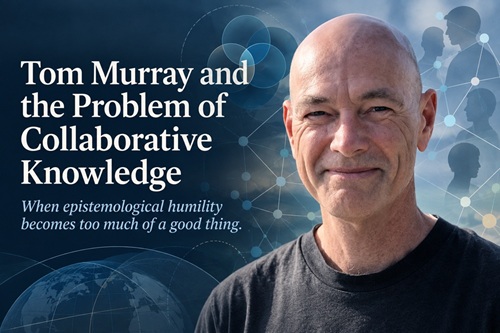 Tom Murray's "Collaborative Knowledge Building and Integral Theory: On Perspectives, Uncertainty, and Mutual Regard" is an unusually thoughtful document from the early years of the Integral movement. Published in 2006, it appeared at a moment when Ken Wilber's AQAL framework was expanding rapidly and when the Integral community was beginning to confront a problem that Wilber himself had helped create: if Integral theory is supposed to include multiple perspectives, methodologies and modes of knowing, how should Integralists actually decide between competing claims? Murray's answer is to turn Integral theory away from the construction of ever more elaborate maps and toward the process by which knowledge is collectively constructed. His central concept is “epistemological indeterminacy”: the unavoidable uncertainty, ambiguity and perspectival character of concepts, theories and communication. He proposes that Integral communities should become more conscious of this indeterminacy and develop practices for dealing with it through mutual understanding, mutual agreement and mutual regard. There is much to admire here. Indeed, some of Murray's recommendations are remarkably sensible. But there is also a fundamental problem. He diagnoses the epistemological difficulties of Integral theory more clearly than he confronts their possible source. The problem may not merely be that Integralists need better methods for managing disagreement. It may be that some of the disagreements exist because the underlying claims of Integral theory are insufficiently established in the first place. That distinction matters enormously. From Wilber's theory to a theory of theorizingMurray begins from an important observation. Wilber's later work was increasingly concerned with “multiple perspectives and multiple knowledge building methodologies.” Murray sees this as a possible transition from an emphasis on ontology—what reality is—toward epistemology—how we know what is. This is arguably one of the most promising directions Integral theory could have taken. Instead of endlessly expanding AQAL with new levels, lines, states, types, quadrants, perspectives and mathematical notations, why not ask how these constructs are justified? What evidence supports them? What would count against them? Which parts are empirical, which are interpretive, which are philosophical, and which are simply useful metaphors? Murray comes remarkably close to asking these questions. He proposes “indeterminacy analysis,” in which theorists explicitly identify the uncertainties, ambiguities, fuzzy boundaries and limitations of their concepts. He also proposes “differential analysis,” in which competing theories are broken down into their constituent concepts and assumptions before being evaluated. This is excellent advice. In fact, one could argue that Murray's methodological recommendations point toward a much more modest Integral theory than Wilber's own. If every model is treated as an approximation, if every concept has boundaries, if every theory must disclose its assumptions and if competing explanations are decomposed before being integrated, then the grand architecture of AQAL begins to lose its privileged status. And that is where Murray's argument becomes particularly interesting. The great achievement: making uncertainty explicitMurray's discussion of epistemological indeterminacy is strongest when he refuses the fantasy of perfect certainty. Concepts are fuzzy. Categories overlap. Models simplify. Language is metaphorical. Individuals interpret things differently. Social and psychological factors influence interpretation. Even apparently straightforward claims depend upon background assumptions. Murray carefully catalogues these sources of uncertainty. This is not a trivial point. Integral theory has often presented itself as the framework capable of incorporating the partial truths contained in competing paradigms. But before one can integrate competing paradigms, one must establish what makes their claims true, partly true, useful, or merely interesting. Murray rightly notices that Integralists often leap over this difficulty. His proposed remedy is a kind of epistemological self-consciousness: don't merely make a claim; become aware of the conditions under which you are making it. That is a valuable intellectual discipline. But there is a danger here. Not every disagreement is an epistemological problemMurray's greatest weakness is that he sometimes treats disagreement as though it were primarily a problem of indeterminacy. Suppose two Integral theorists disagree about the interpretation of a quadrant. That may indeed be a problem of terminology, perspective or conceptual ambiguity. But suppose someone claims that consciousness is a fundamental property of matter. That is a different kind of disagreement. Or suppose someone claims that evolution is driven by an intrinsic cosmic impulse toward greater complexity. That is different again. Or suppose someone claims that mystical experience reveals an ultimate nondual reality. These are not merely disagreements produced by different perspectives on an inherently ambiguous subject. They are substantive claims about reality. They require arguments and, where appropriate, evidence. Murray recognizes this distinction to some degree. He explicitly says that his concern is not to determine whether particular criticisms of Wilber are correct, but to investigate how communities handle competing claims when there is no clear empirical or scientific method for settling them. But that qualification is precisely where the difficulty lies. What happens when there actually is a reasonably clear empirical method? Then epistemological pluralism should not prevent us from using it. The danger of turning truth into negotiationMurray says that Integral theories are primarily “organizational or explanatory,” and therefore their validity depends more on meaning-generation and practical usefulness than on empirically determined truth. This is an important concession—but also a dangerous one. There are many kinds of intellectual activity. A conceptual framework can indeed be useful without being literally true. A metaphor can illuminate without describing the furniture of reality. A map can be valuable without reproducing the territory. But if that is the case, Integral theory should say so much more explicitly. The trouble begins when a useful interpretive framework quietly turns into an ontology. Wilber's language repeatedly crosses this boundary. AQAL is presented not simply as a vocabulary for organizing experience but as a framework revealing fundamental structures of reality. Holons, developmental levels, Eros, consciousness, Spirit, states and stages are not always offered merely as pragmatic constructs. They are frequently treated as discoveries about how reality itself is structured. Murray's methodological caution is therefore potentially devastating to the stronger claims of Integral theory. If models are maps, then AQAL is a map. If maps are perspectival, incomplete and purpose-dependent, then AQAL cannot automatically claim privileged access to the territory. And if its ontological claims exceed what its methods can establish, no amount of mutual regard can solve the problem. “Everybody is partially right” is not an epistemologyOne of Murray's recurring themes is that Integral methodological pluralism should not mean that everybody is simply right. Rather, apparently conflicting perspectives may contain partial truths because they arise from different perspectives. This sounds attractive. It is also one of the most problematic habits in Integral discourse. Sometimes two perspectives really do illuminate different aspects of the same phenomenon. But sometimes one proposition is simply false. The heliocentric and geocentric models do not become complementary because each reflects a different perspective. Germ theory does not become merely one perspective on disease alongside the idea that illness is caused by evil spirits. Evolution by natural selection does not become one partial truth alongside the claim that species were separately created because both originate within different cultural frameworks. Perspectivalism becomes intellectually dangerous when it loses the ability to discriminate between different perspectives on the same reality and different claims about reality that are incompatible. Murray himself provides the tools for making that distinction, but does not push the point far enough. His principle of “least ontological commitment” is particularly useful here. He argues that knowledge frameworks should make as few claims about reality as necessary. If that principle were consistently applied to Integral theory, it would dramatically reduce the metaphysical baggage of AQAL. The irony of “transcend and include”Murray accepts the Integral slogan that theories should “transcend and include” earlier theories rather than simply reject them. But this principle itself needs scrutiny. Sometimes intellectual progress does transcend and include. Newtonian mechanics remains enormously useful within domains where relativity is unnecessary. But sometimes progress involves abandoning a conceptual structure because it is wrong. The history of science is full of discarded theories, not merely transcended-and-included perspectives. There is therefore a danger in turning “transcend and include” into an epistemological commandment. It can encourage Integralists to search for the partial truth in every competing idea when the more appropriate question is sometimes: is this idea supported at all? Murray's own recommendation of differential analysis points toward a better answer. Instead of asking how two grand systems can be integrated, dismantle them. Identify their assumptions. Separate their useful distinctions from their speculative metaphysics. Test their claims individually. This is a much more skeptical procedure than Integral theory normally suggests. The politics of mutual regardMurray is also concerned with the social and ethical dimension of intellectual disagreement. He draws on Habermas to distinguish mutual understanding, mutual agreement and mutual regard, arguing that knowledge-building depends upon communication in which dissent is possible, participants are heard, and people treat one another with respect. Again, this is valuable. The history of Integral World itself provides ample evidence for Murray's concern. Integral debates can become remarkably personal. Accusations of misunderstanding, misrepresentation and bad faith easily replace analysis of arguments. Murray correctly observes that critics of Wilber can sometimes reproduce precisely the rhetorical behavior they criticize in Wilber. But mutual regard must not be confused with epistemic equality. We can respect a person without respecting a proposition. We can understand why somebody believes something without accepting the belief. We can give somebody a fair hearing without giving their claim equal evidentiary status. And we can criticize an argument quite severely without attacking the person making it. This distinction is essential. Otherwise “mutual regard” can become a social lubricant that makes intellectual disagreement more comfortable while leaving the underlying claims insufficiently examined. The hidden problem: the Integral community becomes the laboratoryThere is another subtle problem in Murray's argument. The Integral community becomes both the subject and the laboratory of his epistemological theory. The community is diagnosed as suffering from epistemological indeterminacy. It then develops practices of greater reflexivity, empathy, dialogue and perspective-taking. But who determines whether these practices actually produce better knowledge? That question cannot be answered merely by observing that the participants feel more understood. A group can become extraordinarily skilled at understanding one another while collectively believing something false. A conspiracy community can have tremendous mutual regard. A religious sect can possess extraordinary internal solidarity. A political movement can develop sophisticated mechanisms for incorporating diverse perspectives. None of this guarantees that its beliefs correspond to reality. This is the missing external constraint. Knowledge building requires not merely better conversation but better contact with whatever the conversation is supposed to be about. Where Murray is strongest: his critique of AQAL's proliferationIronically, Murray's most damaging observations concern the increasingly elaborate machinery of Integral theory itself. He discusses the disputes over Wilber's quadrants, primordial perspectives and “integral mathematics.” Critics developed increasingly elaborate alternative diagrams and systems of perspectives. Murray asks the obvious question: what practical problems do these increasingly complicated models actually solve? That is an excellent question. A theory does not become more adequate merely because it has more distinctions. Indeed, there is a point at which additional distinctions cease to illuminate reality and begin to generate a private language. Murray observes that some of these models become “bordering on baroque” and that it is unclear what practical purposes justify the effort required to master them. This may be one of the most important observations in the entire paper. Integral theory has a recurring tendency to respond to criticism by adding distinctions. A problem with a concept produces another qualification; a problematic category produces another level of differentiation; an ambiguity produces another diagram. The result can be a theory that becomes increasingly difficult to falsify precisely because it becomes increasingly difficult to state clearly what it actually claims. Murray's demand for simplicity, usability, internal consistency, external coherence and empirical grounding points in the opposite direction. The strange status of “validity”Murray eventually offers a long list of criteria for judging Integral theories: breadth, integration, differentiation, parsimony, coherence, clarity, external consistency, legitimate sources, examples, counterexamples, sincerity and respectfulness. Most of these are reasonable. But notice what is missing from the center of the list: testability. Murray does mention empirical validity and causal or teleological mechanisms, but largely as one consideration among many. His account remains pluralistic about validity. That makes sense for a framework whose principal function is meaning-making. It becomes much less convincing when the framework makes claims about the actual structure of consciousness, evolution or reality. There is a category mistake lurking here. Different kinds of claims require different standards of justification. A scientific claim requires evidence. A mathematical claim requires proof. A philosophical argument requires logical justification. A historical claim requires documentary and contextual evidence. A phenomenological claim requires careful description of experience. A moral claim requires normative argument. A metaphor requires explanatory or imaginative usefulness. These standards overlap, but they cannot simply be blended into a generalized concept of “validity.” Otherwise a theory can compensate for weaknesses in one domain by strengths in another. A metaphysical claim might be defended because it is psychologically meaningful; a developmental claim because it is conceptually elegant; a spiritual claim because it resonates with contemplative experience. That is precisely the kind of epistemic slippage a critical Integral methodology should prevent. The most revealing sentence in the paperPerhaps the most revealing passage comes near the end, when Murray says that acceptance of a theory ultimately depends less on formal evaluation than on an accumulated personal sense of how well it “fits,” “feels,” “works” or “makes sense.” This is psychologically plausible. It is also epistemologically dangerous. Many false theories fit. Many metaphysical systems feel profound. Many elegant explanations make sense. The human mind is exceptionally good at constructing coherence. That is why external correction matters. Science, at its best, is not a system for producing theories that feel coherent to their creators. It is a system for exposing theories to evidence that might prove them wrong. This is precisely where Murray's otherwise sophisticated epistemology should have gone further. What would a genuinely Integral knowledge community look like?Murray asks an excellent question: what would it mean for an Integral community to practice the epistemology it preaches? My answer would be somewhat more radical than Murray's. It would mean that Integralists should become willing to say: This distinction is useful, but we do not know whether it corresponds to reality. This spiritual interpretation is meaningful, but meaning is not evidence. This developmental model organizes observations, but it does not establish a developmental law. This claim sounds plausible, but what observation would count against it? This perspective is interesting, but why should we regard it as true? This theory integrates many ideas, but perhaps the ideas should not be integrated. And most importantly: What would make us give up this theory? That final question is the one Murray's framework needs most. Without it, “epistemological sensitivity” can become another form of sophisticated intellectual self-reflection. The community becomes increasingly aware of its uncertainty without necessarily becoming better at discovering what is true. From collaborative knowledge to collaborative skepticismThere is therefore a fascinating possibility hidden inside Murray's paper. Its deepest contribution may not be a method for building Integral knowledge at all. It may be a method for deconstructing Integral knowledge. His insistence on uncertainty, differential analysis, minimum ontological commitment, counterexamples, explicit assumptions and model limitations could be turned against AQAL itself. Take any Integral proposition. Strip away the jargon. Separate observation from interpretation. Separate interpretation from metaphysical inference. Identify the empirical assumptions. Identify what is merely phenomenological. Identify what depends on Wilber's terminology. Ask what independent evidence exists. Ask what rival explanation might account for the same observations. Then ask what would falsify the claim. This would produce a very different Integral discourse. It would probably contain fewer grand theories. It would certainly contain fewer “orienting generalizations.” It might also contain fewer claims about Spirit, Eros, consciousness and evolution. But what remained would be more defensible. The unresolved tensionMurray's paper thus contains a productive contradiction. On the one hand, he wants Integral theory to become more epistemologically sophisticated. He recognizes that models are incomplete, perspectives are partial, concepts are fuzzy and claims are vulnerable to interpretation. He wants Integralists to become more self-critical, more dialogical and more aware of their assumptions. On the other hand, he remains committed to the Integral project sufficiently strongly that the question of whether some of its foundational claims should simply be rejected never becomes central. That is the unresolved tension. If epistemological indeterminacy is genuinely taken seriously, then Integral theory must be willing to discover that some of its cherished ideas are not merely partial truths but unsupported ideas. And if the Integral community is genuinely committed to knowledge building, it must distinguish between including perspectives and accepting propositions. Perspectives deserve consideration. Propositions deserve testing. People deserve regard. Ideas deserve scrutiny. Those are not the same thing. Conclusion: The epistemology Integral theory needsTom Murray's "Collaborative Knowledge Building" remains an impressive attempt to bring epistemological self-consciousness into a movement that too often concentrates on constructing ever more comprehensive conceptual maps. His concepts of epistemological indeterminacy, indeterminacy analysis, differential analysis and minimum ontological commitment are particularly valuable. His insistence that dialogue requires understanding, dissent, reflection and mutual regard is equally important. But Murray stops one step short of the conclusion his own analysis invites. The central problem of Integral theory may not be that Integralists are insufficiently good at managing uncertainty. It may be that the theory itself generates unnecessary uncertainty by combining empirical observations, phenomenological reports, philosophical interpretations, developmental models and metaphysical assertions into a single overarching framework. In that situation, more dialogue is useful—but not sufficient. The cure for an overgrown map is not necessarily a more sophisticated map. Sometimes it is to go back to the territory. And there the Integral question should become brutally simple: What do we actually know? Not what fits the model. Not what integrates elegantly. Not w
Widget is loading comments...
|