|
TRANSLATE THIS ARTICLE
Integral World: Exploring Theories of Everything
An independent forum for a critical discussion of the integral philosophy of Ken Wilber
  Frank Visser, graduated as a psychologist of culture and religion, founded IntegralWorld in 1997. He worked as production manager for various publishing houses and as service manager for various internet companies and lives in Amsterdam. Books: Ken Wilber: Thought as Passion (SUNY, 2003), and The Corona Conspiracy: Combatting Disinformation about the Coronavirus (Kindle, 2020). Frank Visser, graduated as a psychologist of culture and religion, founded IntegralWorld in 1997. He worked as production manager for various publishing houses and as service manager for various internet companies and lives in Amsterdam. Books: Ken Wilber: Thought as Passion (SUNY, 2003), and The Corona Conspiracy: Combatting Disinformation about the Coronavirus (Kindle, 2020).
Check out my other conversations with ChatGPT
Can Integral Theory Be Wrong?
The Problem of Collaborative Knowledge The Problem of Integral Self-Criticism The Problem of Intellectual Fallibility Is Integral Theory a Good Meta-Theory? Tom Murray and the Problem of Integral Self-CriticismA Critical Examination of Post-Metaphysics, Developmental Hierarchies, and the Persistence of Integral ThinkingFrank Visser / ChatGPT
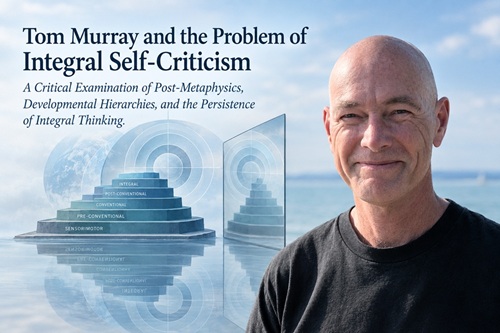 Tom Murray occupies an unusual position within the Integral Theory landscape. He is neither a straightforward disciple of Ken Wilber nor an external critic of integral theory. Instead, he has spent much of his career trying to make Integral Theory more epistemically modest, philosophically sophisticated, scientifically respectable, and self-critical—without abandoning the developmental and spiritual architecture that gives the integral project its identity. That makes Murray particularly interesting. His writings can be read as an extended attempt to solve a problem that he himself repeatedly identifies: How can integral thinkers make large claims about consciousness, development, spirituality and reality while simultaneously acknowledging the fallibility of those claims? Murray's answer is a sophisticated vocabulary of post-metaphysics, epistemic drives, embodied realism, negative capability, meaning-generative claims, developmental maturity and, more recently, wisdom skills. Yet a tension runs through the entire project. Murray is remarkably good at diagnosing the epistemic dangers of Integral Theory. He is considerably less successful at escaping the developmental metaphysics that generates those dangers in the first place. The result is an intriguing paradox: Murray has developed one of the more sophisticated critiques of integral certainty from within the integral movement, while continuing to rely on many of the developmental assumptions that make integral certainty possible. The insider who learned to distrust certaintyMurray's intellectual trajectory is unusually broad. His Perspegrity archive ranges from collaborative knowledge-building and educational technology through epistemology, Integral Theory, post-metaphysics, mystical experience, embodied realism, developmental psychology, contemplative practice, STAGES and, more recently, AI ethics. His current profile describes his work as spanning adult developmental theory, AI alignment and ethics, wisdom skills, meta-theories, contemplative dialogue and advanced learning technologies. This breadth is important because Murray's integral work is not primarily an attempt to construct another grand theory of everything. Quite the opposite. Again and again he worries about what happens when grand theories mistake their own conceptual constructions for reality. His 2013 paper Mystical Claims and Embodied Knowledge in a Post-Metaphysical Age is perhaps the clearest statement of this concern. Murray explicitly criticizes Wilber and other integralists for presenting claims about Spirit, infinity, timelessness, primordial reality and the Ground of Being with a degree of certainty that is difficult to justify. He argues that such claims can slide into "magical thinking" and "misplaced concreteness." This is not an external attack. Murray repeatedly emphasizes his respect for Wilber and the value of mystical experience. His question is rather how mystical insights can be retained without turning them into assertions about ultimate reality. That distinction is crucial. Murray is trying to preserve the phenomenological and existential value of spirituality while weakening its ontological pretensions. This is arguably the most defensible direction available to Integral Theory. But it also creates the central problem of Murray's own work. From metaphysical claims to "meaning-generative" claimsMurray's post-metaphysical strategy begins with a relatively simple insight: human beings inevitably construct concepts through which they interpret reality, and abstract concepts are particularly vulnerable to reification. In his discussion of embodied realism, Murray argues that Integral Theory itself makes strong ontological claims about such entities as Eros, the Nondual Ground of Being, perspectives as primordial, involution and tetra-emergent holons. He observes that these claims sit awkwardly beside Integral Theory's professed post-metaphysical stance. This is one of the strongest observations in his corpus. If "Spirit," "Eros," "holon," "involution" and "Ground" are conceptual constructions used to organize experience, then they should not automatically be treated as discoveries about the furniture of the universe. Murray therefore proposes a softer category: meaning-generative claims. A claim does not necessarily have to be literally or metaphysically true to be useful. A concept may organize experience, generate insight, stimulate ethical action or provide a fruitful symbolic framework. This move has considerable merit. But it also changes the game. Once "truth" becomes partly displaced by "meaning generation," the question becomes: meaning for whom, generated by what, under what conditions, and with what consequences? A myth can be meaning-generative. So can astrology. So can Marxism, Christianity, Jungian archetypes, Integral Theory, Buddhism, psychoanalysis and conspiracy theory. Meaning generation by itself therefore cannot establish epistemic legitimacy. Murray knows this. His work repeatedly emphasizes fallibility, uncertainty and the need for critical dialogue. But the problem remains unresolved: the criteria that distinguish a productive meaning-generative framework from a seductive but false one cannot simply be supplied by the developmental framework itself. Otherwise the theory risks becoming its own judge and jury. The "epistemic drives" are one of Murray's best ideasOne of Murray's most interesting contributions is his notion of epistemic drives. He argues that human cognition is not a neutral truth-detection mechanism. We possess powerful tendencies toward certainty, coherence, unity, completeness, permanence, predictability, purity and essentiality. These tendencies influence what we experience as true or real. This is a powerful corrective to naïve rationalism. It also applies beautifully to Integral Theory. Why does Integral Theory so often seek elegant maps in which consciousness, culture, spirituality and evolution can all be arranged into a coherent developmental architecture? Murray's answer would be that the human mind has a powerful appetite for precisely such coherence. The irony is obvious. Integral Theory may be particularly vulnerable to the very epistemic drives that Murray identifies. Its elaborate maps satisfy several of them simultaneously: • unity, • comprehensiveness, • hierarchical order, • developmental progression, • explanatory elegance, • integration of apparent opposites, • and the promise that apparently contradictory phenomena can be located within a larger whole. Murray himself recognizes that there is something psychologically satisfying about "ordering things," discovering generalities and integrating multiplicity into unity. But this should lead to a more radical question than Murray generally asks: What if Integral Theory's extraordinary appeal is partly explained by the very epistemic drives that its practitioners believe they have learned to transcend? The AQAL framework is not simply a neutral map. It is an exceptionally powerful machine for producing coherence. And coherence can be mistaken for truth. The developmental escape hatchHere Murray's project becomes more problematic. His response to epistemic drives is itself developmental. Human beings, he argues, can become increasingly aware of their own cognitive tendencies. They can learn to make "subject object"—to recognize and regulate previously unconscious epistemic drives. This is familiar territory in developmental psychology and especially familiar territory in Integral Theory. There are less reflective forms of cognition and more reflective ones. There are less differentiated perspectives and more differentiated ones. There are developmental capacities that allow people to hold contradiction, ambiguity and uncertainty with increasing sophistication. This can be a useful empirical hypothesis. But it becomes dangerous when epistemic sophistication itself becomes a hierarchy of human beings. Murray occasionally comes close to this problem because the very concept of post-metaphysical thinking is presented developmentally. His Knowing and Unknowing Reality explicitly connects post-metaphysical thinking with developmental levels of sophistication and with what he calls "4th person perspective" and beyond. The paradox is striking: The person who recognizes that developmental maps are constructions may still construct a developmental map of the person who recognizes that developmental maps are constructions. That is not necessarily a contradiction. But it is a danger that deserves much more scrutiny. STAGES: the map becomes empiricalThe tension becomes particularly important when Murray's philosophical work is connected to STAGES. Murray has been deeply involved in the development, validation and defense of the STAGES developmental model. The 2020 Integral Review special issue devoted substantial space to the model, including Murray and Terri O'Fallon's summary of validation research. There is legitimate empirical work here. A 2020 Heliyon paper involving Murray and colleagues describes a scoring methodology for sentence-completion assessments and reports validity evidence in relation to earlier ego-development assessments. That should not simply be dismissed as "Integral pseudoscience." But neither should empirical validation of a scoring procedure be allowed to validate the entire philosophical architecture surrounding it. This distinction is crucial. A test can demonstrate some degree of reliability or construct validity for differentiating patterns in language without thereby establishing that: • consciousness is fundamentally organized into the proposed developmental stages; • those stages represent a universal hierarchy of human maturity; • later stages are intrinsically wiser; • the trajectory is culturally universal; • development proceeds toward greater integration; • contemplative realization corresponds to particular developmental structures; • or the STAGES model captures the deeper ontology of consciousness. Murray and his colleagues explicitly distinguish STAGES from a simple application of AQAL and argue that the model was inspired by AQAL rather than predicted by it. That clarification is valuable. But it leaves an important methodological question: how far can the empirical findings legitimately carry the much larger developmental interpretation attached to them? That question is not answered merely by improving the psychometrics. Murray's critique of Wilber is therefore incompleteMurray is quite prepared to criticize Wilber. He notes that Wilber's post-metaphysical language sometimes coexists with remarkably metaphysical claims. Wilber can reject traditional metaphysics while simultaneously speaking of Spirit, Eros, the Ground of Being and evolutionary drives as if they possessed some reality independent of the conceptual framework used to describe them. Murray's criticism is justified. But the deeper problem is that Murray sometimes treats the solution as though it were simply a more sophisticated version of Integral Theory. The implicit structure becomes: Wilber's Integral Theory → post-metaphysical refinement → greater construct-awareness → greater epistemic sophistication. But why should we assume that the developmental framework doing the refining is itself sufficiently independent to adjudicate the question? This is the point at which a genuinely external philosophy of science becomes important. If one accepts the premise that our conceptual systems are historically, culturally and cognitively conditioned, then Integral Theory must be subjected to the same scrutiny as every other theoretical construction. Not merely its metaphysical claims. Its developmental claims. Its stage architecture. Its categories. Its claims about increasing complexity. Its distinctions between earlier and later cognition. And, crucially, its own claims to self-correction. The "post-metaphysical" label can conceal rather than remove metaphysics There is another difficulty. Murray's post-metaphysical vocabulary sometimes risks turning metaphysics into a problem of how claims are held rather than a problem of whether the underlying claims are warranted. This distinction is visible in his description of post-metaphysics as a more humble and reflective attitude toward truth and belief, acknowledging the fallibility of knowledge. That is valuable. But humility does not make a proposition true. A person can say: "I hold this belief tentatively." and still be wrong. Likewise: "This is my current developmental interpretation." does not establish that the developmental interpretation corresponds to reality. The danger is that epistemic humility becomes a kind of rhetorical immunization. The theory becomes harder to criticize because its advocates can always reply: "We never claimed certainty." But the actual architecture may continue doing substantial explanatory work. This is particularly important with concepts such as "development," "higher stages," "wisdom," "complexity," "spiritual clarity," and "transcendence." The vocabulary becomes softer. The hierarchy remains. From complexity to simplicity: a revealing turnMurray's later work shows that he is aware of some of these difficulties. His metamodernism paper criticizes the simplistic assumption that development always means increasing complexity. He argues that development must also incorporate unlearning, releasing complexity, healing and shadow work. This is an important correction to the classic integral narrative. Rather than endlessly "transcending and including," human beings may sometimes need to let go. Murray explicitly argues that human development does not simply progress through a neat "simplexity" in which each higher stage preserves everything valuable from previous stages. Psychological and social development can introduce contradiction, trauma and shadow, requiring processes of release and healing. This makes his model considerably more psychologically interesting. Yet the hierarchical structure survives. Murray ultimately describes foundational capacities as being "occluded" by higher hierarchical structures and suggests that development involves recovering these deeper resources. The old integral architecture has therefore not disappeared. It has been inverted. Instead of: more development → more complexity → transcendence we increasingly get: more development → sufficient complexity → deconstruction → recovery of deeper simplicity. That is more subtle. But it is still a developmental story. The curious return of involutionThere is an especially revealing phrase in the title of Murray's metamodernism draft: "healing developmental models through involutionary descent." This is where Murray comes surprisingly close to the very metaphysical territory he has criticized in Wilber. His earlier critique correctly identifies involution as one of Integral Theory's strong ontological commitments. Yet later Murray's developmental framework begins talking about "descending" into more primordial structures, recovering foundational capacities and releasing higher-order complexity. Of course, this need not mean Wilber's literal cosmological involution. Murray's model is primarily psychological. But the family resemblance is unmistakable. The vertical developmental imagination remains. There is still a deep structure. There are still levels. There are still higher and lower strata. There are still processes of transcendence and descent. There is still an implicit distinction between more and less adequate forms of consciousness. The metaphysics has not necessarily vanished. It has become more psychologically sophisticated and epistemically cautious. Murray's treatment of mysticism is simultaneously strong and revealingMurray deserves considerable credit for refusing to choose between two crude alternatives. He does not simply dismiss mystical experience as nonsense. Nor does he accept mystical interpretation as automatically revealing ultimate reality. Instead he distinguishes experience from the conceptual claims subsequently made about experience. That distinction is indispensable. A person can have an extraordinary experience of unity without thereby discovering that the universe literally consists of a metaphysical principle called "Spirit." Murray's discussion of this issue is one of the strongest aspects of his work. He argues that mystical experience can contain valuable intuitions while the metaphysical interpretations attached to it remain fallible. Yet there is an unresolved problem. If mystical experiences are treated as privileged sources of wisdom that become properly intelligible only through sufficiently advanced developmental capacities, the theory can still reproduce an epistemic elite. The traditional mystic says: "I have seen Reality." The integral developmentalist may say: "You cannot yet understand what I am saying because your meaning-making structure is not sufficiently developed." The rhetoric is radically different. The epistemic asymmetry can be remarkably similar. That is why Murray's insistence on "idea portability" is so important. He argues that the greater the conceptual distance between interlocutors, the more carefully one must attend to indeterminacy and translation. Taken seriously, this principle could become one of the strongest antidotes to integral elitism. But it cuts both ways. It should also apply to Murray's own developmental language. The great strength—and weakness—of "wisdom"Murray's recent work increasingly organizes these themes around wisdom skills. The current Perspegrity bibliography presents wisdom, complexity, transcendence, meditation, unlearning and adult development as major strands of his research. This is potentially more fruitful than the older language of "higher consciousness." "Skill" is less metaphysically loaded than "stage." A skill can be learned, practiced, assessed, context-dependent and imperfect. But the danger is that "wisdom skills" can become a new vocabulary for an old hierarchy. If the framework ultimately says that some people possess more complex, more integrated, more self-aware and more developmentally mature ways of meaning-making, then the language of skills has not eliminated the hierarchy. It has simply made it more psychologically palatable. The crucial empirical question becomes: What independently observable evidence demonstrates that a particular developmental capacity produces wiser judgments, rather than merely more sophisticated descriptions of judgment? That distinction is not trivial. A person can become extraordinarily good at reflecting on their own cognition without necessarily becoming more truthful, compassionate or morally reliable. Indeed, history contains plenty of highly sophisticated rationalizers. Murray and the problem of reflexivityThere is therefore a deeper philosophical problem running through Murray's work: reflexivity can become recursive without becoming empirical. We can critique our concepts. Then critique the critique. Then become aware of the developmental assumptions underlying the critique. Then become aware of the epistemic drives underlying those assumptions. Then become aware of the developmental level from which we are doing all this. At some point the theory can become extraordinarily sophisticated. But sophistication is not the same thing as truth. This may be the central lesson Murray's own work inadvertently teaches. His writings are at their best when they undermine the confidence of grand integral narratives. They become less convincing when the developmental framework is treated as the privileged mechanism through which that undermining takes place. The ultimate test of a post-metaphysical theory should therefore not be how many caveats it contains. It should be how readily it permits its own central architecture to fail. An interesting extension: AIMurray's recent work on artificial intelligence demonstrates that these concerns have not remained confined to Integral Theory. His 2026 paper Can AIs Care About Us, and Should We Care About Them? applies ideas about anthropomorphism, reification, linguistic indeterminacy, complex adaptive systems and human alignment to the AI debate. He argues that the human tendency to project agency and personhood onto machines may be more immediately important than settling the metaphysical question of machine consciousness. This is strikingly consistent with his earlier work. The same warning recurs: • Do not confuse the conceptual category with the reality it purports to describe. • Do not confuse "consciousness" with an independently existing thing merely because we have given it a name. • Do not confuse sophisticated language with evidence of interiority. • Do not confuse meaningful experience with metaphysical certainty. Here Murray's earlier critique of Integral Theory becomes unexpectedly relevant to AI. Indeed, his AI work could be read as an application of his own epistemological lesson: before asking whether something possesses a mysterious property, examine how the category itself has been constructed. What Murray gets right—and what he leaves unresolvedMurray's writings represent a significant internal maturation of Integral Theory. He recognizes problems that Wilber himself has often glossed over: • the difference between experience and interpretation; • the difference between epistemology and ontology; • the fallibility of knowledge; • the danger of reification; • the psychological attraction of certainty; • the ambiguity of abstract concepts; • the danger of turning developmental categories into fixed realities; • and the ethical consequences of speaking with unwarranted certainty. His notion of epistemic drives is particularly useful because it turns the critical gaze inward. Integral thinkers are not somehow exempt from the cognitive tendencies they identify in everybody else. But Murray's solution remains caught within the gravitational field of developmental theory. The hierarchy survives. The language of "higher" and "later" survives. The developmental interpretation of epistemic sophistication survives. The assumption that increasingly differentiated consciousness can gain greater access to complexity, ambiguity and wisdom survives. And beneath the post-metaphysical vocabulary there remains a persistent image of human development as a structured movement toward greater integration, clarity and wisdom. That may ultimately be true. But Murray's own epistemological principles require that it remain an open hypothesis, rather than the background ontology of the entire enterprise. Beyond Integral Theory?The most interesting question Murray raises, therefore, is not whether Integral Theory can become more sophisticated. It clearly can. The more interesting question is whether Integral Theory can become sufficiently self-critical that it is genuinely willing to discover that some of its foundational developmental assumptions are wrong. That would mean applying Murray's own principles to the developmental model itself. If epistemic drives can distort our understanding of reality, then developmental hierarchies must be examined for the drives they satisfy. If abstract categories are inherently indeterminate, then "higher," "later," "complex," "integrated," "wisdom" and "spiritual clarity" require the same scrutiny as "Spirit" and "Eros." If metaphysical claims should be held fallibly, developmental claims should be held fallibly too. If models are meaning-generative rather than literal representations of reality, then STAGES and related frameworks should be treated as instruments rather than ontological maps of consciousness. And if Murray's "idea portability" principle is taken seriously, then the ultimate test of an integral developmental model may be whether it remains intelligible and useful outside the community that already accepts its assumptions. That is where Integral Theory has historically struggled. Conclusion: The critic who remains inside the mapTom Murray is therefore best understood neither as a Wilberian orthodox thinker nor as an opponent of Integral Theory. He is something more interesting: an internal reformer attempting to make Integral Theory intellectually survivable after the collapse of its metaphysical certainties. His great contribution is to recognize that the integral project cannot simply proclaim a comprehensive map of consciousness and then invoke "post-metaphysics" as a philosophical upgrade. The map itself has to become an object of criticism. Murray gets remarkably close to that insight. But he does not always follow it to its most radical conclusion. For the deepest problem with Integral Theory may not be that Wilber occasionally makes metaphysical claims too confidently. It may be that the entire developmental architecture encourages us to imagine that reality itself has a developmental grammar—levels, stages, depths, higher and lower structures, integration and transcendence—and that increasingly sophisticated observers can progressively decipher that grammar. Murray has spent years teaching integralists to distrust certainty. The next step would be to distrust the map that teaches them how to distrust certainty. That would be a genuinely post-integral move. And perhaps the most Murray-like one imaginable.
Widget is loading comments...
|