|
TRANSLATE THIS ARTICLE
Integral World: Exploring Theories of Everything
An independent forum for a critical discussion of the integral philosophy of Ken Wilber
  Frank Visser, graduated as a psychologist of culture and religion, founded IntegralWorld in 1997. He worked as production manager for various publishing houses and as service manager for various internet companies and lives in Amsterdam. Books: Ken Wilber: Thought as Passion (SUNY, 2003), and The Corona Conspiracy: Combatting Disinformation about the Coronavirus (Kindle, 2020). Frank Visser, graduated as a psychologist of culture and religion, founded IntegralWorld in 1997. He worked as production manager for various publishing houses and as service manager for various internet companies and lives in Amsterdam. Books: Ken Wilber: Thought as Passion (SUNY, 2003), and The Corona Conspiracy: Combatting Disinformation about the Coronavirus (Kindle, 2020).
Check out my other conversations with ChatGPT
Integral Collisions:
Integral Thoughts on the Middle East Conflict When Integral Perspectives Collide The Intractable Israeli-Palestinian Conflict Irreconcilable Integral Perspectives When Integral Perspectives Become IrreconcilableRay Harris, Joseph Dillard, and the Gaza WarFrank Visser / ChatGPT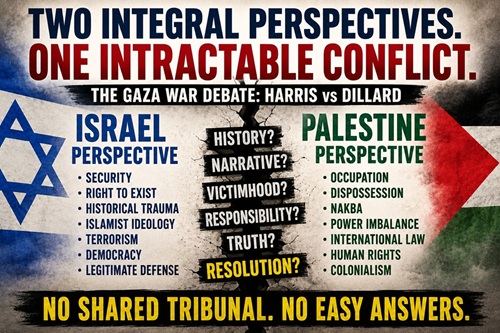 The debate over Gaza between Ray Harris and Joseph Dillard is striking for a reason that goes beyond the substantive question of Israel and Palestine. It is another example of a recurring phenomenon on Integral World: two writers who share a vocabulary of perspectives, complexity, development and integral thinking nevertheless arrive at radically opposed political conclusions. And, as happened earlier between Harris and Jeff Meyerhoff, the arguments do not converge. Each side produces more evidence, more historical context and more accusations of distortion, yet the fundamental disagreement remains intact. This is not simply because the Israel-Palestine conflict is unusually complicated. Something more interesting is happening. Harris and Dillard are not merely disagreeing about facts. They are operating with different causal narratives, different conceptions of moral responsibility, different understandings of power and, most importantly, different ideas about which perspective has been systematically neglected. That is why the argument can continue indefinitely. The old Harris-Meyerhoff argument returnsThere is a remarkable continuity between the earlier Harris-Jeff Meyerhoff exchange and the present Harris-Dillard confrontation. In 2007, Meyerhoff challenged Harris's defense of Israel and his claim that Arab and Palestinian intransigence and violence were fundamental causes of the conflict. Meyerhoff placed greater emphasis on occupation, dispossession, political power and the historical responsibility of Israel. He argued that the Palestinians were an occupied and politically weaker population and therefore that responsibility could not simply be distributed equally between the two sides. Harris eventually summarized their disagreement quite explicitly: he believed that "Arab intransigence and violence" constituted the underlying cause, while Meyerhoff assigned greater responsibility to Israel. Harris accepted a Jewish right to live in the land and regarded Palestinian violence as an obstacle to peace. Meyerhoff, meanwhile, argued that the appropriate framework was "land for peace" and maintained that Israel bore the greater responsibility for perpetuating the conflict. His final replies increasingly complained that the debate had become futile because he would cite historical scholarship, Harris would challenge particular claims or sources, and then Harris would return to his broader causal interpretation. That pattern has now returned almost twenty years later. Only the names have changed. Harris: Israel as the besieged democracyHarris's contemporary position is recognizably continuous with his earlier one. He places considerable explanatory weight on Jewish historical experience, Israeli security concerns, Islamist ideology and the history of Arab and Muslim attitudes toward Jews. His recent series on Israel and Palestine culminates in "The Chosen People," where he directly attacks Dillard's interpretation of the conflict. Harris argues that Dillard's account is ideologically driven and systematically privileges Palestinian grievances while minimizing Jewish historical claims and the history of Jewish vulnerability under Muslim rule. The key to Harris's worldview is therefore not simply "Israel good, Palestinians bad." It is a particular causal hierarchy. Jewish historical claims are real. Jewish persecution is historically profound. Israel is a secular democracy rather than a theocracy. Hamas represents an Islamist movement with a record of violence and antisemitism. Arab and Muslim hostility toward Israel cannot simply be explained as a reaction to Zionist oppression. And Western progressives, in Harris's view, have developed a habit of excusing or minimizing political violence when it is committed by groups perceived as victims of Western imperialism. This is also why Harris objects so strongly to Dillard's invocation of Islamic history. Dillard presents the historical position of Jews and Christians under Muslim rule as evidence that Islam historically accommodated the other Abrahamic faiths. Harris instead emphasizes the subordinate status of dhimmis and periods of persecution, arguing that this history cannot simply be converted into a story of harmonious coexistence. From Harris's perspective, the central distortion is therefore one of asymmetrical moral attention. Why, he implicitly asks, should Israel's actions be placed under an enormous moral microscope while Hamas, Islamist ideology, Arab rejectionism and Jewish historical vulnerability are treated as secondary? Dillard: Palestine as the dominated populationDillard reverses the hierarchy. His "Simplifying the Israel/Palestine Conflict" explicitly rejects the idea that the central issue is an evenly balanced clash of competing narratives. He argues that once the conflict is viewed through international law, power and morality, much of the supposed complexity disappears. Israel possesses vastly greater military, economic and geopolitical power, while Palestinians are the occupied and dominated population. Dillard therefore regards "both sides" language with suspicion. To describe Israel and Hamas as equally responsible, he argues, can create the appearance of neutrality while concealing an enormous asymmetry of power. For him, October 7 cannot be treated as the beginning of the story. The historical context includes the Nakba, occupation, displacement, settlement and decades of Palestinian subordination. His moral question is consequently not primarily, "What did Hamas do?" but "What system of domination produced the circumstances in which this violence occurred, and who possesses the power to change that system?" This produces a radically different weighting of evidence. A Hamas atrocity does not disappear from Dillard's analysis. But it does not occupy the same explanatory position as Israeli military power and Palestinian dispossession. Conversely, Israeli security concerns do not disappear from Harris's analysis, but they do not have the same explanatory weight as Islamist ideology and Arab rejectionism. Each believes the other has placed the wrong phenomenon at the center. The crucial difference: what counts as the "context"?This may be the deepest source of the disagreement. There is no such thing as context-free political judgment. Every historical event is embedded in a causal chain. But where do you begin that chain? Harris begins much earlier than October 7. But he begins with Jewish history: ancient Jewish statehood, exile, persecution, antisemitism, Arab nationalism, Muslim political domination and the rejection of Jewish sovereignty. Dillard also begins much earlier than October 7. But his historical starting points are dispossession, Zionist colonization, the Nakba, occupation and the asymmetry between Israeli power and Palestinian power. Both therefore accuse the other of "starting the story in the wrong place." This is crucial because changing the starting point changes the moral meaning of subsequent events. If the story begins with centuries of Jewish persecution culminating in the establishment of Israel, Israel appears as a refuge and survival project whose subsequent security concerns are understandable. If the story begins with Palestinian dispossession and the creation of a stateless population, Israel appears as the dominant power in a continuing structure of dispossession. Neither narrative requires every fact to be false. That is precisely what makes the disagreement so durable. The strange role of "perspective"Here we encounter an almost comical paradox for integral thinkers. Integral Theory celebrates the ability to take multiple perspectives. Yet Harris and Dillard demonstrate that taking multiple perspectives does not tell you how to weigh them. Harris believes he is recovering a neglected perspective: that of Israelis confronting terrorism, Islamist ideology and existential insecurity. Dillard believes he is recovering a neglected perspective: that of Palestinians living under occupation, military domination and dispossession. Both can therefore accuse the other of insufficient perspective-taking. This is a very important distinction. There are two separate questions: "Have you included perspective X?" and "How much explanatory and moral weight should perspective X receive?" Integral thinking is much better at answering the first question than the second. One can endlessly add perspectives without resolving the hierarchy between them. That is exactly what we see here. The politics of the neglected perspectiveThere is an additional psychological mechanism at work. People who are politically engaged in highly polarized conflicts frequently come to identify with the perspective they believe the mainstream ignores. Once that happens, the neglected perspective becomes morally privileged. Harris sees mainstream Western discourse as too willing to excuse Islamist violence, minimize antisemitism and portray Israel exclusively as an aggressor. Consequently, evidence demonstrating Israeli culpability does not have the same corrective force for him that evidence demonstrating Palestinian or Islamist culpability does. Dillard operates almost exactly in reverse. He sees Western governments, liberal institutions and much of the integral community as insufficiently willing to acknowledge Palestinian suffering and Israeli responsibility. Consequently, evidence demonstrating Hamas's brutality does not have the same corrective force for him that evidence demonstrating Israeli domination does. This produces an epistemic feedback loop. "I see what you fail to see." "No, I see what you fail to see." "And your failure to see it proves your ideological bias." At that point, disagreement itself becomes evidence for the diagnosis of the opponent. From disagreement to ideological diagnosisThis is where the debate becomes considerably less productive. Harris does not merely disagree with Dillard's interpretation. In his latest essay he characterizes Dillard's position as "ideologically motivated," "anti-Western" and representative of a "regressive left" tendency. Dillard's rhetoric is equally uncompromising. He describes Western integralists who refuse his interpretation as suffering from moral denial and argues that avoiding terms such as genocide, ethnic cleansing and apartheid amounts to refusing to confront obvious reality. Once the argument reaches this level, the opponent is no longer simply wrong about the Middle East. The opponent is explained. Harris can explain Dillard's conclusions through anti-Western ideology. Dillard can explain Harris's conclusions through Western exceptionalism and identification with the powerful. This is a devastating development for dialogue, because evidence presented by the opponent can now be reclassified as a symptom of the opponent's ideology. If Harris cites evidence of Islamist antisemitism, Dillard can regard it as a distraction from the occupation. If Dillard cites evidence of Palestinian dispossession, Harris can regard it as a selective narrative designed to delegitimize Israel. The debate has become self-sealing. Why facts don't settle the argumentThis also explains why the debate does not end when factual errors are demonstrated. Meyerhoff discovered this with Harris almost twenty years ago. He complained that he would provide scholarly evidence, only to find Harris contesting particular interpretations and returning to the same underlying conclusions. Harris, for his part, objected that Meyerhoff was reducing a complicated history to a one-sided account and relying excessively on controversial historians. The same structure is visible today. Dillard thinks the relevant facts establish a clear moral asymmetry. Harris thinks that Dillard has selected his facts to manufacture that asymmetry. The disagreement is therefore not simply over facts. It is over which facts are causally decisive. That is a much harder disagreement to resolve. The Israel-Palestine debate as a test of Integral TheoryThis exposes a weakness in the common assumption that an integral framework will naturally produce a more balanced political judgment. It doesn't. Integral Theory can encourage someone to recognize multiple perspectives. But it does not supply an algorithm that tells us which historical narrative is correct, which causal mechanism dominates, how responsibility should be distributed or how competing moral principles should be ranked. Indeed, the opposite may happen. An integral vocabulary can make an existing political position more sophisticated without necessarily making it less partisan. Harris can incorporate developmental levels, cultural differences, religious worldviews and competing narratives into a broadly pro-Israel interpretation. Dillard can incorporate power analysis, international law, moral universalism and historical context into a strongly pro-Palestinian interpretation. Both can claim that the other has failed to be genuinely integral. And, in a limited sense, both have a case. The Meyerhoff precedent is revealingThe Meyerhoff debate is particularly instructive because Harris's fundamental position has remained remarkably stable. In 2007 Meyerhoff argued that Israel's greater power and responsibility were being obscured by focusing on Palestinian violence. Harris argued that Arab rejectionism and violence were fundamental causes and that Israeli concessions without reciprocal Palestinian security guarantees were inadequate. Nearly twenty years later, Dillard makes essentially the Meyerhoff argument in a more radical form. And Harris responds in essentially the same structural manner. This suggests that the Gaza debate has not fundamentally changed Harris's worldview. Nor has it changed Dillard's. Indeed, the exchange demonstrates something important about intellectual debate generally: new events often reinforce existing explanatory frameworks rather than overturning them. October 7 did not cause Harris to abandon his interpretation. The subsequent devastation of Gaza did not cause Dillard to abandon his. Instead, each event was assimilated into an already existing causal model. There is no resolution because there is no shared tribunalA genuine intellectual resolution requires some mutually accepted procedure for deciding between competing claims. Do Harris and Dillard share such a tribunal? Not really. Do they agree on which historians should be trusted? No. Do they agree on the proper historical starting point? No. Do they agree on how much weight should be assigned to religious ideology versus political power? No. Do they agree on the moral significance of asymmetries of power? No. Do they even agree on what constitutes the central problem? No. Dillard sees domination and impunity as the fundamental problem. Harris sees rejectionism, Islamist ideology and the failure to acknowledge Jewish legitimacy as fundamental problems. Consequently, there is no final piece of evidence that could settle the dispute. Every piece of evidence is interpreted inside a prior framework. That is why the argument goes around in circles. What would genuine dialogue require?The interesting lesson is not that one must split the difference. "Both sides have some legitimate points" is true but intellectually insufficient. The conflict is not resolved by averaging two narratives. A more productive debate would require Harris and Dillard to make their underlying assumptions explicit. For example: How much causal responsibility should be assigned to actors according to their power? How much should historical responsibility matter relative to present responsibility? Can terrorism be explained by oppression without being morally excused by it? Can legitimate Israeli security concerns coexist with a fundamental critique of occupation and settlement? Can Palestinian dispossession be acknowledged without treating Hamas as a legitimate representative of Palestinian aspirations? Can Jewish historical claims be recognized without turning ancient history into a justification for contemporary political domination? And perhaps most importantly: what evidence would make you change your mind? That final question is usually missing from polarized political debate. Without it, an argument is not really an investigation. It is advocacy. The deeper ironyThere is a final irony here. Harris and Dillard are both, in different ways, performing the role of the integral critic. Each believes the mainstream has become trapped inside a partial narrative. Each claims to be widening the frame. Each accuses the other of narrowing it. Yet their disagreement demonstrates the limitation of perspective-taking when it is not accompanied by a disciplined method for adjudicating perspectives. More perspectives do not automatically produce greater truth. Sometimes they simply produce more sophisticated ways of disagreeing. That is what happened between Harris and Meyerhoff. And it is happening again between Harris and Dillard. The remarkable thing is not that they have failed to reach agreement over Gaza. Given their premises, that was almost inevitable. The remarkable thing is that both can continue to regard themselves as the person who has escaped ideological blindness while looking at the other and seeing precisely the blindness they believe they themselves have overcome. That may be the real lesson of the Harris-Dillard exchange. The problem is not that there are too few perspectives. It is that perspectives do not adjudicate themselves. And until the participants agree on some independent standards for weighing historical evidence, causal responsibility, power, international law and moral principles, the debate can continue forever—each side becoming increasingly certain that the other's refusal to agree is itself proof that the other side simply does not understand.
Widget is loading comments...
|