|
TRANSLATE THIS ARTICLE
Integral World: Exploring Theories of Everything
An independent forum for a critical discussion of the integral philosophy of Ken Wilber
  Frank Visser, graduated as a psychologist of culture and religion, founded IntegralWorld in 1997. He worked as production manager for various publishing houses and as service manager for various internet companies and lives in Amsterdam. Books: Ken Wilber: Thought as Passion (SUNY, 2003), and The Corona Conspiracy: Combatting Disinformation about the Coronavirus (Kindle, 2020). Frank Visser, graduated as a psychologist of culture and religion, founded IntegralWorld in 1997. He worked as production manager for various publishing houses and as service manager for various internet companies and lives in Amsterdam. Books: Ken Wilber: Thought as Passion (SUNY, 2003), and The Corona Conspiracy: Combatting Disinformation about the Coronavirus (Kindle, 2020).
Check out my other conversations with ChatGPT
Integral Collisions:
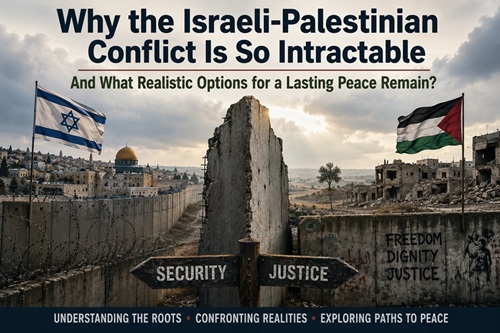
Integral Thoughts on the Middle East Conflict When Integral Perspectives Collide The Intractable Israeli-Palestinian Conflict Irreconcilable Integral Perspectives Why the Israeli-Palestinian Conflict Is So IntractableAnd What Realistic Options for a Lasting Peace Remain?Frank Visser / ChatGPT
Few conflicts in the modern world have generated such a combination of historical trauma, territorial dispute, religious symbolism, national identity and geopolitical entanglement as the Israeli-Palestinian conflict. It is tempting to explain the persistence of the conflict by pointing to one villain, one ideology or one missed diplomatic opportunity. But that temptation is precisely what makes the conflict so difficult to understand. The central problem is not simply that Israelis and Palestinians disagree about territory. They disagree about history, legitimacy, security, justice, sovereignty, refugees, Jerusalem, settlements and the meaning of national self-determination. Worse, each side's deepest fears have been repeatedly reinforced by the other's actions. Israeli fear of annihilation has been reinforced by terrorism and war; Palestinian fear of dispossession and permanent subjugation has been reinforced by occupation, settlement expansion and displacement. Violence therefore does not merely cause suffering. It reproduces the political conditions that make further violence appear rational. That is why the conflict has proved so resistant to solutions that look perfectly reasonable on paper. Two national movements, one landAt its deepest level, the conflict is a collision between two national projects that developed in the same geographical space. For Jews, modern Zionism emerged partly from the experience of European antisemitism and persecution, culminating catastrophically in the Holocaust. The establishment of Israel in 1948 therefore came to represent not merely national independence but physical survival. For Palestinians, however, 1948 is remembered as the Nakba, the catastrophe in which a large part of the Palestinian population fled or was expelled from their homes and became refugees. The same historical event consequently occupies radically different moral positions in the two national narratives. The UN's historical account notes that Israel expanded to about 77 percent of Mandatory Palestine during the 1948 war, while more than half of the Palestinian Arab population fled or were expelled. This is one of the conflict's fundamental asymmetries: Israelis tend to begin the story with Jewish persecution and the need for a secure homeland; Palestinians tend to begin it with dispossession and the loss of their homeland. Both narratives contain genuine historical trauma. Neither can simply be wished away. The 1967 war created another decisive layer. Israel occupied the West Bank, Gaza Strip and East Jerusalem, bringing millions of Palestinians under Israeli military rule. United Nations diplomacy thereafter increasingly focused on the principle of exchanging territory for peace and establishing arrangements that would satisfy both Israeli security and Palestinian political rights. Thus the modern conflict contains two related but distinct questions. The first is whether Israel has a right to exist as a secure Jewish-majority state. The second is whether Palestinians have a right to self-determination in their historic homeland. A durable settlement has to answer both questions. Any solution that satisfies only one is likely to be rejected by the other side. The security dilemmaOne reason the conflict becomes so easily trapped in cycles of violence is that actions intended to increase one side's security can decrease the other's. Israel has powerful reasons to fear armed Palestinian groups. Hamas's October 7, 2023 attack, in which approximately 1,200 people were killed and 251 people were abducted, reinforced the Israeli perception that territorial withdrawal without effective security guarantees can produce catastrophic consequences. But the Palestinian experience generates an opposite conclusion. From the Palestinian perspective, decades of occupation, settlement expansion, military restrictions and the absence of sovereign statehood demonstrate that negotiations without substantial external pressure can simply preserve an unequal status quo. This produces a classic security dilemma. Israel says: We cannot withdraw unless we know that Palestinians cannot use the resulting territory to attack us. Palestinians answer: We cannot accept indefinite Israeli control because Israel's security requirements are being used to prevent us from becoming genuinely sovereign. Both propositions contain a rational element. And because each side interprets the other's defensive measures as potentially offensive, compromise becomes politically dangerous. The result is a grim equilibrium in which neither side trusts the other enough to make the concessions required to create the trust that might eventually make those concessions safe. Settlements changed the geography of the problemThe expansion of Israeli settlements in the West Bank is particularly important because it transformed what was once primarily a question of borders into a question of whether a Palestinian state remains geographically and politically viable. The United Nations Security Council has repeatedly treated settlement activity in territory occupied since 1967 as lacking legal validity and as a major obstacle to the two-state solution. In 2026, UN reporting continued to document substantial settlement activity; one report covering late 2025 and early 2026 recorded more than 6,000 housing units advanced or approved in the West Bank and East Jerusalem. The practical consequence is more important than the diplomatic terminology. A Palestinian state cannot easily function if its territory is fragmented into disconnected enclaves surrounded by Israeli-controlled territory, roads and security infrastructure. This is why the conflict cannot be solved simply by saying, "Let the two sides negotiate their differences." Negotiations take place against a continually changing physical reality. If facts on the ground change faster than diplomacy, the eventual bargaining position itself changes. The settlement question therefore creates a profound paradox. Israel can regard settlements as contributing to its security, historical claims or strategic depth, while Palestinians regard their expansion as evidence that Israel does not actually intend to permit a viable Palestinian state. Recent developments make this problem even more acute. UN reporting and other observers have described continued settlement expansion and increased settler violence in the West Bank in 2026. Jerusalem and the refugeesEven if the territorial question could somehow be solved, two extraordinarily emotional questions would remain: Jerusalem and the Palestinian refugee issue. Jerusalem is not merely a capital city. It contains sites of enormous religious significance to Jews, Muslims and Christians. Both Israelis and Palestinians claim it as their capital. A solution therefore cannot simply divide the city with a line on a map and assume that the religious and psychological problem has disappeared. Previous negotiations nevertheless demonstrated that creative solutions are possible. The Clinton Parameters proposed dividing sovereignty in Jerusalem largely along demographic lines, while devising special arrangements for the most sensitive religious sites. The refugee issue is equally difficult because it involves both justice and practicality. Millions of Palestinians descend from people who became refugees in 1948 and subsequent conflicts. Many Palestinians regard recognition of the right of return as an essential acknowledgment of their historical experience. Israel, however, fears that unrestricted return would effectively eliminate the Jewish demographic character of the state. A realistic agreement therefore probably cannot consist of either unlimited return or complete abandonment of the refugee claim. It would require a package combining recognition of the Palestinian tragedy, compensation, resettlement options, family reunification and a limited and mutually agreed return mechanism. Clinton's earlier parameters already pointed toward such a combination of symbolic recognition, compensation and practical alternatives. In other words, peace will require distinguishing between recognizing a historical right or grievance and implementing that grievance in its maximal possible form. The failure of OsloThe Oslo process of the 1990s remains perhaps the greatest missed opportunity. Israel and the Palestine Liberation Organization mutually recognized one another, and the Palestinian Authority was created as an interim mechanism for self-government. But Oslo contained a fatal structural weakness: it postponed the hardest questions while allowing the interim period to become a permanent reality. The final-status questions—borders, Jerusalem, refugees, settlements and sovereignty—were supposed eventually to be resolved. Instead, mistrust accumulated, settlements continued, Palestinian violence continued, Israeli military control continued, and the political center on both sides weakened. The Second Intifada destroyed much of the remaining Israeli confidence in the peace process. Palestinian violence and Israeli military responses reinforced each other. The political lesson drawn by many Israelis was that territorial concessions could produce insecurity. The Palestinian lesson was that negotiations could produce neither sovereignty nor an end to occupation. The peace process therefore became associated with failure itself. Why maximalism is so seductiveThe conflict is sustained not only by governments and armies but by political narratives that promise absolute solutions. On the Palestinian side, maximalist currents have sometimes treated the disappearance of Israel as the only acceptable outcome. Hamas's history includes precisely such rejectionism, even though its political positions and diplomatic calculations have evolved over time. On the Israeli side, maximalist currents have envisioned permanent Israeli control over the West Bank, annexation or the expansion of settlements while denying meaningful Palestinian sovereignty. These positions are mirror images in an important sense. Both imply that the other national community can ultimately be subordinated rather than accommodated. Yet the demographic and political reality makes such maximalism extraordinarily dangerous. Neither population is going to disappear. Neither is likely to voluntarily surrender its national identity. A lasting settlement therefore has to be built around coexistence rather than victory. What about one state?The apparent alternative to partition is a single state between the Jordan River and the Mediterranean Sea. In principle, one democratic state with equal citizenship for Israelis and Palestinians could eliminate the territorial dispute. There would be no need to decide where the border runs because there would be no international border. But the political difficulty is immense. Israelis who want Israel to remain a Jewish national homeland fear that a single state incorporating millions of Palestinians would eventually end the Jewish majority. Palestinians who have lived under occupation are unlikely to accept a single state if it simply formalizes unequal political power. Thus "one state" can mean two very different things: a genuinely democratic state with equal citizenship, or a single territorial entity in which one national community dominates the other. Only the first would constitute a genuine peace settlement, and creating the political conditions for it currently appears extraordinarily difficult. There is, however, an intermediate idea that deserves more attention: confederation. Under an Israeli-Palestinian confederation, there could be two sovereign states with shared institutions, open or semi-open movement, coordinated security, economic cooperation and potentially some Israelis living under Palestinian sovereignty and Palestinians living under Israeli sovereignty. Jerusalem could function as a shared capital. This model addresses one of the greatest weaknesses of conventional partition: the physical intermingling of the two populations makes a perfectly clean separation increasingly unrealistic. It would be more complicated than two states, but perhaps more realistic than pretending that the populations can simply be separated. So what could actually work?The realistic answer is uncomfortable: there is probably no single diplomatic formula capable of solving the conflict. What might work is a sequence of mutually reinforcing settlements. The first requirement is security. Israeli civilians must be able to live without the permanent threat of attacks, hostage-taking and rocket or missile warfare. Palestinian civilians must likewise be able to live without permanent bombardment, arbitrary violence, displacement and indefinite military domination. That means Palestinian armed groups cannot retain the capacity to wage large-scale war against Israel. But it also means that Israeli security cannot become a permanent justification for denying Palestinian political rights. The second requirement is Palestinian political reconstruction. Gaza cannot simply be left under Hamas rule, nor can it be indefinitely governed through Israeli military power. A credible Palestinian administration, supported by Arab states and the international community, would need to provide security, services and reconstruction. Current international proposals involving Palestinian administration, disarmament and an international stabilization force illustrate the direction, even though implementation remains deeply contested. The third requirement is a genuine freeze on settlement expansion, followed eventually by a negotiated territorial settlement. Without this, the two-state option will gradually become physically impossible. The fourth is an international security architecture. Israel will be reluctant to accept Palestinian sovereignty if it believes that withdrawal simply creates another armed frontier. A Palestinian state will be reluctant to accept demilitarization if it believes Israel can re-enter whenever it wishes. The obvious solution is therefore not to demand unilateral trust but to institutionalize mutual guarantees: international monitoring, phased Israeli withdrawal, Palestinian security forces, restrictions on heavy weaponry, border monitoring, regional guarantees and clear consequences for violations. The fifth requirement is economic. Gaza and the West Bank need an economy capable of supporting a functioning society. Reconstruction cannot simply mean rebuilding houses while leaving the underlying political and economic system intact. A viable peace requires infrastructure, water, energy, trade, employment and freedom of movement. And finally there must be a political bargain over the issues that previous negotiations repeatedly postponed. The broad contours are not mysterious. The Clinton Parameters, later negotiations and the Arab Peace Initiative already demonstrated that many of the apparent contradictions can be addressed through territorial swaps, differentiated sovereignty in Jerusalem, refugee compensation and security guarantees. The Arab Peace Initiative, for example, offered Israel normalization with the Arab world in exchange for withdrawal to the 1967 lines and a negotiated solution to the refugee issue. The difficulty has never been an absolute absence of ideas. It has been the absence of sufficient political trust, leadership and leverage to implement them. The uncomfortable role of the outside worldThis leads to a final point. The conflict is often described as though Israelis and Palestinians alone must solve it. That is unrealistic. The United States has enormous influence over Israel. Arab states possess significant influence over Palestinian politics and regional normalization. Europe possesses economic and diplomatic leverage. International institutions can provide monitoring, reconstruction and guarantees. For decades, however, external actors have frequently treated the conflict as a problem to be managed rather than a political structure that must be transformed. That approach has repeatedly failed. If external powers genuinely want a settlement, they have to make the costs of permanent conflict greater than the costs of compromise. That applies to both sides. Israel cannot be expected to accept existential security risks. Palestinians cannot reasonably be expected to accept indefinite occupation and political dependency. The same principle must apply to Hamas and other armed groups: attacks against civilians and hostage-taking cannot be justified as legitimate resistance. Nor can the destruction or displacement of Palestinian civilian populations be justified as an inevitable cost of security. A serious peace policy has to reject both forms of moral exceptionalism. The real obstacle: the politics of fearUltimately, the Israeli-Palestinian conflict is not intractable because Israelis and Palestinians are uniquely irrational or hateful. It is intractable because both communities have experienced historical trauma that makes the other's aspirations appear existentially threatening. For Israelis, Palestinian nationalism can appear to carry the historical memory of wars, terrorism and the destruction of Jewish sovereignty. For Palestinians, Israeli nationalism can appear to carry the historical memory of dispossession, occupation and the denial of Palestinian sovereignty. Each side consequently tends to see its own violence or coercion as defensive and the other's as aggressive. That psychological structure cannot be defeated by a clever map. It has to be broken by changing the incentives. Peace must become safer than war. Compromise must become politically survivable. Extremists must lose their ability to veto agreements through violence. Moderates must be able to demonstrate that concessions actually produce tangible improvements in people's lives. And this is why peace cannot begin with the demand that one side first abandon its narrative. Israelis do not have to stop being Zionists, and Palestinians do not have to stop being Palestinian nationalists. They have to accept that their national aspirations can survive only if the other community's national existence survives too. The least unrealistic futureThe most realistic long-term outcome may therefore not be the perfectly separated two-state solution traditionally imagined by diplomats. Nor is it likely to be an immediate one-state solution. It may be a two-state settlement evolving toward confederation. Two states could provide the essential psychological recognition of Palestinian and Israeli national self-determination. Confederation could then address the geographical reality that the populations are too interwoven to separate completely. Israel would have sovereignty and security. Palestine would have sovereignty and self-government. Jerusalem could be shared. Borders could become increasingly permeable. Economic and infrastructural systems could be coordinated. Israelis and Palestinians could gradually acquire the experience that the other population is not an existential enemy. But even this attractive model requires something that has been missing for generations: a willingness to accept an imperfect victory. Israel would not obtain absolute security. Palestine would not obtain every territorial or historical claim. Refugees would not all return to their original homes. Jerusalem would not belong exclusively to either side. Settlers would face difficult choices. Palestinian armed groups would have to surrender military autonomy. Both societies would have to accept painful compromises. That may be precisely why such an agreement has remained elusive. The deepest problem is that both sides have repeatedly been encouraged to believe that peace means obtaining justice without surrendering anything important. History suggests otherwise. A lasting peace will almost certainly feel, at first, less like victory than like mutual disappointment. But that is not necessarily failure. In conflicts between peoples who cannot defeat or remove one another, mutual disappointment may be the beginning of political maturity. The Israeli-Palestinian conflict will not end when one side finally proves that it was completely right about history. It will end when enough Israelis and Palestinians conclude that the future is more important than winning the argument about the past. That is an extraordinarily difficult transformation. But it is not impossible. And, given the alternative, it is probably the only realistic one.
Widget is loading comments...
|