|
TRANSLATE THIS ARTICLE
Integral World: Exploring Theories of Everything
An independent forum for a critical discussion of the integral philosophy of Ken Wilber
  Frank Visser, graduated as a psychologist of culture and religion, founded IntegralWorld in 1997. He worked as production manager for various publishing houses and as service manager for various internet companies and lives in Amsterdam. Books: Ken Wilber: Thought as Passion (SUNY, 2003), and The Corona Conspiracy: Combatting Disinformation about the Coronavirus (Kindle, 2020). Frank Visser, graduated as a psychologist of culture and religion, founded IntegralWorld in 1997. He worked as production manager for various publishing houses and as service manager for various internet companies and lives in Amsterdam. Books: Ken Wilber: Thought as Passion (SUNY, 2003), and The Corona Conspiracy: Combatting Disinformation about the Coronavirus (Kindle, 2020).
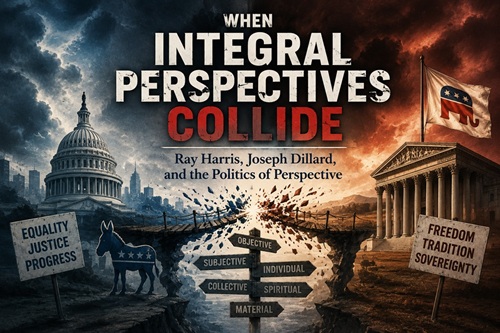
Check out my other conversations with ChatGPT When Integral Perspectives CollideRay Harris, Joseph Dillard, and the Politics of PerspectiveFrank Visser / ChatGPT
Integral theory is supposed to be particularly well equipped for a world of competing narratives. Its great promise is that no single perspective exhausts reality: interior and exterior, individual and collective, agency and structure, culture and systems all have to be taken into account. Yet the debates over Ukraine and Gaza on IntegralWorld reveal a striking paradox. Two authors can share a broadly integral vocabulary—and even appeal to the same virtues of complexity, multiperspectivalism and developmental awareness—while arriving at radically different geopolitical conclusions. Ray Harris and Joseph Dillard provide an unusually revealing case. On Ukraine, Harris has strongly rejected the realist interpretation associated with John Mearsheimer and has criticized Dillard for giving excessive weight to Russian grievances and Western responsibility. Dillard, by contrast, has repeatedly argued that Western integralists have fallen into groupthink by failing to take Russian security concerns, NATO expansion and the history of the conflict seriously. On Gaza, the polarity is similarly pronounced. Dillard has argued that integralists have failed morally by treating Israel and Palestinians as if their power and responsibility were equivalent. Harris has been much more critical of Hamas, Islamist ideology and what he sees as Western progressives' tendency to romanticize or excuse political violence. The important question, however, is not simply who is right. It is: How can two people using an ostensibly integral framework produce such different pictures of reality? The answer is that Integral Theory does not actually determine a geopolitical position. It supplies a vocabulary for constructing one. The decisive work happens earlier and deeper: in the selection of facts, causal models, moral priorities, historical analogies, conceptions of power, and judgments about which perspective deserves epistemic weight. The integral paradoxHarris's four-part Integral Geopolitics series is itself an attempt to answer this problem. He began the series precisely because he was surprised that some integralists were adopting Mearsheimer's argument that the West and NATO were substantially responsible for Russia's invasion of Ukraine. Harris considers offensive realism too reductionist and instead explores realist, liberal and constructivist approaches, arguing that more complex levels of analysis can integrate them. This is recognizably integral reasoning. Instead of asking which grand theory is simply true, Harris asks what each theory illuminates and what it leaves out. Yet the same method can generate Dillard's position. Dillard's Ukraine essays likewise insist on multiple perspectives. His explicit claim is that understanding the Russian perspective is not equivalent to endorsing it. He argues that integralists should be able to understand Russian security perceptions, NATO expansion, Ukrainian nationalism and Western policy simultaneously. Dillard even makes empathy itself a test of integral consciousness. He has argued that he has been criticized for siding with Russia and with Palestinians, while maintaining that he can understand Ukrainian and Israeli perspectives as well. His complaint is that many of his critics cannot reciprocate that exercise of empathy toward Russians and Palestinians. So we encounter an intriguing symmetry: both sides accuse the other of failing at integral perspective-taking. Harris says, in effect, "You have incorporated the Russian narrative so thoroughly that you have lost sight of Ukrainian agency and Russian responsibility." Dillard says, in effect, "You have incorporated the Western narrative so thoroughly that you have lost sight of Russian security concerns and Palestinian suffering." Both can therefore claim the mantle of multiperspectivalism. And both claims contain some truth. Perspective-taking is not perspective-equivalenceThis is where an important distinction gets lost. To understand a perspective is not necessarily to give it equal explanatory or moral weight. Integral thinking becomes confused when "including" a perspective is treated as equivalent to "accepting" its interpretation of reality. Harris is particularly concerned about this problem. In his critique of Dillard, he objects to what he sees as excessive sympathy for the Russian interpretation of Ukrainian history and politics. His discussion of Ukraine stresses Ukrainian agency: Ukrainians themselves overwhelmingly sought greater independence from Russia and closer integration with Europe. To reduce the Maidan to a Western-backed coup, Harris argues, risks treating Ukrainians as passive objects of great-power competition rather than political actors. Dillard makes almost the inverse accusation. He argues that Western discourse tends to treat Russia as the sole causal agent while relegating the larger geopolitical environment to background conditions. His recurring question is not whether Russia invaded Ukraine—it plainly did—but whether explaining the invasion requires taking seriously the security architecture that preceded it. The disagreement therefore concerns more than facts. It concerns causal hierarchy. One person asks: "What did Russia do?" The other asks: "What produced the conditions under which Russia did it?" Those are not mutually exclusive questions. But emphasizing one can dramatically alter the resulting narrative. The problem of the moral lensThe disagreement becomes even sharper in Gaza. Dillard's approach is strongly grounded in universalism and international law. In his Simplifying the Israel/Palestine Conflict, he argues that an integral approach should not retreat into developmental-level analysis or hide behind the claim that the conflict is simply "complicated." He insists that questions of power, international law, accountability and civilian suffering must remain central. His later essays make the same point even more forcefully. In his retrospective on Ukraine, Dillard explicitly connects Ukraine and Gaza as tests of whether integralists actually apply their moral principles universally. Harris's approach is different. He also invokes international law, and his essay Against Political Violence explicitly argues that war crimes should be investigated regardless of which side commits them. But he is particularly concerned about selective application of moral standards. He argues that Western audiences sometimes condemn Israeli or American violence while minimizing Hamas, Iranian or Russian responsibility. This produces another fascinating inversion. Dillard sees the danger as moral equivalence: treating actors with radically different power and responsibility as if they were morally interchangeable. Harris sees the danger as moral asymmetry: applying one standard to one's favored side and another to one's opponent. Both are legitimate dangers. And both can occur simultaneously. A powerful state can have greater responsibility for civilian suffering while its opponent can still commit atrocities that must be condemned. Conversely, condemning atrocities by the weaker party does not erase the structural asymmetry between the parties. The genuinely integral position would therefore have to tolerate uncomfortable conjunctions: • Russia can be responsible for an illegal invasion, while NATO policy can have contributed to the security dilemma. • Hamas can commit atrocities against Israeli civilians, while Palestinian civilians can simultaneously be subjected to catastrophic suffering. • Ukraine can possess genuine agency, while Western governments can still pursue policies that have geopolitical consequences for Ukraine. • Israel can have legitimate security concerns, while Israeli military conduct can still be subject to international law. This is much harder than choosing a side because it requires maintaining several causal and moral propositions at once. Why "integral" does not settle the disputeThere is a deeper lesson here. Integral Theory is sometimes presented as though moving to a higher developmental level naturally produces better political judgments. But the Harris-Dillard dispute demonstrates why that cannot be assumed. A person can possess sophisticated cognitive complexity and still organize that complexity around a preferred historical narrative. Indeed, greater cognitive complexity can sometimes make motivated reasoning more effective. The individual does not necessarily become less partisan; he becomes better at constructing an intellectually elaborate justification for his partisanship. This is one reason why both Harris and Dillard can produce lengthy, sophisticated arguments while remaining deeply unconvinced by one another. The disagreement is not simply between "complex" and "simplistic" thinkers. It is between different complexes of complexity. Harris tends to emphasize liberal-democratic agency, pluralism, secularism, resistance to authoritarianism, and the dangers of political violence. Dillard emphasizes reciprocity, power asymmetry, historical context, international law, imperial decline and the voices of groups he believes Western discourse systematically marginalizes. These are not random preferences. They are coherent moral-intellectual configurations. But they generate different salience structures. Each makes certain facts glow brightly and others recede into the background. The hidden role of political priorsThis may be the most important point. Integral analysis does not begin with a blank slate. Harris's suspicion of Russian authoritarianism is connected to a broader concern about regression into traditionalism and authoritarian political structures. His later writing on Russia, China and the Israel-Palestine conflict repeatedly emphasizes the dangers of political and religious reaction. Dillard's political sensibility, meanwhile, is strongly shaped by suspicion of Western exceptionalism and dominant narratives. His Ukraine writings repeatedly ask why Western integralists have accepted mainstream Western assumptions so readily, while his Gaza writings ask why those same integralists hesitate to apply international-law standards to Israel and its Western supporters. Thus the same integral injunction—"look at perspectives you normally ignore"—pushes them in opposite directions. For Harris, the neglected perspective may be the Ukrainian one when Western commentators focus excessively on Russian grievances. For Dillard, the neglected perspective may be the Russian one when Western commentators focus almost exclusively on Russian aggression. In Gaza, Harris emphasizes the neglected perspective of Israelis confronting Hamas and Islamist violence, whereas Dillard emphasizes Palestinians confronting Israeli military power and Western political support. The crucial variable is therefore not simply whether one includes excluded perspectives, but which perspectives one initially experiences as excluded. That is a much more subtle problem. The danger of becoming the "anti-mainstream" integralistThere is another psychological mechanism worth considering. Integralists often pride themselves on seeing what ordinary political discourse misses. This can be intellectually productive. But it creates a peculiar vulnerability: the identity of being the person who sees through the dominant narrative can itself become a source of bias. Once someone concludes that the mainstream media, governments and liberal institutions are systematically misleading the public, contrarian evidence acquires disproportionate weight. This is visible in Dillard's repeated emphasis on Western groupthink. His project is partly an epistemological intervention: wake up from the consensus and listen to voices that have been excluded. Harris is doing something similar, but from the opposite direction. He believes that some integralists have been seduced by contrarian geopolitical narratives that appear sophisticated because they challenge Western orthodoxy. His critique of Mearsheimer is therefore also a critique of the intellectual glamour of the contrarian position. The irony is delicious. The integralist who distrusts the mainstream can become predictable in his contrarianism; the integralist who distrusts contrarianism can become predictable in his defense of mainstream positions. Neither is automatically more integral. Their disagreement is therefore instructiveIt would be too easy to conclude that one author is "really integral" and the other is not. A more interesting conclusion is that their disagreement exposes a limitation in Integral Theory itself. AQAL and developmental models can help us map perspectives. They cannot by themselves tell us which historical claims are true. They do not establish whether NATO expansion was a decisive cause of the Ukraine war, whether Russia's invasion represented imperial revanchism, whether Israeli conduct in Gaza satisfies the legal definition of genocide, or what political arrangement could realistically produce peace. Those questions require history, international relations, military analysis, political science, law, demography, economics and empirical investigation. Integral Theory can help organize these disciplines. It cannot replace them. This is particularly important because both Harris and Dillard sometimes invoke "integral" as if it carries normative authority. But an integral map does not magically validate the territory being mapped. The ultimate test is empirical and moral: Are the facts correct? Are causal relationships adequately established? Are competing explanations seriously considered? Are standards applied consistently? Are civilians treated as human beings rather than instruments in an argument? A useful synthesisPerhaps Harris and Dillard are most valuable when read together. Harris reminds us that empathy can become indulgence, that historical grievance does not erase agency, that political violence cannot be excused by asymmetric power, and that authoritarian narratives deserve scrutiny. His warning against selective moral outrage is important. Dillard reminds us that condemnation of aggression does not constitute a complete causal explanation, that power asymmetries matter, that international law should apply universally, and that listening to marginalized perspectives is not optional for a genuinely multiperspectival worldview. Each therefore supplies something the other risks neglecting. The synthesis would not be a bland "both sides have a point" conclusion. That can itself become a form of evasion. Rather, it would require asymmetrical pluralism: take multiple perspectives seriously without assuming they are equally true, equally powerful, or equally responsible. That is considerably harder than conventional bothsidesism. It means being able to say that Russia's invasion was wrong without pretending the prehistory is irrelevant; that NATO policy can be criticized without converting criticism into justification for invasion; that Hamas's atrocities can be condemned without using them to suspend concern for Palestinian civilians; and that Israeli security concerns can be recognized without granting Israel immunity from international law. Such a position will inevitably disappoint people on both sides. That may be a sign that it is getting somewhere. The deeper lesson for Integral WorldThe Harris-Dillard confrontation is therefore more than an argument between two integral authors about foreign policy. It is an inadvertent experiment in the limits of integral consciousness. Both authors demonstrate that multiperspectivalism is not simply the ability to collect more perspectives. It is the ability to subject one's own preferred perspective to the same scrutiny one applies to everybody else's. That second step is much harder. The first-order integral move is: "Can I understand the Russian perspective?" The second-order move is: "Can I understand why I find the Russian perspective especially compelling?" Likewise: "Can I understand the Palestinian perspective?" must eventually become: "Why am I particularly sensitive to Palestinian suffering, and could that sensitivity cause me to minimize something else?" And the same questions must be asked in reverse. "Why do I instinctively trust liberal-democratic institutions?" "Why am I particularly suspicious of authoritarian regimes?" "Why does Israeli security resonate with me?" "Why does Western imperial power bother me more than Russian imperial power?" These are not merely political questions. They are questions about the observer. And that is precisely where integral thinking should become genuinely interesting. The real challenge is not to become a person who can see many perspectives. Harris and Dillard can both do that. The harder achievement is to become aware of the mechanisms by which some perspectives become salient, credible and morally urgent to us while others become peripheral, dubious or invisible. That is the difference between having a map of many perspectives and actually examining the mapmaker. In that sense, the Harris-Dillard dispute is not an embarrassment to Integral Theory. It is one of its most useful stress tests. It demonstrates both the power and the limitation of the integral project: we can learn to see more of the picture, but we do not thereby escape the human tendency to decide which parts of the picture matter most. And perhaps that is the most integral conclusion of all: perspective-taking does not eliminate bias. It gives us a better opportunity to discover where our bias has hidden itself.
Widget is loading comments...
|