|
TRANSLATE THIS ARTICLE
Integral World: Exploring Theories of Everything
An independent forum for a critical discussion of the integral philosophy of Ken Wilber
  Frank Visser, graduated as a psychologist of culture and religion, founded IntegralWorld in 1997. He worked as production manager for various publishing houses and as service manager for various internet companies and lives in Amsterdam. Books: Ken Wilber: Thought as Passion (SUNY, 2003), and The Corona Conspiracy: Combatting Disinformation about the Coronavirus (Kindle, 2020). Frank Visser, graduated as a psychologist of culture and religion, founded IntegralWorld in 1997. He worked as production manager for various publishing houses and as service manager for various internet companies and lives in Amsterdam. Books: Ken Wilber: Thought as Passion (SUNY, 2003), and The Corona Conspiracy: Combatting Disinformation about the Coronavirus (Kindle, 2020).
Check out my other conversations with ChatGPT
On Choosing Sides—Or Not: When Wars Become Black and White When Moral Certainty Becomes an Obstacle to Peace How to Think Clearly About Wars We Care About How to Think Clearly About Wars We Care AboutFrank Visser / ChatGPT
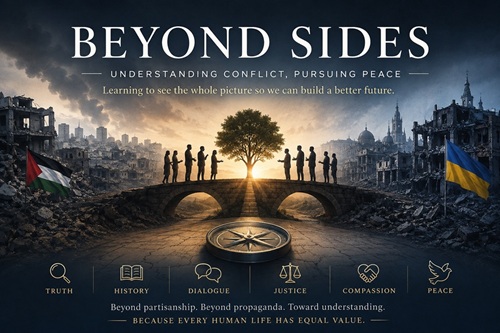
The preceding discussion leads to a practical question: if partisan thinking is so dangerous, how should an ordinary person actually evaluate a war? The answer is not to become an expert in everything. It is to develop a few intellectual habits that make manipulation more difficult. Start with facts, not narrativesEvery war arrives wrapped in narratives. One side says, "We are defending ourselves." The other says, "We are liberating ourselves." One side calls an attack terrorism. The other calls it resistance. One side calls a military operation self-defense. The other calls it aggression. These words may contain legitimate moral judgments, but they can also function as shortcuts that prevent further investigation. A useful first step is therefore to separate the basic empirical proposition from the interpretation attached to it. Did the attack occur? Who carried it out? When did it happen? How many people were killed? What evidence establishes responsibility? What happened immediately beforehand? What happened afterward? Only after establishing the factual foundation should we move toward interpretation and moral evaluation. This sounds obvious. In the information environment of modern warfare, it is surprisingly difficult. Separate three layers of disagreementMany political arguments become confused because people disagree at three different levels without realizing it. The first is factual disagreement: "This event happened" versus "This event did not happen." The second is causal disagreement: "This happened because of X" versus "This happened because of Y." The third is normative disagreement: "This action was justified" versus "This action was wrong." These are different arguments. Two people might completely agree about what happened but disagree about why it happened. Or they might agree about both facts and causes while disagreeing about whether the action was morally permissible. Recognizing the level of disagreement makes discussion much more productive. Beware of selective historyHistory is essential, but historical context can also become propaganda. A partisan will often select the beginning of the story that makes their side look innocent. For one person, the story begins with October 7, 2023. For another, it begins with the Nakba in 1948. For one person, the Russian-Ukrainian war begins with February 24, 2022. For another, it begins with NATO enlargement after the Cold War. Neither approach is sufficient by itself. The historian's task is to reconstruct the sequence rather than selecting a politically convenient starting point. That does not mean every event has equal importance. It means that causation usually operates through chains of events rather than a single original sin. Ask what would falsify your positionOne of the most powerful tests of intellectual honesty is surprisingly simple: "What evidence would make me change my mind?" If the answer is "nothing," you no longer have an empirical position. You have an identity. A scientific hypothesis must be vulnerable to evidence. Political beliefs are not scientific hypotheses in exactly the same sense, but they can still be held with greater or lesser intellectual discipline. If every piece of evidence against your position is automatically classified as propaganda, fabricated news, Western propaganda, Russian propaganda, Israeli propaganda, Palestinian propaganda or AI-generated misinformation, your worldview has become unfalsifiable. An unfalsifiable worldview can explain everything. That is precisely why it explains nothing. Apply the same standard to allies and enemiesPerhaps the simplest test of intellectual consistency is to reverse the flags. Suppose an enemy government attacks civilian infrastructure. What would you say? Now imagine your own government did exactly the same thing. Would your description remain unchanged? Suppose an enemy government claims that its military operation is defensive. Would you accept that explanation automatically? Now imagine your own government made the identical argument. Would you demand evidence? This mental experiment is extremely useful because it exposes double standards that remain invisible when we reason within our own political tribe. Moral principles only become principles when they survive the substitution of identities. Distinguish intention from consequenceAnother important distinction concerns intention. An action can have a legitimate objective and still produce unacceptable consequences. A government may genuinely intend to protect its population while conducting a military operation that causes excessive civilian suffering. Conversely, an actor may have deeply illegitimate political objectives while producing consequences that happen to be beneficial in some particular respect. Intentions matter, but they do not settle moral judgment. Neither do consequences alone. A serious assessment therefore considers intention, foreseeable consequences, proportionality, alternatives and the rules governing armed conflict. This is one reason international humanitarian law is so important. It provides standards that are intended to constrain warfare even when governments believe their cause is just. Do not confuse explanation with exonerationThis deserves repetition because it is one of the most common errors in polarized political discussion. Explaining why Hamas emerged does not justify the deliberate killing of civilians. Explaining Russian security concerns does not justify Russia's invasion of Ukraine. Explaining Israeli fears does not automatically justify Israeli military policies. Explaining Palestinian grievances does not make every act committed in the name of Palestinian liberation legitimate. The causal explanation and the moral evaluation can coexist. In fact, they need each other. Without explanation, condemnation becomes shallow. Without moral evaluation, explanation can become apologetics. Listen for dehumanizing languageLanguage is an early warning system. When people begin talking about entire populations as though they were a single organism, something has gone wrong. "The Russians are..." "The Israelis are..." "The Palestinians are..." "The Ukrainians are..." Such formulations erase internal diversity. Every population contains political disagreements, religious differences, generational differences, ideological differences and people who simply want to live normal lives. The same applies to political movements. Hamas is not synonymous with every Palestinian. The Israeli government is not synonymous with every Israeli. Putin is not synonymous with every Russian. Once these distinctions disappear, collective responsibility becomes psychologically easier to accept. That is dangerous territory. Resist atrocity arithmeticThere is another particularly destructive habit: comparing suffering as though it were a scoreboard. "More Israelis were killed." "More Palestinians were killed." "More Ukrainians were killed." "More Russians were killed." Numbers matter enormously for understanding the scale of human suffering. But moral worth cannot be calculated by comparing casualty totals. One innocent civilian death is not rendered morally irrelevant because another side suffered more deaths. Nor does a larger number automatically establish every element of legal or moral responsibility. Statistics describe suffering. They do not, by themselves, provide a complete moral theory. Understand propaganda without assuming everything is propagandaModern warfare is also information warfare. Governments deliberately communicate narratives. Armed groups produce propaganda. Intelligence agencies release selective information. Social media algorithms reward emotionally engaging material. False claims can spread rapidly, sometimes deliberately and sometimes through genuine confusion. But there is a danger on the other side. Once someone discovers propaganda, they may become convinced that everything is propaganda. That is another form of epistemic laziness. The existence of propaganda does not mean that truth is inaccessible. It means that evidence must be evaluated more carefully. A photograph can be genuine but misleadingly captioned. A government statement can contain both accurate information and strategic omissions. A journalist can make a mistake without being part of a conspiracy. Reality is usually messier than the propaganda-versus-truth binary suggests. Learn to say "I don't know"This may be the most underrated intellectual virtue in wartime. There are claims for which we simply do not yet possess sufficient evidence. Who ordered a particular strike? What exactly happened inside a particular building? How many casualties resulted from a particular operation? Was a particular target being used for military purposes? What were the precise motives of a political leader? Sometimes the honest answer is: we don't know. That is not weakness. It is epistemic discipline. The pressure to have an immediate opinion about every battlefield event is one of the peculiar features of social media. But uncertainty is not the same as ignorance. Sometimes withholding judgment until better evidence emerges is the most rational position available. Do not let compassion become tribalCompassion is one of the best antidotes to ideological thinking, but it too can become tribal. A person watches an Israeli child killed by Hamas and feels horror. Another watches a Palestinian child killed in Gaza and feels horror. Another sees Ukrainian civilians killed by Russian missiles. Another sees Russian soldiers dying on the battlefield. The mature response is not to decide which child deserves more compassion. Human suffering does not require political permission before it becomes tragic. This does not mean that all political claims are equally valid. It means that empathy should not be rationed according to nationality. Compassion for one population does not diminish compassion for another. The ultimate test: what kind of future does your position produce?Political arguments often concentrate on the past. Who started it? Who committed the first atrocity? Who has the stronger historical claim? These questions matter. But peace requires another question: "If my preferred policy succeeds, what happens next?" If Ukraine achieves its maximal military objective, what security arrangement follows? If Russia achieves its maximal objective, what happens to Ukrainian sovereignty? If Israel permanently eliminates Hamas militarily, what political order emerges in Gaza? If Palestinian statehood is achieved, how will Israeli security be guaranteed? If one side is completely humiliated, how will resentment be prevented from producing another conflict? A political position should be evaluated partly by its consequences. It is not enough to have a morally satisfying account of the past. We need a plausible account of the future. The discipline of complexityComplexity is sometimes treated as an excuse for indecision. It should be the opposite. To say that a conflict is complex does not mean that nothing can be known. It means that different truths may operate simultaneously. Russia can be the aggressor in Ukraine while Russian security concerns remain historically relevant. Hamas can commit atrocities while Palestinians retain legitimate national aspirations. Israel can have legitimate security needs while its government can still be held accountable for unlawful conduct. Ukraine can deserve support while particular Ukrainian policies can still be criticized. The ability to hold such propositions simultaneously is not relativism. It is cognitive maturity. A better political vocabularyPerhaps we should therefore replace some familiar questions. Instead of "Whose side are you on?" ask, "Which claims do you think are supported by the evidence?" Instead of "Who is good and who is evil?" ask, "Which actions are justified and which are not?" Instead of "Who started everything?" ask, "What causal sequence produced the present conflict?" Instead of "Why does the other side hate us?" ask, "What experiences and beliefs produce their behavior?" Instead of "How can we defeat them?" ask, "What political settlement could make renewed violence less attractive?" And instead of "How can I prove my side is right?" ask: "What would help these people live without killing one another?" That final question changes the entire intellectual landscape. Conclusion: Beyond the tribeWars inevitably produce partisans. Some partisanship is understandable. When people are attacked, threatened or subjected to atrocities, solidarity is a natural human response. But solidarity becomes dangerous when it turns into epistemic tribalism: the conviction that truth itself belongs to our side. The cure is not moral neutrality. It is disciplined impartiality. We should be capable of condemning aggression without denying context, defending victims without dehumanizing perpetrators, recognizing legitimate grievances without excusing atrocities, and supporting a political cause without surrendering our capacity for independent judgment. Above all, we should remember that conflicts are not abstractions. The people living inside them do not experience "geopolitics." They experience explosions, funerals, displacement, fear, hunger, grief and uncertainty. Most civilians did not design the ideology, strategy or historical circumstances that placed them in danger. A partisan sitting safely thousands of kilometers away can afford absolute certainty. The people living through the war cannot. For them, what matters is not whether we have constructed the most satisfying narrative. What matters is whether the killing stops. That is why the ultimate purpose of understanding war should not be to produce better partisans. It should be to produce better citizens, better journalists, better historians, better diplomats—and ultimately better chances for peace.
Widget is loading comments...
|