|
TRANSLATE THIS ARTICLE
Integral World: Exploring Theories of Everything
An independent forum for a critical discussion of the integral philosophy of Ken Wilber
  Frank Visser, graduated as a psychologist of culture and religion, founded IntegralWorld in 1997. He worked as production manager for various publishing houses and as service manager for various internet companies and lives in Amsterdam. Books: Ken Wilber: Thought as Passion (SUNY, 2003), and The Corona Conspiracy: Combatting Disinformation about the Coronavirus (Kindle, 2020). Frank Visser, graduated as a psychologist of culture and religion, founded IntegralWorld in 1997. He worked as production manager for various publishing houses and as service manager for various internet companies and lives in Amsterdam. Books: Ken Wilber: Thought as Passion (SUNY, 2003), and The Corona Conspiracy: Combatting Disinformation about the Coronavirus (Kindle, 2020).
Check out my other conversations with ChatGPT
On Choosing Sides—Or Not: When Wars Become Black and White When Moral Certainty Becomes an Obstacle to Peace How to Think Clearly About Wars We Care About When Moral Certainty Becomes an Obstacle to PeaceFrank Visser / ChatGPT
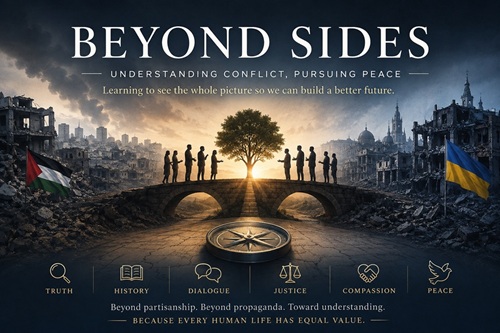
There is a paradox at the heart of political conflict. The stronger our moral convictions become, the easier it can be to lose sight of the practical conditions required to end the conflict itself. This is especially visible in discussions about Gaza and Ukraine. Many people do not merely support one side. They have incorporated the conflict into their moral identity. They know who the aggressor is, who the victim is, who is telling the truth and who is spreading propaganda. Once that worldview becomes part of one's identity, contrary information no longer appears as information. It appears as an attack. That psychological transformation matters because the mindset required to condemn a war is not necessarily the mindset required to end one. You can be right and still be unhelpful Imagine that someone has reached a largely correct moral conclusion about a conflict. Perhaps Russia bears overwhelming responsibility for launching the full-scale invasion of Ukraine. Perhaps Hamas's deliberate attacks on Israeli civilians were indefensible. Perhaps Israel's conduct in Gaza deserves severe criticism. None of these conclusions automatically tells us how the war can end. A courtroom and a negotiating table perform different functions. A court asks questions of responsibility, evidence and law. Negotiation asks what each party wants, what each party fears, what concessions are possible and what arrangements could make renewed violence less attractive. Confusing these functions is a common mistake. The statement "the other side is wrong" may be morally correct and strategically useless. The enemy's worldview is part of realityOne of the most difficult disciplines in conflict analysis is reconstructing the worldview of the other side without adopting it. This means asking questions such as: What does the Russian leadership believe about NATO, Ukraine and Russia's place in Europe? What does the Ukrainian leadership believe it must achieve for Ukraine to remain sovereign and secure? What do Israelis believe about the threat posed by Hamas and other armed groups? What do Palestinians believe about occupation, displacement, sovereignty and their future? The purpose is not to declare these beliefs true. It is to understand that people act on perceived reality, not on the reality we would prefer them to perceive. Research on conflict and negotiation repeatedly identifies failures of perspective-taking, confirmation bias and "fixed-pie" assumptions as obstacles to resolving disputes. People routinely assume that their own priorities are also their opponent's priorities, even when they are not. That is enormously important. If we misunderstand what motivates the other side, we may offer solutions to problems they do not consider their primary problems. Peace requires dealing with interests, not just positionsA position is what somebody says they want. An interest is why they want it. A government may demand territory because it believes territorial control is necessary for security. Another government may refuse to surrender that territory because doing so would make it vulnerable to future attack. A movement may demand sovereignty because it sees political independence as inseparable from dignity and survival. The positions appear irreconcilable. The underlying interests may not be. This is one of the central insights of negotiation theory: conflicts become less intractable when participants move from positional bargaining toward examination of underlying interests. Political argument itself can become more productive when participants approach disagreement with curiosity, intellectual humility and attention to shared interests rather than treating every dispute as a zero-sum contest. That does not mean that every conflict has a compromise available. Some demands really are incompatible. But discovering which demands are genuinely incompatible requires understanding them first. Dehumanization creates a self-reinforcing cycleThere is another reason partisan thinking is dangerous. Prolonged conflicts generate what researchers have described as a psychological repertoire of hatred, fear, distrust, dehumanization and desire for revenge. Once established, these attitudes can themselves help perpetuate the conflict. The mechanism is straightforward. We fear them because they hate us. They hate us because they attacked us. Therefore we must become stronger. Our military response causes suffering among them. That suffering confirms their belief that we hate them. Their resulting radicalization confirms our belief that they are inherently hostile. And the cycle continues. At some point the original causes become almost secondary. The conflict acquires its own psychological momentum. This is why peacebuilding is not merely about signing a document. It requires changing the social and psychological conditions that make renewed violence attractive or inevitable. Why "understanding" is so easily misunderstoodThere is a legitimate fear that understanding an enemy's perspective can slide into excusing it. But there are actually three distinct questions: "What happened?" "Why did it happen?" "Was it justified?" The first is empirical. The second is explanatory. The third is normative. They should not be collapsed into one. If we discover why someone committed an atrocity, we have not thereby justified the atrocity. If we discover why a state felt threatened, we have not thereby established that its response was legitimate. In fact, serious moral judgment requires causal understanding. Without it, we are not really judging an action; we are merely condemning it. The importance of inclusivenessPeace processes also fail when they assume that the loudest or most powerful representatives speak for everybody. A government does not necessarily represent every citizen. An armed movement does not necessarily represent every member of the population from which it emerged. Diasporas, minorities, women, young people, political opposition groups and civil society can possess interests that differ substantially from those of armed actors. This is why modern peacebuilding places considerable emphasis on inclusive processes. The United Nations identifies preparedness, consent, impartiality, inclusivity, national ownership and respect for international law among the fundamental principles of effective mediation. Research on conflict prevention similarly suggests that inclusion can help address underlying grievances and make peace processes more sustainable, although its effectiveness depends heavily on the particular conflict and the design of the political process. In other words, "peace between the leaders" is not necessarily the same thing as peace among the people. Justice and reconciliation are not oppositesThere is another false choice that partisan thinking creates: either justice or peace. In reality, durable peace often requires both. A ceasefire can stop people from killing one another. It does not necessarily resolve the grievances that produced the conflict. A political agreement can distribute territory or political power. It does not automatically heal trauma, establish accountability or rebuild trust. The difficult question is therefore not simply whether perpetrators should be punished. It is how accountability, security, reconciliation and political settlement can be combined without making peace impossible. This is an ethical problem, not merely a technical one. A peace imposed entirely through humiliation may contain the seeds of another war. Conversely, a peace that simply ignores serious crimes may leave victims with no confidence in the new order. The art of peacebuilding lies partly in navigating that tension. What impartiality actually meansImpartiality is often confused with indifference. It is not. An impartial observer can say that one action was worse than another. They can identify an aggressor. They can condemn terrorism, invasion, occupation, collective punishment or attacks on civilians. They can support one party's legitimate right to defend itself. What they cannot do consistently is apply one moral standard to their friends and another to their enemies. That is the real test. If killing civilians is wrong, it is wrong regardless of the flag above the aircraft. If territorial conquest is wrong, it is wrong regardless of whether the conqueror is an adversary or an ally. If international law matters, it cannot be invoked selectively. And if civilian suffering matters, it cannot become invisible when acknowledging it would complicate our political narrative. The higher form of solidarityThere is also a more humane alternative to partisan solidarity. Instead of saying, "I support the Ukrainians and therefore oppose everything Russian," one can say, "I support Ukrainian civilians and their right to determine their future, while also wanting to understand Russian security concerns and the historical dynamics that produced this war." Instead of saying, "I support Israel, therefore I defend whatever Israel does," one can say, "I support Israeli civilians' right to live in security, Palestinian civilians' right to live in freedom and dignity, and a political settlement that makes both possible." This form of solidarity is harder because it does not provide a simple enemy. But it is also more compatible with peace. The citizen's responsibilityMost of us will never sit at a negotiating table in Kyiv, Moscow, Jerusalem or Gaza. We cannot personally negotiate a ceasefire or redraw a border. But we do participate in the informational environment in which political decisions are made. That gives ordinary citizens a modest but real responsibility. We can refuse to circulate unverified claims simply because they favor our side. We can distinguish facts from interpretations. We can read sources we disagree with. We can ask what information would change our minds. We can acknowledge inconvenient facts without feeling that we have betrayed our political identity. Most importantly, we can resist the temptation to turn political opponents into moral monsters. This is not weakness. It is intellectual self-defense. From winning the argument to ending the warPerhaps the most important question is therefore not: "Which side has the better narrative?" It is: "What would have to become true for the killing to stop?" That question immediately changes the conversation. It forces us to think about security guarantees, territory, political representation, refugees, borders, disarmament, accountability, reconstruction, recognition and the fears of ordinary civilians. It forces us to think beyond the next battlefield victory. And it reminds us that the ultimate objective cannot be to construct the most convincing moral narrative about the war. It must be to create conditions under which another war becomes less likely. The United Nations' approach to mediation reflects precisely this practical orientation: effective mediation requires impartiality and inclusivity, but also consent, ownership, attention to international law and agreements capable of being implemented. The difficult middle groundThere is a misconception that the opposite of partisanship is sitting safely in the middle and saying that "everyone is equally guilty." That is not the goal. The real alternative is more demanding: proportional judgment. Some actors may bear much greater responsibility than others. Some actions may be vastly more reprehensible. Some historical claims may be strongly supported by evidence while others are demonstrably false. The task is not to flatten these differences. It is to preserve them without turning them into a totalizing worldview. A mature observer can therefore say: "This side is primarily responsible for this particular action." "This side has a legitimate grievance about that particular issue." "This claim is unsupported." "This atrocity is indefensible." "This historical circumstance helps explain the behavior." "This proposed solution is unlikely to work." And, finally: "I may be wrong." That last sentence is not a sign of moral weakness. It is the beginning of intellectual humility. The paradox of peaceThe deepest paradox is that peace often requires people to understand perspectives they find morally repugnant. The negotiator must understand the enemy. The historian must reconstruct the enemy's worldview. The journalist must investigate claims made by both sides. The citizen must resist propaganda from his own side. And the politician eventually has to talk to people whom he once promised never to recognize. None of this requires moral equivalence. It requires something more difficult: refusing to let moral judgment destroy our capacity for understanding. Wars are fought between human beings who have competing memories, fears, interests, identities and visions of the future. Treating one population as pure and the other as evil may make the conflict psychologically satisfying to watch from a distance. It does not make the conflict easier to resolve. The real intellectual challenge is therefore not to become neutral. It is to become less tribal while remaining morally awake. Because if our only objective is to prove that the other side is evil, we can remain satisfied indefinitely. If our objective is to end the war, we have to understand the people we disagree with. And that is where education, history, diplomacy and genuine empathy become more important than partisan certainty.
Widget is loading comments...
|