|
TRANSLATE THIS ARTICLE
Integral World: Exploring Theories of Everything
An independent forum for a critical discussion of the integral philosophy of Ken Wilber
  Frank Visser, graduated as a psychologist of culture and religion, founded IntegralWorld in 1997. He worked as production manager for various publishing houses and as service manager for various internet companies and lives in Amsterdam. Books: Ken Wilber: Thought as Passion (SUNY, 2003), and The Corona Conspiracy: Combatting Disinformation about the Coronavirus (Kindle, 2020). Frank Visser, graduated as a psychologist of culture and religion, founded IntegralWorld in 1997. He worked as production manager for various publishing houses and as service manager for various internet companies and lives in Amsterdam. Books: Ken Wilber: Thought as Passion (SUNY, 2003), and The Corona Conspiracy: Combatting Disinformation about the Coronavirus (Kindle, 2020).
Check out my other conversations with ChatGPT
On Choosing Sides—Or Not: When Wars Become Black and White When Moral Certainty Becomes an Obstacle to Peace How to Think Clearly About Wars We Care About When Wars Become Black and WhiteWhy Partisanship Cannot Resolve ConflictFrank Visser / ChatGPT
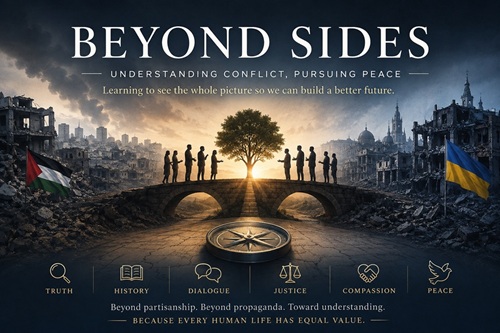
Wars have a peculiar effect on the human mind. They simplify reality. Faced with images of dead civilians, destroyed cities, displaced families and acts of extraordinary cruelty, it is natural to ask: Who is right? Who is wrong? Who started it? Who is the aggressor? Such questions are not illegitimate. Indeed, moral judgment is indispensable in wartime. But there is a dangerous step beyond moral judgment: turning a complex conflict into a worldview in which one side embodies absolute evil and the other absolute innocence. This partisan mindset is particularly visible in reactions to the wars in Gaza and Ukraine. To some observers, the moral picture appears completely black and white. Israel is seen as the aggressor in Gaza, while Hamas is reduced to a footnote; or Hamas is seen as the sole cause of the conflict, while the suffering of Palestinians becomes irrelevant. In Ukraine, Russia is seen as an unprovoked imperial aggressor, while others emphasize NATO expansion, Western policy and Russian security concerns. In the most extreme versions, acknowledging anything about the other side's history or motivations is treated as apologetics. There is an important distinction here: explaining is not excusing. Moral clarity and intellectual humilityA person can condemn Russia's invasion of Ukraine while still wanting to understand Russian security perceptions, NATO enlargement and the history of Russia-Ukraine relations. Likewise, one can condemn Hamas's attacks on Israeli civilians without believing that every Israeli military action is therefore justified. One can recognize Israel's right to protect its population while simultaneously questioning the proportionality, legality or strategic wisdom of particular military operations. These positions are not contradictions. They are what mature moral reasoning looks like. The alternative is tribal reasoning. Once someone identifies completely with one side, information is no longer evaluated according to its evidential quality. It is evaluated according to whether it helps or hurts "our" side. Civilian casualties caused by the enemy are evidence of barbarism; civilian casualties caused by one's own side are unfortunate accidents, unavoidable consequences or fabrications. Historical context is emphasized when it favors one's position and ignored when it complicates it. This is not rationality. It is motivated reasoning. The danger of symmetrical thinkingBut rejecting partisanship does not mean pretending that every conflict is morally symmetrical. There can be genuine aggressors and victims. States can invade other states. Armed organizations can deliberately target civilians. Governments can commit war crimes. Occupation, terrorism, ethnic cleansing, forced displacement and attacks on civilian infrastructure are not rendered morally equivalent merely because they occur in the same conflict. The phrase "both sides are to blame" can itself become a form of intellectual laziness. If an army invades another country, responsibility for initiating that invasion does not disappear because the invaded country has also committed mistakes. Similarly, the existence of serious crimes by Hamas does not automatically establish that every action undertaken by Israel is justified. The challenge is therefore to maintain two capacities simultaneously: moral discrimination and causal understanding. We must be capable of saying that an action is wrong while still asking why the people who committed it acted as they did. Causes are not justificationsThis distinction is crucial because human beings constantly confuse causes with justifications. If Russia's leadership believed NATO expansion threatened Russian security, that belief is relevant to explaining the invasion. It does not establish a legal or moral right to invade Ukraine. If Palestinians have experienced decades of occupation, displacement, blockade and political frustration, those circumstances are relevant to understanding the emergence and persistence of militant violence. They do not justify deliberately murdering civilians. If Israelis have experienced terrorism, antisemitism, persecution and the Holocaust, those historical realities help explain Israeli fears and political behavior. They do not automatically justify every policy pursued by the Israeli government. Understanding the causal chain does not require endorsing its outcome. Indeed, refusing to understand causes can make conflicts harder to resolve. If we reduce an enemy to irrational evil, we become incapable of understanding what would make that enemy change its behavior. We may achieve emotional satisfaction, but we lose strategic intelligence. Why partisan narratives are so attractivePartisan narratives provide psychological benefits. They offer identity, certainty and moral simplicity. The world becomes divided into "us" and "them." Our motives are defensive; theirs are aggressive. Our violence is reluctant; theirs is deliberate. Our historical grievances matter; theirs are propaganda. Our civilian casualties demonstrate our innocence; theirs demonstrate their barbarism. Social media intensifies this tendency because outrage travels faster than nuance. A complicated historical explanation does not compete easily with a shocking photograph, an emotionally charged slogan or a thirty-second video presenting one side's narrative as the whole truth. There is also a social cost to dissent. Once political communities become polarized, questioning one's own side can be interpreted as betrayal. A person who says, "Russia is responsible for the invasion, but Western policy also deserves examination," may be accused of being pro-Russian. Someone who says, "Hamas committed atrocities, but Palestinians also have legitimate political grievances," may be accused of supporting Hamas. This creates an intellectual environment in which the safest position is not necessarily the most accurate one. The missing distinction between people, governments and movementsAnother source of confusion is the tendency to treat populations as if they were identical to their governments or armed organizations. Russians are not the Russian government. Palestinians are not Hamas. Israelis are not the Israeli government. Ukrainians are not every decision made by Kyiv or its military leadership. This distinction matters morally as well as analytically. Civilian populations frequently have little control over the decisions that determine whether they live in peace or war. Once an entire population is identified with the political enemy, however, collective punishment becomes easier to rationalize. The language changes first: "they" become terrorists, fascists, Nazis, imperialists, colonizers or collaborators. Eventually individual human beings disappear behind political categories. That is one of the oldest psychological mechanisms of warfare. The uncomfortable truth about historyEvery serious conflict has a history, and histories rarely begin at the moment most convenient to one's political argument. The Israeli-Palestinian conflict did not begin on October 7, 2023. The Russian-Ukrainian conflict did not begin on February 24, 2022. Both statements are obvious, yet discussions frequently behave as though the chosen starting date determines the entire moral narrative. A historian therefore asks a different question: What sequence of events produced the present situation? That question inevitably introduces uncomfortable facts. It may reveal genuine aggression by one side, legitimate grievances by the other, missed diplomatic opportunities, ideological movements, security dilemmas, political mistakes, external interventions and decisions that appeared rational to their participants but produced disastrous consequences. History does not distribute innocence evenly. But neither does it distribute stupidity, evil or wisdom exclusively to one side. Conflict resolution requires seeing the other sideThere is an even more practical reason to resist partisan thinking: conflicts are not resolved by defeating an argument. They are resolved by changing the behavior of people who currently have incompatible interests. Negotiators therefore need to understand what the other side fears, wants and believes. They need to distinguish maximalist rhetoric from genuine objectives. They need to identify interests that can potentially be reconciled. This is impossible if the enemy is regarded as incomprehensible evil. Peace negotiations have repeatedly required governments to talk to people whom they had previously denounced. That does not mean forgetting atrocities or abandoning justice. It means recognizing that yesterday's enemy may have to become tomorrow's negotiating partner. Moral outrage may motivate resistance. It rarely provides a complete diplomatic strategy. The discipline of "both/and"A more sophisticated approach to war often requires replacing "either/or" thinking with "both/and." Russia can be responsible for launching an illegal war while NATO policy can still be criticized. Hamas can be responsible for deliberately attacking civilians while Palestinians can still possess legitimate national and political rights. Israel can have a legitimate security concern while Israeli policies can still be condemned. Western governments can support Ukraine's right to defend itself while making mistakes in their broader geopolitical strategy. These propositions do not cancel one another out. They operate at different levels of analysis. The key is to ask precise questions: Who did what? When? Why? What evidence supports the claim? What alternatives existed? What legal principles apply? What were the consequences? Who benefited? Who suffered? What does the opposing side actually believe? And, crucially, what would a realistic path toward ending the conflict look like? Such questions are much harder than choosing a team. The goal is not neutrality but truthThere is sometimes a fear that rejecting partisanship means becoming morally neutral. It does not. Neutrality says: "I refuse to judge." Intellectual impartiality says: "I will judge, but I will apply the same standards to everyone." That is a radically different position. The impartial observer does not have to assign fifty percent blame to one side and fifty percent to the other. Evidence may lead to a very unequal distribution of responsibility. What matters is that the standard of judgment remains consistent. If deliberately killing civilians is wrong when the enemy does it, it remains wrong when our allies do it. If territorial conquest is unacceptable in one case, we should explain why it is acceptable in another. If international law matters, it cannot become merely a weapon for condemning our adversaries. Consistency is the real test of moral seriousness. Beyond the comfort of the tribeThe deepest lesson of Gaza and Ukraine is therefore not that "both sides are equally guilty." That formulation is often as simplistic as the partisan narratives it tries to replace. The lesson is that complexity and moral clarity can coexist. We can condemn aggression without demonizing an entire population. We can recognize legitimate grievances without legitimizing atrocities. We can investigate historical causes without turning them into excuses. We can support victims without adopting every claim made by their political representatives. And we can criticize our own side without becoming the enemy's propagandist. This is difficult because it deprives us of the emotional comfort of the tribe. But wars are not solved by winning arguments on social media. They are solved when sufficient numbers of people on opposing sides eventually discover that their futures are interconnected. That requires something more demanding than choosing the right side. It requires learning to see the whole conflict.
Widget is loading comments...
|