|
TRANSLATE THIS ARTICLE
Integral World: Exploring Theories of Everything
An independent forum for a critical discussion of the integral philosophy of Ken Wilber
  Frank Visser, graduated as a psychologist of culture and religion, founded IntegralWorld in 1997. He worked as production manager for various publishing houses and as service manager for various internet companies and lives in Amsterdam. Books: Ken Wilber: Thought as Passion (SUNY, 2003), and The Corona Conspiracy: Combatting Disinformation about the Coronavirus (Kindle, 2020). Frank Visser, graduated as a psychologist of culture and religion, founded IntegralWorld in 1997. He worked as production manager for various publishing houses and as service manager for various internet companies and lives in Amsterdam. Books: Ken Wilber: Thought as Passion (SUNY, 2003), and The Corona Conspiracy: Combatting Disinformation about the Coronavirus (Kindle, 2020).
Check out my other conversations with ChatGPT
JUNG MEETS WILBER: Jung's Revenge: A Fourfold Obsession The Shadow of Integral Shadow Work Ken Wilber as a Jungian Case Study Ken Wilber as a Jungian Case StudyA Speculative Analysis of Wilber's Public Intellectual Persona Through Jung's Four FunctionsFrank Visser / ChatGPT
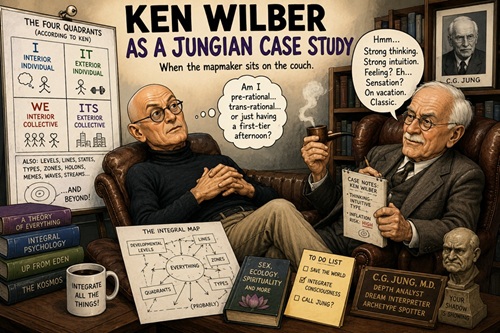
There is a delicious irony in applying Carl Jung's psychology to Ken Wilber. Wilber spent much of his career criticizing Jung for confusing psychological depth with spiritual transcendence, for insufficiently distinguishing pre-rational from trans-rational states, and for failing to integrate the developmental insights of modern psychology. Yet Wilber's own intellectual persona is unusually amenable to a Jungian reading. His enormous theoretical ambition, his fascination with totality, his insistence on integration, and even his recurring conflicts with critics can all be viewed through the lens of Jung's psychology. This is not an attempt to psychoanalyze Wilber from a distance. That would be presumptuous. Nor is it a claim about his private personality, which only he and those close to him could really know. What follows is a reading of Wilber's public intellectual persona: the figure who emerges from his books, interviews, polemics, diagrams, debates, and spiritual teachings. And if Jung were invited to conduct such an analysis, he might begin with a deceptively simple question: Which of the four functions dominates? Jung's famous typology distinguishes four fundamental psychological functions: thinking, feeling, sensation, and intuition. These are not four personality boxes but four modes through which consciousness relates to reality. Thinking seeks conceptual coherence. Feeling evaluates according to value. Sensation attends to concrete actuality. Intuition apprehends possibilities, patterns, and wholes. Everyone possesses all four, but they are not equally developed or equally conscious. One or two tend to dominate. The others may become auxiliary, inferior, or relatively unconscious. Seen from this perspective, Wilber's public persona looks remarkably like a thinking-intuitive type. And that combination explains a great deal. The Thinking Function: The Great ArchitectIf one function unmistakably dominates Wilber's intellectual persona, it is thinking. Wilber thinks in structures. He distinguishes. He categorizes. He differentiates. He compares. He ranks. He integrates. He builds conceptual architectures capable of accommodating enormous amounts of material. The hallmark of his thought is the conviction that confusion arises when distinctions that should be made are not made. The pre-rational is confused with the trans-rational. States are confused with stages. The individual is confused with the collective. The interior is confused with the exterior. Science is confused with scientism. Mysticism is confused with mythology. Reductionism is confused with legitimate methodological abstraction. This is thinking at full power: the determination to make distinctions in order to prevent category errors. Wilber's mind is therefore deeply architectural. He does not merely want to know that something is true. He wants to know where it belongs. This is why his theories continually generate taxonomies. The four quadrants. The eight zones. The developmental levels. The lines of development. The states of consciousness. The types. The stages. The holons. The waves. The streams. The integral map becomes increasingly elaborate because the thinking function is never satisfied with merely seeing the whole. It wants to know the relations among the parts. The result is one of Wilber's greatest strengths. He can see connections that specialists often miss because specialization encourages people to remain within disciplinary boundaries. Wilber's thinking function refuses those boundaries. Psychology must talk to sociology. Sociology must talk to biology. Biology must talk to spirituality. Spirituality must talk to neuroscience. The architect wants every room connected. But Jung would have recognized the danger as well. The thinking function can become imperial. It may begin by organizing experience and end by believing that everything important must be organized. The map becomes so impressive that one risks forgetting the territory. The Thinking Function's ShadowEvery dominant function has a shadow. For a strongly thinking-oriented personality, the shadow may include precisely those aspects of experience that cannot easily be controlled by conceptual distinctions. Ambiguity. Emotion. Embodiment. Contradiction. Mystery. Uncertainty. The irrational. The merely personal. The stubbornly concrete. None of these is absent from Wilber's work. Indeed, he has written extensively about emotion, body, relationships, shadow, and states of consciousness. But they tend to be incorporated into a conceptual framework. This is the key difference. Wilber does not usually leave ambiguity alone. He explains it. He does not merely encounter paradox. He classifies the kinds of paradox. He does not simply acknowledge mystery. He asks what quadrant the mystery belongs to. This is not a criticism in itself. It is a psychological observation about style. The thinking function's characteristic temptation is to believe that if something has been correctly conceptualized, it has thereby been adequately understood. But the unconscious is not obliged to respect our conceptual clarity. Jung's great contribution was precisely to insist that the psyche contains autonomous processes that cannot simply be mastered by conscious intelligence. The unconscious does not sit patiently waiting for the right diagram. It dreams. It produces symptoms. It generates symbols. It contradicts itself. It surprises us. It makes a mockery of our categories. And this is perhaps where Wilber's thinking function encounters its greatest Jungian challenge. What happens when the thing you are trying to integrate refuses to be integrated on your terms? The Intuitive Function: The Visionary Behind the SystemIf thinking is the architect of Wilber's system, intuition is its source of inspiration. Without intuition, there would be no Integral Theory. Thinking alone does not produce a vision of the entire Kosmos as a single developmental process. Thinking organizes. Intuition leaps. Wilber's intellectual project is fundamentally intuitive in the Jungian sense because it begins with a perception of patterns across apparently unrelated domains. He sees a common structure. He senses a developmental sequence. He notices recurring forms. He perceives an underlying unity. Then the thinking function arrives and begins building. This gives Wilber's work its distinctive combination of visionary scope and conceptual precision. He does not merely want to understand psychology. He wants to understand psychology as part of a larger evolutionary story. He does not merely want to understand spirituality. He wants to locate spirituality within the total development of consciousness. He does not merely want to reconcile science and religion. He wants to build a framework in which their legitimate domains can coexist without reducing one to the other. This is intuition operating on a gigantic scale. The intuitive function is always asking: What is the larger pattern? Where is this going? What is emerging? What does this remind me of? What larger whole does this belong to? Wilber's enormous intellectual ambition can therefore be understood as the collaboration of two functions: Intuition sees the Kosmos. Thinking draws the map. That may be the secret of his influence. And perhaps also the source of some of his problems. When Intuition Becomes Evolutionary CertaintyThe intuitive function has a characteristic weakness. It can perceive possibilities so vividly that they begin to feel like inevitabilities. Wilber's evolutionary vision sometimes displays precisely this tendency. Consciousness is developing. Humanity is evolving. New stages are emerging. Second-tier consciousness is becoming possible. Integral culture is on the horizon. The Kosmos is moving toward greater complexity, depth, and integration. These ideas can be enormously inspiring. But intuition is not the same thing as evidence. A pattern perceived by intuition may be profound. It may also be mistaken. This is where the thinking function is supposed to provide discipline. Yet in Wilber's case, the two dominant functions reinforce each other. Intuition proposes the grand evolutionary pattern. Thinking constructs the conceptual apparatus that explains it. The result can become remarkably persuasive. But there is a danger of closed-loop confirmation. The theory predicts development. The theorist sees evidence of development. The evidence is interpreted through the theory. The theory is therefore confirmed. This does not make the theory false. But it does create a potential epistemological blind spot. Jung might have asked whether the intuition itself should sometimes be subjected to the same critical scrutiny as the concepts built upon it. The great visionary must occasionally ask: What if the pattern I see is partly a projection of my own mind? That question is difficult precisely because intuition often feels like discovery rather than construction. The Feeling Function: The Missing Counterweight?The most provocative part of a Jungian reading concerns the feeling function. Here we must be especially careful. In Jung's terminology, feeling does not simply mean having emotions. The feeling function is a mode of evaluating experience according to value: good or bad, meaningful or meaningless, worthwhile or destructive. It is a function of valuation. Wilber certainly has strong values. He cares deeply about human development, spiritual realization, compassion, freedom, authenticity, and the possibility of a more integrated culture. His work is not emotionally empty. Indeed, it is animated by a powerful moral and spiritual vision. But in his public intellectual persona, feeling often appears to operate through the architecture of thought rather than alongside it. Values become developmental principles. Moral concerns become lines of development. Spiritual aspiration becomes stages of consciousness. Cultural conflict becomes a clash between memes. The feeling function is translated into the language of the system. This may be one reason why Wilber's polemical writing can sometimes seem surprisingly harsh for someone whose ultimate vision is profoundly compassionate. The conceptual opponent can become a category. The category can become a developmental level. The developmental level can become an explanation of the opponent's psychology. And once the opponent has been placed within the architecture, the emotional reality of the disagreement can disappear behind the theory. This is precisely where a Jungian might ask: What happens when the feeling function is insufficiently differentiated from the thinking function? The answer may be a peculiar phenomenon: one can have extremely strong values while becoming insensitive to the emotional experience of those who disagree. The person believes deeply in compassion. But the critic experiences contempt. The person believes in inclusion. But the dissenter experiences exclusion. The person believes in integration. But the opponent experiences being psychologically classified. This is not necessarily hypocrisy. It may be a psychological imbalance. The value is real. The feeling function is simply not fully in dialogue with the thinking function. The Sensation Function: The Problem of the ConcreteIf intuition looks upward and outward toward patterns and possibilities, sensation brings us back down to earth. What is actually happening? What does the body experience? What are the concrete facts? What happened yesterday? What is happening now? What can be observed without interpretation? Wilber has often been criticized for operating at a high level of abstraction. This criticism may be related to the relative absence of sensation in his public intellectual persona. Again, this does not mean that Wilber lacks bodily awareness or sensory experience in his private life. It means that his theoretical style tends to privilege patterns over particulars. The individual case becomes an example of a larger structure. The personal conflict becomes an instance of a developmental dynamic. The historical event becomes evidence of an evolutionary pattern. The concrete is rapidly translated into the abstract. This is the great strength of the intuitive thinker. It is also the great danger. Because reality has a stubborn way of refusing to behave like the pattern. Individuals do not always conform to developmental stages. Cultures do not always move upward. History does not necessarily evolve. People regress. Institutions decay. Spiritual teachers behave badly. Intelligent people believe foolish things. And sometimes the concrete event simply refuses to fit the grand theory. The sensation function would keep asking: Yes, but what actually happened? That may be precisely the question that every grand theorist needs to hear. The Inferior Function and the Return of the RepressedJung believed that the least developed function can become the inferior function. This does not mean it is simply absent. Quite the opposite. It often lives in the unconscious and can emerge in exaggerated, primitive, or unpredictable forms. This offers a fascinating way of thinking about Wilber's public conflicts. If thinking and intuition dominate, and sensation and feeling occupy less conscious territory, then situations that demand emotional restraint or attention to concrete interpersonal realities may become psychologically charged. The person who is brilliant at conceptual integration may struggle with a situation that cannot be solved conceptually. The person who sees the developmental pattern may become impatient with the person standing in front of him. The person who understands projection may become blind to the emotional impact of his own behavior. The person who knows the map may have difficulty when the territory pushes back. This is not a diagnosis. It is a Jungian hypothesis about the psychological risks of intellectual dominance. And it might explain why episodes of interpersonal conflict can become disproportionately revealing. The unconscious function does not emerge in the comfortable lecture. It emerges under stress. Wyatt Earp and the Return of the Inferior FunctionThis brings us back to the 2006 Wyatt Earp episode. The transformation is almost archetypal. The philosopher becomes the gunslinger. The system-builder becomes the sheriff. The theorist becomes the combatant. The language of integration gives way to the rhetoric of the frontier. From a Jungian perspective, one might interpret this as the emergence of a shadow persona. The qualities that are difficult to reconcile with the conscious self-image appear in symbolic form. The man of consciousness becomes Wyatt Earp. This does not prove that Wilber secretly wanted to be a cowboy. It suggests something more interesting. Under pressure, the psyche may express itself through an archetypal form that compensates for the dominant persona. The highly cerebral thinker suddenly becomes embodied in a mythic figure of action and force. The result can be entertaining. It can also be psychologically revealing. And here the Jungian question becomes unavoidable: Was Wyatt Earp merely a rhetorical costume—or did the costume reveal something the ordinary persona was reluctant to acknowledge? Perhaps both. The Four Functions and the Four QuadrantsWe can now return to the curious relationship between Jung's four functions and Wilber's four quadrants. They are not the same. Jung's functions describe modes of consciousness. Wilber's quadrants describe perspectives on reality. But psychologically, the analogy remains suggestive. Wilber's intellectual persona seems to have a strong affinity with the interior-individual and interior-collective dimensions: consciousness, meaning, culture, values, and development. His theoretical framework then insists that these must be balanced by the exterior dimensions: behavior, biology, systems, and social structures. The architecture is designed to compensate for one-sidedness. And yet, the same question can be asked of the man who created the architecture: Does the theorist himself embody the balance he prescribes?This is perhaps the ultimate Jungian test. A theory can be more balanced than its creator. A map can contain dimensions that the mapmaker personally finds difficult. One can advocate integral consciousness without possessing an equally integrated personality. One can understand the importance of shadow without having fully integrated one's own. One can explain the four quadrants without living comfortably in all four. This is not a uniquely Wilberian problem. It is a universal human problem. But it becomes particularly visible when one's public identity is built around the promise of integration. The Hero Archetype and the Danger of InflationThere is one final Jungian pattern worth considering: the Hero. Wilber's intellectual biography has the structure of a heroic quest. The academic disciplines are fragmented. Science and spirituality are divided. Psychology is divided. Religion is divided. The Hero sees the fragmentation and undertakes the great task of integration. He returns with the map. The map promises to reconcile the opposites. This is a genuinely heroic intellectual project. But Jung would have warned about archetypal inflation. The Hero can begin to identify with the heroic mission. The person no longer merely serves the vision. The person becomes the embodiment of the vision. Criticism then becomes psychologically threatening because it challenges not merely an argument but an archetypal identity. If I am the integrator, what does it mean when someone says I am excluding? If I am the theorist of development, what does it mean when someone says I am psychologically immature? If I am the teacher of shadow work, what does it mean when someone points to my shadow? The greater the identification with the archetype, the greater the danger. The Hero's greatest enemy may therefore be the realization that he is not the Hero. He is simply a person who sometimes does heroic things. And sometimes foolish things. And sometimes insightful things. And sometimes embarrassing things. That is psychologically healthier. It is also much less mythological. The Wilberian PuzzleA Jungian analysis of Wilber's public persona therefore produces a fascinating picture. We see a dominant thinking function that seeks clarity, structure, hierarchy, and integration. We see a powerful intuitive function that perceives vast patterns and evolutionary possibilities. We see a feeling function expressed strongly in values and spiritual aspirations but often translated into conceptual and developmental language. And we see a sensation function that appears less prominent in the public intellectual style, leaving open the perennial question of whether the concrete, embodied, and particular can resist absorption into the grand pattern. This combination produces both Wilber's genius and his vulnerabilities. The thinking function gives him architecture. The intuitive function gives him vision. The feeling function gives the architecture a moral and spiritual purpose. The sensation function, when sufficiently present, keeps the entire structure connected to reality. But when any two functions dominate too strongly, the others may return through the shadow. The intuitive thinker may become overconfident in patterns. The conceptual architect may mistake coherence for truth. The spiritual visionary may become impatient with the ordinary. The teacher of shadow may become blind to his own. And the theorist of integration may discover that the most difficult thing to integrate is not another theory. It is himself. The Jungian VerdictWould Jung have liked Ken Wilber? Probably not always. Would he have found him fascinating? Almost certainly. Jung would have recognized the extraordinary ambition of a thinker attempting to create a comprehensive map of consciousness. He might have admired Wilber's insistence that no single perspective exhausts reality. But he would probably have issued a warning. Do not confuse the map with the psyche. Do not confuse developmental altitude with psychological wholeness. Do not confuse the ability to identify another person's shadow with the ability to integrate your own. Do not confuse the intuition of a grand pattern with proof that the pattern exists. And above all, do not imagine that the unconscious has been integrated simply because it has been given a place in the theory. The ultimate Jungian irony is therefore that Wilber's most important contribution to Jungian psychology may be inadvertent. By building an elaborate theory of integration, Wilber demonstrates how difficult integration really is. The system can integrate four quadrants. The mind can integrate dozens of developmental lines. The theorist can integrate science and spirituality. But the individual human being remains stubbornly unfinished. The shadow remains. The inferior function remains. The unconscious remains. And somewhere, perhaps, Carl Jung is smiling at the spectacle of the great system-builder confronting the one territory that cannot finally be mapped: the mapmaker himself. Because in the end, Jung's most subversive lesson was not that we should understand the psyche. It was that we should never become too certain that we have understood it. And that is perhaps the one lesson that Ken Wilber's public intellectual persona—thinking, intuitive, visionary, architectonic, occasionally combative, endlessly integrative—still has the opportunity to teach us. Not by explaining it. But by embodying the difficulty of it. Appendix: When the Map Is Wiser Than the MapmakerOne of the most interesting paradoxes in intellectual history is that a person can formulate a theory that is wiser, broader, and more balanced than the person who formulated it. This sounds strange at first. We tend to assume that a great theory is an expression of the person who created it, and therefore that the theory's virtues must reflect the creator's virtues. If someone develops a theory of compassion, we expect them to be compassionate. If someone writes about humility, we expect them to be humble. If someone constructs a theory of psychological integration, we naturally assume that the theorist must be an integrated person. But this inference does not follow. A person can understand something intellectually without fully embodying it psychologically. Indeed, this may be one of the most common features of human beings. We can know what we ought to do and fail to do it. We can understand a psychological mechanism and remain subject to it. We can recognize our own biases and continue to have them. We can formulate a sophisticated theory of cognitive distortion while being spectacularly distorted in our own judgments. The theory may therefore contain a wisdom that exceeds the wisdom of its author. And this is particularly relevant to Ken Wilber. The Four Quadrants as a better person than Wilber?Consider Wilber's four-quadrant model. At its most basic, the model tells us something very sensible: reality is complex, and no single perspective is sufficient. We need to consider subjective experience, objective behavior, shared culture, and social systems. The interior and exterior matter. The individual and collective matter. This is, in principle, an excellent antidote to reductionism. It tells the materialist that subjective experience cannot simply be dismissed. It tells the mystic that biology cannot simply be ignored. It tells the psychologist that culture matters. It tells the sociologist that individual consciousness matters. It tells the spiritual seeker that social structures cannot be wished away. The model itself therefore embodies a kind of intellectual pluralism. But the person using the model may not always display the same pluralism. Here lies the paradox. The theory says: Don't reduce one perspective to another. But the theorist may reduce critics to their psychological motivations. The theory says: Take multiple perspectives seriously. But the theorist may dismiss an opposing perspective as "first-tier," "Green," or "shadow-driven." The theory says: No single quadrant is sufficient. But the theorist may sometimes explain an intellectual disagreement primarily through the critic's interior psychology. The map says, in effect: "Look at everything." The mapmaker may occasionally say: "Look at what is wrong with the person who disagrees with me." The theory is therefore potentially more balanced than its creator. And that is not a trivial observation. It is a profound one. The theory can correct its own creatorThere is an even more interesting possibility. A good theory may contain principles that can be used to criticize the behavior of the person who invented it. This means that the theory has acquired a degree of independence from its author. Wilber's integral framework can be used to critique Wilber. That is one of the best things that can happen to a theory. Suppose Wilber makes a claim about a critic's psychological motivations. The Upper Left quadrant might indeed be relevant: perhaps the critic has unresolved emotional material. But the other quadrants immediately complicate the picture. The Upper Right asks: What observable behavior actually occurred? The Lower Left asks: What cultural norms and group dynamics are involved? The Lower Right asks: What institutional structures and power relations are operating? Suddenly, "the critic is projecting" is revealed as an incomplete explanation. The critic may be projecting and making a valid argument. The critic may have personal resentment and be responding to a real institutional problem. The critic may be psychologically immature and accurately identifying an intellectual weakness. The theory, properly applied, prevents the theorist from reducing the critic to a single psychological explanation. In this sense, Integral Theory can be more integral than its own application by Wilber. The framework contains a corrective to the framework's occasional misuse. The mapmaker's blind spotThis is a general problem with all systems of thought. The creator of a map is usually particularly good at seeing the territory that the map was designed to illuminate. But the very act of mapping creates a blind spot. The cartographer becomes accustomed to looking at reality through the map. Everything starts to resemble the map. The four quadrants appear everywhere. The developmental levels explain everything. The memes explain everything. The lines explain everything. And eventually the danger arises that the map begins to dictate what counts as reality. Jung would have appreciated the irony. The conscious mind creates a model to understand the unconscious. Then the conscious mind forgets that it created the model. The model becomes autonomous. The map begins to behave like an archetype. It takes possession of the mapmaker. This may be what happens to all comprehensive theories. The person who invented the system eventually has to live inside it. And that can be dangerous. The system can see what the ego cannotHere we come close to a genuinely Jungian insight. The psyche is larger than the ego. A person may consciously identify with one part of themselves while unconsciously embodying another. The same may be true of intellectual systems. A theory can contain elements that contradict the conscious intentions of its creator. Marxism contains critiques of authoritarianism that Marxists sometimes ignore. Liberalism contains principles of tolerance that liberals sometimes violate. Christianity contains teachings about humility that Christians sometimes forget. Buddhism contains teachings about attachment that Buddhists can become attached to. And Integral Theory contains a critique of one-sidedness that Integralists can apply one-sidedly. The theory may therefore become a kind of unconscious corrective to its own creator. It says, in effect: "You have forgotten something that I myself contain." This is why the most interesting question is not whether Wilber personally embodies every principle of Integral Theory. He obviously does not—and neither does anyone else. The more interesting question is: Can Integral Theory be used to correct Wilber? If the answer is yes, then the theory has achieved something important. It has become larger than its founder. The creator is not the final authorityThis is one of the healthiest principles in intellectual life. Once an idea enters the world, its creator no longer has complete authority over it. Readers reinterpret it. Critics challenge it. Later thinkers improve it. Sometimes they discover implications that the original author never intended. Sometimes they find contradictions the author never noticed. Sometimes they use the theory against its creator. This is not betrayal. It is intellectual maturation. A theory that cannot survive being used against its founder is not a theory. It is a doctrine. And a doctrine has a different function. The doctrine protects the founder. The theory invites correction. Wilber's own integral principles should therefore be applied to Wilber himself. If he argues for multiple perspectives, we should examine his own perspective from the outside. If he argues for developmental humility, we should ask whether his developmental claims are themselves sufficiently humble. If he argues for shadow work, we should ask whether he applies it symmetrically. If he argues for integration, we should ask what his system leaves out. If he argues that no single perspective is complete, we should take that claim seriously enough to include perspectives that challenge Integral Theory itself. Otherwise, the theory becomes the one exception to its own rule. And that is the classic sign of a closed system. The irony of the Integral EmperorThis creates a particularly amusing paradox. Wilber's theory tells us: Everyone is partial. Except, perhaps, the person who explains partiality. Everyone is trapped in a perspective. Except the person who has mapped the perspectives. Everyone has a shadow. Except the person who identifies shadows. Everyone is situated at a developmental level. Except the person who ranks the levels. Everyone is subject to cognitive biases. Except the person who explains the biases. This is obviously an exaggeration, but it captures the psychological danger of becoming identified with a comprehensive theory. The theorist gradually occupies the position of the meta-observer. Everyone else is inside the map. The theorist stands outside it. But there is no such position. The mapmaker is also on the map. The observer is also an object of observation. The analyst also has a psyche. The theorist also has a shadow. The creator of the developmental model is also developing. And this is where the phrase becomes most important: A theory can be more balanced than its creator because the creator is also one of the phenomena the theory is supposed to explain. The ultimate test of Integral TheoryPerhaps the best test of Integral Theory is therefore not whether it can explain Wilber's critics. It is whether it can explain Wilber. Can it account for his extraordinary intellectual strengths? His visionary intuition? His conceptual brilliance? His ability to integrate disparate traditions? Can it also account for his defensiveness? His polemical tendencies? His occasional reduction of critics to developmental categories? His use of shadow language? His moments of apparent psychological contradiction? Can it accommodate the possibility that the person who created the map does not always live up to it? If the answer is yes, then Integral Theory remains genuinely useful. If the answer is no—if every criticism must be explained away as lower-level consciousness, projection, envy, or shadow—then the theory has ceased to be a framework for understanding reality. It has become a self-protective worldview. The strange freedom of letting the theory outgrow its creatorThere is, finally, something liberating about recognizing that a theory can exceed its creator. It means we do not have to choose between hero worship and total rejection. We do not have to say: "Wilber is a great theorist, therefore everything he says is correct." Nor do we have to say: "Wilber has personal flaws, therefore Integral Theory is worthless." Both are forms of psychological reductionism. A better position is more uncomfortable and more mature. Wilber can be wrong while Integral Theory is useful. Wilber can be psychologically defensive while his theory contains valuable psychological insights. Wilber can misuse shadow work while 3-2-1 remains a potentially helpful exercise. Wilber can be overly certain while his framework teaches the importance of multiple perspectives. The theory can therefore become an independent intellectual resource—even a resource for criticizing its creator. That may be the highest compliment one can pay a thinker. The mapmaker's final lessonThe deepest irony is that Wilber's own theory points toward this conclusion. If reality is larger than any one perspective, then Wilber's perspective must also be partial. If all maps are incomplete, then the Integral map is incomplete. If every thinker is situated, then the Integral thinker is situated. If every ego has a shadow, then the Integral ego has a shadow. If every developmental stage has limitations, then the theorist's stage has limitations. And if no one can stand outside the Kosmos and see the whole thing from nowhere, then neither can the person who drew the most elaborate map of it. Perhaps, then, the most genuinely integral attitude toward Wilber is neither reverence nor dismissal. It is to take the theory seriously enough to apply it to its creator. To say: "Your map is useful. Now let's put you on it." That may be the ultimate test of a comprehensive theory. Not whether it can explain everyone else. But whether it is humble enough to explain the person who made it. And perhaps this is where the map really does become wiser than the mapmaker. Because the map says: "There are many perspectives." The mapmaker sometimes says: "Here is the correct one." The map says: "Reality is larger than any single quadrant." The mapmaker sometimes says: "Your disagreement is your shadow." The map says: "We must integrate the opposites." The mapmaker sometimes becomes Wyatt Earp. At that point, the theory has something important to teach its creator. And the creator's greatest achievement may be precisely this: He built a map that can find the blind spots of the man who drew it. That is when a theory becomes genuinely larger than its author. And that, perhaps, is when the mapmaker finally becomes part of the territory. Widget is loading comments...
|