|
TRANSLATE THIS ARTICLE
Integral World: Exploring Theories of Everything
An independent forum for a critical discussion of the integral philosophy of Ken Wilber
  Frank Visser, graduated as a psychologist of culture and religion, founded IntegralWorld in 1997. He worked as production manager for various publishing houses and as service manager for various internet companies and lives in Amsterdam. Books: Ken Wilber: Thought as Passion (SUNY, 2003), and The Corona Conspiracy: Combatting Disinformation about the Coronavirus (Kindle, 2020). Frank Visser, graduated as a psychologist of culture and religion, founded IntegralWorld in 1997. He worked as production manager for various publishing houses and as service manager for various internet companies and lives in Amsterdam. Books: Ken Wilber: Thought as Passion (SUNY, 2003), and The Corona Conspiracy: Combatting Disinformation about the Coronavirus (Kindle, 2020).
Check out my other conversations with ChatGPT
JUNG MEETS WILBER: Jung's Revenge: A Fourfold Obsession The Shadow of Integral Shadow Work Ken Wilber as a Jungian Case Study The Shadow of Integral Shadow WorkWhat the Wyatt Earp episode of 2006 reveals about the psychological misuse of JungFrank Visser / ChatGPT
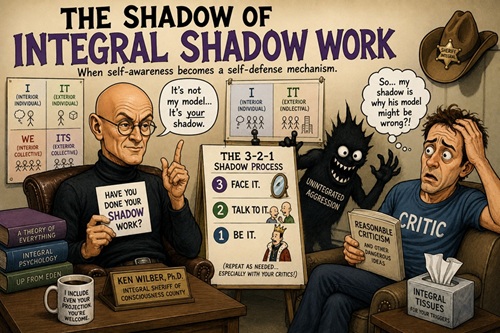
There is a peculiar irony at the heart of Ken Wilber's relationship with Jungian psychology. Wilber has spent much of his career warning us about the dangers of confusing psychological depth with spiritual transcendence. He has insisted, rightly, that spiritual realization does not automatically confer psychological maturity, emotional integration, or ethical wisdom. He has also made the distinction between the pre-rational and the trans-rational central to his critique of certain forms of depth psychology. And yet, when his own critics became troublesome, Wilber sometimes reached for one of the most psychologically potent—and rhetorically dangerous—tools in the Jungian toolbox: the shadow. The implication was clear enough. If you are disturbed by Ken Wilber, perhaps the problem is not Ken Wilber. Perhaps you are projecting your own shadow onto him. This possibility can never be ruled out. But the moment it becomes the default explanation for criticism, something has gone badly wrong. The shadow has ceased to be an instrument of self-examination and become a weapon of self-defense. The 2006 Wyatt Earp episode provides an almost perfect case study. What began as an angry response by Wilber to his critics developed into something much more revealing: a psychological drama in which the person who had been criticized became the analyst, the critics became the patients, and the theory itself became the consulting room. The central question is therefore not simply what happened in 2006. It is: What happens when a spiritual teacher discovers that the language of shadow work can be used to explain away the shadow that has suddenly become visible in himself? The Wyatt Earp persona: the shadow comes riding into townIn June 2006, Wilber responded to criticism in a series of blog posts written in a deliberately Wild West style, beginning with What We Are, That We See: Response to Some Recent Criticism in a Wild West Fashion. The very choice of persona was psychologically revealing. Wilber did not merely answer as Ken Wilber, philosopher and theorist. He summoned Wyatt Earp, the legendary frontier lawman. The symbolism is hard to miss. The frontier is lawless. The town is overrun by outlaws. The sheriff arrives. There will be a reckoning. The critics are not interlocutors in an intellectual debate. They are enemies to be confronted, humiliated, and driven from town. This was not the language of the patient cartographer of consciousness. It was the language of the gunslinger. And from a Jungian perspective, that is precisely where things become interesting. For Jung, a persona is the social mask we present to the world. It is necessary, even indispensable. But when the persona becomes too strongly identified with the ego, whatever it excludes tends to accumulate in the shadow. The spiritual teacher may therefore have a shadow. The enlightened person may have a shadow. The integral theorist may have a shadow. And, perhaps most importantly, the person who is publicly identified with psychological sophistication may have a particularly difficult relationship with his own shadow. Because the more one is known for having transcended something, the more embarrassing it becomes when that thing reappears. The man who teaches about ego may have an ego. The man who teaches about shadow may have a shadow. The man who teaches about second-tier consciousness may have a very first-tier afternoon. And sometimes, apparently, the man who teaches integral theory becomes Wyatt Earp. The strange transformation of criticism into projectionThe most consequential feature of the episode was not simply Wilber's anger. Anger is human. Critics can be unfair. Intellectuals can lose their tempers. The deeper problem was the psychological interpretation of the criticism. Wilber's response increasingly suggested that much of the negative reaction to his behavior was itself evidence of shadow projection. Critics were encouraged to examine what his words had triggered in them. Perhaps they were seeing in him what they had not integrated in themselves. Again, there is a legitimate psychological point here. Suppose someone reacts to a public figure with disproportionate hatred. It is entirely reasonable to ask why. Perhaps envy is involved. Perhaps old authority wounds have been activated. Perhaps the person resembles a parent, teacher, or rival. Projection is a real phenomenon. But the existence of projection does not establish that the target is innocent. This is the crucial distinction that gets lost. A person can project onto you and still be right about you. The two propositions are not mutually exclusive. I may dislike you because you remind me of my father. You may also be behaving badly. I may envy your success. You may also be wrong. I may have unresolved shadow material. Your argument may still be nonsense. Psychological motivation and intellectual validity belong to different questions. Yet the Wyatt Earp episode encouraged a move from one question to the other. Instead of asking, "Is the criticism justified?" the discussion could be redirected toward, "Why are these people so disturbed?" And suddenly the critic is on the couch. The perfect defensive maneuverThis is where shadow work becomes rhetorically dangerous. Imagine the following exchange: Critic: "Your behavior was arrogant and insulting." Wilberian: "What is your shadow around arrogance?" Critic: "I don't think this is about my shadow. I'm talking about your behavior." Wilberian: "That's exactly what someone in denial would say." The argument has now become structurally invulnerable. If you object, you are projecting. If you deny that you are projecting, you are resisting your shadow. If you become angry, your anger proves the projection. If you remain calm, you may simply be repressing it. The psychological theory has become a closed loop. And this is the precise moment when shadow work itself becomes a defense mechanism. The theory no longer helps us examine ourselves. It helps us avoid examining the person who is using the theory. This is not Jungian psychology at its best. It is the weaponization of Jungian psychology. Jung's warning: projection works both waysThe irony is that Jung himself provides the tools for exposing this maneuver. Projection is not something that only other people do. The person who sees projection everywhere must be particularly careful. Jungian psychology is fundamentally recursive. It turns the interpretive gaze back upon the interpreter. You see my shadow. But what is happening in you as you see it? And I see your shadow. But what is happening in me as I see it? This is the uncomfortable symmetry that disappears when shadow language is used defensively. Wilber's critics may have projected onto him. But Wilber may also have projected onto his critics. Perhaps he saw envy where there was disagreement. Perhaps he saw resentment where there was legitimate criticism. Perhaps he saw "Green" where there was simply an unwillingness to accept his developmental hierarchy. Perhaps he saw the shadow of his critics because it was psychologically easier than confronting the possibility that some of them had identified real weaknesses in his work. A genuinely Jungian interpretation must therefore entertain both directions. What if the critics were projecting? And: What if Wilber was projecting that they were projecting? The second question is the one that shadow work often mysteriously forgets to ask. The shadow of the enlightened teacherThere is a particularly delicate psychological problem here. When an ordinary person becomes angry, we call it anger. When a spiritual teacher becomes angry, the anger may be reinterpreted as a teaching. When an integral theorist becomes aggressive, the aggression may be explained as "skillful means." When a guru insults his critics, perhaps he is "cutting through their ego." And when someone objects to all this, perhaps their ego is the problem. This is an extraordinarily powerful psychological arrangement. It creates what we might call interpretive asymmetry. The teacher gets to interpret the student. The student does not get to interpret the teacher. The teacher knows about projection. The critic is projecting. The teacher has transcended ego. The critic is egoic. The teacher has shadow awareness. The critic has shadow material. The teacher's anger is purposeful. The critic's anger is evidence. At this point the relationship has ceased to be symmetrical. And that is precisely where Jung would become nervous. For Jung, the encounter with another person is never entirely under our control. The other person can surprise us. The other person can reveal something about us that we would rather not know. The moment I become certain that I understand you better than you understand yourself, I may already be in trouble. The Wyatt Earp persona as a shadow eruptionThe most fascinating Jungian reading of the 2006 episode may therefore be to treat Wyatt Earp himself as a kind of shadow figure. Not necessarily because Wilber was secretly a violent or aggressive person. That would be speculative and unfair. Rather, the Wyatt Earp persona symbolically expressed qualities that were difficult to reconcile with Wilber's public spiritual identity: aggression, contempt, domination, mockery, retaliation, and the pleasure of defeating one's enemies. The spiritual philosopher became the cowboy. The integrator became the gunslinger. The theorist of compassion reached for the six-shooter. And then came the extraordinary psychological maneuver: instead of simply saying, "I was angry, I lashed out, and perhaps I went too far," the event became incorporated into a larger spiritual narrative. The critics were projecting. The episode was misunderstood. The reactions revealed the critics' shadow. The whole thing could be reframed as a teaching opportunity. From a Jungian perspective, this is exactly the moment when one would want to pause. Because the shadow has a peculiar habit. It does not disappear when we explain it. Sometimes the explanation itself becomes the new defense. The "shadow of the shadow"This is perhaps the deepest point. There is an obvious shadow in the Wyatt Earp episode: the aggression that erupted into public view. But there may also be a shadow of the shadow. The first shadow is: "I am angry." The second is: "I am not angry. You are projecting your anger onto me." The first is psychologically uncomfortable. The second is psychologically ingenious. It allows the original anger to remain unintegrated while being reclassified as someone else's problem. This is why the episode is so interesting from a Jungian perspective. The real failure of shadow work is not necessarily failing to recognize one's shadow. It is recognizing it in everyone else. The critic as patient, the guru as analystThe Wyatt Earp episode also reveals a fundamental problem with power. Who gets to diagnose whom? If Wilber tells a critic to examine his shadow, the critic may reasonably reply: "Fine. But perhaps you should examine yours too." That is not a refusal of shadow work. It is reciprocal shadow work. The problem begins when the teacher claims the authority to interpret the critic's psyche while placing his own behavior beyond interpretation. The hierarchy then becomes psychologically self-protective. The critic is analyzed. The teacher is obeyed. The theory explains the critic. The critic is not allowed to explain the theory. This is particularly ironic in an integral framework that claims to honor multiple perspectives. What happened to the perspective of the person being criticized? What happened to the perspective of the outsider? What happened to the possibility that the "lower-level" critic might occasionally see something that the "higher-level" theorist cannot? The answer, in the Wyatt Earp episode, was often developmental altitude. The critic was not necessarily wrong. The critic was simply not at the right altitude to understand why he was wrong. This is a remarkably effective way of defending a theory. It is also epistemologically disastrous. When psychology replaces argumentOne of the great temptations of contemporary psychological culture is to replace argument with diagnosis. You don't disagree with me. You are triggered. You don't have a counterargument. You are projecting. You don't like my behavior. You have an authority complex. You don't accept my theory. You are defending your worldview. The problem with this style of reasoning is not that these psychological explanations are always false. The problem is that they are irrelevant to the truth of the argument. Even if every critic of Wilber were deeply neurotic, jealous, and shadow-ridden, his theories would not thereby become more true. And even if every critic were perfectly integrated, their criticisms would not thereby become more true. Truth does not care about the critic's childhood. This is where the four quadrants themselves ought to come to the rescue. The critic's subjective motivations are one thing. The objective quality of the argument is another. The cultural dynamics of the community are another. The institutional power relations are another. The shadow is one dimension. It is not the whole Kosmos. The irony is almost too perfect: Wilber's own integral framework, properly applied, would prevent the very reductionism that his shadow rhetoric sometimes enacted. The Jungian boomerangThere is therefore a devastatingly simple question that Wilber's use of shadow language should have invited: What if the person accusing others of projection is himself projecting? Perhaps the critics were projecting. Perhaps Wilber was projecting. Perhaps both sides were. That is what makes human conflict interesting. The mature Jungian position is not: "I have found your shadow." It is: "I wonder what our interaction is revealing about both of us." That is much harder. It requires relinquishing the privileged position of the analyst. It requires accepting that the person criticizing you may know something about you that you do not know about yourself. It requires entertaining the possibility that the enemy is not merely a projection screen. The enemy may be a mirror. And sometimes mirrors are unpleasant precisely because they are accurate. The great irony of 2006The 2006 Wyatt Earp episode can therefore be understood as a kind of psychological parable. A theorist famous for integrating opposites encounters opposition. He responds by creating a persona that embodies aggression. Critics object. Their objections are interpreted as projections. The shadow is identified—but primarily in the other person. The person doing the interpreting escapes interpretation. And the theory that was supposed to integrate everything becomes, temporarily, a defense against something it cannot integrate: criticism. That is the real shadow of Integral Shadow Work. The problem was never that Wilber talked about shadow. The problem was that shadow language could be deployed asymmetrically. The critic's shadow became an explanation. Wilber's shadow became a teaching. The critic's anger became pathology. Wilber's anger became "Wyatt Earp." The critic needed integration. Wilber needed understanding. And the entire episode could therefore be absorbed into the system without the system having to absorb the criticism. That is not integration. That is immunization. What genuine shadow work would have looked likeA genuinely Jungian response to the Wyatt Earp episode would have been much simpler—and much more difficult. Wilber could have said: "I was angry." "I felt attacked." "I believe some of the criticism was unfair." "I also believe some of it was justified." "I may have projected my own feelings onto my critics." "I may have been arrogant." "I may have used my developmental model defensively." "I invite critics to examine their projections, but I will examine mine as well." That would have been extraordinary. It would have turned the episode from a battle into an act of individuation. Instead of Wyatt Earp riding into town to shoot the critics, Ken Wilber could have invited the critics into the saloon. And then, perhaps, they could have discovered that everyone had a shadow. Including the sheriff. The ultimate shadow questionThe deepest lesson of the Wyatt Earp episode is therefore not about Wilber alone. It concerns every spiritual teacher, therapist, psychologist, intellectual, and community leader who acquires a sophisticated vocabulary for interpreting other people. The more powerful your interpretive tools become, the easier it is to use them defensively. If you know about projection, you can accuse others of projecting. If you know about narcissism, you can accuse others of narcissism. If you know about developmental stages, you can rank your critics. If you know about shadow work, you can tell your enemies to do theirs. And if you know about integral theory, you can put all of them in the appropriate quadrant. But there is one thing no theory can protect you from. The possibility that you are wrong. That is the real shadow. Not the shadow of the critic. Not the shadow of the enemy. Not the shadow of the "Green meme." The shadow of the self. Perhaps the most genuinely integral response to criticism would therefore be the least glamorous one: "Maybe you're right." That sentence contains no developmental altitude. No quadrant. No shadow diagnosis. No spiritual trump card. No Wyatt Earp. Just the possibility of learning. And perhaps that is why it is so difficult. Because the ultimate test of shadow work is not whether we can identify the unconscious motives of our critics. It is whether we can tolerate the possibility that our critics have seen something in us that our theories have taught us not to see. That is where Jung would probably have started. And that is where Integral Theory, at its most defensive, stopped. Appendix: Is Wilber's 3-2-1 Shadow Work an Improvement on Jung?Ken Wilber's 3-2-1 shadow process is one of the more practical contributions to the Integral approach. It takes the notoriously elusive Jungian idea of confronting the shadow and turns it into a simple exercise that ordinary people can actually perform. The method is memorable: 3 — Face it. Look directly at the person or situation that triggers you. 2 — Talk to it. Imagine the person or figure sitting opposite you and engage in a dialogue with them. 1 — Be it. Stop treating the shadow as something "out there" and identify with the qualities you have been rejecting. It is an elegant little psychological technology. But is it an improvement on Jung? The short answer is: yes, as a practical exercise; no, as a theory of the shadow. And that distinction matters enormously. Jung's Great Discovery: The Shadow Is Not a TechniqueJung did not invent a three-step exercise for getting rid of your shadow. He discovered something much more unsettling. The shadow is a structural fact of the psyche. Whatever the conscious personality excludes, disowns, represses, or refuses to recognize does not simply disappear. It continues to exist, often autonomously, and returns in disguised forms. The shadow is therefore not simply a psychological object waiting to be integrated. It is part of the mysterious autonomy of the unconscious. Jung's great insight was that the ego does not own the psyche. This is where 3-2-1 can subtly depart from the Jungian spirit. The Integral practitioner begins with a trigger and proceeds methodically toward integration. Jung would probably say: "Excellent. Now be prepared for the possibility that the unconscious has other plans." The difference is between a method of working with shadow material and a theory of the psyche in which the shadow is ultimately larger than the ego's methods for dealing with it. Where 3-2-1 Is BrilliantNevertheless, Wilber's method has genuine strengths. The first is accessibility. Jung can be difficult. The language of archetypes, complexes, anima and animus, individuation, projection, and the collective unconscious can seem intimidating to anyone without a background in depth psychology. 3-2-1 strips the process down to something immediately recognizable. You are angry with someone. Fine. Start there. Look at them. Talk to them. Become them. The procedure also contains an important corrective to the most common misunderstanding of projection. Instead of merely saying, "That person is terrible," the exercise asks: "What is it about this person that is disturbing me so much?" That is psychologically useful. Perhaps the person is arrogant. Can I recognize arrogance in myself? Perhaps the person is needy. Can I acknowledge my own neediness? Perhaps the person is aggressive. Do I have an aggressive side that I prefer not to see? This is classic shadow work. And it can be transformative. The Great Advantage Over Ordinary "Shadow Talk"The strongest feature of 3-2-1 is that it turns an abstract concept into an embodied process. Most people know, intellectually, that they project. Knowing this does not stop them from projecting. The 3-2-1 process forces the practitioner to move from abstraction to encounter. The irritating person is no longer an abstract example. You have to imagine them sitting in front of you. You have to speak to them. You have to listen to them. And finally, you have to become them. That last step can be surprisingly powerful. The person you hate is no longer simply "the other." You temporarily occupy their position. This is an exercise in psychological decentration. And in that respect, 3-2-1 may actually improve upon the way shadow work is sometimes presented in popular Jungian culture. It makes the unconscious practical. It gives the ego something to do. It prevents "shadow work" from becoming another grand spiritual concept that everyone admires but nobody practices. But Jung Would Ask: Who Is Doing the Integration?Here, however, the Jungian objection begins. Who is doing the shadow work? The ego. The ego identifies the trigger. The ego constructs the dialogue. The ego imagines the opposite perspective. The ego then integrates the disowned quality. This is all useful. But Jung might ask whether the ego is really in control of the process. For Jung, individuation is not simply the ego integrating its unwanted characteristics. It is a dialogue between the ego and the Self, the larger organizing totality of the psyche. The unconscious is not merely a warehouse full of rejected personality traits waiting for conscious integration. It is creative, autonomous, symbolic, and sometimes profoundly disruptive. A dream may reveal something the ego did not ask for. A symptom may resist interpretation. A complex may take over. An archetype may overwhelm the ego. The unconscious does not always cooperate with the therapeutic program. This is where 3-2-1 can appear almost suspiciously tidy. Face it. Talk to it. Be it. Done. Jung's version would be more like: Face it. Talk to it. Be it. Dream about it. Get confused. Misinterpret it. Discover that it has a completely different meaning. Realize that you have been projecting again. Start over. This is not as catchy. But it may be closer to the psyche. The Problem of the "Shadow = Me" FormulaThere is another limitation. The 3-2-1 process can encourage the idea that if someone triggers me, the quality I dislike must exist within me. Sometimes it does. But not always in the simple sense. Suppose I am disgusted by cruelty. Must I therefore discover my own cruelty? Perhaps. But perhaps I am disgusted because cruelty is genuinely cruel. Suppose I object to narcissism. Must I therefore integrate my own narcissism? Possibly. But perhaps the person really is narcissistic. This is the problem of over-psychologizing projection. Not every negative judgment is projection. Sometimes we are simply perceiving reality. The shadow is not a universal solvent that dissolves all distinctions between good and bad, right and wrong, healthy and unhealthy. A person can have a shadow and still make accurate judgments. This is especially important in the context of Wilber's later use of shadow language against critics. The 3-2-1 method is potentially valuable when applied to oneself. It becomes dangerous when applied to other people as a diagnosis. The first says: "Maybe I am projecting." The second says: "You are projecting." The first is shadow work. The second may be shadow work disguised as counterattack. The Difference Between "I Have This" and "I Am This"The "Be it" stage also requires careful handling. There is a difference between saying: "I have an aggressive part." and: "I am an aggressive person." Jung's shadow is not simply a collection of traits that we should adopt. Integration does not mean acting out everything we have repressed. It means becoming conscious of it. This distinction is essential. The person who represses anger does not need to become more aggressive. They may need to become more conscious of their anger. The person who represses selfishness does not need to become selfish. They may need to acknowledge that they have legitimate needs. The person who represses power does not need to dominate others. They may need to recognize their own capacity for agency. In this respect, "Be it" is best understood as imaginatively inhabiting the quality, not literally becoming it. Jung would probably approve of the experiment but insist on greater ambiguity about the result. The Missing Step: "Ask What It Wants"Perhaps the most important thing missing from 3-2-1 is a distinctly Jungian question: What does this shadow want? Not: "What trait am I repressing?" But: "What is this autonomous psychic energy trying to tell me?" Suppose I am triggered by someone's arrogance. Perhaps I have repressed my own ambition. But perhaps I also have a legitimate need for recognition. Perhaps I have been too passive. Perhaps my anger is telling me that I have surrendered too much of myself. The shadow may therefore contain not merely an unwanted trait but a compensatory message. Jung's unconscious is not simply the junk drawer of the personality. It may be trying to correct the conscious attitude. The person who is excessively humble may dream of becoming powerful. The person who is excessively rational may dream of irrationality. The person who is excessively spiritual may dream of sex. The person who is excessively controlled may dream of chaos. The shadow does not merely say: "You are secretly bad." It may say: "You have become too narrow." This is one of the deepest insights that could enrich 3-2-1. The Paradox of Integral Shadow WorkThere is therefore a fascinating paradox. Wilber's 3-2-1 process may be more useful than Jung for beginners. It is simpler. It is more accessible. It is easier to practice. It can interrupt projection. It encourages self-reflection. It makes shadow work actionable. But Jung may ultimately be more useful for understanding why the process can never be complete. The shadow is not a box to tick. It is not a developmental level. It is not a problem that can be solved once and for all. It is part of the permanent structure of human consciousness. There will always be something we do not know about ourselves. And that is why genuine individuation never ends. The Great IronyThis brings us back to the strange irony of Wilber's own use of shadow work. The 3-2-1 process is at its best when it says: "Look at yourself." It becomes problematic when it says: "Look at your critic." The first is a method of self-examination. The second can become a defense mechanism. The irony is that the more sophisticated one's knowledge of projection becomes, the easier it becomes to project the concept of projection onto others. The person who says, "You are projecting your shadow onto me," may be correct. But they may also be projecting their own unwillingness to hear criticism onto the critic. This is the shadow of shadow work. And it is precisely where Jung's deeper psychology remains indispensable. Verdict: An Improvement in Technique, Not in DepthSo, is 3-2-1 an improvement on Jung? As a technique, yes. As a psychology, not really. It is a superb practical distillation of one aspect of Jungian thought. It takes the insight of projection and turns it into an exercise that people can actually perform. But it should not be mistaken for an advance beyond Jung's understanding of the psyche. Jung's shadow is stranger, deeper, more autonomous, and more dangerous than 3-2-1 sometimes suggests. The unconscious is not a cooperative employee waiting for the Integral practitioner to complete the appropriate three-step form. And perhaps the best version of 3-2-1 would therefore add a fourth step. 3 — Face it. 2 — Talk to it. 1 — Be it. 0 — Let go of the idea that you are in control. That final step may be the most Jungian of all. Because the goal of shadow work is not to become the master of your unconscious. It is to discover that you were never the master in the first place. And that may be the one lesson that even the most elaborate integral system cannot diagram away.

Widget is loading comments...
|