|
TRANSLATE THIS ARTICLE
Integral World: Exploring Theories of Everything
An independent forum for a critical discussion of the integral philosophy of Ken Wilber
  Frank Visser, graduated as a psychologist of culture and religion, founded IntegralWorld in 1997. He worked as production manager for various publishing houses and as service manager for various internet companies and lives in Amsterdam. Books: Ken Wilber: Thought as Passion (SUNY, 2003), and The Corona Conspiracy: Combatting Disinformation about the Coronavirus (Kindle, 2020). Frank Visser, graduated as a psychologist of culture and religion, founded IntegralWorld in 1997. He worked as production manager for various publishing houses and as service manager for various internet companies and lives in Amsterdam. Books: Ken Wilber: Thought as Passion (SUNY, 2003), and The Corona Conspiracy: Combatting Disinformation about the Coronavirus (Kindle, 2020).
Check out my other conversations with ChatGPT
JUNG MEETS WILBER: Jung's Revenge: A Fourfold Obsession The Shadow of Integral Shadow Work Ken Wilber as a Jungian Case Study Jung's RevengeHow Ken Wilber Tried to Escape the Jungians and Ended Up with Four QuadrantsFrank Visser / ChatGPT
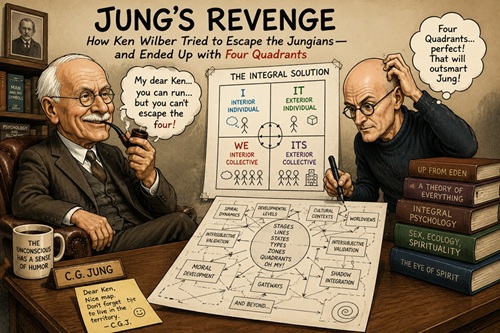
There is a delicious irony in the intellectual history of Ken Wilber. Wilber has never been particularly kind to Carl Jung. In his grand taxonomy of spiritual thinkers, Jung occupies an awkward position: important, influential, occasionally insightful—but ultimately guilty of what Wilber regards as a fundamental confusion between psychological development and spiritual realization. Jung, in Wilber's telling, was a brilliant cartographer who sometimes mistook the basement for the heavens. And yet, for all Wilber's criticism of Jungian psychology, there is something faintly Jungian about Wilber's own intellectual architecture. Especially about his famous four quadrants. One might even formulate the thesis provocatively: Perhaps the four quadrants are Jung's revenge. Not literally, of course. Jung has been dead since 1961, and there is no evidence that he has been haunting Boulder, Colorado, rearranging Wilber's diagrams at night. But intellectually, the joke has some substance. Wilber's obsession with dividing reality into four fundamental perspectives bears an uncanny resemblance to a Jungian impulse: the conviction that human experience becomes distorted whenever we absolutize one perspective and forget the others. Jung might have said: You are not the whole psyche. Wilber replies: You are not the whole Kosmos. The difference is considerable. The family resemblance is nevertheless intriguing. Jung's Four Functions and Wilber's Four QuadrantsJung's famous psychological typology distinguishes four basic functions of consciousness: thinking, feeling, sensation, and intuition. These are not four separate compartments in the mind. They are four different ways of apprehending reality. Thinking asks what something means. Feeling evaluates its value. Sensation registers what is concretely present. Intuition apprehends possibilities, patterns, and potentials. The point was not that everyone should choose one function and ignore the others. Quite the opposite. Psychological development, for Jung, involved a movement toward greater differentiation and integration. Wilber's four quadrants are, formally speaking, a very different affair. His familiar scheme divides reality into: • the interior-individual ("I"), • the exterior-individual ("It"), • the interior-collective ("We"), • the exterior-collective ("Its"). Thus we get consciousness, behavior, culture, and social systems. No thinking, feeling, sensation, or intuition here. And yet the underlying gesture is surprisingly similar. Both Jung and Wilber are suspicious of reductionism. Both insist that reality must be approached from multiple irreducible perspectives. Both construct a fourfold architecture designed to prevent us from mistaking one dimension of reality for the whole. Jung says, in effect: Don't reduce the psyche to one function. Wilber says: Don't reduce the Kosmos to one quadrant. Jung gives us four windows onto the psyche. Wilber gives us four windows onto everything. It is perhaps the most Wilberian escalation imaginable. From Four Functions to Four QuadrantsIf Jung had a tendency to multiply psychological distinctions, Wilber turned the multiplication dial to eleven. • Jung had four functions. • Wilber has four quadrants. • Then four quadrants become eight zones. • Then the zones interact with levels. • Then levels develop through lines. • Then lines are influenced by states. • Then states are interpreted through stages. • Then types enter the picture. Before long, one begins to suspect that Wilber has not merely constructed a map of reality but has opened a cartographic franchise. The difference, however, is crucial. Jung's four functions describe ways consciousness operates. Wilber's four quadrants describe perspectives from which reality can be studied. So Wilber did not simply borrow Jung's fourfold model and rename the parts. The resemblance is structural rather than genealogical. But perhaps this is precisely where the Jungian ghost becomes interesting. Because Wilber's entire project is animated by a problem Jung understood very well: the danger of one-sidedness. The Great Enemy: One-SidednessJung was deeply suspicious of intellectual systems that claimed to explain everything from a single principle. The psyche is too complicated. Human beings are too complicated. Symbols are too ambiguous. The unconscious is too inventive. Every theory casts a shadow. This last point is especially relevant to Wilber. Wilber's great ambition has always been to construct a framework capacious enough to include science and spirituality, psychology and sociology, biology and culture, meditation and neuroscience. Hence the quadrants. The neuroscientist studies the brain. The psychologist studies subjective experience. The sociologist studies social structures. The anthropologist studies cultural meanings. Nobody is wrong. Everybody is incomplete. This is, at least in spirit, remarkably close to the Jungian suspicion that psychological reality cannot be exhausted by a single explanatory language. But here comes the irony. Wilber's response to the problem of one-sidedness is itself a highly systematic system. Jung's solution to reductionism was often to complicate the psyche. Wilber's solution was to build a bigger map. Jung multiplies meanings. Wilber multiplies dimensions. And somewhere between them sits the poor reader, wondering whether four quadrants really are enough. The Jungian Crime: The Pre/Trans TrapThe deepest reason for Wilber's criticism of Jung lies elsewhere. Wilber's famous pre/trans fallacy argues that lower, pre-rational states can be confused with higher, trans-rational states because both appear to transcend ordinary rational consciousness. The infant's undifferentiated consciousness and the mystic's nondual realization may both look "beyond the rational ego," but they are not therefore equivalent. For Wilber, this distinction is absolutely fundamental. And Jung, in Wilber's reading, sometimes gets caught in precisely this confusion. Jung's archetypes, collective unconscious, mythology, symbolism, and encounters with the numinous can, according to Wilber, blur the difference between psychological depth and spiritual transcendence. Wilber therefore places Jung in a somewhat awkward position. Jung discovered the depths. Wilber wants to know whether those depths are downward or upward. Is the dragon an archetypal image arising from the unconscious? Is it a spiritual symbol? Is it both? Is it neither? Wilber wants a developmental ladder. Jung, being Jung, keeps finding snakes in the basement. This is where their temperaments diverge. Wilber is fundamentally a vertical thinker. He wants levels, stages, waves, hierarchies, and developmental sequences. Jung is more of a depth psychologist. He is interested in what emerges when consciousness encounters what it cannot fully control or explain. Wilber asks: What level are you at? Jung asks: What is trying to happen to you? These are not the same question. Jung Would Probably Have Hated the Quadrant DiagramThere is another irony here. Wilber's quadrants are meant to prevent reductionism. But their visual elegance creates a new danger: the temptation to believe that reality really does come in four neat boxes. Jung would probably have been suspicious. The unconscious does not respect quadrant boundaries. Dreams do not politely announce whether they belong to the Upper Left or Lower Left. A myth is simultaneously psychological, cultural, historical, symbolic, and perhaps physiological. A religious experience can be a private event, a neurological event, a cultural event, and a social event all at once. Jung would likely have looked at Wilber's four quadrants and said something like: "Very nice. Now tell me what happens when the archetype refuses to stay in its quadrant." Wilber's answer would presumably be that the four quadrants are not boxes but perspectives, and that every event has correlates in all four dimensions. Which is perfectly reasonable. But Jung's response might be: "Then why draw the boxes?" And there we have the eternal quarrel between the psychologist and the system-builder. The psychologist says: Reality is messier than your categories. The system-builder says: Yes, but without categories you cannot think clearly about the mess. Both are right. And both are probably annoyed. The Four Quadrants as an Anti-Jungian JungianismPerhaps the most interesting way to understand the relationship is this: Wilber is Jungian in his problem, but anti-Jungian in his solution. He shares Jung's fear of reductionism. He shares the conviction that human experience has multiple dimensions. He shares an interest in consciousness, transformation, spirituality, symbolism, and development. But when Wilber encounters complexity, he reaches for architecture. When Jung encounters complexity, he reaches for depth. Wilber wants to integrate the perspectives. Jung wants to explore the tensions between them. Wilber's ideal is a map in which every legitimate perspective finds its proper place. Jung's world is one in which the opposites remain in tension until something unexpected emerges. This difference is profound. Wilber's favorite word might be include. Jung's might be integrate. But even these words conceal different ambitions. To include something in Wilber's system is to give it a place. To integrate something in Jung's psychology is to undergo a transformation through encountering it. The former is architectural. The latter is existential. The Jungian RevengeSo is Wilber's four-quadrant obsession really a belated revenge of Jung? No—not in any straightforward historical sense. Wilber's quadrants do not derive from Jung's four functions, and the conceptual structures are fundamentally different. But as an intellectual joke, the idea works because it identifies something deeper. Wilber spent considerable energy explaining why Jungian depth psychology was not enough. And yet his own project repeatedly returns to the problem that Jung made central: how do we avoid mistaking one perspective for the whole of reality? Jung's answer was to differentiate the functions of consciousness and confront the unconscious. Wilber's answer was to differentiate the perspectives of reality and integrate them into a comprehensive framework. Jung gave us a psyche that refuses to be reduced. Wilber gave us a Kosmos that refuses to be reduced. Jung drew four functions. Wilber drew four quadrants. Jung's unconscious kept escaping the diagram. Wilber's quadrants keep multiplying to catch it. Perhaps that is why Jung's ghost should be amused. Wilber may have spent decades telling us that Jung confused depth with transcendence. But in the end, Wilber's own system carries a faint Jungian warning: beware of one-sidedness. The difference is that Jung whispers this warning from the unconscious, while Wilber puts it in a four-box diagram, adds arrows, levels, developmental lines, explanatory footnotes, and eventually a website. And perhaps that is the final irony. Jung's revenge is not that Wilber became a Jungian. It is that Wilber became so determined to transcend Jung that he ended up repeating one of Jung's deepest intuitions: No single perspective is the whole truth. The Jungian might smile. The Wilberian might draw a quadrant. And the rest of us might ask whether the two are, finally, looking at the same elephant from different sides—or whether there are actually four elephants, eight zones, and a developmental sequence explaining why we keep arguing about it. Appendix: If Jung Had Analyzed Ken WilberWhat would Carl Jung have made of Ken Wilber? We should begin with a disclaimer that Jung himself would probably have appreciated: you cannot psychoanalyze a person you have never met, and certainly not from books alone. What follows is therefore not a diagnosis of Wilber's personality, but a playful Jungian interpretation of his intellectual persona—the psychological style that emerges from his writings, arguments, ambitions, and recurring battles with his critics. And if we imagine Jung sitting across from Wilber, listening carefully, he might eventually lean back and say: "My dear Ken, you have a remarkable relationship with the number four." The Fourfold MindJung believed that psychological consciousness tends to organize itself around four basic functions: thinking, feeling, sensation, and intuition. Wilber, meanwhile, seems to organize reality around four quadrants. This could hardly be more suggestive. The Wilberian personality, viewed through a Jungian lens, appears overwhelmingly thinking-intuitive. Thinking supplies the architecture. Intuition supplies the vision. Together they produce the characteristic Wilberian combination: a breathtakingly ambitious theory of everything, accompanied by an almost irresistible urge to put it into a diagram. The thinking function wants distinctions. The intuitive function wants the whole. The result is a personality caught between two powerful imperatives: "Everything is connected." and "Yes, but let's first distinguish these twenty-seven things." This may explain much of Wilber's intellectual energy. He does not merely want to understand phenomena individually. He wants to know where they belong in the total structure. • Where does this fit? • What level is this? • Which quadrant? • Which line? • Which stage? • Which state? • Which zone? For Jung, this might indicate a highly differentiated thinking function serving an enormous intuitive vision. But there is a catch. The more powerful the thinking function becomes, the greater the danger that it begins to believe it can organize the whole psyche from above. And this is precisely where the Jungian shadow enters. The Intuitive Thinker and His ShadowJung's great warning was that the dominant function tends to cast the undeveloped functions into the unconscious. The person who lives primarily through thinking may neglect feeling. The person who lives through intuition may neglect sensation. The more one-sided consciousness becomes, the more the neglected functions acquire an autonomous life in the shadow. Now imagine applying this to Wilber. His public intellectual persona is extraordinarily comfortable with abstraction. He is much less comfortable with ambiguity that cannot be conceptually resolved. This is why Wilber can be so devastatingly clear when criticizing other theories—and occasionally so exasperating when confronted with phenomena that resist his preferred developmental distinctions. A Jungian might therefore ask: What happens when the master system-builder encounters something that refuses to be systematized? The answer might be found in Wilber's repeated battles with Jungian psychology itself. Jung represents precisely the sort of thinker who allows ambiguity, symbol, paradox, dream, myth, and unconscious material to remain psychologically alive. Wilber wants to know where these things belong in a developmental architecture. Jung might reply: "Perhaps their refusal to belong is the point." This is the classic confrontation between thinking and the unconscious. The thinking function says: "Let me explain this." The unconscious says: "First, let me give you a dream." The Shadow of the SystemFrom a Jungian perspective, the shadow is not simply "the bad stuff" we repress. It consists of everything the conscious personality does not recognize as belonging to itself. For a highly rational, systematic thinker, the shadow might contain precisely those qualities that the conscious personality finds inconvenient: • emotional ambiguity, • irrationality, • contradiction, • bodily experience, • uncertainty, • vulnerability, • dependence, • messiness, • and the possibility of simply not knowing. One should be cautious here. There is no reason to claim that Wilber personally represses all these qualities. But his intellectual style often seems to wage war against their theoretical equivalents. The Wilberian system is designed to prevent confusion. The Jungian psyche thrives on the fact that confusion is sometimes psychologically productive. Wilber wants to distinguish the pre-rational from the trans-rational. Jung wants to know what the unconscious is doing while you are making the distinction. This could be interpreted as a clash between the heroic ego of differentiation and the trickster intelligence of the unconscious. And the trickster has one great advantage: It does not have to respect your diagram. The Hero ArchetypeThere is also something distinctly archetypal about Wilber's intellectual project. Jung might have recognized the Hero. The Hero leaves the ordinary world, encounters chaos, confronts monsters, and returns with a treasure that can benefit the community. Wilber's intellectual biography can be read in a similar symbolic fashion. The ordinary academic disciplines are fragmented. • Psychology has its theories. • Sociology has its theories. • Neuroscience has its theories. • Religion has its theories. • Spirituality has its theories. Everyone has a piece of the elephant. Enter the Hero. He will unite them. The quadrants become the map. The levels become the ladder. The developmental lines become the pathways. The states become the changing weather. The types become the different travelers. And the Integral framework becomes the promised cartography of the whole. There is something genuinely heroic about this ambition. But Jung would have added a warning. The Hero can become inflated. The Hero's danger is to identify with the treasure he has brought back. Instead of saying, "I have found a map," the Hero begins to say, "I am the mapmaker." And once that happens, criticism can begin to feel less like disagreement with an argument and more like resistance to the mission itself. This is where Jung's concept of inflation becomes relevant. Not arrogance in the ordinary sense. Something subtler. The ego becomes identified with an archetypal role. The individual begins to experience himself as the bearer of a larger historical or evolutionary task. The danger is not that the person is simply conceited. The danger is that the archetype is conceited through the person. Wilber as the Puer Aeternus?A Jungian might also notice another possibility: the archetype of the puer aeternus, the eternal youth. The puer is associated with vision, transcendence, possibility, spiritual aspiration, and resistance to limitation. He sees the heights. He sees what humanity could become. He is impatient with the ordinary world and its compromises. The danger is that he may become more fascinated with the next stage of development than with the messy responsibilities of the present one. Again, this should not be taken as a diagnosis of Wilber personally. But there is something of the puer in the Integral imagination. The world is always evolving toward something greater. Humanity is climbing. Consciousness is unfolding. New stages are emerging. The next wave is coming. The next level is waiting. This is a powerful vision. But Jung might ask: What about the part of the psyche that does not want to evolve? What about regression? What about repetition? What about the tragic? What about the ordinary? What about the fact that human beings can be extraordinarily advanced in one dimension and remarkably primitive in another? Here Wilber's later emphasis on multiple developmental lines becomes important. It can be read as a partial correction to precisely this problem. The Heroic evolutionary narrative becomes more psychologically sophisticated when one admits that a person can be highly developed cognitively and badly developed emotionally, spiritually advanced and ethically immature, or intellectually brilliant and psychologically wounded. In other words, the shadow has been invited to the Integral party. It just hasn't always been given the microphone. The War with JungThe most revealing aspect of Wilber's relationship with Jung may therefore be psychological rather than theoretical. Wilber criticizes Jung for collapsing psychological depth into spiritual transcendence. But Jung, from the other side, might criticize Wilber for trying to control the unconscious with a sufficiently comprehensive taxonomy. Wilber says: "Don't confuse the basement with the penthouse." Jung replies: "Fine. But have you actually visited the basement?" This is the great Jungian challenge. Spiritual development is not simply a matter of ascending. It also requires descent. The shadow must be encountered. The rejected parts of the personality must be integrated. The unconscious must be allowed to speak. The psyche must become whole, not merely higher. From this perspective, the tension between Jung and Wilber reproduces an ancient psychological conflict between ascent and descent. Wilber is the great theorist of ascent. Jung is the great psychologist of descent. Wilber asks how consciousness evolves upward. Jung asks what happens when consciousness meets what it has left behind. Perhaps both are necessary. The Missing FunctionIf we take the Jungian typology seriously, one might speculate that Wilber's dominant functions are thinking and intuition. The interesting question then becomes: what happens to feeling and sensation? Here again, we should not confuse an intellectual style with a person's actual psychological constitution. But in Wilber's public work, the two less conspicuous functions appear to be precisely those most difficult to integrate into a grand theoretical system. Feeling cannot simply be reduced to an evaluative category. Sensation cannot simply be placed in the Upper Right quadrant. The body does not always cooperate with the map. And human relationships are notoriously resistant to developmental diagrams. Perhaps this is why Wilber's most interesting intellectual development has occurred when he has been forced to acknowledge precisely these dimensions: ethics, shadow, psychological maturity, interpersonal relations, and the possibility that spiritual realization does not automatically produce a fully integrated human being. That realization might be called, in Jungian language, a movement toward individuation. And individuation is not the same as becoming a perfect exemplar of a theory. It is the process by which the person becomes increasingly capable of holding contradictions within himself. The Final Jungian JokeIf Jung had the last word, he might therefore say something like this: "Ken, you have spent your life trying to build a theory that includes every possible perspective." Wilber might nod. "Yes." "You have divided reality into four quadrants." "Yes." "You have added levels, lines, states, types, and zones." "Yes." "And you have spent considerable time explaining why my psychology does not adequately distinguish the lower from the higher." "Yes." Jung pauses. Then he smiles. "Very good. Now tell me: which quadrant contains your shadow?" Wilber reaches for a pen. And somewhere in the unconscious, Carl Jung laughs. The deepest Jungian criticism of Wilber, then, would not be that his system is too broad. It might be that it is not broad enough to contain the person who created it. Every great system casts a shadow. Every map leaves something unmapped. Every theory of development has a developmental history of its own. And every thinker who tries to explain the whole of reality must eventually confront the most inconvenient fact of all: The mapmaker is also part of the territory. Perhaps that is Jung's final revenge. Wilber built the quadrants to ensure that no perspective would be left out. Jung would simply ask whether Wilber remembered to put Ken Wilber himself somewhere on the map.
Widget is loading comments...
|