|
TRANSLATE THIS ARTICLE
Integral World: Exploring Theories of Everything
An independent forum for a critical discussion of the integral philosophy of Ken Wilber
  Frank Visser, graduated as a psychologist of culture and religion, founded IntegralWorld in 1997. He worked as production manager for various publishing houses and as service manager for various internet companies and lives in Amsterdam. Books: Ken Wilber: Thought as Passion (SUNY, 2003), and The Corona Conspiracy: Combatting Disinformation about the Coronavirus (Kindle, 2020). Frank Visser, graduated as a psychologist of culture and religion, founded IntegralWorld in 1997. He worked as production manager for various publishing houses and as service manager for various internet companies and lives in Amsterdam. Books: Ken Wilber: Thought as Passion (SUNY, 2003), and The Corona Conspiracy: Combatting Disinformation about the Coronavirus (Kindle, 2020).
Check out my other conversations with ChatGPT When Realism Becomes UnrealisticReview of Joseph Dillard's Counter-ArgumentFrank Visser / ChatGPT
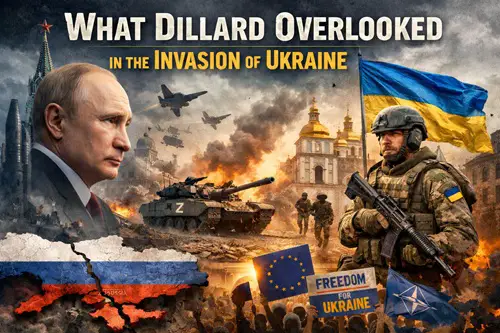 Joseph Dillard's reply to “What Putin Strategically Overlooked in the Invasion of Ukraine” positions itself as a realist corrective to what he portrays as Frank Visser's liberal-internationalist framing. In doing so, Dillard assembles an expansive indictment of Western policy, NATO expansion, intelligence hypocrisy, and historical amnesia. The essay is ambitious, densely documented, and rhetorically forceful. However, it also suffers from analytical slippage, selective sourcing, and a recurring tendency to transform realist explanation into quasi-exculpation. 1. Realism as Explanation vs. Realism as JustificationDillard's strongest contribution lies in reminding readers of a core realist insight: security dilemmas are reciprocal, and great powers often act preemptively when they perceive encirclement. His invocation of Mearsheimer, NATO expansion, and Russia's historical vulnerability is standard realist fare and cannot be dismissed out of hand. Visser's essay indeed focuses more on agency, ideology, and miscalculation than on systemic pressures. However, Dillard repeatedly crosses a critical line: he moves from explaining Russian perceptions to legitimizing Russian actions. The claim that the invasion was “justified under Article 51 of the UN” is not merely controversial—it is legally untenable. Article 51 allows self-defense in response to an armed attack, not in response to speculative future threats, rejected treaty proposals, or generalized fears of NATO proximity. By that standard, almost any war of aggression could be retroactively justified. Here realism becomes a rhetorical shield rather than an analytical tool. Visser never denied that Russia felt threatened. His argument is that Putin catastrophically misjudged how those threats would materialize and backfire. Dillard does not directly refute that claim. 2. Overloading the Argument: When Everything Is Provocation, Nothing IsDillard's essay attempts to explain the invasion by aggregating an extraordinary range of grievances: • NATO expansion since 1990 • MI6 and CIA links to Bandera in the 1940s • The Crimean War • Language laws in Ukraine • Burisma and Hunter Biden • OSCE ceasefire violations • Sevastopol school renovations • Minsk II bad faith • Johnson's 2022 visit • Western “fascism tolerance” The problem is not that these topics are irrelevant individually. The problem is cumulative overdetermination. When causality is stretched across 170 years, responsibility dissolves into historical fog. Strategic decision-making in 2022 becomes almost irrelevant, replaced by an implicit narrative of inevitability. Visser's essay asks: What did Putin get wrong when he chose war? Dillard answers a different question: Why the West deserved what happened. That rhetorical shift is never explicitly acknowledged. 3. The Bandera Argument: Historical Context or Strategic Distraction?The sections on Bandera, MI6, and postwar intelligence operations are historically interesting but strategically weak. They suffer from three flaws: • Temporal distance - Cold War intelligence opportunism does not explain Putin's 2022 operational assumptions. • Category error - Intelligence collaboration ≠ state ideology ≠ modern Ukrainian governance. • Inflation of marginal actors - Far-right elements exist in Ukraine (as they do in Russia), but Dillard treats them as structurally decisive rather than electorally marginal. Most importantly, this line of argument does not rebut Visser's central point: that Putin expected Ukrainian collapse and instead triggered national consolidation. Historical grievances do not explain why that expectation failed. 4. Ukrainian Agency Is Systematically MinimizedThroughout the essay, Ukraine appears less as a political actor than as a geopolitical instrument: • a “proxy state” • a “buffer” • a “forward missile platform” • a “Western construct” This is a classic realist blind spot, and Visser explicitly targets it. Ukrainian resistance, civic mobilization, and willingness to absorb staggering losses are not plausibly explained by NATO coercion alone. Nor is the sustained legitimacy of the Ukrainian state reducible to IMF loans or Western media narratives. Dillard acknowledges that the invasion “unified Ukraine,” but frames this as a predictable backlash rather than a strategic misjudgment. Yet predictable backlash is precisely what Putin failed to anticipate. Calling it “predictable” after the fact does not absolve the error. 5. Diplomatic Overtures: Selective Emphasis, Selective SilenceDillard repeatedly cites: • December 2021 security proposals • Minsk II • Istanbul talks But he omits or minimizes: • Russia's recognition of separatist republics before the invasion • The maximalist nature of pre-war demands (effectively veto power over NATO) • Russia's simultaneous troop buildup during “diplomacy” • The absence of credible withdrawal signals Realism recognizes diplomacy as signaling under power constraints. From that perspective, Western skepticism toward Russian proposals was not irrational—it reflected a belief that Russia was negotiating with a gun on the table. Visser's claim is not that diplomacy never occurred, but that Putin overestimated its coercive leverage. 6. Economics, Casualties, and the Slippage into Outcome BiasDillard cites Russian GDP growth, BRICS trade, and European energy pain to argue Russian resilience and Western failure. But this is outcome bias, not strategic foresight. The question Visser poses is not whether Russia can survive the war, but whether Putin correctly assessed: • duration • cost • international isolation • military performance • regime risk • demographic impact On those metrics, even Dillard's own casualty figures (600,000 Russian dead or wounded) quietly undermine his thesis. A strategy that achieves partial territorial aims at catastrophic human cost can be explained by realism—but it cannot be defended as strategically sound. 7. What Was Actually “Promised” to Gorbachev?Dillard repeatedly invokes the claim that NATO expansion violated “promises” made to Mikhail Gorbachev. This argument is ubiquitous in realist and pro-Russian literature, but it requires precision. What is documented: • In 1990, during negotiations over German reunification, U.S. Secretary of State James Baker floated the phrase “not one inch eastward” in reference to NATO forces in East Germany, not NATO membership writ large. • Similar informal assurances were discussed by West German officials (e.g., Hans-Dietrich Genscher), again explicitly tied to German reunification, not Eastern Europe as a whole. • These assurances were never codified in treaty form, never extended to Warsaw Pact states, and were overtaken by the collapse of the USSR itself. What is not documented: • Any binding promise that NATO would never expand beyond Germany. • Any agreement granting Russia veto power over future NATO membership. • Even Gorbachev later acknowledged that NATO expansion “was not discussed at all” in relation to Eastern Europe in 1990. Russia's grievance is therefore political and psychological, not contractual. Visser's argument does not deny that NATO expansion angered Russia. It argues that Putin converted grievance into entitlement, and then into war—an escalation realism alone cannot justify. 8. Why the West Rejected Putin's 2021 “Diplomatic Treaties”Dillard presents Putin's December 2021 treaty proposals as sincere diplomatic overtures cavalierly dismissed by the West. This framing omits their maximalist and coercive nature. Putin's draft treaties demanded: • A permanent halt to NATO enlargement (including a rollback of the 2008 Bucharest pledge). • Withdrawal of NATO forces and infrastructure from all post-1997 member states. • De facto Russian veto power over alliance decisions. These were not confidence-building measures. They amounted to a demand for rewriting the European security order under military duress, while Russian troops massed on Ukraine's borders. From a realist standpoint, the West's rejection was predictable: • Accepting the treaties would have fractured NATO internally. • It would have validated coercive diplomacy backed by force. • It would have undermined the principle (rightly or wrongly upheld) that sovereign states choose alliances. Visser's point stands: Putin overestimated the leverage of threat-based diplomacy and underestimated the reputational costs of invasion. 9. Did the West “Sponsor Fascism” in Ukraine?Dillard's most inflammatory claim is that the U.S. and UK “fueled Nazi-allied nationalist groups” in Ukraine and that neo-Nazis effectively controlled the post-Maidan state. This claim conflates three distinct issues: a) Cold War Intelligence OperationsYes, MI6 and the CIA cooperated with anti-Soviet nationalists, including Bandera-linked networks, in the late 1940s and 1950s. This is well-documented and morally compromised. However: These operations failed militarily. • They ended decades before modern Ukraine existed. • They do not explain Putin's expectations in 2022. Historical sin does not confer perpetual strategic relevance. b) Far-Right Presence in Modern UkraineUkraine has far-right groups (Azov, Right Sector), as does Russia (Rusich, Wagner's ideology, Duginist currents). However: • Far-right parties consistently polled below 3% nationally. • They held no controlling positions in government. • Zelensky, a Russian-speaking Jew, was elected with 73% of the vote. Calling Ukraine a “neo-Nazi state” is propaganda, not analysis. c) Russian Instrumentalization of Anti-FascismRussia's trauma from WWII is real. Its instrumentalization of “denazification” is not. Putin used historical memory as a legitimizing myth for aggression, not as an accurate threat assessment. Visser's argument is not that fascism does not exist—it is that Putin vastly exaggerated its relevance to justify war. 10. Donbas, Minsk II, and the Question of Bad FaithDillard is correct that Minsk II was never implemented and that Western leaders later admitted it bought time for Ukraine. This is damning—but incomplete. What Dillard omits: • Russia also violated Minsk repeatedly. • Russia never withdrew support for separatist forces. • Minsk was ambiguous by design, reflecting incompatible interpretations. Crucially, Minsk failure does not logically entail full-scale invasion. It explains frustration, not escalation. Visser's critique remains intact: Putin treated diplomatic failure as proof that force would succeed, rather than as evidence of structural deadlock. 11. Istanbul Talks and the “Johnson Sabotage” ClaimThe claim that Boris Johnson singlehandedly scuttled peace in April 2022 is now widely circulated, but evidence remains ambiguous. What is known: • Preliminary talks occurred. • Drafts explored neutrality and security guarantees. • Russian atrocities (e.g., Bucha) hardened Ukrainian resistance. • Russia never formally withdrew maximalist demands. Even if Johnson discouraged concessions, the deeper issue remains: Putin expected rapid leverage through violence and did not get it. Diplomacy failed because the invasion failed to produce favorable facts on the ground. 12. NATO Expansion and the Security Dilemma—AgainDillard treats NATO expansion as a sufficient explanation for war. Visser treats it as a contributing condition, not a determinant. Key point: Security dilemmas do not mechanically produce invasions. If they did: • Finland's NATO accession would justify Russian invasion of Finland. • Poland's membership would have justified war decades earlier. Putin chose Ukraine because he believed it was weak, divided, and reclaimable. That belief—not NATO per se—was the strategic error. 13. Economics, Sanctions, and Outcome BiasDillard cites Russian GDP growth and European energy pain as proof that Putin's strategy was sound. This is post hoc reasoning. Visser's claim is not that Russia would collapse—but that Putin misjudged the costs relative to gains: • Hundreds of thousands of casualties. • Permanent loss of European markets. • NATO expansion to Russia's border. • Ukrainian nationhood consolidated. Survival is not success. 14. Nuclear Signaling and “Restraint”Dillard portrays Russian nuclear signaling as defensive and restrained. In reality: • Nuclear threats were frequent and escalatory. • They deterred NATO entry, not Western support. • They normalized nuclear blackmail as a policy tool—reducing, not increasing, credibility. Visser's argument stands: nuclear weapons froze the conflict but could not shape its outcome. 15. The Core Failure of Dillard's RealismThe most serious flaw in Dillard's essay is that it never confronts the decisive counterfactual: What did Putin reasonably expect to happen that did not require Ukrainian capitulation? • Not regime collapse • Not NATO retreat • Not Western neutrality • Not rapid Donbas resolution If realism explains everything, then realism must also explain why the war did not end as planned. On that question, Dillard largely changes the subject. Realism can explain why Putin felt threatened. It cannot explain why he believed war would fix that threat. Visser's thesis remains unrefuted: Putin misread identity, resilience, alliances, economics, and the nature of 21st-century war. Conclusion: Structural Context Is Not Strategic CompetenceDillard's essay is valuable as a catalogue of Western failures, hypocrisies, and unintended consequences. It successfully challenges moral absolutism and reminds readers that great powers do not act in vacuums. But as a rebuttal to “What Putin Strategically Overlooked,” it ultimately fails—because it explains why Putin felt justified, not why he failed. Realism that explains everything explains nothing. Realism that excuses failure becomes ideology. Putin did not lose because NATO expanded. He lost because he believed force could reverse political reality. That belief—not Western provocation—is the strategic error at the heart of this war.
Widget is loading comments...
|